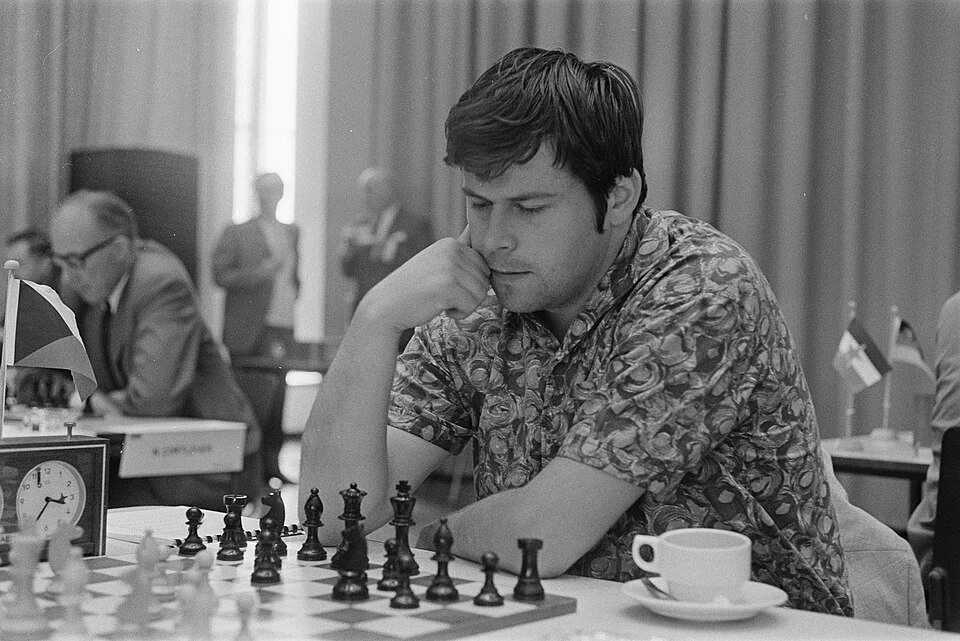
Vlastimil Hort. Eric Koch for Anefo, CC0, via
On August 1, 1970, Lev Polugaevsky drew with Kick Langeweg in eight moves. The game ended so quickly that, according to the Amsterdam newspaper De Tijd, it took some effort afterward to find out what moves they had played. Polugaevsky had secured at least a share of first place in the IBM International Chess Tournament. At another board, world champion Boris Spassky still had to win with Black against Hungary’s István Csom to catch him. Their game had started at ten that morning. It would last well into the afternoon.¹
From the IBM canteen to the Amsterdam RAI
Langeweg had won the first IBM tournament himself. In 1961, members of Amsterdam’s VAS chess club wanted to give strong local players a chance to earn a master norm. Chess journalist Berry Withuis secured 5,000 guilders from IBM, and the company supplied the canteen at its office on the Johan Huizingalaan. Langeweg, then a mechanical engineering student, won his first eight games and finished half a point ahead of Dutch grandmaster Jan Hein Donner. Both men returned for the tenth edition.²
Spassky was the first reigning world champion to enter. At the drawing of lots on July 13 at the Esso Motor Hotel, the organizers called his name first, then went through the others alphabetically. Play began the next day at the RAI. Ten of the sixteen players in the main group were grandmasters, and each player would meet the other fifteen. The organizers had kept a place for club players, too. Alongside the grandmaster and master sections were two reserve groups and another 180 players competing in groups of ten.³
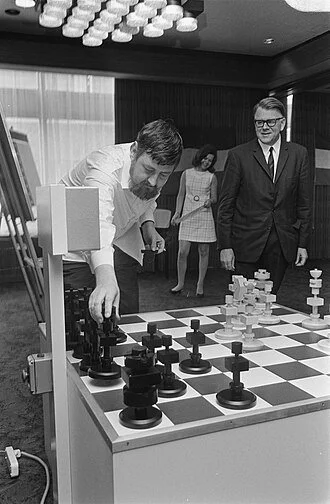
Eric Koch for Anefo. JH Donner
Spassky’s attack against Dragoljub Ćirić
All eight games in the first round ended in draws. Spassky’s took 45 moves. Yugoslavia’s Svetozar Gligorić had given up both rooks, but his queen reached the white king with enough checks to save the game. Four rounds later, another Yugoslav grandmaster, Dragoljub Ćirić, faced Spassky across a very different board. On move 24, Ćirić sent a rook to a2 to collect a pawn. Spassky left it there. His own rook took the pawn on e6, and his queen soon came down to h6. After 29.Rxf6 removed the knight guarding the king, Ćirić resigned. Polugaevsky later singled it out as the most beautiful game of the tournament.⁴
Thirteen hours against Gligorić
Polugaevsky had already beaten fellow Soviet grandmaster Efim Geller when he took Black against Gligorić on July 20. Their sixth-round game was still going three days later. At the third adjournment, Gligorić tried to persuade him that the ending was a theoretical draw. Each man had a single pawn left. Polugaevsky had a rook against a bishop and wanted to play on. On Thursday, July 23, Gligorić resigned after Black’s 108th move. The two men had spent thirteen hours at the board. Once the result was in, Polugaevsky led the field with 6½ from eight games.⁵
Back in Moscow, Polugaevsky described the daily routine to Aleksandr Roshal, a reporter for the Soviet chess weekly 64. Play ordinarily ran from one until six. Anyone with an adjourned game came back from eight until ten. Polugaevsky made a point of eating a proper dinner as soon as the first session ended. The organizers also handed out drinks vouchers. He remembered being particularly grateful for the black coffee.⁶
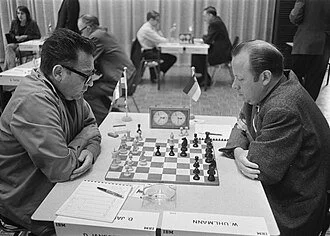
Wolfgang Uhlmann offers a draw
The next afternoon Polugaevsky faced Wolfgang Uhlmann. The East German grandmaster had already beaten Geller and was only half a point behind the leader. About forty minutes into the game, Uhlmann offered a draw. Polugaevsky thought this was his chance to stop a rival who had already played most of his strongest opponents. He continued. With queens and rooks exchanged, he pushed his a-pawn to a5. Much later his knight crossed to the kingside, where Uhlmann’s bishop had run short of squares. Uhlmann resigned on move 51. It was his only defeat in Amsterdam.⁷
Spassky beat Donner in round eight, then Hans Ree, Langeweg and Rob Hartoch in his next three games. After eleven rounds the two Soviet grandmasters had nine points apiece. Two rounds later, Polugaevsky beat Donner while Spassky drew with Vlastimil Hort. That put Polugaevsky half a point ahead just as the two leaders were due to meet.⁸
András Adorján earns an invitation
The masters played in the same hall, close enough for Polugaevsky to follow the games of twenty-year-old András Adorján. The Hungarian had finished second to Anatoly Karpov at the 1969 World Junior Championship. On July 27, he beat Lodewijk Prins with Black to win the Amsterdam master section with 7½ from eleven. Denmark’s Svend Hamann beat Jan Timman to finish half a point behind him. At the prizegiving, Adorján received 1,000 guilders and Max Euwe announced that he would be invited to the 1971 grandmaster group.⁹
Csom and Spassky in the final round
On July 30, Spassky had White against Polugaevsky. Their seventeen-move draw was a Najdorf Sicilian in which Spassky sacrificed a knight on e6 and took the pawn there with check. Polugaevsky kept his half-point lead. When he drew with Langeweg on the final morning, he left Spassky needing a full point from a player who had held Polugaevsky himself to a draw earlier in the tournament.¹⁰
Csom kept the position level through a series of exchanges. With one rook left on each side, his 28.a4 gave Spassky’s b-pawn a route to promotion. It captured on a4, advanced to a3 and reached a2 on move 30. Csom had a passed pawn of his own, but when it reached d6, Spassky put his rook behind it. Csom resigned after 34...Kf7. Spassky then showed him where he could have held the draw.¹¹
Spassky and Polugaevsky shared first place with 11½ out of 15. Each had won eight games and drawn seven. Uhlmann finished third with 10½. Fourth place was already Geller’s when he sat down opposite Hans Ree that morning. He played on for six hours, beat Ree and reached ten points. Donner led the Dutch players with 6½. National champion Eddie Scholl, who had drawn with Spassky, needed a win against Dragoljub Janošević for an international master result. He took his chances in a sharp middlegame and lost. On Monday, the Algemeen Handelsblad singled him out all the same. Of the Dutch players, its correspondent reported, Scholl had won the greatest admiration from the visiting grandmasters, Spassky among them.¹²
Further reading from Soviet Chess History · Lev Polugaevsky
Notes
“Csom bezwijkt onder druk Spasski,” De Tijd, August 3, 1970, 11. The Groningen daily gives the hours of play. De Tijd’s final-round report · Nieuwsblad van het Noorden, p. 14.
Peter Doggers, “Twee decennia IBM-toernooi,” Amsterdam Chess Open, May 12, 2025. Doggers draws on the tournament bulletins for the origins of the VAS/IBM event. Dutch history of the IBM tournament. chessopen.amsterdam
Leeuwarder Courant, Algemeen Handelsblad and Trouw, July 14, 1970. Their opening reports identify the two venues, the order of the draw and the amateur sections. Polugaevsky counted the world champion and nine other grandmasters in his interview in note 6. Drawing of lots, p. 15 · Field and amateur groups, p. 5 · Play at the RAI, p. 9.
“Амстердам” [Amsterdam], 64, no. 31 (1970), 16. The weekly printed both games. Polugaevsky’s assessment appears on page 11 of his interview in note 6. Original Russian game scores · Opening-round results · Replay Spassky against Ćirić. sovchess.ru
“Schaaksucces na 108 zetten,” Algemeen Handelsblad, July 24, 1970, 5. The report records the third adjournment, Gligorić’s assessment and the thirteen hours of play. Dutch report · Replay Gligorić against Polugaevsky. IBM Amsterdam 1970, Round 6
A. Roshal, “В дороге…” [On the road], interview with Lev Polugaevsky, 64, no. 33 (August 14–20, 1970), 10–11. Roshal conducted the interview in Moscow while riding in Polugaevsky’s car. Original Russian interview, pp. 10–11. sovchess.ru
Roshal, “В дороге…,” 11. Polugaevsky describes Uhlmann’s draw offer and identifies the game as his most important in Amsterdam. De Tijd reported the result on July 25, 1970, 4. Polugaevsky’s account and game score · Dutch account of round nine. sovchess.ru
“IBM in cijfers,” De Telegraaf, July 28, 1970, 13. The Soviet weekly reported the standings after thirteen rounds. Standings after eleven rounds · Soviet report after round thirteen · Spassky’s fifteen game scores. sovchess.ru
“Jeugdige Hongaar Adorjan pakt eerste prijs bij meesters IBM-toernooi,” Trouw, July 28, 1970, 8. The ANP report gives the prize and Euwe’s announcement. For the shared playing hall, see Roshal, 10–11. Dutch masters report · FIDE’s biography of Adorján. sovchess.ru
“Амстердам,” 64, no. 32 (1970), 11. The Soviet report identifies both leaders’ final opponents. Soviet report on the finish · Spassky against Polugaevsky · Round-five results. sovchess.ru
“Scholl geroemd als grootmeester in spe,” Algemeen Handelsblad, August 3, 1970, 5. The report prints all 34 moves and describes Spassky’s analysis with Csom after the game. Contemporary account and game score · Replay Csom against Spassky. share.chessbase.com
“Poloegajefski en Spasski gelijk,” Nieuwsblad van het Noorden, August 3, 1970, 14. The Algemeen Handelsblad report in note 11 records the visiting players’ opinion of Scholl. Final results and Geller’s game · Contemporary Soviet crosstable. sun.tsu.ru
