41st USSR Chess Championship
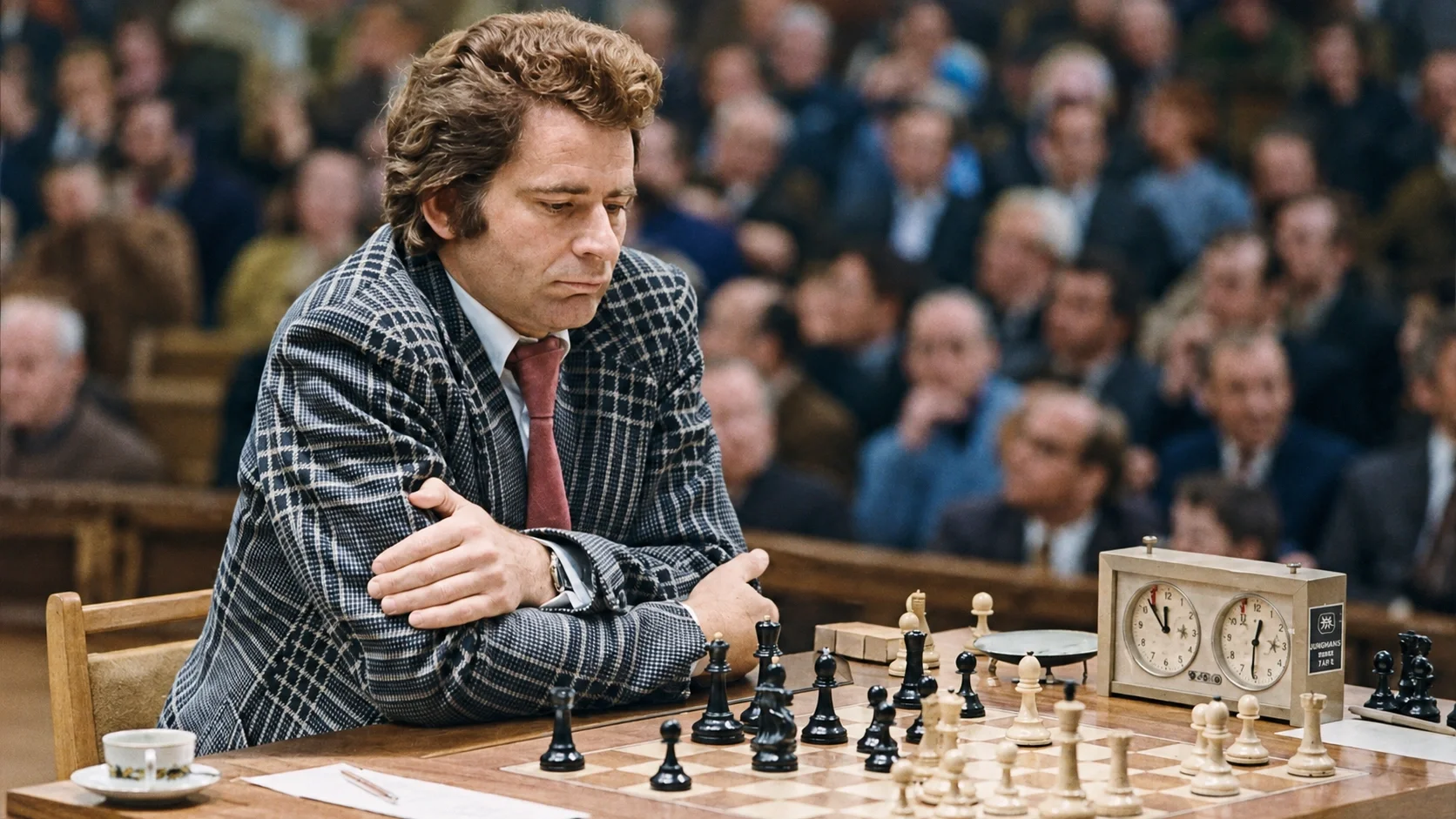
Boris Spassky in Moscow at the 1973 USSR Chess Championship. Image Souce: Douglas Griffin Chess
The 41st USSR Championship deserves to be treated as one of the key Soviet chess events of the postwar decades. Most Russian summaries date the event from 1 to 27 October 1973, while several detailed accounts that focus on the actual playing schedule give 2 to 26 October. The likeliest explanation is simple: the wider range includes the opening and closing ceremonies, while the narrower range covers the rounds themselves. What is beyond dispute is the venue and the form: the Higher League final was held in Moscow, in the Central House of Railwayworkers, as an 18-player all-play-all, while the new First League ran simultaneously in Tbilisi.
This was a national championship in name, yet in practical terms it looked like a summit meeting of Soviet chess power. Former world champions, world title challengers, elite seconds, theoreticians, fast-rising youths, and dangerous non-establishment masters were brought into one arena at a politically sensitive moment. The result was a tournament that helps explain Soviet chess culture more clearly than many world championship matches do.
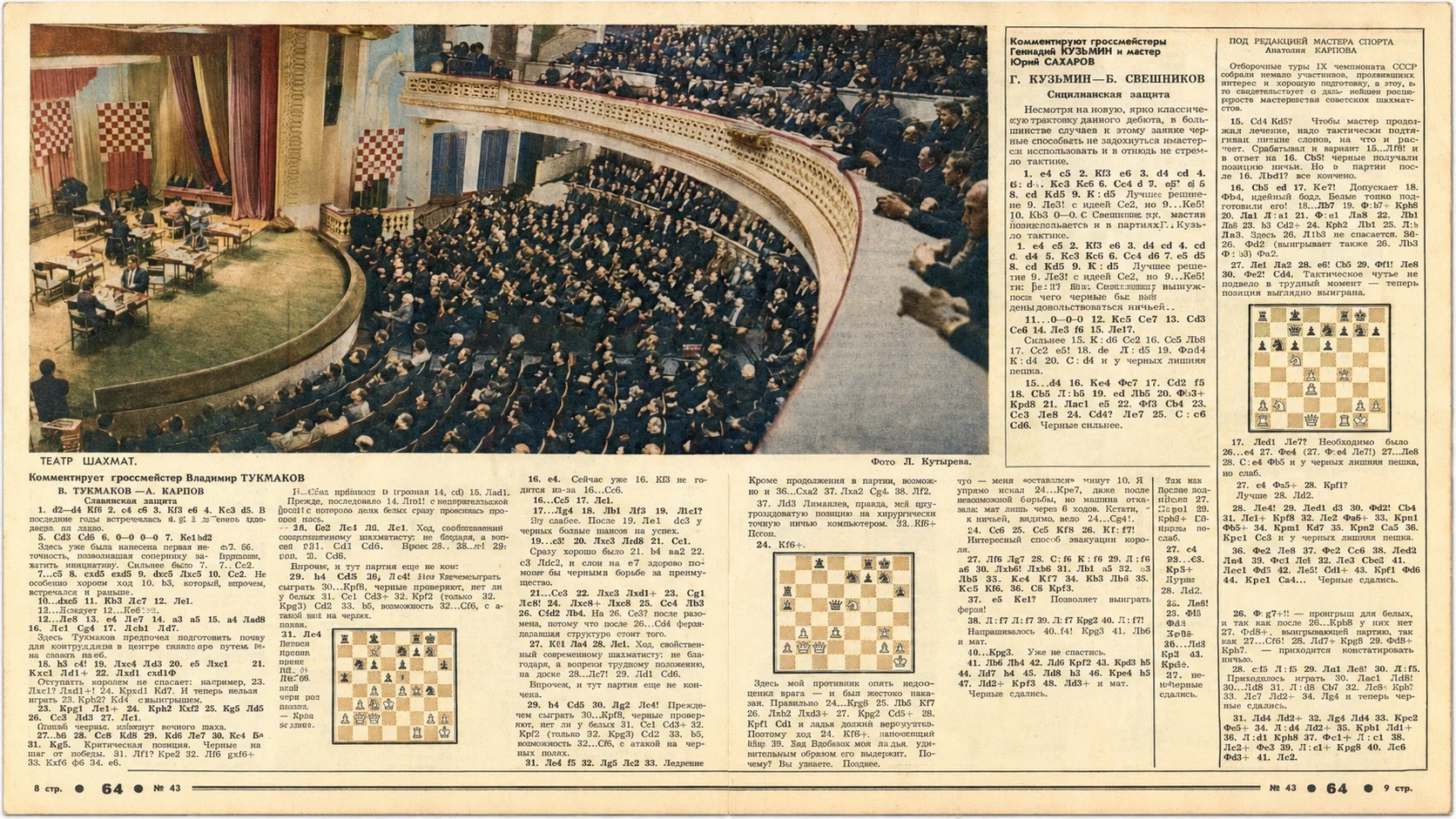
Image Source: Douglas Griffin Chess
After Reykjavik and Moscow
The immediate background was the shock of Reykjavik. Fischer’s 1972 victory over Spassky ended the Soviet Union’s long hold on the world title, and official chess bodies still describe that match as a Cold War confrontation in which the traditionally dominant Soviet chess power was dethroned. Russian chess retrospectives are equally direct about the domestic consequence: after Fischer beat Spassky, the Soviet chess leadership decided that the leading grandmasters should no longer drift in and out of the national championship. The 1973 event was therefore conceived in a heightened post-Reykjavik atmosphere, with prestige, discipline, and demonstration value all built into it from the start.
The organizational form itself reflected this response. Viktor Korchnoi later recalled that in 1973 the USSR Championship system was reworked into Higher and First Leagues, with severe relegation pressure from the top division. A later Russian book on the final Soviet championship era identifies the league format introduced in 1973 as the most productive late Soviet model. In other words, the championship was being tightened institutionally at the very moment Soviet chess was trying to reassert its authority.
The setting deepened the historical charge. Douglas Griffin’s work from Soviet press sources places the tournament on Komsomolskaya Square in the Central House of Railwayworkers, a familiar championship site going back at least to the 16th USSR Championship in 1948. Korchnoi later remembered that he had already played there in 1952, back when Stalin’s portrait still hung in the hall. By 1973 the portrait was gone, yet the institutional continuity was unmistakable. Soviet chess was presenting renewal inside a building thick with memory.
Why Spassky's victory carried special weight
Boris Spassky’s victory was significant first because of timing. He entered Moscow as the ex-world champion who had lost the most famous match in modern chess and had gone home under the burden of national disappointment. Later accounts describe a cold reception and a period of depression after Reykjavik. The Russian Chess Federation’s own profile of Spassky treats his 1973 USSR title as one of the greatest achievements of his career and calls the event itself the strongest Soviet championship in history. That verdict is retrospective, yet it is grounded in the scale of the field and the political mood in which the tournament was staged.
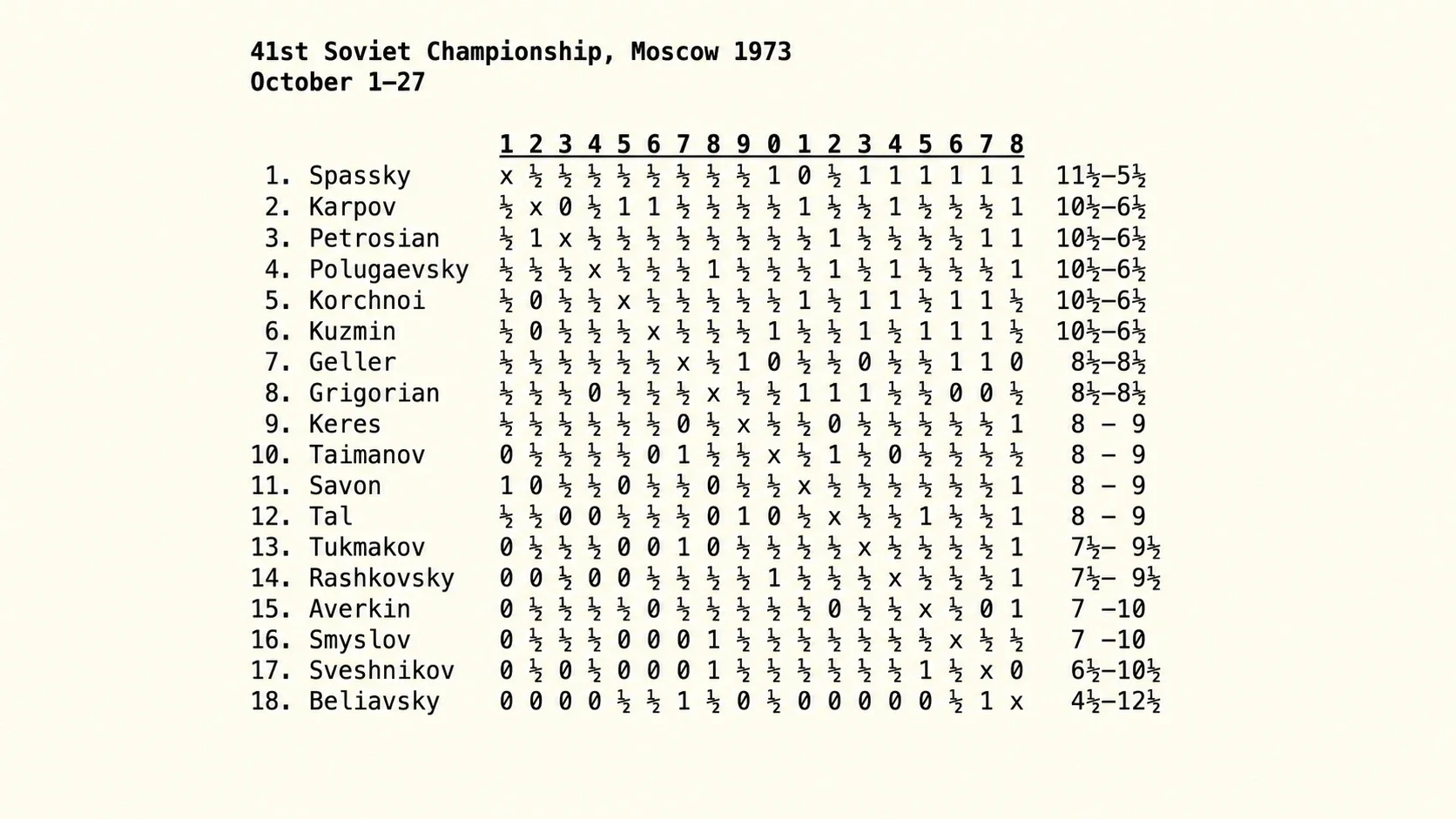
The sporting result was clear enough to be felt psychologically. Spassky finished first outright on 11½ points from 17 games, a full point ahead of the large group tied for second through sixth: Anatoly Karpov, Tigran Petrosian, Lev Polugaevsky, Viktor Korchnoi, and Gennady Kuzmin. He was not merely co-first in a crowded Soviet finish. He separated himself from a field that included the man many already saw as the future of Soviet chess and several men who had spent years in the world title orbit.
The shape of his tournament added to the effect. Russian biographical material notes that Spassky pulled away with three straight wins from rounds eleven through thirteen, against Mark Taimanov, Evgeny Sveshnikov, and Alexander Beliavsky, then secured the title in the last round with a draw. Vladimir Savon dealt him his only defeat, which only sharpens the broader point: the event was full of danger, yet Spassky still emerged alone at the top. In Soviet sporting culture, that kind of recovery spoke to authority and rank as much as to form.
That is why the win meant more than a line in a crosstable. It did not erase Reykjavik. It did restore standing. A Soviet world champion who had stumbled before the entire world now proved, in front of the hardest domestic audience available, that he still had the strength to lead the national field. For a player whose international image had become inseparable from defeat to Fischer, this was a powerful domestic correction.
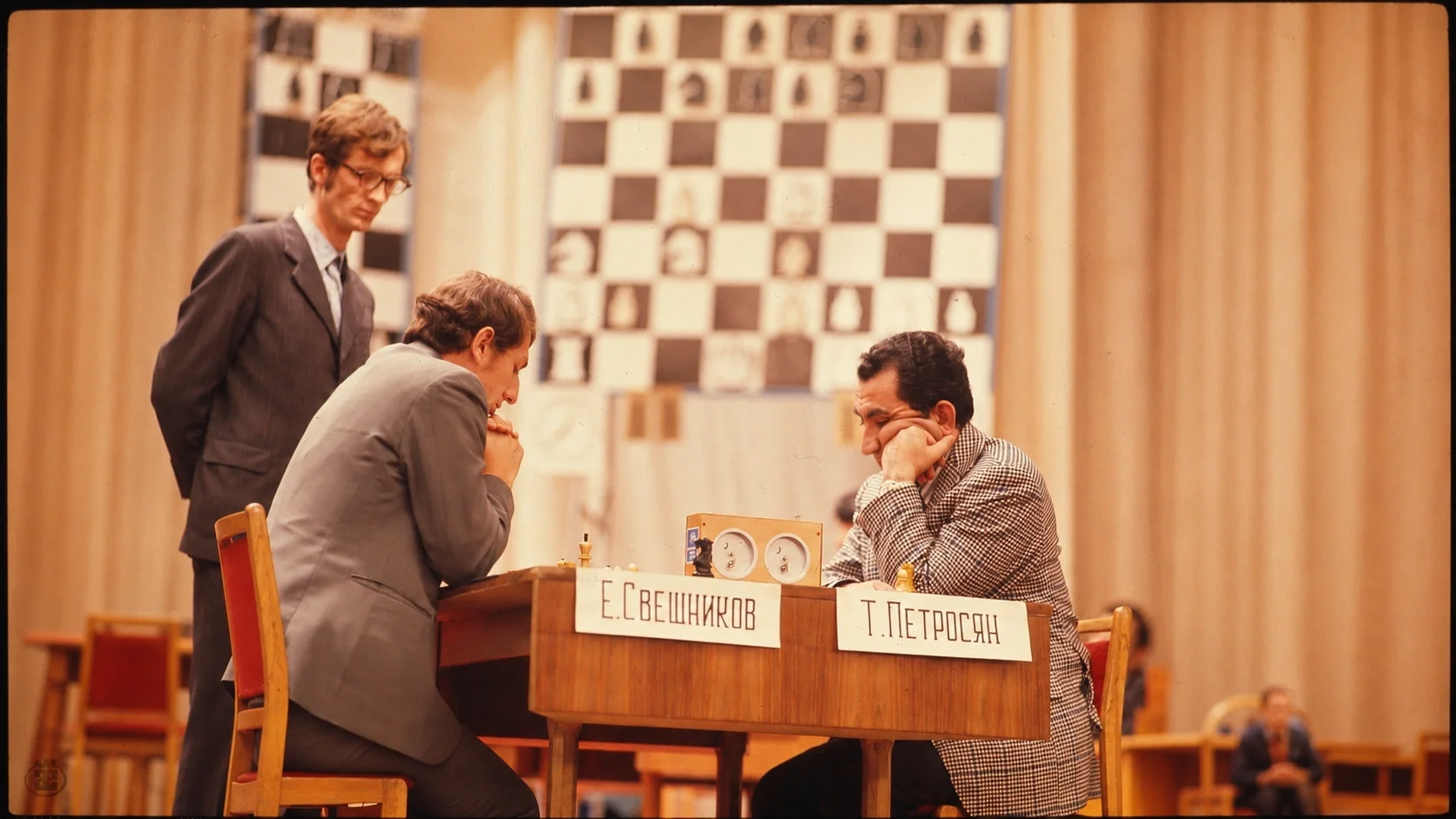
Evgeni Sveshnikov and Tigran Petrosian. Image Source: Douglas Griffin Chess
The field and the meeting of generations
The field itself explains why the championship continues to grip historians. It brought together Spassky, Petrosian, Tal, Smyslov, Karpov, Korchnoi, Polugaevsky, Geller, Taimanov, Keres, Savon, Kuzmin, Tukmakov, Karen Grigoryan, Sveshnikov, Beliavsky, and other leading Soviet masters in an 18-player final. Contemporary and retrospective accounts alike emphasize the same fact: four ex-world champions and one future world champion were seated in the same event. Tukmakov later added two details that are especially evocative. The oldest participant was Paul Keres, and the youngest was Alexander Beliavsky, whose major career was only beginning.
That layering of ages made the tournament a meeting point of historical worlds. Keres brought the aura of the pre-Botvinnik and early Botvinnik decades. Smyslov carried the classical refinement of the 1950s. Tal, Petrosian, and Spassky represented the great middle generation that had defined Soviet supremacy in the 1960s. Karpov represented the next answer to the world title problem. Beliavsky and Sveshnikov were present as signs that the system continued producing new talent even while it was reeling from Fischer’s success.
It is easy to romanticize this kind of field, yet the tournament was interesting precisely because it did not behave like a reunion. The older giants were still dangerous, though they no longer monopolized the top places. Savon later shared ninth through twelfth with Keres, Taimanov, and Tal on 8/17, and he handed Spassky his only defeat. Geller’s recorded tournament result was 8½/17, good for a place just below the leaders. Korchnoi later wrote that even names as formidable as Keres, Tal, and Smyslov could spend the whole event stuck in the negative half. The point is not decline in any simplistic sense. The point is competitive density. Reputation no longer guaranteed altitude.
The field also contained figures who sat uneasily within neat official narratives. Karen Grigoryan, for instance, was no mere filler around the great names. A recent Russian retrospective notes how proud he remained of his result in the star-studded 1973 championship, explicitly measuring it against famous supertournaments of other eras. That memory is revealing. The championship did not only gather legends. It gathered strong Soviet players whose careers were shaped by the system without ever fully becoming its public face.
One point of accuracy is worth stating plainly. David Bronstein belongs to any serious discussion of Soviet chess culture from the 1950s through the 1970s, yet the line-up materials and tournament summaries used for this article do not place him in the final Moscow Higher League field of October 1973. He is part of the era’s larger historical constellation, though not of this specific participant list.
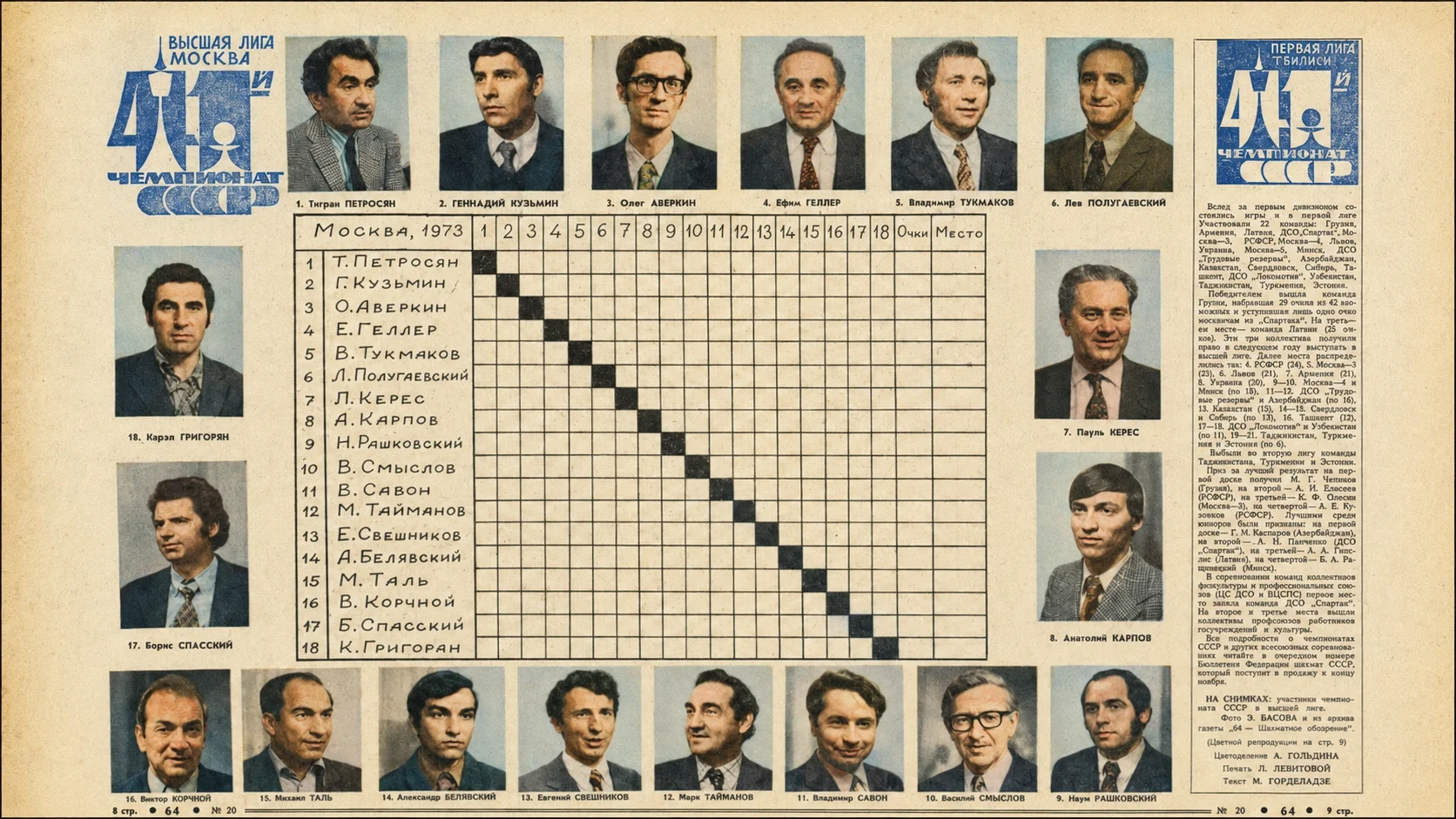
Image Source: Douglas Griffin Chess
Karpov, Korchnoi, and the changing order
If Spassky’s triumph gave the event its emotional center, Anatoly Karpov gave it its long historical shadow. The Russian Chess Federation’s Karpov profile is unusually frank about the way Soviet chess viewed the post-Fischer crisis. In its telling, the generation beaten by the American was no longer able to return the title, and the stake was placed on the young, fast-progressing Karpov. That statement is retrospective and somewhat harsh toward older Soviet stars, yet it captures the institutional logic that was already visible in 1973. Karpov had been world junior champion in 1969, had risen rapidly through elite events, and arrived in Moscow with his authority already growing.
Moscow 1973 confirmed that rise. Griffin notes that Karpov had just shared first in the Leningrad Interzonal with Korchnoi a few months earlier, keeping open the route to a future match with Fischer. In the USSR Championship he tied for second through sixth, and Griffin explicitly reads that result as further confirmation that Karpov was the man most likely to win the world title back for the Soviet Union. Seen from this angle, the championship was less a side event between candidate stages than a domestic test of succession.
Korchnoi’s presence gave the same succession drama a harder edge. In 1973 he was still fully inside Soviet chess life: a leading grandmaster, a recent Interzonal co-winner with Karpov, and a continuing candidate for the world title. Later political rupture should not be projected backward too easily. Yet his own memoir already shows the strain between his fiercely independent temperament and the Soviet official environment. He described the 1973 Higher League as one of the strongest tournaments of his life, even stronger in practical force than the 1985 Candidates event in Montpellier, and he shared second place in Moscow. At this stage he was neither dissident symbol nor exile. He was a central Soviet competitor whose relationship with the establishment had already become tense and whose rivalry with Karpov would soon define the next cycle.
This is one reason the tournament feels so historically charged. Karpov and Korchnoi stood in the same elite corridor, still representing the same state, while embodying two different futures. Karpov increasingly looked like the answer favored by institutions, trainers, and planners. Korchnoi looked like the answer generated by stubborn competitive force. Moscow did not settle that contest. It staged it early, in concentrated form, before the political drama of later years altered the frame.
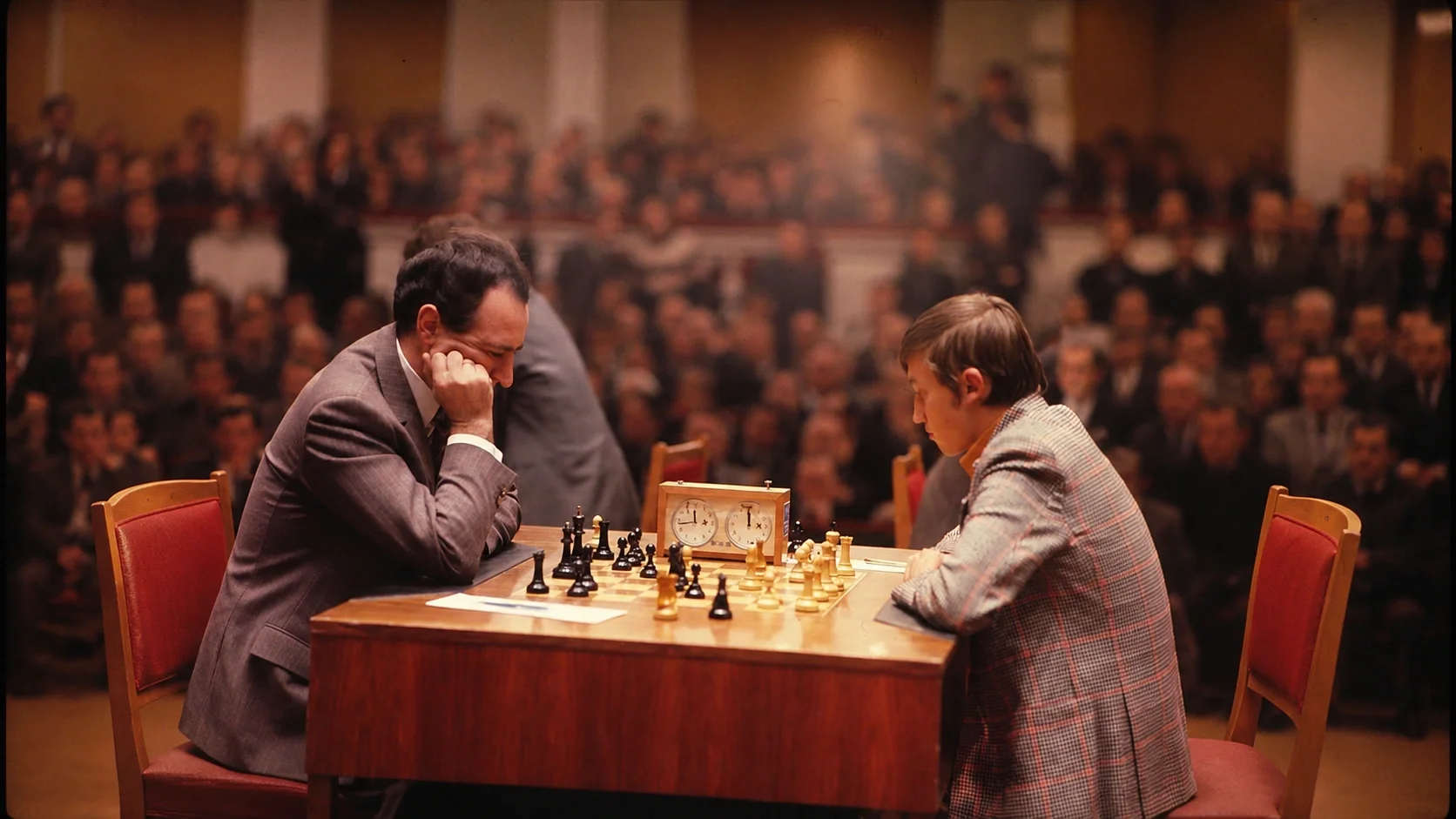
Polugaevsky and Karpov, 1973. Image Source: Douglas Griffin Chess
Institutions, press, and pressure
To understand the championship fully, one has to see it inside the institutions that sustained Soviet chess. A Soviet federation plenum in 1969 declared that USSR championships were rightly considered a school of chess mastery. That was official language, yet it described a genuine belief inside the system. The national title was not a mere local decoration. It functioned almost as a domestic crown, a proving ground where selection, prestige, advancement, and public legitimacy converged. After Reykjavik, the symbolic value of that “small crown” rose still further. The tightening of the championship format in 1973 and the insistence on elite participation make sense in exactly that light.
The press environment reinforces the point. Griffin, working from contemporary Soviet material, notes that weekly 64 announced the final field with a full two-page spread, later published Karpov’s annotations to his draw with Spassky and Tukmakov’s notes to his own game with Karpov, and continued to frame the event as an object of serious public attention. ChessPro’s historical summary adds that 64 actively covered the championship throughout and then interviewed the winner, Boris Spassky, after the finish. The Soviet chess press was not simply reporting moves. It was narrating hierarchy, responsibility, style, and future expectation.
The hall in Moscow seems to have felt all of that pressure. Korchnoi remembered enormous public interest, a packed room, powerful acoustics, and a crowd reacting audibly to the games. He recalled needing to shout at the spectators during his game with Spassky to quiet the noise long enough to continue. The image is vivid because it reminds us that Soviet chess was a mass spectator culture as well as an institutional system. This was high-level competition before an informed public that expected to witness significance in real time.
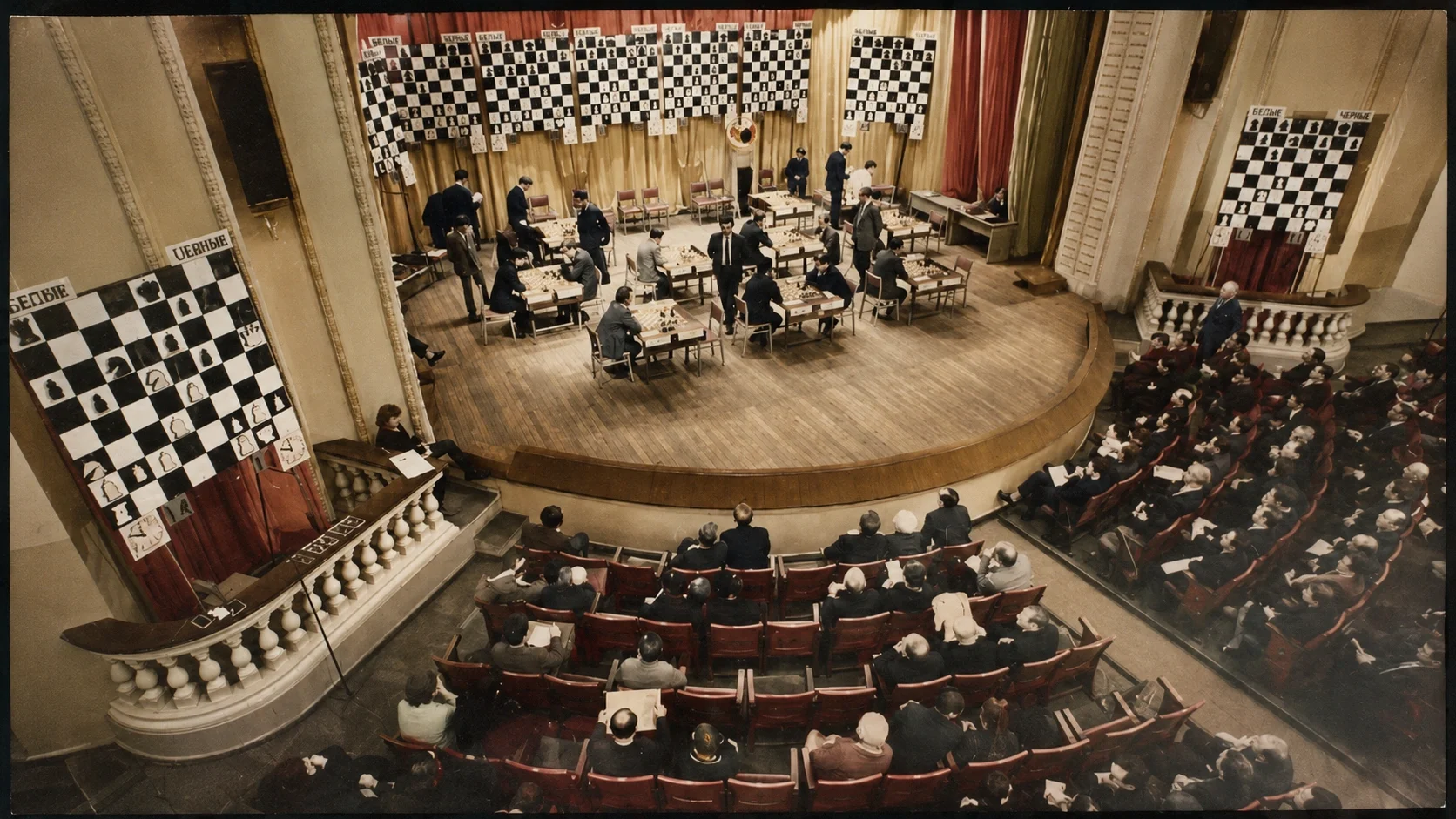
Railway Workers Hall, Moscow. Image Source: The Chess Collector
Caution is necessary when speaking about intelligence or state-security influence. The reliable sources used here do not document direct KGB management of the championship itself. Korchnoi does describe KGB attention and intrusive oversight in connection with the Soviet team’s trip to the 1973 European Team Championship in Bath, which took place after Moscow, and he later linked that conflict to his worsening relationship with the Soviet authorities. That is valuable evidence about the wider atmosphere around elite Soviet chess. It is not the same thing as documented security control inside the championship hall. Keeping that distinction clear is essential.
The 41st USSR Championship remains useful because it shows Soviet chess as a whole environment. It reveals the system’s strengths with unusual clarity: immense depth, a culture of relentless internal competition, strong publication and annotation practices, public fascination, and institutions capable of assembling a field that looked stronger than many international supertournaments. It also reveals the system’s strains: prestige anxiety after Fischer, the burden placed on individual players as representatives of state success, generational fatigue among older champions, and the urgent search for the next stabilizing figure.
This is why the tournament belongs near the center of any serious history of Soviet chess from the 1950s through the 1970s. In one hall, the old inheritance of Keres and Smyslov met the charismatic central generation of Tal, Petrosian, Spassky, and Korchnoi, while Karpov stepped forward as the player around whom a new order could be built. The post-Fischer wound had not healed, yet Soviet chess had already begun to reorganize itself. Moscow 1973 captured that reorganization in public view.
