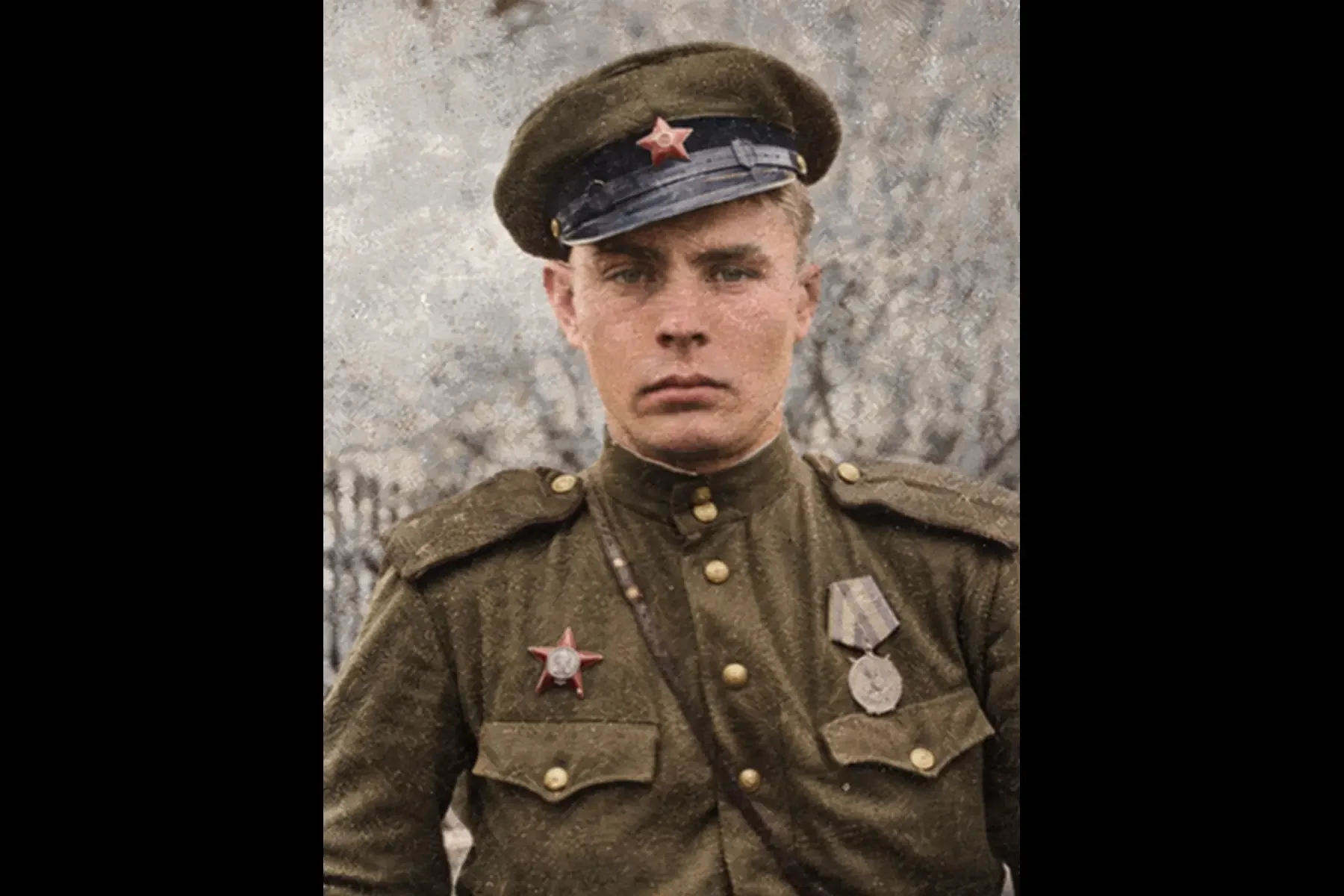
In the early summer of 1984, Alexander Cherepkov won Leningrad’s White Nights international tournament with 8 points from 13 games. He finished ahead of Mark Taimanov, Wolfgang Uhlmann, Jonathan Speelman and several younger Soviet masters. Cherepkov was sixty-three. He earned the International Master title that year, after decades of competition and teaching in one of the Soviet Union’s strongest chess cities. [1][2]
His career connected several generations of Leningrad chess. He learned from masters active before the Second World War, returned from military service to teach, and continued producing strong tournament results into old age. The surviving evidence includes his own memoirs, recollections by pupils and opponents, contemporary reporting, and tournament records. Together, these sources reveal a player whose competitive longevity accompanied a sustained contribution to chess education.
Growing Up in Leningrad’s Chess Circles
Alexander Vasilyevich Cherepkov was born in Rzhev on 30 October 1920. His father worked in the militia. In 1924, the family moved to Leningrad, where Alexander grew up with a younger brother in a communal apartment on Vasilievsky Island. After completing school, he worked at the Baltic shipyard. The available biographical accounts provide little detail about his formal education beyond these circumstances. [3]
Cherepkov’s own recollections describe his chess formation with considerable specificity. In 1934, he joined Andrei Batuev’s chess circle at the Kirov Palace of Culture with a school friend. Batuev organized tournaments, simultaneous exhibitions, consultation games and solving competitions. Visiting masters brought the pupils into direct contact with the city’s established chess community. Cherepkov also remembered studying a collection of Mikhail Chigorin’s games. [4]
Other influences followed. Visits to Vsevolod Rauzer introduced him to explanations of strategic principles, particularly weaknesses in a position. He studied under Peter Romanovsky and later joined Viacheslav Ragozin’s group at the Palace of Pioneers. His memoir portrays a varied education conducted through conversation, practical play, lectures and the examination of pupils’ games. [4]
Two lessons remained memorable. Vladimir Zak urged young players to verify published analysis independently. Ragozin challenged Cherepkov’s tendency to attach approving annotations to his own moves while criticizing his opponents’ decisions. Recalling these episodes many years later, Cherepkov preserved a picture of instruction that encouraged independent judgment and scrutiny of one’s own play. [4]
War, Injury and the Return to Chess
The war interrupted this development. In a memoir published in 2001, Cherepkov recalled imprisonment at Segezhlag before his return to Leningrad in 1941. He survived the first siege winter and was called into the Red Army in February 1942. His account describes service on the Volkhov Front, officer training and command responsibilities in an antitank rifle unit. [5]
He was seriously wounded on 13 October 1943. A reproduced military award recommendation, published with Nikolai Mishuchkov’s later account of his life, independently records both an earlier wound in March 1942 and the severe injury that October. This document provides corroboration for an episode otherwise known chiefly through Cherepkov’s recollections. [6]
After months in hospitals, he returned to service. His memoir dates his appointment as a platoon commander in the 15th Separate Penal Company to April 1944. He described accepting this command from the officer reserve. He reached Prague at the war’s end and was demobilized in February 1946. [5]
The transition to civilian life brought him into the Trudovye Rezervy sports society. There he worked with Zak, who subsequently persuaded him to join the teaching staff at the Leningrad Palace of Pioneers. Cherepkov dated the beginning of that appointment to December 1949. [5]
Establishing Himself as a Soviet Master
Cherepkov developed his tournament career alongside his teaching. He fulfilled the Soviet master norm in 1954, finishing behind Boris Spassky and Lev Polugaevsky in an all-Union tournament. He received formal recognition as a Master of Sport in 1955. The qualifying performance and the award belong to separate years. [2][3]
His breakthrough into the Soviet championship final came through the Vilnius semifinal of 1960. He scored 11½ points from 17 games, finishing fourth, only half a point behind the joint leaders Eduard Gufeld, Polugaevsky and Vladimir Simagin. The field also included Aivars Gipslis, Vladimir Antoshin, Vladimir Bagirov, Salo Flohr and Alexander Tolush. Qualification from such company was a substantial achievement. [7]
At forty, Cherepkov made his first appearance in a Soviet championship final. The Moscow tournament ran from 11 January to 11 February 1961 and was won by Tigran Petrosian. Cherepkov scored 7½/19 in a field that included Vasily Smyslov, Spassky, David Bronstein, Efim Geller, and Viktor Korchnoi. He drew with Korchnoi, Spassky and several other leading participants. [8]
He subsequently played in the large Swiss-system Soviet championship at Kharkov in 1967 and the championship held at Alma-Ata across 1968 and 1969. These three appearances place him among the experienced Soviet masters who repeatedly reached national competition while maintaining substantial responsibilities elsewhere in chess. [9]
Team competition formed another part of his career. He represented Leningrad in the Soviet team championships of 1955, 1960 and 1967. The city finished second in 1955 and won in 1960. His participation connected his individual results with the collective strength of Leningrad’s chess institutions. [10]
Three Leningrad Championships
Cherepkov became champion of Leningrad in 1967, retained the title in 1968 and won it again in 1982. The city’s historical champions list places him alongside the succession of masters who sustained its exceptionally competitive local chess life. His three titles were separated by fifteen years. [11]
The 1968 result requires some precision. Cherepkov, Vladimir Bykov and Viacheslav Osnos each scored 12½/17 in the main tournament. Their subsequent playoff also ended level, with each player scoring two points from four games. Cherepkov appears in the historical record as the champion, although he had shared first place in both stages of the competition. Describing the event simply as an outright tournament victory would obscure that distinction. [11][12]
His third title, in 1982, came after his sixtieth birthday. It began a particularly productive period of late competitive success. [3][11]
Thirty Years at the Palace of Pioneers
Cherepkov taught at the Palace of Pioneers for approximately thirty years. Among the pupils associated with his work were Leonid Yudasin, Lyubov Kristol, Ekaterina Bishard, Flora Dmitrieva and Elena Belova, later known as Elena Bystryakova. His contribution to the development of women players was a substantial part of his teaching career. [2][3]
The recollections of those pupils help explain what the work involved. Bystryakova’s account of the 1974 schoolchildren’s Spartakiad in Alma-Ata describes Cherepkov and Sergei Khavsky preparing the Leningrad team at a summer training camp and throughout the competition. Coaching extended to individual preparation, the analysis of adjourned games and the management of a team under pressure. [13]
One incident captures Cherepkov’s practical approach. Bystryakova carried a small toy bear as a talisman. When teammates began joking that their prospects depended on whether she remembered it, Cherepkov ordered them to prepare their games and told her to leave the bear behind. In her recollection, the episode preceded the decisive match against Moscow. Leningrad won 5–3 and took first place. She also credited the coaches’ extensive analysis of the adjourned positions. [13]
His pupils later went on to careers outside professional chess. Vladimir Kuts, writing in an academic journal about his education, recalled entering the Leningrad schoolboys’ team in eighth grade. Cherepkov became his coach, and Yudasin his sparring partner. Kuts subsequently pursued engineering and research. His account preserves the place of serious chess training within a wider educational experience. [14]
Alexander Khalifman offered another perspective on the institution. In a 2007 interview, he named Cherepkov alongside Vasily Byvshev, Zak and Khavsky when describing the Palace’s strong teaching staff. Khalifman identified Byvshev as his own first coach and credited the school as a whole with much of his development. His testimony shows how a teacher’s influence could extend across the shared environment of the club. [15]
Cherepkov’s departure from the Palace did not end his coaching. He later worked with Nina Sirotkina, and in 1987 received the title of Honored Trainer of the RSFSR. [6]
Style and the Judgment of His Contemporaries
Korchnoi left a valuable assessment of Cherepkov’s chess in a memorial article published in 2010. Discussing his victory over Tolush at Vilnius in 1960, Korchnoi emphasized his willingness to enter complicated positions whose theoretical assessment remained uncertain. He associated Cherepkov’s play with confidence, tenacity and independence. This was the judgment of a strong contemporary who had known him over many years. [16]
Korchnoi also remembered a more personal detail: after play in Minsk, Cherepkov had recited passages from Lermontov’s Masquerade, a work he particularly enjoyed. The recollection offers a glimpse of the literary interests that accompanied his life in chess. [16]
Mishuchkov supplied complementary evidence about his technical ability. Recalling their game in the 1974 Leningrad championship, he described receiving a lesson from Cherepkov in the handling of a minor-piece ending. He explicitly recognized endgame skill alongside combinational talent. Taken together, these assessments suggest a player comfortable with complicated struggles and capable of precise work when the position simplified. [6][16]
White Nights and International Recognition
Retirement gave Cherepkov more opportunity to concentrate on competition. In 1984 he won the all-Union veterans’ tournament in Yerevan and achieved his most conspicuous international success at White Nights. [2]
The Leningrad tournament took place in May and June. Cherepkov scored four wins, eight draws and one loss, finishing alone in first place on 8/13. Andrei Lukin and Alex Yermolinsky followed on 7½. The field included established international players and younger masters who would become prominent in subsequent years. Cherepkov’s pupil Yudasin was also among the participants. [1]
The date establishes his age precisely: he was sixty-three, with his sixty-fourth birthday still several months away. His International Master title was awarded in 1984. The surviving sources establish the year but do not provide a clear enough award date to assign an exact age to the formal recognition. [1][2]
His strength persisted. At the Leningrad international tournament of 1990, he finished clear second with 9½/13, half a point behind Konstantin Sakaev. This result came in the year Cherepkov turned seventy and extended the record of substantial performances beyond his White Nights victory. [17]
Later Years and Historical Legacy
Contemporary reporting shows that Cherepkov remained an active competitor during the following decade. In December 1995, international arbiter Alexander Geller reported on a tournament celebrating his seventy-fifth birthday. Cherepkov scored four points from seven games, finishing half a point behind the joint winners. Geller also identified him as Russia’s reigning veterans’ champion. Former pupils, colleagues, and family members joined in celebrating the occasion. [18]
Local historical research records further victories in tournaments commemorating the lifting of the siege of Leningrad in 2002, 2004 and 2005. Cherepkov was already over eighty. He died in Saint Petersburg on 12 July 2009, aged eighty-eight. [3]
His memoirs preserve another contribution. They describe the everyday workings of prewar chess education: small teaching groups, visiting masters, shared analysis and the gradual acquisition of independent judgment. Their retrospective character requires care, but their detail gives historians evidence about experiences that tournament records cannot capture. [4]
Cherepkov deserves attention for the continuity of his work across a remarkably long chess life. His three Leningrad championships, Soviet championship appearances and late international results establish his strength as a competitor. Testimony from pupils and colleagues establishes his importance as a teacher. Through both activities, he helped transmit Leningrad’s chess knowledge across generations, while continuing to test his own understanding at the board.
Notes and Sources
Rusbase, “International Tournament Leningrad ‘White Nights,’ May–June 1984”, undated compiled crosstable. Records the dates, field, individual results and Cherepkov’s outright first place. al20102007.narod.ru
Chess Federation of Russia, “Александр Черепков” (“Alexander Cherepkov”), page dated 30 October 2025. Used for the 1954 master norm, teaching associations, veterans’ success and 1984 International Master title. ruchess.ru
Vadim Faibisovich, “О воинах павших, о прошедших войну: Александр Черепков”, e3e5, page dated 29 October 2022. Biographical notice covering family background, employment, titles and later competition. The page also contains a later reminiscence by Alexander Kentler; its original heading does not date that appended text. e3e5.com
Alexander Cherepkov, “Послушайте, ребята, что вам расскажет дед”, Shakhmatny Peterburg, nos. 3–4, 2000; reproduced by e3e5 on 20 July 2009. First-person recollections of his early chess education. e3e5.com
Alexander Cherepkov, “Военная бывальщина” (“A Wartime Recollection”), Shakhmatny Peterburg, no. 1, 2001; reproduced by e3e5 on 21 April 2025. First-person account of military service, demobilization and his December 1949 appointment at the Palace of Pioneers. e3e5.com
Nikolai Mishuchkov, “Жизнь на два фронта” (“Life on Two Fronts”), 64: Shakhmatnoe obozrenie, no. 10, 2020, pp. 64–67. The reproduced award recommendation and the author’s account of their 1974 game appear on p. 65. The article also discusses later coaching and the 1987 trainer award. Ноткин М.
Rusbase, “Semifinal of the USSR Championship, Vilnius, 20 August–16 September 1960”, undated compiled crosstable. al20102007.narod.ru
Rusbase, “28th USSR Championship, Moscow, 11 January–11 February 1961”, undated compiled crosstable. al20102007.narod.ru
OlimpBase, “35th Soviet Chess Championship, Kharkov 1967” and “36th Soviet Chess Championship, Alma-Ata 1968/1969”, undated historical competition records. olimpbase.org
OlimpBase, “Soviet Team Chess Championship: Alexander Cherepkov”, undated player record. Documents his Leningrad appearances and team results. olimpbase.org
Ruschess, “Champions of Petrograd, Leningrad and Saint Petersburg”, historical list preserved in the site’s 1998 championship archive. Credits Cherepkov with the titles of 1967, 1968 and 1982. ruschess.com
Rusbase, “Leningrad Championship, 1–28 August 1968, and Playoff”, undated compiled crosstables. Records the shared first place and the equally scored playoff. al20102007.narod.ru
Elena Bystryakova, “Рассказы” (“Stories”), e3e5, 9 September 2015. First-person recollections of Cherepkov, Khavsky and the Leningrad team at the 1974 schoolchildren’s Spartakiad. e3e5.com
Vladimir A. Kuts, “Lifelong Education: The Experience of Self-Reflection”, Nepreryvnoe obrazovanie: XXI vek, no. 4, winter 2013, especially p. 3. Published by Petrozavodsk State University. A scholarly autobiographical essay containing the author’s recollection of training with Cherepkov. lll21.petrsu.ru
Andrei Paneyakh, “Alexander Khalifman: ‘I Have Always Behaved as I Considered Necessary’”, ChessPro, 2007. Interview containing Khalifman’s assessment of the Palace of Pioneers teaching staff. Интервью c Александром Халифманом
Viktor Korchnoi, “Памяти Александра Черепкова” (“In Memory of Alexander Cherepkov”), 64: Shakhmatnoe obozrenie, no. 5, 2010, pp. 76–78, especially p. 76. Used for Korchnoi’s chess assessment and personal recollection. Its introductory reference to a June 2009 death is erroneous; the date used here follows the biographical sources in notes 2 and 3. Шахматное обозрение №5 за 2010 год
Rusbase, “International Tournament, Leningrad 1990”, undated compiled crosstable. Records Cherepkov’s clear second place on 9½/13. al20102007.narod.ru
Alexander Geller, “Вспомню я пехоту и штрафную роту”, 64: Shakhmatnoe obozrenie, no. 12, 1995, p. 35. Contemporary report on Cherepkov’s seventy-fifth-birthday tournament and veterans’ championship status.
