
Hans Peters for Anefo
Nigel Short’s 1992 victory over Anatoly Karpov marked a major breach in the competitive supremacy of the Soviet chess establishment. By defeating the former world champion in a Candidates match, Short removed the player who had contested five successive world championship matches against Garry Kasparov. His victory over Jan Timman then earned the English grandmaster his own title challenge in London in 1993.
His career spans an important historical transition. Short developed while Soviet players dominated international chess, reached the world’s leading group during the USSR’s final years, and played his decisive matches against Karpov and Kasparov after its dissolution. His achievements belong to the history of England’s emergence as a major chess nation. His later work as a player, writer, teacher, and administrator also shows how far professional chess expanded beyond its established European centers.
A Lancashire Childhood and an English Chess Education
Nigel David Short, generally known as Nigel Short, was born on 1 June 1965 in Leigh, Lancashire, and grew up in nearby Atherton. His parents, David and Jean, helped turn an early fascination into regular competitive activity. In his father’s account, Nigel became interested while watching David teach his older brother, Martin. The Fischer–Spassky world championship of 1972 intensified that enthusiasm: the young Short followed newspaper reports and played through the games.
The family initially knew little about organized chess. Jean’s inquiries, help from Nigel’s headteacher, Joe Rowland, and contact with local organizer Richard Furness led him to Golborne Chess Club. Furness subsequently encouraged him to enter the Liverpool Schools Chess Congress at Easter 1973. These connections show how family initiative, schoolteachers, and voluntary chess organizations supplied his earliest opportunities.
As his results improved, Short attracted the attention of Leonard Barden, an influential figure in English junior chess. In a recollection preserved by Edward Winter, Barden described assessing Short’s potential during 1975 and arranging for the experienced master Čeněk Kottnauer to examine his play. Such interventions connected a talented provincial child with people capable of recognizing and encouraging international potential.
Short attended Bolton School, whose strong chess team influenced his choice. Returning there in 2024, he recalled playing regularly for the school and credited his English education with helping him think and express himself clearly. That retrospective judgment connects his schooling with the newspaper and magazine writing that later became a substantial part of his professional life.
His development also attracted premature judgments. In April 1982, when Short was sixteen, David Levy published an article entitled “Is Nigel Short a Has-Been?” Winter recorded objections to its criticism of Short’s apparent emphasis on schoolwork. The episode illustrates the expectations surrounding a celebrated junior before he had completed his transition into adult professional chess.
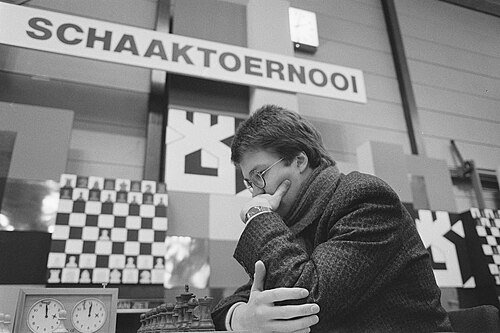
Hoogovens 1987. Croes, Rob C. / Anefo
From Prodigy to World-Class Grandmaster
In 1977, Short qualified for the British Championship three days before his twelfth birthday. Two years later, he shared first place at Chester with John Nunn and Robert Bellin, scoring 8/11. Bellin won the tie-break, an important detail when accounts describe Short as the 1979 champion. At the 1980 World Junior Championship in Dortmund, Short finished second behind Kasparov.
FIDE awarded him the grandmaster title in 1984, when he was nineteen. That year also brought his first British Championship title; he won further national titles in 1987 and 1998.
His ascent formed part of an exceptional period for English team chess. England won Olympiad silver medals in 1984, 1986, and 1988, finishing behind the Soviet Union on each occasion, and added bronze in 1990. Short progressed from reserve in 1984 to first board in 1988. At Dubai in 1986, his 10/13 earned the individual gold medal on board three. Alongside players including Tony Miles, Nunn, Jonathan Speelman, and Murray Chandler, he helped sustain England’s challenge across successive international competitions.
Individual tournament results established his standing independently of national expectations. At Wijk aan Zee in 1986, Short scored an undefeated 9½/13, finishing a point and a half clear of the field. The opposition included established elite players such as Ljubomir Ljubojević, Robert Hübner, and Yasser Seirawan. This was a convincing victory in a demanding international tournament.
By July 1988, Short stood third on the FIDE rating list. The date is worth specifying because some retrospective profiles place his arrival at that ranking earlier in the year. The historical lists establish July as the relevant publication.
The Road Through Karpov
Progress toward a world championship match required adjustments. Short lost his 1988 Candidates encounter with fellow Englishman Jonathan Speelman. In a contemporary profile published during the next Candidates cycle, William Hartston described a subsequent change in Short’s approach to preparation. Short acknowledged that he had previously lacked a sufficient understanding of disciplined chess work. Collaboration with the Czech-born American grandmaster Lubomir Kavalek helped him develop a more systematic professional method.
The results of 1991 demonstrated renewed strength. At Amsterdam’s VSB tournament, Short shared first place with Valery Salov on 6/9, ahead of both Kasparov and Karpov. He remained unbeaten. Finishing above the two dominant figures in world chess gave this success particular significance, even though his individual games against them were drawn.
In the Candidates competition, Short overcame Speelman after their eight scheduled games ended level, winning the additional games to take the encounter 5½–4½ overall. He then defeated Boris Gelfand 5–3 in Brussels. These victories earned him a semifinal against Karpov at Linares in April 1992.
Karpov remained an exceptionally formidable opponent, ranked second in the world. Short lost the opening game but recovered to win the match 6–4, scoring four victories against two defeats. The achievement was substantial in both sporting and historical terms: an English player had eliminated the man whose rivalry with Kasparov had defined the championship for much of the preceding decade.
Contemporary coverage reveals how strongly older political categories continued to shape perceptions. Dominic Lawson, who visited Short during the match, titled his Spectator account “How the West Has Won.” His report provides valuable evidence of the atmosphere surrounding Short and Kavalek, while also reflecting an openly sympathetic, partisan perspective. The USSR had already ceased to exist. The victory was nevertheless interpreted through the language of the long struggle against Soviet chess dominance.
Short completed the qualifying campaign by defeating Timman 7½–5½ at San Lorenzo de El Escorial in January 1993. His route had required success against opponents with markedly different backgrounds and competitive strengths. The resulting title challenge rested on a sustained series of match victories.
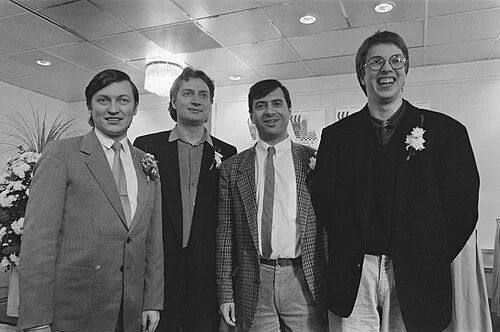
By Rob Croes for Anefo - http://proxy.handle.net/10648/ad691dd2-d0b4-102d-bcf8-003048976d84, CC0, https://commons.wikimedia.org/w/index.php?curid=66638758
London 1993 and the Championship Split
Before Short and Kasparov met, their championship became the centre of an institutional rupture. On 26 February 1993, the two players announced that they would organize the contest outside FIDE through the new Professional Chess Association. Their joint statement alleged that FIDE had selected Manchester as the venue without the consultation required with the players. Contemporary Associated Press reporting preserves this as their stated grievance; FIDE officials declined to comment for that report.
The match eventually took place at London’s Savoy Theatre from 7 September to 21 October. Meanwhile, FIDE staged a separate championship between Karpov and Timman, the two players Short had eliminated in the final stages of qualification. Karpov won that contest. The emergence of competing championship lines made Short a participant in one of the most consequential administrative disputes in modern chess.
Against Kasparov, Short was decisively beaten, 12½–7½. The champion won six games and lost one; Short’s sole victory came in game sixteen. Kasparov’s early lead placed the challenger under sustained pressure and left him with little room to recover.
Short’s later assessment identified practical weaknesses. In a 2011 interview with Carl Portman, he acknowledged insufficient variety in his preparation with the black pieces, along with time-pressure losses and failures to convert advantageous positions. This retrospective account helps explain the gap between obtaining opportunities and successfully exploiting them against the world champion.
The institutional decision also received later criticism from within the partnership. Interviewed in 2005, Kasparov called the break with FIDE a mistake and argued that the players should have negotiated from their strong position. That was Kasparov’s retrospective judgment. It should be distinguished from Short’s own explanations and from the grievances recorded when the split occurred.
Imagination, Technique, and Competitive Longevity
Short’s chess resists a single stylistic label. Asked about it in 2013, he described his style as “amorphous” and named Paul Morphy as his favourite player. His celebrated victory over Timman at Tilburg in 1991 provides a vivid example of his imagination: he brought his king forward to participate in an attack, finding an exceptional use for a piece usually sheltered during such operations.
His own recollections also emphasize technical achievement. In a 2023 interview, Short singled out his victory over Vasily Smyslov at the 1987 Subotica Interzonal. He recalled the satisfaction of defeating a former world champion renowned for endgame mastery in precisely that phase. Together, these examples convey the range required for his strongest results: inventive attacking play, positional judgment, and the ability to sustain a struggle after much of the material had disappeared.
The 1993 defeat was followed by further setbacks and substantial successes. In the next PCA Candidates competition, Gata Kamsky defeated Short 5½–1½ in 1994. Contemporary reporting fixes the year, which is sometimes confused with the subsequent championship match in 1995.
Short reached the semifinals of the Groningen knockout in December 1997, the qualifying event for FIDE’s 1998 championship. He defeated Michał Krasenkow in the quarterfinal before losing to Michael Adams after tie-breaks. The presence of two English players among the last four demonstrated the continuing strength of the generation to which Short belonged. Earlier in 1997, he had played first board for England’s gold-medal team at the European Team Championship in Pula.
His later tournament career extended well beyond the period of realistic world championship ambitions. At Gibraltar in 2012, aged forty-six, he shared first place with Hou Yifan on 8/10 and won their playoff 1½–½. It was his third Gibraltar title. A decade later, he joined Adams in England’s victorious over-fifty team at the 2022 World Senior Team Championship.
Short maintained his English chess affiliation while establishing his family home in Greece. His wife, Rhea, is Greek, and they have two children. In a 2013 interview, he identified Athens as his home. He had received an MBE for services to chess in 1999. Teaching, Writing, and Public Debate
Short’s international activity included coaching Iran in 2006–2007. Discussing that work with Alexander Klemm in 2010, he emphasized the value of regular practice, sustained enthusiasm, and opportunities to compete. His teaching experience thus extended into a chess culture undergoing its own development, far from the English institutions that had supported his childhood.
Simultaneous exhibitions provided another way to connect with ordinary players. In his interview with Portman, Short explained that these engagements supplied income and reduced the distance between professionals and club chess. This practical aspect of his career deserves attention: exhibitions and discussions brought a former championship challenger into local chess communities whose members might otherwise encounter grandmasters only through published games or broadcasts.
His writing reached both specialist and general audiences, including readers of New in Chess, The Sunday Times, and The Daily Telegraph. In his own recollection, the connection to his school education is unusually explicit: clear written expression became a professional resource alongside playing strength.
Winning, published by Quality Chess in 2021, is his most substantial autobiographical contribution to chess literature. It examines eight tournament victories and presents the complete sequence of games from each selected event. The format preserves uneven performances, short draws, and difficult moments as parts of a tournament’s unfolding story. In the introduction, Short also acknowledges that shortcomings in his analytical work had hindered his career.
The introduction contains a useful bibliographical qualification. Short explains that earlier books carrying his name had been ghostwritten, with the exception of an early work on the French Defense. Readers should therefore distinguish his personal authorship of Winning from titles previously marketed under his name. The English Chess Federation’s 2021 judging panel highly commended the book.
His public commentary has also generated controversy. In a 2015 New in Chess article, Short argued that differences between men and women helped explain the imbalance at the top of competitive chess. Judit Polgar publicly challenged his position, emphasizing equal conditions, training, determination, and her own experience competing successfully against leading men. These were competing arguments about gender and opportunity; Short’s position should be presented as his opinion rather than as an established explanation of chess performance.
Development Work and Historical Legacy
Short eventually assumed significant responsibilities within the federation he had challenged in 1993. Appointed a FIDE vice-president in 2018, he became its Director for Chess Development in September 2022. The latter role focused on assisting less developed federations, including support for organizing international competitions and strengthening local chess activity.
Describing this work in 2023, he explained that federations faced different organizational difficulties. His account of a visit to Belize emphasized bringing people together, securing publicity through an exhibition, and encouraging regular competition. He reported subsequent improvements while explicitly declining sole credit. The account is valuable as his explanation of the work, although it remains a participant’s assessment of its effects.
His involvement continued into 2026. FIDE’s February report on his visit to Togo described discussions about club organization, coach training, and wider participation, together with the launch of a chess popularization program. The report documents the activities and their stated objectives; their longer-term results require separate assessment.
Short deserves attention as a central figure in England’s sustained challenge to the Soviet-trained elite. His defeat of Karpov demonstrated what that challenge could achieve in a demanding championship match. His wider career adds the institutional consequences of the 1993 split, decades of international competition, candid writing about professional practice, and work extending organized chess into new communities. Studying those strands together places his championship appearance within a substantial and continuing contribution to the game.
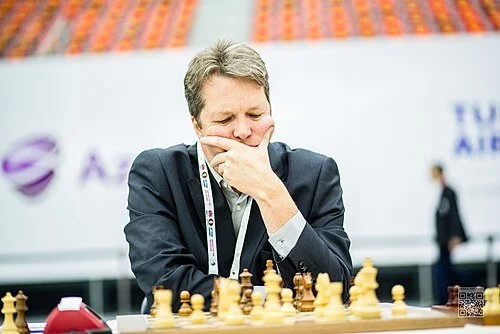
By Andreas Kontokanis from Piraeus, Greece - Short Nigel, CC BY-SA 2.0, https://commons.wikimedia.org/w/index.php?curid=52473440
Notes and Sources
[^1]: OlimpBase, match records for the 1990–1993 championship cycle: Candidates semifinal, Linares 1992; Candidates final, San Lorenzo de El Escorial 1993; PCA World Championship, London 1993; and FIDE World Championship, 1993. These provide match scores, individual results, and event details.
[^2]: Frederic Friedel, “Nigel Short turns forty,” ChessBase, 1 June 2005. Includes an excerpt from David Short, Nigel Short: Chess Prodigy (London: Faber and Faber, 1981). The childhood recollections cited here were inspected through that reproduced excerpt, rather than the complete book.
[^3]: Edward Winter, “Nigel Short,” Chess Notes, collected entries. Relevant material includes Leonard Barden’s retrospective account of assessing Short in 1975, and the discussion of David Levy’s April 1982 CHESS article in C.N. 136 and 247.
[^4]: Bolton School, “Old Boy and Chess Grandmaster Nigel Short Returns to Bolton School,” 22 November 2024. Institutional report of Short’s visit and recollections.
[^5]: John Saunders, BritBase, “Nigel Short: Games 1975–1983,” and “66th British Championship, 1979, Chester.” The latter includes contemporary material and the championship report from the British Chess Federation Yearbook 1979–80, pp. 61–63.
[^6]: FIDE, “Short, Nigel D,” player profile, ID 400025, for identity, federation, and the 1984 grandmaster award; OlimpBase, historical FIDE rating record for Nigel Short, particularly the January and July 1988 lists.
[^7]: John Saunders, “British Chess Champions, 1904–present,” BritBase. Records Short’s titles in 1984, 1987, and 1998.
[^8]: OlimpBase, Nigel David Short’s Olympiad record; England at Dubai 1986; and event records for Thessaloniki 1984 and Thessaloniki 1988.
[^9]: OlimpBase, “Wijk aan Zee 1986,” tournament crosstable.
[^10]: William Hartston, “Profile: Advance of a pawn king,” The Independent, January 1993. Contemporary profile discussing Short’s development, work habits, and collaboration with Kavalek.
[^11]: OlimpBase, “Amsterdam 1991,” VSB tournament crosstable.
[^12]: OlimpBase, 1991 Candidates round of sixteen and 1991 Candidates quarterfinals, covering Short’s matches against Speelman and Gelfand.
[^13]: Dominic Lawson, “How the West Has Won,” The Spectator, 2 May 1992, pp. 15–16. Contemporary eyewitness account, written from a perspective sympathetic to Short.
[^14]: Associated Press, “Kasparov, Chess Challenger Rebel Against Organization,” Deseret News, 27 February 1993. Reports the players’ announcement and their allegations concerning consultation.
[^15]: Carl Portman, “Exclusive Interview with GM Nigel Short MBE,” interview conducted in October 2011 for Defence Focus, PDF hosted by Shropshire Chess. See PDF pp. 1–2 for simultaneous exhibitions and Short’s assessment of the 1993 match.
[^16]: ChessBase, “The Garry Kasparov Interview, Part 2,” 14 April 2005. Kasparov’s retrospective assessment of the 1993 breakaway.
[^17]: Tendai, “Interview with Nigel Short, Chess Grandmaster,” Africa Chess, 1 June 2013. First-person answers concerning Short’s identity, home in Greece, preferences, and playing style.
[^18]: Mark Rivlin, “Interview with GM Nigel Short,” English Chess Federation, 28 July 2023. Covers Smyslov, writing, development work, Belize, and future plans; the introduction records his MBE.
[^19]: Mark Crowther, The Week in Chess, no. 3, 1 October 1994. Contemporary reporting of Kamsky’s victory over Short in the PCA Candidates competition.
[^20]: OlimpBase, 1998 FIDE championship knockout, Groningen qualifying event, played in December 1997; and Short’s European Team Championship record, including Pula 1997.
[^21]: ChessBase, “Hou Yifan, Short win Gibraltar, Nigel wins playoff,” 3 February 2012.
[^22]: FIDE, “FIDE World Senior Team Championship 2022: England wins golden double,” 30 June 2022.
[^23]: Alexander Klemm, interview with Nigel Short, Bangkok Chess Club, conducted 21 April 2010 and published 18 May 2010. Includes Short’s account of coaching Iran in 2006–2007.
[^24]: Nigel Short, Winning (Quality Chess, 2021), introduction, pp. 9–11, and contents, inspected in the publisher’s sample PDF. The statements about authorship and earlier ghostwritten books are Short’s own.
[^25]: Ray Edwards, Jovanka Houska, and Sean Marsh, “ECF Book of the Year 2021,” English Chess Federation, 8 October 2021. Winning received a highly commended distinction.
[^26]: Nigel Short, “Vive la Différence,” New in Chess, no. 2, 2015, reproduced with permission in “Vive la Différence: the full story,” ChessBase, 22 April 2015; Sandor Peto, Reuters, “Tempest on a chess board: Hungary’s Polgar disputes UK’s Short,” republished by SBS, 23 April 2015.
[^27]: FIDE, “General Assembly 2018 Decisions,” published 18 October 2018, decision GA-2018/10; and “Mr Short and Mr Iashvili appointed Director for Chess Development and Special Tasks Director,” 30 September 2022.
[^28]: FIDE, “FIDE Director for Chess Development visits Togo,” 23 February 2026. Official account of the visit, programme launch, and stated development objectives.
