Michal Krasenkow
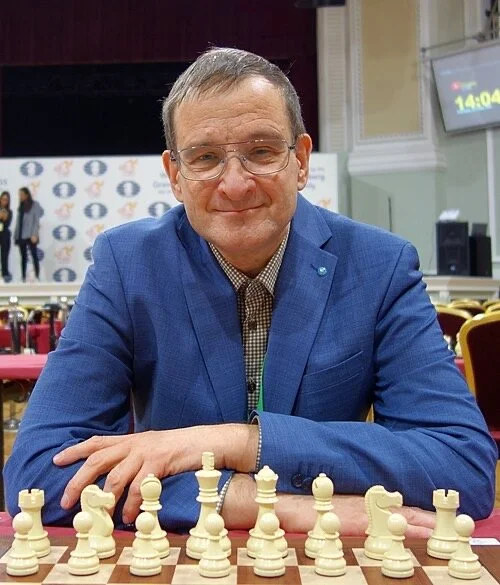
“Michał Krasenkow, chess grandmaster from Poland.” - Stefan64
Michał Krasenkow belongs to the generation whose careers connected Soviet chess institutions with the increasingly international professional circuit of the 1990s. Trained in Moscow, he established his adult career in Poland, reached the world’s top ten, and became a significant contributor to Polish chess as a player and national coach. His competitive peak was substantial: a quarter-final appearance in the Groningen knockout competition of 1997 and a rating of 2702 in 2000. His subsequent work as a teacher and author carried that experience forward across several generations.
His Polish name is Michał Krasenkow, commonly printed internationally without the diacritic as Michal Krasenkow. Russian sources identify him as Михаил Владимирович Красенков, transliterated Mikhail Vladimirovich Krasenkov. These spellings refer to the same player; earlier records and his autobiography also preserve his birth surname, Azos.
Family, Education, and Moscow Chess
Krasenkow was born in Moscow on 14 November 1963. In his autobiography, he describes growing up with his mother, Galina, an engineer, and his maternal grandparents. He writes that he never knew his father. His grandparents, Shloma Azos and Anna Salganik, were Jewish and came from Radomysl in Ukraine. His grandfather introduced him to chess. This family history rests principally on Krasenkow’s own account, rather than independently inspected civil or archival records.
Organized instruction began at the Moscow Palace of Pioneers. Recalling his beginnings for the European Chess Union in 2021, Krasenkow dated his arrival there to 1972 and named Evgeny Penchko as his first teacher. The Palace provided access to regular competition and professional instruction within the Soviet system of extracurricular education.
His progress was uneven. In a 2019 interview, he recalled nearly abandoning chess after a prolonged period without improvement. Viktor Lublinsky persuaded him to continue. Subsequent instruction included work with Eduard Shekhtman and participation in the Smyslov school. These were distinct relationships, with different teachers contributing to his development, rather than a single uninterrupted apprenticeship.
The Soviet educational environment also imposed difficulties that chess alone could not resolve. Krasenkow recalled that his mother changed his surname and the nationality designation in his documents because she feared that anti-Jewish discrimination would obstruct admission to Moscow State University. He failed its oral entrance examination and subsequently studied at the Gubkin institute. The family’s motives and his interpretation of the admissions experience should be understood as retrospective testimony; the sources consulted do not include his admissions file.
He graduated in 1985 in applied mathematics. Meanwhile, his chess career had reached Soviet master level in 1982. Military service then brought him to Georgia, where he continued playing and won the Georgian championship in 1987. This phase illustrates the geographical reach of his Soviet formation: Moscow supplied his early instruction, while service in another republic provided further competitive opportunities.
International advancement came relatively late by the standards of celebrated Soviet prodigies. He became an international master in 1988 and completed grandmaster norms at Ptuj, Budapest, and Lillafüred in 1989, approaching his twenty-sixth birthday. A small discrepancy requires preservation: autobiographical and Polish sources give 1989 for the grandmaster title, whereas FIDE’s current profile lists 1990. The January 1990 rating list already identifies him as a grandmaster.
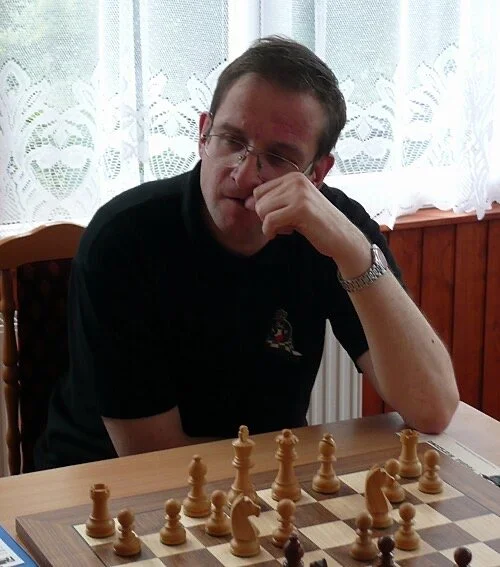
GM Michał Krasenkow, Karpacz 2008. Tokarski
Establishing a Career in Poland
Krasenkow’s move to Poland grew out of a club relationship. Stilon Gorzów offered the practical basis for relocation in 1992, during the upheaval following the Soviet Union’s dissolution. In a Polish interview published in 2025, he described the move as an opportunity that arose through chess. Gorzów’s proximity to Germany also made participation in German tournaments easier. Housing, club employment, and access to competitions were concrete elements in the decision.
He acquired Polish citizenship in 1996. Over time, Poland became his settled home, rather than simply a federation affiliation. In the same 2025 interview, he described himself as Polish because Poland was his homeland and Poles were his compatriots, while also acknowledging the international character of his professional life. His own account gives Polish identity a central place in a biography that English-language references often compress into the label “Russian-born.”
The transition coincided with substantial competitive growth. His rating reached 2595 in 1993, but advancement beyond that level took time. By January 1996 he stood at 2610, and by July 1997 at 2645. His strongest period therefore developed through several years of professional competition after relocation.
The Breakthrough of 1997
Krasenkow began 1997 by winning the Reggio Emilia tournament with an undefeated 7/9. Its category XI field averaged 2511, making it a substantial international success, though the event should not be confused with stronger editions of Reggio Emilia. Viktor Bologan finished half a point behind him.
At the New York Open in April, Krasenkow and Bologan shared first place with 8/9. Krasenkow defeated Bologan in their individual encounter and also beat Tony Miles, Alexei Aleksandrov, and Alexander Morozevich. The result demonstrated his effectiveness in a demanding open tournament containing numerous established grandmasters. Mark Crowther’s contemporary report singled out the strength of his performance.
His most consequential result followed in December at Groningen. In the knockout competition forming part of the 1997–98 FIDE world championship, he eliminated Paul van der Sterren, Gildardo García, Evgeny Bareev, and Zurab Azmaiparashvili. The Azmaiparashvili match required an extended sequence of tiebreak games. Krasenkow then lost both quarter-final games to Nigel Short.
The precise description is important: he reached the quarter-finals of the Groningen knockout stage. This was a major world championship competition, although it belonged to the divided championship arrangements of the period. His success required victories in four successive matches, including encounters with Bareev and Azmaiparashvili, both formidable international opponents. It provided stronger evidence of his ability to challenge leading players than an isolated upset would have done.
Krasenkow himself continued to regard Groningen as a defining achievement. Asked by the European Chess Union in 2021 to identify his most important accomplishments, he selected that performance and his subsequent entry into the world’s top ten.
The Top Ten and Its Limits
In July 2000, Krasenkow reached 2702, sharing tenth place on the FIDE rating list. He retained that rating in October, when he occupied tenth place outright. He was thirty-six, and his ascent had been gradual: international titles in his twenties, major tournament successes in his thirties, and a brief place among the highest-rated players in the world.
National achievements accompanied this international standing. He won the Polish championship in 2000 and again in 2002, scoring 10½/13 on both occasions. Between 1996 and 2004 he represented Poland at five Olympiads, playing first board in the first four appearances and second board in the fifth.
The top-ten position did not become permanent. By July 2001, his rating had fallen to 2573, a decline of 129 points in a year. Looking back in 2019, Krasenkow connected this period with disappointing results and the absence of invitations to the strongest tournaments. He did not claim to know whether better invitations would have produced a different outcome. His testimony identifies a frustration without proving a simple causal explanation for the decline.
Style, Calculation, and Intellectual Influences
When asked to characterize his style in a Russian-language question-and-answer session in 2009, Krasenkow chose the word “active.” He discussed studying Rubinstein, Petrosian, and Karpov, while recognizing that his own practical preferences did not reproduce theirs. He also described a disciplined approach to calculation influenced by Alexander Kotov and Mark Dvoretsky: identifying candidate moves, examining alternatives, and checking conclusions.
His theoretical work reveals how personal experience and inherited ideas interacted. In a German-language ChessBase article, Krasenkow traced an important part of his repertoire against the King’s Indian Defence to a conversation with Igor Khenkin in 1991. Khenkin introduced him to games by Vladimir Bagirov. Krasenkow credited Bagirov with the strategic foundations of the system he subsequently explored in his own practice and publications. That acknowledgment is useful evidence of an intellectual lineage extending beyond the names commonly attached to opening variations.
His assessments of his own limitations were correspondingly practical. In 2025 he described deterioration in memory and visualization, together with an increased susceptibility to mistakes. These are his observations about aging as a competitor, rather than evidence for a retrospective diagnosis of particular defeats.
Clubs, Coaching, and Polish Chess
Team chess was a substantial part of Krasenkow’s professional life. His record includes the 1990 Soviet team championship with Moscow’s Petrosian club and the 1997 European Club Cup with Ladya Azov. These achievements place him within the institutional continuities between late Soviet club competition and the international club circuit that followed.
German records provide a particularly clear example of his contribution. In the 2007 German team cup final, Baden-Baden defeated Solingen 2½–1½. Krasenkow’s first-board victory over Jörg Wegerle was the match’s only decisive game. Such performances help explain the importance of club employment in a career whose public reputation is more often attached to individual tournaments. His coaching work crossed national boundaries. The Polish biographical record documents collaboration with Viswanathan Anand in 1999–2000, service as Poland’s national men’s coach from 2010 to 2014, and work with Turkey’s team at the 2016 Olympiad and 2017 World Team Championship. FIDE awarded him the Senior Trainer title in 2012.
In an interview with Vladimir Barsky during the 2013 European Team Championship, Krasenkow explained his transition toward coaching. Around 2010, he had concluded that younger Polish players with comparable or higher ratings could replace him in the national lineup. He could contribute through preparation, captaincy, and experience.
His discussion of Polish chess also extended beyond individual talent. He emphasized the need for strong tournaments, sustained sponsorship, and opportunities for promising players to encounter grandmasters. He praised emerging players, including Jan-Krzysztof Duda, while describing the financial and institutional constraints on their development. This is evidence of Krasenkow’s perspective as a national coach, not grounds for attributing the achievements of a later Polish generation to him alone.
Writing and the Transmission of Experience
Krasenkow’s books reflect a progression from specialized theoretical writing toward broader instruction. His early publications included The Open Spanish and The Sveshnikov Sicilian. Later work placed greater emphasis on calculation, judgment, and the interpretation of his own games.
Finding Chess Jewels assembled more than 220 exercises at increasing levels of difficulty. Reviewing it for the German Correspondence Chess Federation in 2014, Uwe Bekemann emphasized its treatment of visualization and calculation. He also identified a limitation: the introductory discussion assumed knowledge that inexperienced readers might need to acquire elsewhere. The book’s principal contribution lay in sustained practical work with carefully selected positions.
Learn from Michal Krasenkow, published in 2019, combined autobiography with 54 selected victories and twelve endgames. Its thematic organization covered attack, positional play, defense, and other practical problems. British reviewer Colin Purdon particularly valued the combination of verbal explanation and detailed analysis.
The book also records an author revisiting his own earlier judgments. Krasenkow explained that he had checked previously published analysis with modern engines. The resulting work preserves a player’s recollections while subjecting his chess conclusions to later scrutiny. Its autobiographical passages remain valuable testimony, with the normal limitations of a memoir written decades after some of the events described.
Continued Competition and Historical Assessment
Krasenkow continued producing notable results long after his rating peak. At Porticcio in 2017, aged fifty-three, he scored 8/9 and finished a full point clear. His final-round victory over Gawain Jones secured first place. The contemporary German report documents both the strength of the result and the competitive difficulties encountered along the way.
At the 2021 World Cup in Sochi, he eliminated Kirill Alekseenko, who had recently competed in the Candidates Tournament. His victory received the organizers’ award for the best game of the second round. This offers a specific, contemporary basis for discussing his continuing attacking creativity, rather than relying entirely on a general description of his style.
In the following round, Krasenkow recovered from an initial defeat against Rameshbabu Praggnanandhaa to win the second classical game, before losing the rapid tiebreak. At 57, he could still test exceptionally strong opponents from a much younger generation.
In 2024 he took silver in the World Senior Championship’s 50-plus section, scoring 8½/11 and finishing behind Alexander Shabalov on tiebreak. His activity continued beyond senior competition: in June 2026, at age 62, he won the second Chola Chess grandmaster round-robin in Chennai with 7/9. An interview published the following month also recorded his service as a fair-play officer at the 2022 Chennai Olympiad.
Krasenkow’s distinctive contribution lies in combining high-level achievement, sustained professional practice, and knowledge transmission. His career makes the movement of Soviet chess expertise into Polish and international institutions visible through specific relationships, competitions, and books. His top-ten ranking and his time in Groningen establish his competitive stature. His coaching, analytical writing, and continued participation explain why his significance extends beyond that brief peak.
Notes and Sources
The principal autobiographical sources below are retrospective accounts. Tournament reports, rating records, and official results have been used to check competitive claims. Repeated versions of Krasenkow’s recollections have not been treated as independent corroboration.
[^1]: OlimpBase, “Krasenkov, Mikhail: FIDE rating history, 1971–2001”, compiled from historical rating lists. Relevant entries include January 1990, January 1996, July 1997, July and October 2000, and July 2001.
[^2]: Przemysław Jahr, “Michał Krasenkow”, Szachy w Polsce, first published 7 May 2015, updated 8 March 2026. Polish biographical and statistical compilation covering championships, representative appearances, coaching appointments, and publications.
[^3]: Crestbook, “KC-конференция с мг Михаилом Красенковым”, 26 September 2009. Russian-language biographical introduction and extensive questions answered by Krasenkow. The description “active” is translated from his Russian response.
[^4]: Michal Krasenkow, Learn from Michal Krasenkow, Thinkers Publishing, 2019, inspected publisher’s sample: foreword, p. 7; family background, p. 9; early development and education, pp. 10–13; international advancement, p. 15. The linked sample, rather than the complete book, was consulted.
[^5]: Adrian Mikhalchishin, questions to Michal Krasenkow, “Meet Chess Legend GM Michal Krasenkow”, European Chess Union E-Magazine, April 2021, p. 18. First-person recollections and assessments.
[^6]: Sergey Kim, “Михаил Красенков. В очереди за главным”, ChessPro, 1 February 2019. Russian-language interview on childhood, education, Soviet chess, migration, and the consequences of reaching the top ten. Sensitive biographical claims are attributed to Krasenkow.
[^7]: Chess Federation of Russia, “Михаил Красенков”, biographical calendar entry dated 14 November 2025. Used for teachers, Soviet master status, the Georgian championship, and team achievements.
[^8]: FIDE, “Krasenkow, Michal,” player profile, ID 1113100, consulted October 2026. Lists grandmaster year 1990 and FIDE Senior Trainer year 2012. Krasenkow’s memoir and the Polish biography give 1989 for the grandmaster title; the records inspected do not resolve the administrative discrepancy.
[^9]: Filip Zieliński, “Rosjanin od 33 lat mieszka w Polsce. Tak mówi o Polakach”, Przegląd Sportowy Onet, 23 November 2025. Polish-language interview addressing relocation, identity, and continued competition.
[^10]: Mark Crowther, The Week in Chess, no. 114, 13 January 1997, section on Reggio Emilia. Contemporary report and final crosstable.
[^11]: Mark Crowther, The Week in Chess, no. 126, 7 April 1997, “New York Open.” Contemporary reporting, results, and games.
[^12]: OlimpBase, “World Chess Championship 1998: Groningen knockout”. Match bracket and results for the December 1997 competition.
[^13]: Deutscher Schachbund, “Deutsche Pokal-Mannschaftsmeisterschaft 2006/2007”, official results, including the final on 11 March 2007.
[^14]: Michal Krasenkow, “Königsindisch mit 6.h3 (Teil I),” in “Eröffnungsübersichten in CBM 132”, ChessBase, 19 October 2009. German-language first-person account of the influence of Khenkin and Bagirov.
[^15]: Vladimir Barsky, “Михаил Красенков: «Ждем нового бума»”, ChessPro, 25 November 2013. Russian-language interview conducted during the European Team Championship in Warsaw.
[^16]: Uwe Bekemann, review of Finding Chess Jewels, Deutscher Fernschachbund, 2014; see the section bearing the book’s title. German-language assessment of the book’s exercises, progression, and intended readership.
[^17]: Colin Purdon, “Learn from Michal Krasenkow”, British Chess News, July 2019. Review used for the complete book’s contents and reception.
[^18]: ChessBase, “Krasenkow geniesst Porticcio Open in Korsika”, 18 July 2017. German-language tournament report and final standings.
[^19]: FIDE World Cup official website, “Тузы выпадают из колоды”, 18 July 2021, Russian-language report; Michael Rahal, “Round 03, Game 01: Magnus Carlsen on track to win”, FIDE, 18 July 2021, including the second-round best-game award.
[^20]: ChessPro, “Кубок мира, Сочи 2021. 1/32 финала”, 21 July 2021. Russian-language report covering Krasenkow’s match against Praggnanandhaa.
[^21]: André Schulz, “Rainer Knaak und Brigitte Burchardt sind Seniorenweltmeister”, ChessBase, 29 November 2024. German-language report with the 50-plus standings; checked against Paulo Felizes, FIDE’s championship report, 29 November 2024.
[^22]: Second Chola Chess grandmaster round-robin: final standings, Chess-Results, updated 28 June 2026; Devansh Singh, interview, “Michal Krasenkow: ‘If you want a GM norm, beat a GM’”, ChessBase India, republished by ChessBase, 25 July 2026.
