Alexander Kuindzhi
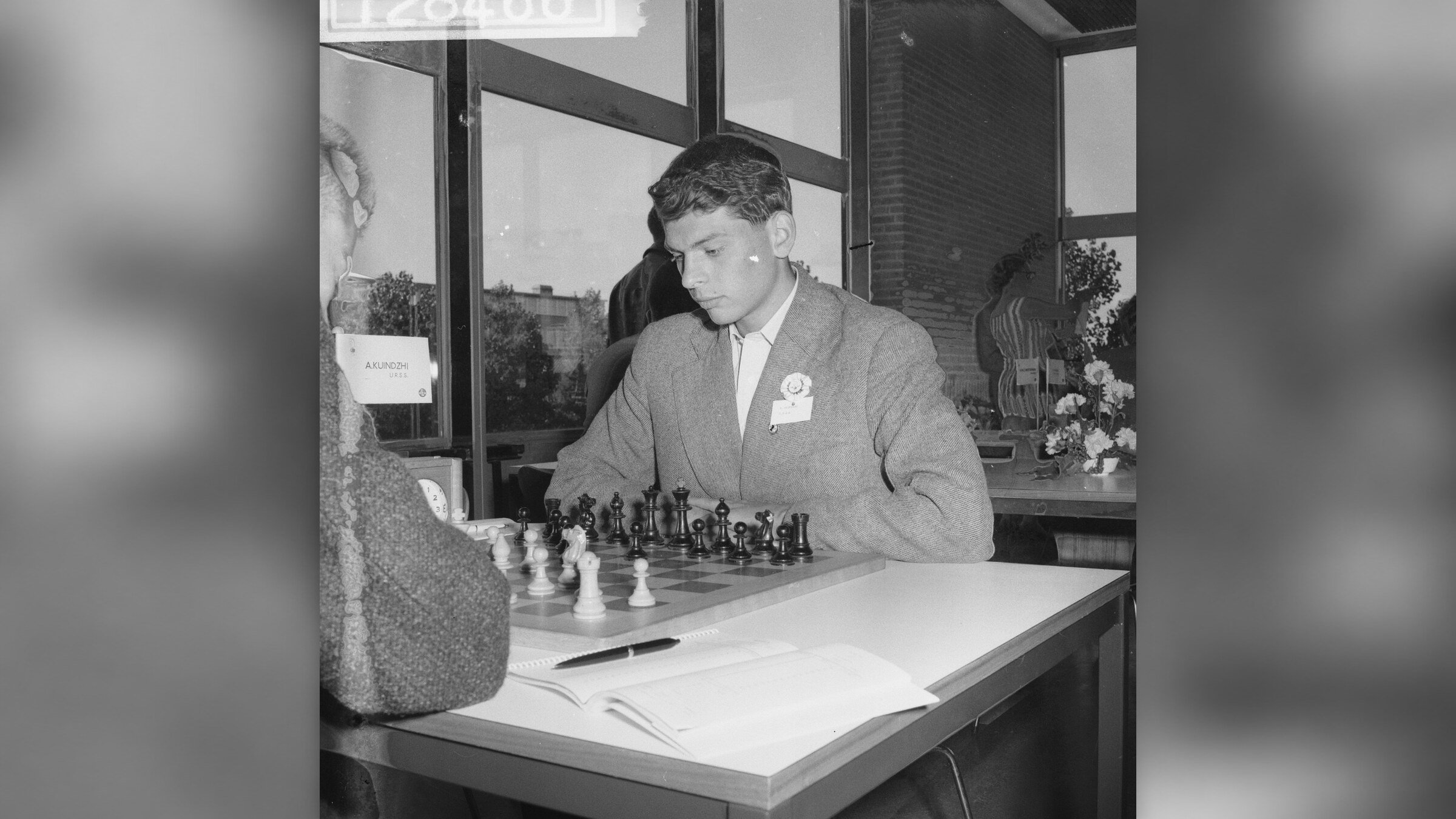
At the 1961 World Junior Championship in The Hague, Alexander Kuindzhi defeated both players who finished above him: Yugoslavia’s Bruno Parma and Romania’s Florin Gheorghiu. His bronze medal established him among the leading juniors of that year. His victories over the gold and silver medallists also gave the result particular distinction, showing how formidable he could be against the tournament's strongest opposition. [1]
Kuindzhi subsequently combined serious competitive chess with employment in aviation. His career spanned Moscow championships, Soviet military chess, and, eventually, international senior competition. Its historical interest lies in that sustained relationship between chess and another demanding occupation, as well as in the achievements themselves.
Identity and Early Formation
His full name is Alexander Anatolyevich Kuindzhi, in Russian Александр Анатольевич Куинджи. Alexander may also be transliterated as Aleksandr, while Anatolievich is another rendering of his patronymic. International records variously use Kuindzhi, Kuindzhy and Kuyindzhi. These spellings refer here to the Moscow player born in 1942, whose identity is confirmed by Russian federation and FIDE records. [2]
According to the Moscow Chess Federation’s anniversary biography, Kuindzhi was born on 8 April 1942 in Kuybyshev, now Samara. His father was chief engineer at an aircraft factory evacuated from Moscow; the family returned to Moscow in 1944. Aviation therefore formed part of his family circumstances before becoming his own profession. [3]
Kuindzhi began organized chess study at twelve, at the Palace of Pioneers on Stopani Lane. He reached first-category strength before leaving school, then studied radio engineering at the Moscow Aviation Institute, playing for its team in Burevestnik student competitions. These institutions provided successive settings for his development: organized youth instruction, university chess and competition through a student sporting society. [3]
The available biographical evidence does not identify his first instructor. It also leaves the precise chronology of his education uncertain. His tournament record becomes considerably clearer in 1961.
International Recognition in 1961
An important preliminary achievement came at the international youth tournament in Lvov, where Kuindzhi finished second with 8/11, behind Vladimir Savon’s exceptional 10½/11. The placing appears in Lev Abramov’s contemporary reference work on Soviet chess; the fuller table is reproduced in Alexander Moiseenko’s later study of Savon. [4]
The event had a practical purpose within Soviet chess development. Writing about Lvov, Yakov Estrin argued that young Soviet players needed more international experience after disappointing results in recent junior and student championships. His contemporary report, consulted through Moiseenko’s reproduction, presented international youth competition as a means of addressing that deficiency. Kuindzhi’s second place consequently belonged to a deliberate effort to prepare younger players for encounters beyond the domestic circuit. [4]
In July, Kuindzhi joined the Soviet team at the World Student Team Championship in Helsinki. His teammates were Leonid Stein, Vladimir Bagirov, Eduard Gufeld and German Khodos. The Soviet Union won with 39½ points from 48, regaining the championship after second-place finishes in 1959 and 1960. [4] [5]
His individual contribution should be stated precisely. Kuindzhi was the reserve and played three games, drawing all three for 1½/3. He shared in a major team success, while the four regular players carried most of the competitive burden. Nevertheless, selection placed him in a strong national squad and gave him further international experience immediately before The Hague. [5]
The World Junior Championship used qualifying groups followed by separate finals. Among twenty-nine competitors, Kuindzhi won his seven-game preliminary group with 6½/7, conceding only a draw to Ricardo Calvo. He advanced to the twelve-player championship final with an imposing qualifying performance. [6]
The final began much less convincingly. Three draws and a defeat by Scotland’s Derek Thomson left him with 1½/4. He then scored 6½ points in the remaining seven games, including successive victories over Parma and Gheorghiu. His final 8/11, comprising six wins, four draws and one defeat, secured third place behind Parma’s nine and Gheorghiu’s eight and a half. [1]
The sequence explains both the distinction and the limitation of his result. Kuindzhi defeated the two most successful competitors, but their greater consistency across the whole final proved decisive. His strong recovery made him a clear medallist without overcoming the cost of the opening rounds.
Playing Style and Contemporary Assessment
A contemporary account by Eric Uhlin, who accompanied Sweden’s Ove Kinnmark, provides a useful assessment of the nineteen-year-old. Writing in Tidskrift för Schack, Uhlin reported that observers, particularly Guimard, considered Kuindzhi close in strength to the two leaders. He thought Kuindzhi especially effective in “sharp attacking games,” a translation from the Swedish. [7]
Uhlin’s report also identifies Yuri Averbakh as Kuindzhi’s second. This is a documented connection with an experienced Soviet grandmaster at a crucial international appearance. Averbakh’s presence supplied analytical assistance during a tournament in which adjourned games could require substantial work away from the board. [7]
Uhlin was critical of Kuindzhi’s uncertain early play, including his handling of a prolonged rook ending against the Norwegian Arne Vinje Gulbrandsen. His assessment offers more substance than a general description of Kuindzhi as an attacking player: it recognizes the force of his best performances while recording difficulties in converting opportunities. These observations concern his play in that particular tournament. [7]
The result and the contemporary commentary together establish a young player capable of defeating the championship’s leading competitors, whose performance still varied considerably from game to game.
Aviation Work and Adult Competition
The Moscow federation biography describes employment at an aviation enterprise, two years’ service in the air-defence forces, and subsequent work in a military representative’s office, including involvement in military helicopter testing. It dates his Soviet Master of Sport title to 1970, following a Moscow championship semifinal, and records military team appearances into the 1980s. [3]
Master of Sport was a Soviet national designation. FIDE’s current record lists no international title for Kuindzhi, a distinction worth preserving when describing a player whose achievements might otherwise encourage an incorrect attribution of the International Master title. [2]
His participation in the 1973 First League of the USSR Championship at Tbilisi brought him into an exceptionally demanding adult field. The eighteen-player tournament included David Bronstein, Evgeny Vasiukov, Rafael Vaganian, Roman Dzindzichashvili and Yuri Razuvaev. Vaganian and Dzindzichashvili shared first place with 11½/17; Kuindzhi finished last with 5½/17. This was the First League, below the Higher League of the Soviet championship system. [8]
Mark Dvoretsky’s recollection gives the result a personal and occupational context. In a photographic reminiscence published by ChessPro in 2007, he described a gathering during a rest day in Tbilisi. Kuindzhi appears among fellow competitors, and Dvoretsky remembered him as talented, strong-willed and confident, but deeply disappointed by his unsuccessful play. He recalled someone reminding Kuindzhi that his opponents were chess professionals while he worked in another field. [9]
This is retrospective testimony, recorded more than thirty years after the tournament. It should be read as Dvoretsky’s recollection of Kuindzhi and their competitive environment. It nevertheless agrees with the independently published account of his employment and identifies a practical constraint on his chess career: preparing for sustained professional opposition while maintaining substantial responsibilities elsewhere. [3] [9]
Kuindzhi continued to achieve significant domestic results. In the 1976 Moscow Championship, he finished third with 10½/15, only half a point behind joint leaders Sergey Makarychev and Mikhail Tseitlin. The contemporary standings in Shakhmaty v SSSR establish both the score and the year. [10]
This was a substantial result in a sixteen-player city championship, achieved fifteen years after The Hague. It demonstrates that his competitive strength persisted into mature adulthood. The Moscow circuit remained an important setting in which he could compete seriously alongside his professional work.
Senior Competition and a Continuing Reputation
Kuindzhi’s later international success came in senior chess. At the 2014 European Senior Championship in Porto, he entered the 65-and-over section, which attracted fifty-nine players. He headed the starting list ahead of grandmasters including Mihai Suba, Algimantas Butnorius and Mark Tseitlin. [11]
Reporting during the event, Moscow chess commentator Alexander Gorin observed that Kuindzhi had recently played relatively few tournaments. He nevertheless described his play as aggressive and inventive, using those qualities to explain why his games were rewarding to follow. Written more than fifty years after Uhlin’s report, the assessment suggests a lasting reputation for active and resourceful chess. It remains Gorin’s judgment, rather than a claim that Kuindzhi’s style remained unchanged throughout his life. [11]
Kuindzhi finished with 6½/9 and received the bronze medal. The European Chess Union’s contemporary report identifies the podium as Nico Schouten, first with 7½, Vladimir Beznosikov, second with 7, and Alexander Kuyindzhi, third with 6½. This was the classical championship in the 65+ category; separate rapid and blitz events followed. [12]
He was seventy-one, approaching his seventy-second birthday. The result gave his career another international distinction more than half a century after his junior medal. Its significance belongs specifically to senior competition, where experienced players could continue to pursue substantial competitive goals.
His involvement has continued well beyond that achievement. The Russian federation’s official record lists him in a nine-round veterans’ rapid tournament in Moscow on 17 May 2026, by which time he was eighty-four. This supplies direct evidence of continuing participation, extending the documented playing career into a seventh decade. [13]
Historical Assessment
Kuindzhi’s distinctive place in chess history rests on the combination of international achievement and a demanding occupation outside the game. His results, together with the testimony of Uhlin, Dvoretsky and Gorin, establish competitive ability and a lasting reputation for inventive play. His career also connects several working institutions of Soviet chess: the Palace of Pioneers, the technical institute, military teams and the Moscow tournament circuit. Its continuation into Russian senior chess gives historians a substantial example of how those institutions shaped a chess life whose significance extends well beyond a single youthful success.
Notes and Sources
OlimpBase, “6th World Junior Chess Championship, The Hague 1961”. Final crosstable and round-by-round results, consulted for Kuindzhi’s score, opponents and sequence of results. olimpbase.org
Chess Federation of Russia, “Куинджи Александр Анатольевич”, official player record; FIDE, “Kuindzhy, Alexander,” player 4105397, consulted October 2026. These identify the Moscow player born in 1942 and distinguish his national Master of Sport status from international titles. The spelling Kuyindzhi also appears in the official European championship report cited in note 12. Рейтинг ФШР
Moscow Chess Federation, “Поздравляем с юбилеем Александра Анатольевича Куинджи!”, 8 April 2022. Principal source for family, education, employment and the 1970 title date. Its school-completion date, 1953, is inconsistent with its own chronology and is omitted here. Its Moscow bronze date is discussed in note 10. For the city’s historical name, see Samara University, “Samara”. moscowchess.org
Lev Ya. Abramov, Советские шахматисты. Справочные данные на 1 марта 1964 года [Soviet Chess Players: Reference Data as of 1 March 1964], Moscow: Central Chess Club of the USSR, 1964, pp. 8, 10 and 20. Checked against Alexander Moiseenko, Гроссмейстер Савон, чемпион и наставник [Grandmaster Savon, Champion and Mentor], Dnepr: Serednyak T. K., 2020, pp. 18–20. Moiseenko reproduces the Lvov table and an account attributed to Yakov Estrin, Shakhmaty (Riga), no. 17, 1961. Estrin’s report was consulted through Moiseenko, not independently in the original issue. Абрамов Л.Я.
OlimpBase, “8th World Student Team Chess Championship, Helsinki 1961: Soviet Union”, with the accompanying event information. Detailed team and individual records distinguish Kuindzhi’s three reserve appearances from the team’s overall victory. olimpbase.org
Belgian Chess History, “6th World Junior Championship, The Hague”. Qualifying and final crosstables; independently checked against OlimpBase. Belgian Chess History
Eric Uhlin, “Junior-VM,” Tidskrift för Schack, no. 7, September 1961, pp. 193–195, especially p. 194. Original scanned pages inspected in the Swedish Chess Federation’s archive. The short quotation and paraphrased assessments in the article are translated from Swedish.
365Chess, “URS-ch sf, Tbilisi 1973”, complete tournament standings. The database uses the label “sf”; Dvoretsky’s account identifies the event as the First League. 365Chess.com Tournaments
Mark Dvoretsky, “Кадры Марка Дворецкого” [“Pictures from Mark Dvoretsky’s Life”], in ChessPro’s anniversary feature, 2007, commentary accompanying the Tbilisi 1973 photograph. First-person retrospective testimony, paraphrased from Russian. К Юбилею Марка Дворецкого
“Итоги чемпионата Москвы 1976 года” [“Results of the 1976 Moscow Championship”], Shakhmaty v SSSR, no. 9, September 1976, p. 12. The 2022 federation biography gives 1975 for Kuindzhi’s Moscow bronze. The contemporary standings explicitly place his 10½/15 third-place result in 1976, which is the date followed here. djvu.online
Alexander Gorin, “Первенство Европы среди ветеранов принимает Португалия” [“Portugal Hosts the European Senior Championship”], Moscow Chess Federation, 13 March 2014. Contemporary source for the field, starting order, recent inactivity and attributed description of Kuindzhi’s play. Официальный сайт Федерации шахмат Москвы
European Chess Union, “New European Senior Chess Champions in Oporto, Portugal,” Newsletter 148, 18 March 2014, p. 7; see p. 9 for the subsequent rapid and blitz schedule. Official confirmation of the 65+ medal results. europechess.org
Chess Federation of Russia, official record of the veterans’ Russian Grand Prix rapid event, Moscow, 17 May 2026. Kuindzhi’s entry links to his federation player profile and records participation in all nine rounds.
