Alexander Zakharov
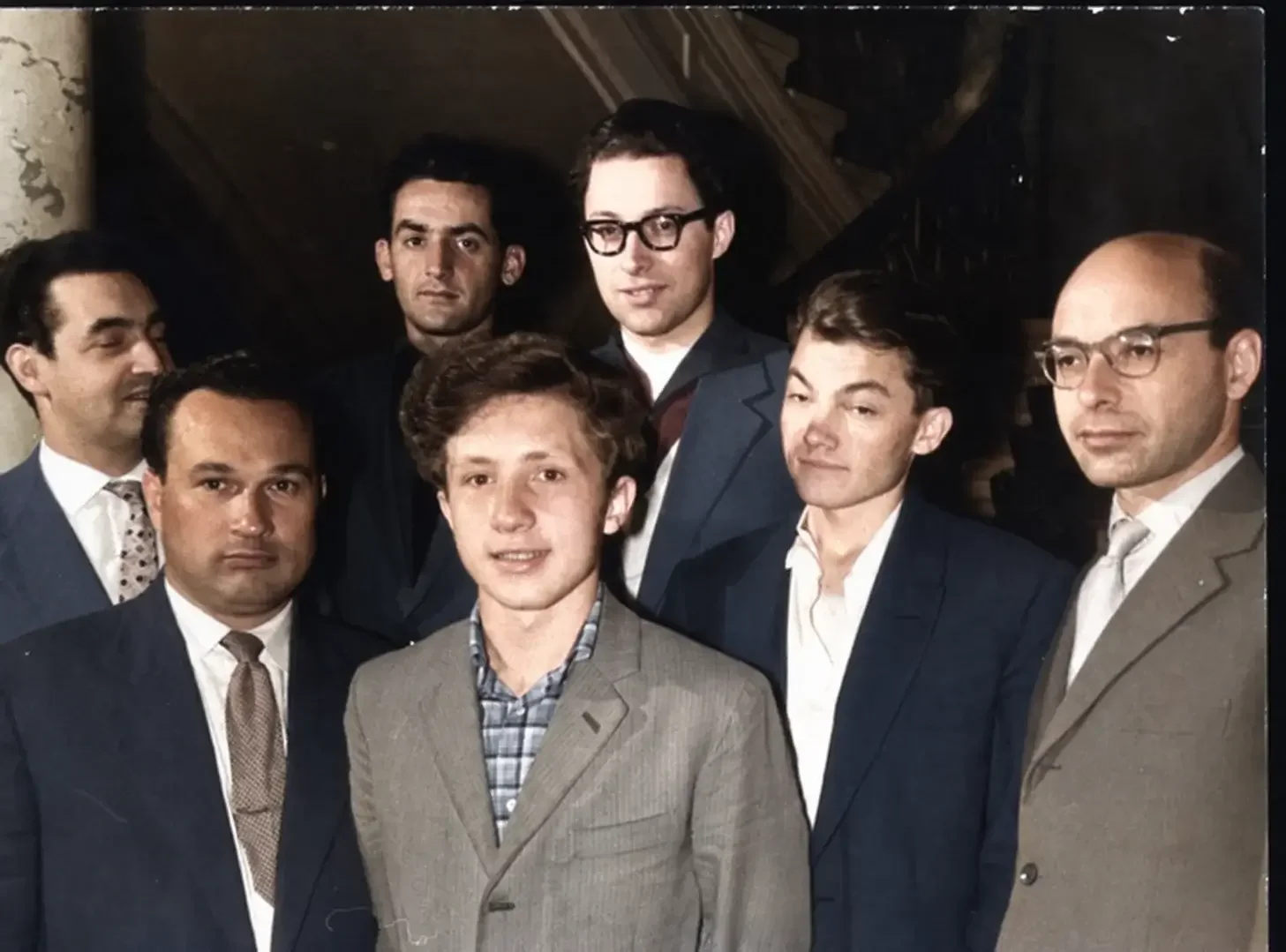
My goodness, what a lineup! via Ruchess (Colorized)
In June 1976, Alexander Zakharov earned a return to the USSR championship final by finishing first on tiebreak at the all-Union qualifying tournament in Rostov-on-Don. He and Vladimir Karasev both scored nine points, ahead of a field that included several established grandmasters. Thirteen years after his first appearance in the national final, Zakharov had again negotiated one of Soviet chess’s demanding routes to its leading domestic competition.[^1]
His importance later extended to his teaching in Rostov. His pupils included Ekaterina Kovalevskaya, Maxim Turov, and Dmitry Kryakvin. Their careers, along with his own sustained tournament activity, make Zakharov a significant figure in transmitting Soviet chess experience to later generations.[^2]
Identity, Childhood, and Chess Formation
His full name is Alexander Ivanovich Zakharov (Russian: Александр Иванович Захаров). Aleksandr Ivanovich Zakharov is another transliteration; Alexander Zakharov is the familiar English form used by FIDE. His FIDE identification number, 4103564, distinguishes him from several other players with the same given name and surname.[^3]
Zakharov was born on 7 October 1943 in Khasavyurt, Dagestan. The consulted published accounts provide little reliable information about his parents, how he learned chess, or his first teacher. Those gaps prevent a detailed reconstruction of his earliest development.[^4]
His schooling and subsequent education are better documented. Nikolai Mishuchkov identifies him as a pupil of School No. 1 in Khasavyurt and records that, after leaving school, he entered Rostov University. Rostov became his lasting professional base.[^5]
Contemporary reporting places Zakharov in the Russian SFSR youth team at fourteen, in the adult Dagestan championships of 1958 and 1959, and as winner of the all-Union schoolchildren’s competition in 1960.[^6]
That schoolchildren’s title brought him into a wider circle of promising players. At a Moscow tournament in March and April 1961, he and Oleg Pavlenko scored eight points from fourteen games, the best results among the juniors. Evgeny Vasiukov, participating outside their competition as an experienced “examiner,” scored nine.[^6]
Zakharov’s progress illustrates the opportunities the Soviet system of regional and national competitions provided. At the 1962 USSR team championship in Leningrad, he occupied the boys’ board for the Russian SFSR, whose senior players included Lev Polugaevsky and Ratmir Kholmov. His 5½ points from eight games helped the team finish second.[^7]
The team's composition is historically revealing. Established masters, women players and juniors contributed to a common result. For a young player from Dagestan, selection offered direct participation in a national chess environment alongside experienced professionals. Zakharov’s emergence can therefore be traced through identifiable competitions and representative teams, even though his earliest instruction remains obscure.
International Junior Chess and the 1963 Soviet Final
In 1963, Zakharov represented the Soviet Union at the World Junior Championship in Vrnjačka Banja, Yugoslavia. He reached the principal final and scored four points from nine games. Five players shared fourth through eighth places on points; the published tiebreak standings placed Zakharov equal seventh and eighth with Arne Zwaig. Florin Gheorghiu won the championship.[^8]
This distinction is important because a compressed statement that Zakharov “shared fourth” can suggest a stronger finish than the complete standings warrant. He finished in the middle of the final, behind the leading contenders.
His advancement in the Soviet adult championship that year was more consequential. In the Moscow semifinal, Zakharov scored nine points from fifteen games, tying with Anatoly Bannik and Boris Vladimirov. He finished ahead of Vladimir Simagin, Vladas Mikenas and Vasiukov.[^9] According to Kryakvin’s later account, Zakharov then won the additional qualifying contest with 3½ points from four games.[^4]
The USSR final took place in Leningrad from November to December 1963. Zakharov, newly twenty, finished seventeenth among twenty participants with seven points from nineteen games. He defeated Semyon Furman, Alexei Suetin, and Viktor Korchnoi. He also drew with Boris Spassky, Leonid Stein and David Bronstein.[^10]
The result establishes both his achievement and his position within that exceptionally strong field. Qualification had brought him into regular competition with leading Soviet players. His individual successes demonstrated that he could trouble distinguished opponents, while his overall score showed the difficulty of sustaining that level across a long championship.
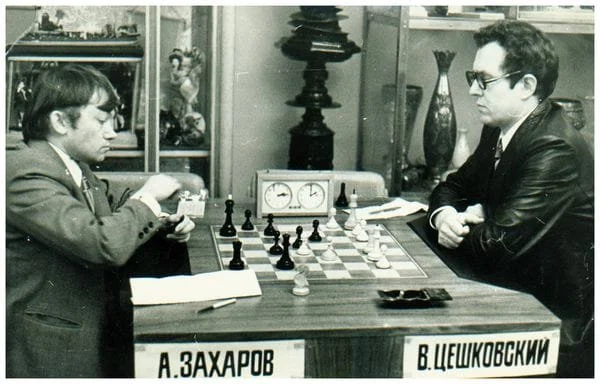
Image via Ruchess
A Second Rise in the 1970s
Zakharov continued competing within the extensive Soviet domestic circuit. Mishuchkov records six appearances in Russian SFSR championship finals between 1972 and 1982.[^5] Kryakvin also places him among the semifinalists in the 1974 USSR Cup, where he lost to the eventual winner, Oleg Romanishin.[^4]
His outstanding qualifying result came in Rostov in 1976. The contemporary report in Shakhmaty v SSSR lists Zakharov and Karasev on nine points, with Buchholz scores of 95.5 and 95.0 respectively. Zakharov therefore took first place on tiebreak and gained direct entry to the championship final.[^1]
The report situates the tournament within a recent institutional change. Large Swiss-system qualifiers had been introduced in 1974. Their use drew criticism because participants faced different opponents, and the pairing procedures required clarification. Zakharov’s success came within a system intended to process a broad national field through a single qualifying event. The precise distinction between shared first on points and first on tiebreak was decisive for his advancement.[^1]
In the Moscow final, Zakharov scored 6½ points from seventeen games, sharing sixteenth and seventeenth places with Vitaly Tseshkovsky. He defeated Rafael Vaganian, Nukhim Rashkovsky and Viktor Kupreichik, and drew with former world champions Tigran Petrosian, Vasily Smyslov and Mikhail Tal. Anatoly Karpov won the championship.[^11]
The two Soviet finals were separated by thirteen years and substantial changes in the leading competitive generation. Zakharov’s return in 1976 demonstrates a sustained capacity to qualify for demanding events. His strongest national achievement was the qualifying victory itself.
International Success and the Title Record
Zakharov achieved a clear international tournament victory at Děčín, Czechoslovakia, in July 1977. He scored 11½ points from fifteen games, finishing a point and a half ahead of Jindřich Trapl. Jiří Lechtýnský and Simon Webb followed. The field also included the experienced Hungarian masters Gedeon Barcza and Andor Lilienthal.[^12]
Another important result followed in Poland in 1978. At the PKWN international festival in Nałęczów and Lublin, Zakharov shared first place with the Yugoslav grandmaster Milorad Knežević on ten points from fifteen games. His record comprised six wins, eight draws and one defeat. Jan Adamski finished third, while Yuri Razuvaev was among those sharing fourth through sixth places.[^13]
These results gave substance to his international standing. Děčín was an outright victory; the Polish success was a shared first place. Together they establish a productive period following his second Soviet championship appearance.
Zakharov became an International Master, although the award year remains inconsistent across the available records. Russian biographical sources give 1977, while FIDE’s current profile gives 1979. The discrepancy cannot responsibly be resolved by assuming an undocumented distinction between qualification and formal approval.[^3]
OlimpBase’s reconstruction of the historical rating lists records him at 2475 in January 1979, with the International Master designation. This provides a useful contemporary measure of his standing without requiring a speculative explanation of the title chronology.[^14]
Style and Contemporary Reputation
The 1961 assessment by Lev Aronin and Boris Isakov offers unusually early evidence of Zakharov’s playing qualities. They reported Simagin’s praise of his intuition and Vasiukov’s admiration for his accurate handling of danger. They also noted his serious competitive approach, interest in varied positions and inclination toward positional play.[^6]
Mishuchkov’s later portrait emphasizes his combinational talent and the depth of his ideas.[^5] Read together, these assessments suggest a player whose reputation included both imaginative attacking play and broader positional ability. Their different emphases also reflect the nature of the sources: one examines a developing junior at a particular tournament, while the other looks back across a long career.
The results provide firmer evidence of practical strength than any expansive stylistic label. Victories over accomplished opponents occurred at widely separated stages of Zakharov’s life. They support a picture of a resourceful competitor whose best performances remained dangerous well beyond his principal years in Soviet championship chess.
Teaching and the Rostov Chess Community
Kryakvin dates the beginning of Zakharov’s coaching career to the late 1970s.[^4] His documented pupils include Kovalevskaya, Turov and Kryakvin, all of whom developed substantial international careers. Rostov’s chess club continues to identify their association with Zakharov as a central part of his contribution to the city.[^2]
Kovalevskaya provides particularly valuable evidence because her testimony is contemporary with her success. In a 2000 interview conducted by Vladimir Barsky for 64–Shakhmatnoe obozrenie, she discussed regaining the Russian women’s championship and said, in translation: “I worked a great deal; Alexander Ivanovich Zakharov helped me.”[^16]
The same interview identifies Yuri and Lyudmila Lyubarsky as teachers who had worked with her from the age of seven and continued to take an interest in her career. Her account places Zakharov within a wider network of instruction and support. It establishes his contribution without assigning every stage of her development to a single coach.[^16]
Kovalevskaya’s subsequent achievements gave that coaching relationship international significance. She became a two-time Russian women’s champion and reached the final of the Women’s World Championship in 2004. The Russian federation’s biographical account identifies Zakharov as her mentor, while also recording the assistance of other trainers during her championship campaigns.[^15]
Kryakvin’s recollections describe a teacher with broad intellectual interests. During chess lessons, Zakharov could also help Kryakvin’s wife with university work involving English, philosophy and literature. Kryakvin credits his teacher’s accounts of encounters with leading players with strengthening his own interest in chess history.[^4]
This is personal testimony from an appreciative former pupil, published for Zakharov’s eightieth birthday. Its strongest historical value lies in what Kryakvin experienced directly: the range of his teacher’s knowledge and the influence of his storytelling. It suggests that Zakharov transmitted an understanding of chess as a historical and intellectual culture alongside competitive instruction.
Teaching and tournament play continued together. In 1996, Zakharov belonged to the Don-SDYuSShOR Rostov-on-Don team that finished third in the Russian Premier League at Azov. He drew all four of his games. Turov and Kovalevskaya also played for the team.[^17]
That shared team membership offers a concrete illustration of continuity within Rostov chess. Teacher and pupils contributed to the same national result, with Zakharov still participating as an active player.
Senior Competition and Later Life
Senior chess became another substantial phase of Zakharov’s career. Mishuchkov dates his first Russian veterans’ championship appearance to 2004 and records his victory in the 2005 Russian senior championship. These events gave him a continuing competitive setting after decades of national and regional play.[^5]
At the 2008 World Senior Championship in Bad Zwischenahn, Germany, Zakharov scored 8½ points from eleven games. He shared third through sixth places on points and was placed fifth in the published final standings. Larry Kaufman and Mihai Suba finished half a point ahead. Zakharov drew with Suba in the penultimate round and Kaufman in the last.[^18]
The closeness of the finish demonstrates that, at sixty-five, he remained capable of competing near the top of an international championship. Descriptions of the result should preserve the distinction between his shared score group and his final tiebreak position.
In 2014, shortly after his seventy-first birthday, Zakharov scored 7½/11 in the over-65 World Senior Championship at Katerini, Greece. He shared fifth through tenth places on points and finished sixth on tiebreak, half a point behind the leading group.[^19]
His competitive longevity also produced a striking result outside senior competition. On 18 January 2014, in the opening round of the Vladimir Dvorkovich Memorial at Taganrog, the seventy-year-old Zakharov defeated Anton Korobov with Black. Korobov entered the tournament with a rating of 2723. The result is recorded in the event’s game database.[^20]
By 2023, Kryakvin reported that health problems had prevented Zakharov from continuing tournament play, although he remained closely interested in chess.[^4] Rostov’s public recognition continued. On 7 October 2026, the city chess club celebrated his eighty-third birthday and announced a classical tournament in his honour, scheduled for 15–23 October.[^2]
Zakharov’s historical contribution rests on the connection between accomplished play and sustained teaching. His career links the youth competitions of Dagestan, the demanding national structures of Soviet chess, Rostov’s training community and the international senior circuit. His pupils’ testimony adds a further dimension: the preservation and transmission of chess experience through personal instruction, conversation and historical memory.
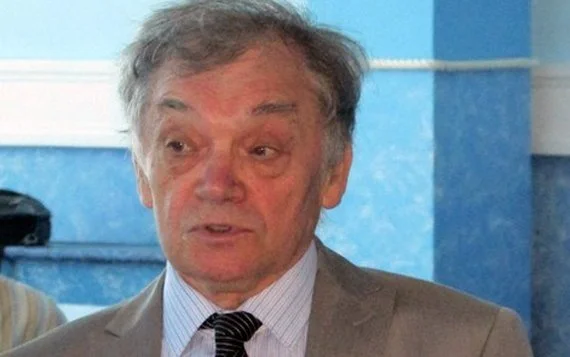
Image via Ruchess
Notes and Sources
The sources below were consulted online. Contemporary periodicals were read in digitized form; later recollections are identified as such. Database results were used to check scores and placements. The unresolved International Master date and discrepancies in the early biographical chronology are explained below.
[^1]: Shakhmaty v SSSR, unsigned report, “Всесоюзный отборочный” (“The All-Union Qualifying Tournament”), no. 9, September 1976, p. 1. The report supplies the standings, Buchholz figures and discussion of the qualifying system. Bernard Cafferty and Mark Taimanov, The Soviet Championships, Cadogan, 1998, pp. 171–172, confirms Zakharov’s direct qualification from the June Rostov tournament. The book’s digitized text was consulted. djvu.online
[^2]: Rostov City Chess Club, “Поздравляем!” (“Congratulations!”), 7 October 2026. Birthday notice identifying pupils and announcing the tournament in Zakharov’s honour. rostovchessclub
[^3]: FIDE, “Zakharov, Alexander,” player profile 4103564, accessed 22 October 2026, especially “Titles,” which gives IM, 1979. The Rostov notice in note 2 and Mishuchkov in note 5 give 1977. No contemporary award document was located to reconcile them. For namesakes, see OlimpBase’s historical player index, letter Z, which separately lists Alexander S. Zakharov, born 1981, and other players of the same name. ratings.fide.com
[^4]: Dmitry Kryakvin, “Морфи советской эпохи” (“Morphy of the Soviet Era”), Chess Federation of Russia, 7 October 2023. An affectionate retrospective by Zakharov’s pupil, used with particular weight for firsthand teaching recollections. ruchess.ru
[^5]: Nikolai Mishuchkov, “Чтобы помнили…” (“So That They Are Remembered”), Chess Federation of Russia, 18 September 2017, sections covering the 2004–2005 Russian veterans’ championships and Zakharov’s biographical entry. ruchess.ru
[^6]: L. Aronin and B. Isakov, “Играет шахматная смена” (“The Next Generation Plays Chess”), Shakhmaty v SSSR, no. 7, July 1961, pp. 216–218. Page 216 explicitly dates the schoolchildren’s victory to 1960, followed here over the 1961 date in later accounts. djvu.online
[^7]: OlimpBase, “8th Soviet Team Chess Championship: Leningrad 1962, Russian SFSR”, undated historical database, team roster and individual results. olimpbase.org
[^8]: OlimpBase, “7th World Junior Chess Championship: Vrnjačka Banja 1963”, undated historical database, “Final A” and championship playoff. olimpbase.org
[^9]: OlimpBase, “31st Soviet Chess Championship Semifinal: Moscow 1963”, crosstable. The additional qualifying contest is described in Kryakvin, note 4; its score is not supplied by this crosstable. olimpbase.org
[^10]: OlimpBase, “31st Soviet Chess Championship: Leningrad 1963”, final crosstable. Also Cafferty and Taimanov, The Soviet Championships, pp. 120–121, linked in note 1. olimpbase.org
[^11]: Shakhmaty v SSSR, no. 3, March 1977, championship standings on the inside front cover; checked against OlimpBase, “44th Soviet Chess Championship: Moscow 1976”. Авербах Ю.Л.
[^12]: 365Chess, “Decin 1977”, tournament standings, July 1977. The database labels the winner “Alexander V Zakharov”; that middle initial conflicts with the Russian biographical identification. Kryakvin’s account independently attributes the Děčín victory to Alexander Ivanovich Zakharov. 365Chess.com Tournaments
[^13]: OlimpBase, “14th PKWN International Chess Festival: Nałęczów / Lublin 1978”, final crosstable. olimpbase.org
[^14]: OlimpBase, “FIDE Rating History: Zakharov, Alexander”, historical rating compilation, January 1979 entry. olimpbase.org
[^15]: Chess Federation of Russia, “Екатерина Ковалевская” (“Ekaterina Kovalevskaya”), biographical entry displayed under 17 April 2026. It identifies Zakharov as her mentor and records her championship achievements. ruchess.ru
[^16]: Vladimir Barsky, interviews under the title “Нервы ни при чем” (“Nerves Had Nothing to Do with It”), 64–Shakhmatnoe obozrenie, no. 7, 2000, pp. 20–21, especially Kovalevskaya’s remarks on p. 21. The short quotation above is translated from Russian. Шахматное обозрение №07 за 2000 год
[^17]: OlimpBase, “4th Russian Chess Premier League: Azov 1996, Final Group Standings”, and Don-SDYuSShOR Rostov-on-Don’s individual results. These establish the team’s third place, Zakharov’s four draws and the participation of Turov and Kovalevskaya. olimpbase.org
[^18]: Free Internet Chess Server, “Relay of the 18th World Senior Chess Championships”, contemporary event page, 28 October–8 November 2008, final standings and last-round results. The venue is also identified in Mishuchkov, note 5. freechess.org
[^19]: Mark Crowther, “World Seniors 2014”, The Week in Chess, dated 24 October 2014 and incorporating final results through 4 November, “World Senior 65+” standings. The Week in Chess
[^20]: 365Chess, “Vladimir Dvorkovich Memorial 2014”, participant ratings and first-round game list, Korobov–Zakharov, 18 January 2014, 0–1.
