Alexander Koblencs
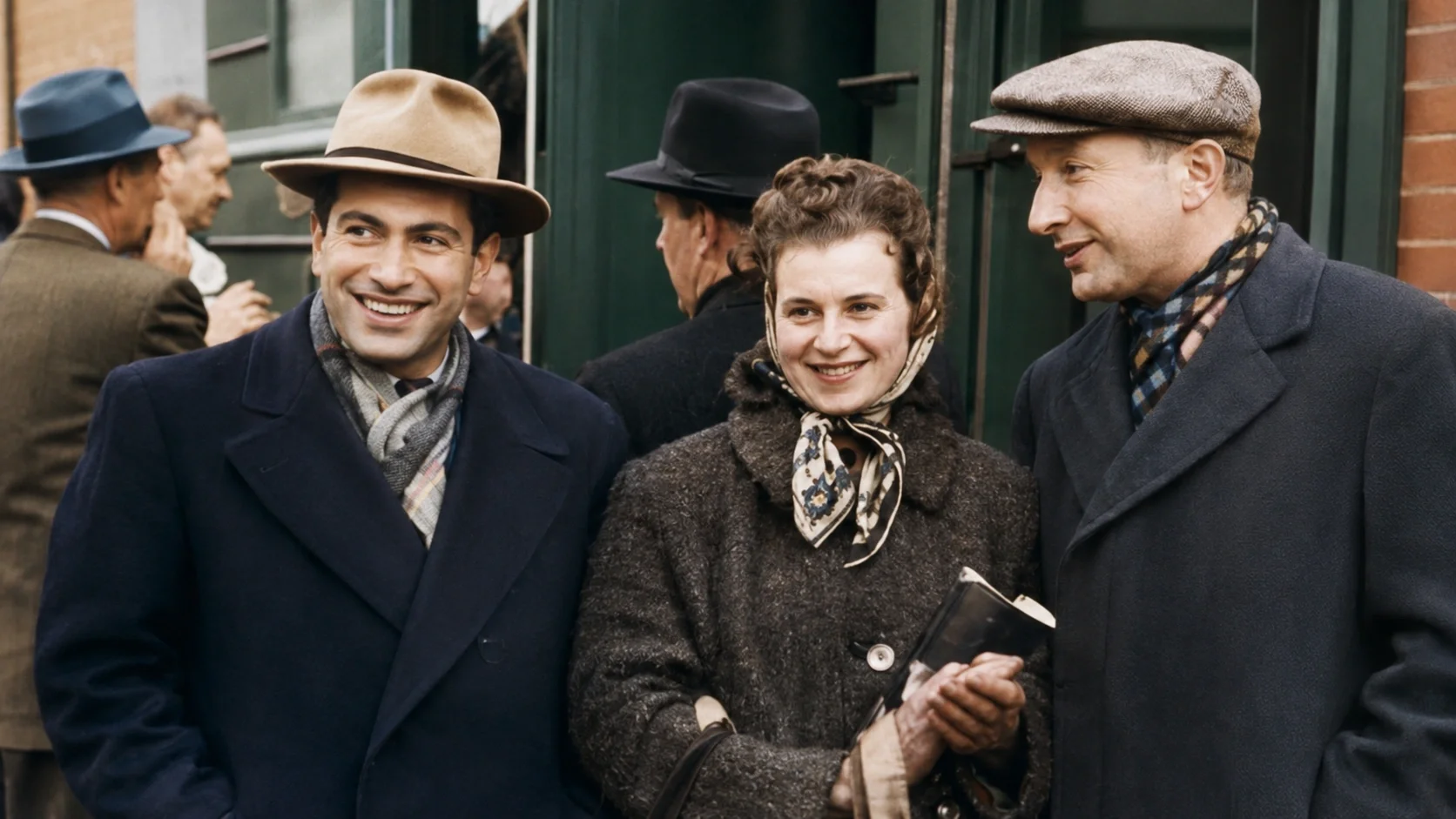
Mihails Tals, Tal’s wife Sally Landau, and Aleksandrs Koblencs
Alexander Koblencs belongs among the central figures in twentieth-century Latvian chess culture, even though his international legacy is usually overshadowed by the fame of his greatest student, Mikhail Tal. The documentary record shows him not only as a strong master and multiple Latvian champion, but also as a trainer, second, editor, publicist, and administrator. In that fuller frame, he appears as a representative figure of Soviet chess modernity: a professional organizer of talent, a mediator between local and imperial institutions, and a pedagogue who treated chess as an art of disciplined imagination rather than mere memorization.
Koblencs’s life was also marked by the violent discontinuities of the Baltic twentieth century. His prewar rise took place in a still-porous European chess world; the occupations of Latvia and the Holocaust shattered that world, and the murder of his mother and sisters in the Riga ghetto left a permanent wound. His postwar career, including his efforts to build institutions in Soviet Latvia, cannot be understood apart from that catastrophe and from the Soviet state’s effort to turn chess into a mass cultural and political instrument.
His largest legacy lies in three connected domains. First, he helped shape Tal’s rise from prodigy to world champion. Second, he built and sustained Latvian chess institutions, periodical culture, and coaching infrastructures. Third, he authored a body of instructional literature that connected opening preparation, middlegame strategy, and endgame technique in a strongly pedagogical idiom. The accessible evidence suggests that his contribution to endgame study was chiefly educational rather than compositional, and that his opening-theory legacy was more synthetic and monographic than eponymous.
At the same time, the record is uneven. Russian and Latvian sources preserve far more biographical detail than official English-language sites. Key facts, including the exact date of death and even the count of his Latvian titles, vary across sources. Those discrepancies do not reduce his stature, but they do show that Koblencs still awaits the kind of archive-based critical biography already available for Tal and other Soviet chess figures.
Life in Riga and the Violent Baltic Century
Aleksandrs Koblencs, in Russian often rendered Aleksandr Koblents or Koblenc, was born in Riga on September 3, 1916, when the city still belonged to the Russian Empire. The Latvian National Library’s authority record classifies him broadly as a chess player, trainer, publicist, and administrator, which already hints that his career transcended tournament performance. His early competitive path took him through Spain, Czechoslovakia, Italy, and Latvia in the late 1930s, culminating in his widely remembered first-place finish at Brno in 1937. That sequence is historically revealing: it places him in the last phase of the interwar European tournament network before war and occupation closed many of those routes.
The Russian Chess Federation’s retrospective portrait places the decisive political rupture after the Molotov-Ribbentrop Pact and the Soviet takeover of Latvia, when repression expanded, and the western path for Latvian national-team players was effectively shut. More broadly, academic work on the Baltic republics confirms that independent Latvia was incorporated into the Soviet Union in 1940 and subjected to rapid Sovietization. Koblencs’s biography, therefore, sits at the intersection of Latvian national chess culture and Soviet imperial integration.
War turned that political rupture into a personal catastrophe. According to the Russian Chess Federation profile, Koblencs returned only after the war and learned that his mother and sisters had perished in the Riga ghetto. The historical setting is grimly well documented. The United States Holocaust Memorial Museum records that German forces occupied Riga in July 1941, established a ghetto, and murdered almost all of the city’s Jews by 1944, with at least 25,000 shot in the Rumbula Forest over three days in late 1941. For Koblencs, then, the postwar chess organizer was also a survivor of a destroyed urban Jewish world.
This biographical context helps explain the tone later observers associated with him. Even when later memoirists idealized him as “the Maestro,” the image was not only that of a skilled chess teacher. It was also the image of a man rebuilding cultural continuity in a city and republic whose institutions, families, and public life had been repeatedly crushed between Soviet and Nazi regimes.
Competitive Player and Public Master
Koblencs was a serious master in his own right, not merely a trainer who happened to play. Available biographical summaries credit him with strong prewar results in Rosas in 1935, Reus in 1936, Brno in 1937, Milan in 1938, and Kemeri-Riga in 1939. What emerges from these events is not the profile of a world-title contender, but that of a genuine international master-level competitor with practical strength, broad opening culture, and sufficient authority to command respect in postwar Soviet chess.
A Latvian National Library article on his road to the Soviet Master of Sport title is especially helpful because it highlights the work behind that title. It describes his failures in strong Soviet semi-finals, the reanalysis of his own games during wartime disruption, his eventual breakthrough in a Kyiv semi-final, and his ability to score notable results in the 1945 Soviet final. That narrative is valuable because it resists the temptation to portray him as effortlessly gifted. The record instead shows an intensely self-correcting professional who studied errors, compared styles, and rebuilt his level through deliberate work.
On the national level, Koblencs indisputably stood among the leading postwar Latvian players. Compiled championship lists securely credit him with Latvian titles in 1941, 1945, 1946, and 1949, while some later retrospective sources call him a five-time champion. The discrepancy probably reflects wartime counting conventions and hors concours complications rather than a substantive dispute over his stature. The prudent conclusion is that he was one of the dominant Latvian masters of the 1940s, and that his domestic authority rested on real tournament achievement rather than later reputation alone.
His playerly importance also needs to be situated within the Soviet sport-state. JSTOR summaries on Soviet sport emphasize how closely the USSR intertwined sport, politics, and cultural prestige, and one such summary notes that millions of Soviet chess players participated in this mass system. In that framework, a figure such as Koblencs was more than an individual competitor. He became a public master whose play, writing, and teaching were woven into a state-supported culture of organized chess.
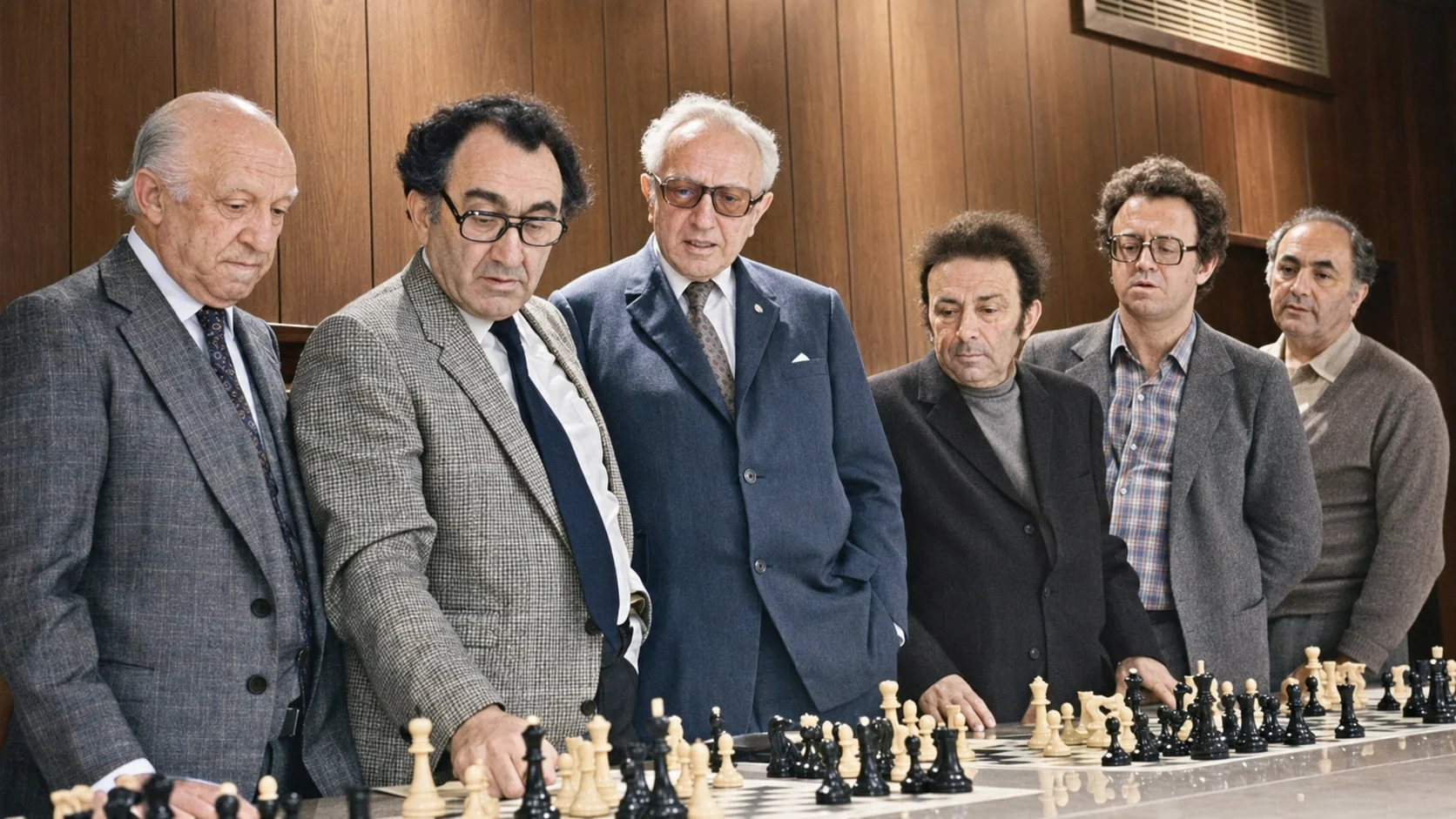
Left to right: Najdorf, Petrosian, Koblencs, Isaac Romanov, Iosif Dorfman, Viktor Kart
Coach, Second, and Institutional Builder
Koblencs’s world-historical visibility comes from his work with Mikhail Tal, but even here the record invites a richer interpretation than the stock phrase “Tal’s trainer.” Russian and English sources agree that he began working with Tal around 1949, when Tal was still a boy, and accompanied him through the rise that led to the 1960 world title. The pedagogical claim most closely associated with Koblencs, repeated in later retrospectives, is that genius cannot be manufactured, only given the right soil for growth. That formulation captures his central method: not mechanical standardization, but cultivation of talent without breaking its originality.
Later testimony broadens his function considerably. The Russian Chess Federation profile says that the role of trainer gradually expanded into adviser, sparring partner, second, psychologist, and manager, while Albert Kapengut’s ChessPro recollection singles out Koblencs’s psychological gifts and his ability to lift Tal’s spirits. These descriptions are important because they place him within the specifically Soviet institution of the second, the trusted intellectual companion who prepared openings, stabilized nerves, managed logistics, and translated a player’s intuition into a workable competitive routine.
The official English-language sources prioritized for this research indirectly reinforce the same point. The World Chess Hall of Fame’s Tal profile concentrates on Tal’s achievements, but it establishes the scale of the career Koblencs helped shape. FIDE’s Emil Sutovsky essay goes further by explicitly naming Koblencs as Tal’s long-term mentor and by describing the difficulty of guiding a genius whose habits resisted routine discipline. Taken together, these sources show that Koblencs was not marginal to Tal’s development. He was one of the chief conditions that made Tal’s improbable ascent sustainable for as long as it was.
Koblencs’s coaching legacy was not confined to Tal. The Russian Chess Federation credits him with helping create the republican chess club in Latvia, securing salaries for Latvian trainers, editing and writing for the magazine Šahs, and coaching the Soviet national team from 1956 to 1960, including two victorious Olympiads. Even if some chronology still needs archival confirmation, the broad shape is clear: Koblencs became an institutional architect of Latvian chess life and, for a period, an organizer within Soviet chess at the highest collective level.
His influence on later students is easiest to demonstrate structurally and hardest to prove individually. For Tal, the relationship is direct and primary. For later Latvian figures, including Alvis Vītoliņš and, in some retrospective writing, Alexei Shirov, the case is better stated as institutional inheritance than as a simple teacher-pupil line. Koblencs helped build the ecosystem, habits, and local prestige that made later Latvian excellence imaginable.
Author, Editor, and Teacher
Koblencs’s literary and editorial work is inseparable from his coaching. The Latvian National Library explicitly identifies him as a publicist, while the Russian Chess Federation notes that he authored numerous chess books and methodological manuals, many of which were translated into German. This is not a side activity. In Soviet and postwar Latvian chess culture, books, magazines, and lectures were the mechanisms by which local schools were formed and sustained.
The most internationally accessible example is Study Chess with Tal, whose Google Books entry describes it as based on diaries kept by Tal’s coach during their training sessions. That point is historiographically significant. It makes the book not just an instructional manual but also a rare coach’s-eye document of elite chess formation. The description emphasizes hard work, application, and the influence of a world-class coach, which aligns closely with Koblencs’s broader pedagogical reputation.
His instructional corpus was wider. Bibliographic records and later descriptions identify Šacha skola in Latvian, first published in Riga in 1951, and School of Chess Play in Russian, published in 1962. Descriptions of the latter state that it covered the foundations of opening, middlegame, and ending knowledge while emphasizing practically useful ideas that stimulate improvement. In other words, Koblencs treated chess education as a connected whole. He did not isolate the endgame as an antiquarian specialty, but fitted it into a complete curriculum of mastery.
The same pattern appears in Lessons in Chess Strategy, published in 1983. Later descriptions present the book as an exposition of his method for explaining strategy, linking tactics to positional struggle and supplying examples for independent work in clubs and at home. This points to a substantial educational legacy. If one asks about Koblencs’s contribution to endgame study, the available evidence suggests that it was pedagogical and integrative rather than centered on famous original studies or specialist endgame theory. He taught endings as part of chess understanding, not as a separate mystique.
His contribution to opening theory is more concrete. Surviving bibliographic traces show that he wrote a 1955 monograph on the Sicilian Defense whose stated aim was to survey the contemporary theory of that opening for highly qualified players, using analyses and tournament materials through October 1954. A Russian state library exhibition on Koblencs further notes a contemporary review asking what an opening monograph should be, specifically in relation to this book. That evidence supports a measured conclusion: Koblencs’s opening-theory legacy lay in synthesis, codification, and pedagogy, especially within the Soviet book culture of debut monographs, rather than in an enduring named variation attached to his own surname.
As an editor, Koblencs clearly played a major role in the Latvian magazine Šahs, which retrospective sources describe as both widely popular and closely associated with his long-term authorship and editorship. Secondary biographical notices also credit him with editorial work for the German Schach-Journal after his move to Germany in 1991. The first claim is strong; the second is plausible but still deserves archival verification from the German periodical itself. Even with that caveat, his editorial profile confirms his importance to chess culture as a mediator of ideas, not only as a producer of them.
Criticisms, Controversies, and Limits of the Record
The most persistent criticism attached to Koblencs concerns not doctrine, but discipline. Later commentators repeatedly wondered whether he gave Tal too much freedom, especially regarding Tal’s health, work habits, and daily routine. Boris Postovsky recalled pressing Koblencs on exactly this point, asking why Tal had been allowed so much latitude, and reported Koblencs’s answer as essentially protective: Tal’s talent was too rare to be constrained in ordinary ways. FIDE’s Sutovsky, from another angle, similarly suggests that at some point Koblencs simply stopped trying to change Tal’s way of living.
This criticism should be taken seriously, but not simplistically. It assumes that stronger discipline would necessarily have preserved Tal’s health or career. The consulted sources do not prove that counterfactual. They do, however, show the dilemma at the heart of Koblencs’s coaching philosophy. He believed in cultivation rather than coercion. That belief may have helped preserve Tal’s creative freedom; it may also have limited Koblencs’s capacity to impose routines that Tal resisted. This tension is central to understanding both men.
There are also documentary controversies. Title counts vary, with some sources giving Koblencs four Latvian championships and later retrospective writing calling him a five-time champion. The date of death also varies between December 8 and December 9, 1993, though Berlin is the most common location in the more accessible sources. Even some widely used chess databases are plainly unreliable on basics; one ChessBase player page misdates his death to 1997. For an academic profile, these inconsistencies are not trivial; they are evidence that Koblencs’s biography remains under-edited and dependent on scattered memorial genres.
A final limitation is historiographical. The official English-language sites prioritized for this research, especially FIDE, World Chess Hall of Fame, and US Chess, preserve Koblencs mostly through Tal-centered memory. JSTOR, by contrast, provides strong historical context on Latvia, the Holocaust in Riga, and the Soviet sport-state, but not a dedicated study of Koblencs himself. The result is a familiar distortion: his presence is unmistakable, yet often visible only in the reflected light of larger narratives.
Legacy, Archives, and Research Agenda
Koblencs’s legacy is best understood as cumulative. He was a strong master, but more importantly, a transmitter of methods, a cultivator of talent, and an organizer who helped rebuild Latvian chess after war, occupation, and genocide. He gave Tal an intellectual home, helped establish Soviet Latvia's institutions and publications, and left behind books that continued to teach long after his peak competitive years had passed. In that sense, he belongs not only to the history of coaching but to the social history of chess culture in Eastern Europe.
The source base used here was multilingual. Russian sources supplied most of the narrative detail; Latvian sources, especially the Latvian National Library, were strongest for authority control and local bibliographic anchoring; English official sources were more useful for Tal-centered context and broader historical framing; German evidence surfaced mainly in bibliographic traces related to his late emigration and editorial work. That linguistic pattern is itself a research finding, because it shows where future scholarship will have to work hardest.
The most urgent archival work would begin with the Latvian National Library’s digital collections and authority files, then move to full runs of Šahs and related Latvian periodicals in Periodika, Soviet chess press such as Shakhmaty v SSSR, the Russian State Public Scientific Technological Library’s bibliographic exhibition materials, and memoir literature around Tal, especially Valentin Kirillov and Gennadi Sosonko. For the wartime family context, USHMM and related Jewish archival repositories remain indispensable. A genuinely critical biography would also need direct examination of Schach-Journal to verify the exact extent of Koblencs’s German editorial role.
Two assumptions guided this report. First, where death records conflict, I have treated Berlin as the most probable place of death and December 8, 1993, as slightly better supported than December 9, while noting that English compiled sources often print the latter. Second, where title counts conflict, I have preferred the conservative formula “multiple Latvian titles, with four securely attested by compiled winner lists,” while flagging that a later Russian memorial source gives five. Both assumptions are revisable if stronger archival evidence appears.
