Andrei Sokolov
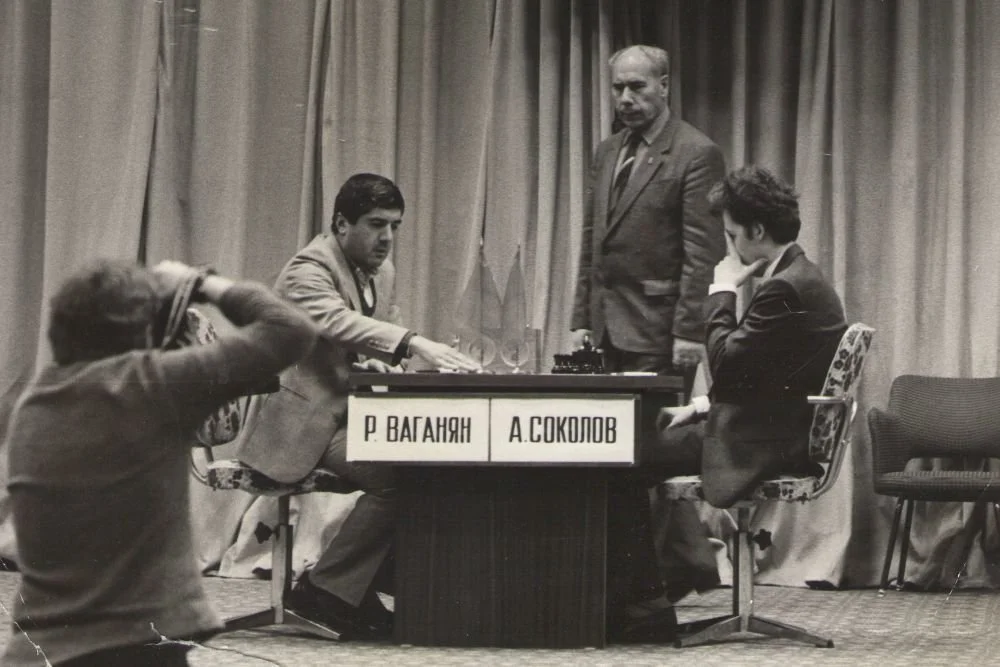
FIDE Candidates’ Quarter-final, Minsk, January 1986. Source: Douglas Griffin
Introduction
Andrei Yuryevich Sokolov, also rendered as Andrey Sokolov and in French sources as Andreï Sokolov, was born on 20 March 1963 in Vorkuta and rose from the Moscow youth circuit to become Soviet champion, a Candidates finalist, and one of the strongest players in the world in the second half of the 1980s. On the January and July 1987 FIDE lists he stood joint third in the world, with a peak rating of 2645 in January 1987, a level that placed him directly behind the Karpov-Kasparov axis of the period. His later career stretched across the late Soviet, Russian, and French chess worlds, with France listed as his federation on the current FIDE register.
Sokolov deserves attention today because his career was unusually compressed and unusually revealing. Between 1982 and 1987 he moved from world junior champion to Soviet champion to a match with Anatoly Karpov for the right to challenge Garry Kasparov. That ascent was genuine rather than accidental, yet it was also brief, which has made him easier to overlook than players whose peaks were longer or whose public profiles were larger. The documentary record shows a player of very high class, strong nerves, and serious professional discipline, whose historical place lies somewhere between the most famous Soviet champions and the later generation of grandmasters who inherited their training culture.
Early Life and Chess Formation
Sokolov was born in Vorkuta, then in the Komi ASSR of the Russian SFSR, and moved with his family to Moscow in childhood. Russian Chess Federation biographical material states that chess held an honored place in the family: his father, Yuri Pavlinovich Sokolov, worked in the youth commission of the USSR Chess Federation, and his older brother rose to master strength. Douglas Griffin’s archival summary agrees on the move from Vorkuta to Moscow and places the family firmly inside the Soviet chess milieu.
His major formative coach was Vladimir Yurkov, who spotted his talent at Moscow’s Stadium of Young Pioneers and worked with him individually. The Russian Chess Federation’s profile of Sokolov emphasizes Yurkov’s method, describing it as oriented toward the harmonious development of the player rather than toward short-term results or cheap opening traps. Sokolov’s development also belonged to the broader Moscow training environment that produced or shaped other leading players, and later Moscow sources still linked his name to the coaching orbit of Yurkov and, in the city’s junior culture, to figures such as Lyudmila Belavenets.
By age seventeen he had earned the Soviet Master of Sport title, and in 1984 he graduated from the State University of Physical Culture and Sport in Moscow, a path characteristic of many serious Soviet professionals whose chess education was closely intertwined with formal sports institutions. Boris Zlotnik, later a major teacher at the chess department of the same institution, also identified Sokolov as one of its students. These details help place his rise inside the institutional side of Soviet chess, not simply its tournament side.
The first major breakthrough came quickly. The Russian Chess Federation records his shared victory in the 1981 Moscow Championship, and in 1982 he won the World Junior Championship in Copenhagen. A contemporary Soviet popular science magazine, Nauka i zhizn, described that junior triumph as a dominant one, noting that he finished with eight wins and five draws, undefeated, against a large international field. That performance established him not as a promising Moscow junior only, but as a player whose strength already translated outside the Soviet internal system.
Rise in Competitive Chess
Sokolov’s arrival in the top Soviet and international ranks was very fast even by Soviet standards. Douglas Griffin’s summary captures the climb with unusual clarity: World Junior champion in 1982, strong qualification results in the Soviet system in 1983, then victory in the 1984 USSR Championship at Lvov with 12.5/17 and no losses. OlimpBase’s championship index confirms him as the winner of that 1984 Soviet final, and FIDE records show that he received the grandmaster title the same year. In a chess culture where the Soviet championship often functioned as a de facto world-class supertournament, winning it at twenty-one instantly altered his status.
The next stage was the world championship cycle. In 1985 Sokolov finished third at the Biel Interzonal, then tied for first through third at the Candidates tournament in Montpellier with Artur Yusupov and Rafael Vaganian. FIDE’s historical account of the Candidates confirms that Montpellier sent four players into the knockout phase, among them Sokolov, while the Russian Chess Federation biography adds the Soviet internal perspective and stresses how rapidly he had moved into a genuine challenge for the crown.
His match play in the cycle was even more impressive than his tournament play. In the Candidates quarterfinal he defeated Vaganian by the lopsided score of 6:2. In the semifinal against Yusupov he staged a comeback that became central to his reputation. After ten of the planned fourteen games he trailed 4:6, yet he won the last three decisive games in succession to take the match. The Russian Chess Federation article notes that Kasparov later used this finish as evidence of Sokolov’s reputation as a “man without nerves.” That phrase should be treated as contemporary characterization rather than neutral description, but it does reflect how strongly his match temperament impressed leading observers.
The reward for that run was unusual and historically important. Because of a one-time FIDE arrangement in the aftermath of the Karpov-Kasparov title matches, Sokolov did not go straight to a championship match. Instead, he had to face former world champion Anatoly Karpov in what FIDE history and Russian sources both describe as the final hurdle of the cycle. The match took place in Linares in 1987, and Sokolov lost 3.5:7.5. FIDE’s retrospective notes the institutional peculiarity of the arrangement, while the Russian Chess Federation account makes clear how much it shaped the public memory of his peak.
Major Career Achievements
A short list of Sokolov’s achievements already explains why historians should take him seriously. He won the World Junior Championship in 1982, won the Soviet Championship in 1984, qualified from the Biel Interzonal in 1985, tied for first in Montpellier the same year, won Candidates matches over Vaganian and Yusupov in 1986, and reached joint third on the world rating list in 1987 with a 2645 rating. That peak is documented in the FIDE rating history preserved by OlimpBase and is the most objective single indicator of how high his strength rose.
His team record was also substantial. As a member of the Soviet national team, Sokolov shared in Olympiad gold medals in Thessaloniki in 1984 and Dubai in 1986, and Russian federation material also credits him with the Soviet world team title and a state decoration, the Medal for Distinguished Labour, in 1985. OlimpBase’s Thessaloniki file shows him scoring 5.5/8 as second reserve for the Soviet team, one of several strong Soviet reserve performances that year. These team results place him well inside the Soviet elite group, not on its fringes.
Selective individual games also illuminate his standing. Douglas Griffin notes that at Reykjavík in the 1988 World Cup Sokolov defeated Kasparov, handing the world champion his only loss of the event. A different source, drawn from the editorial commentary in The Unknown Bobby Fischer, records that Karpov’s rare losses abroad to Soviet or ex-Soviet peers included defeats to Sokolov at Bugojno in 1986 and Belfort in 1988. These games are relevant here only as markers. They show that even after the disappointment of Linares, Sokolov remained fully capable of defeating both the reigning and former world champions in elite company.
His peak proved difficult to sustain. Russian federation material records his upset loss to Kevin Spraggett in the first round of the next Candidates matches in 1988, and the FIDE rating history shows the statistical aftermath with unusual starkness: joint third in January 1987, down to nineteenth in January 1988, and down again to eightieth by January 1992. That decline was real, although it did not mean disappearance. The same rating history shows that he rebuilt himself to around 2600 in the French chapter of his career and even returned to the top hundred in 2001.
Style and Reputation
Sokolov’s contemporaries described a player whose strengths were unusually concrete and unusually disciplined. A Suetin profile, preserved in later English summaries and in periodical excerpts, called him a practical-minded player, highly concentrated, free of impulsiveness, and persistent in pursuing his aims. Mikhail Tal, speaking on Soviet television in 1987 and later translated online, described him as a player faithful to his principles, then added that such principled play could shade into straightforwardness or stubbornness depending on the situation. Neither remark should be treated as a complete technical diagnosis, yet together they point to the same core image: seriousness, self-belief, and a refusal to abandon his own strategic convictions.
Igor Zaitsev, Karpov’s second, gave a more technical assessment after the Linares match. In the Russian Chess Federation profile he credited Sokolov with a memorable attacking style, excellent calculation in complicated variations, and strong handling of the “tempi endgame,” while also arguing that his play was not yet fully universal because certain technical and maneuvering positions still posed problems. Kasparov’s retrospective judgment, quoted in the same source, points in a similar direction: Karpov’s more elastic handling of position remained an unresolved problem for Sokolov, and later results suggested that he never fully repaired the weakness exposed there. As historical evidence, these are valuable because they come from elite contemporaries who had to prepare for him seriously.
The opening record fits that reputation. Griffin’s archival synthesis describes Sokolov’s repertoire as relatively narrow but highly coherent: 1.e4 with White, often in classical Spanish channels, and with Black the Sicilian Scheveningen against 1.e4 and the Nimzo-Indian or Queen’s Indian against 1.d4. Griffin presents this as lifelong consistency rather than theoretical poverty. A French federation interview from 2005 adds something about Sokolov’s self-conception: asked about spectators and conditions, he answered that he did not change his game to create spectacle. That is a small remark, yet it aligns neatly with the documentary image of a professional whose relation to chess was serious, unsentimental, and effortful.
A reasonable historical interpretation follows from these sources. Sokolov was not the broadest stylist of his generation, and his later vulnerability in certain quieter structures was visible to those who faced him at the highest level. Even so, at his best he united three qualities that are not always found together: disciplined practical judgment, tactical calculation, and unusual match nerve. Those qualities explain how a player outside the most famous Soviet line of succession could rise so quickly to the very top.
Contributions Beyond Tournament Play
Sokolov’s contribution beyond tournament results was real, though it was quieter than that of more public-facing contemporaries. The documented record does not present him as a prolific chess author on the model of Tal, Kasparov, or later memoirists. What it does show is a continuing analytical presence. Europe-Echecs used him as one of its grandmaster analysts for major online coverage of the 2013 world championship match and the 2014 Candidates tournament, placing him alongside leading French commentators such as Christian Bauer and Marie Sebag. That role suggests the continuing esteem attached to his judgment within French chess culture.
His post-Soviet significance is especially visible in France. By his own statement in the 2005 French Championship bulletin, he had already taken shared first in the 2003 national championship at Aix-les-Bains before losing on tiebreak and playoff procedures, and later in the same 2005 event he finished second. French official material from 2006 included him in the national delegation for Turin, while OlimpBase confirms his place on France’s team at the 2003 European Team Championship in Plovdiv. These are not the results of a fading ex-star merely visiting the circuit. They show a player who became structurally important within French elite chess.
Club chess forms part of that story as well. French federation records continue to list Sokolov with Mulhouse Philidor, and federation news reports from the 2010s still mention him scoring for the club in the Top 12 and related competitions. The endurance of that association is historically useful because it shows how a late Soviet grandmaster could be absorbed into a different national chess culture without losing his professional identity. In Sokolov’s case, the French chapter was not an appendix. It was a long second career.
Historical Legacy
Sokolov’s historical legacy begins with a paradox. He was strong enough to become Soviet champion, strong enough to reach a Candidates final, and strong enough to stand joint third in the world. Even so, he is less remembered than several contemporaries with comparable or slightly lesser peak results. The record itself suggests why. His rise occurred in the shadow of the Karpov-Kasparov duopoly, his decisive failure came in a match against Karpov at the most visible possible moment, and his years at the summit were brief. Historiographical neglect in this case is understandable, though it still distorts the era if left uncorrected.
He is also a useful figure for understanding the strengths and limits of late Soviet chess production. The strengths are obvious in his biography: family immersion in the game, elite Moscow coaching, sports-institute formation, rapid promotion through junior and national structures, and immediate readiness for world-level competition. The limit appears in the way his game was perceived after Linares. The same system that produced his forceful opening-to-middlegame identity and competitive steel did not automatically produce the stylistic universality needed for a prolonged reign near the very top. That interpretation is supported by the contemporary judgments of Zaitsev and Kasparov, though it remains an interpretation rather than a direct quotation of either man’s full worldview.
His later decades add a second legacy. Sokolov did not vanish after the Soviet collapse. The rating record shows renewed strength in the 1990s and early 2000s, the French championship bulletins show him fighting for the national title, and the current FIDE file shows that he remains an active player for France in 2026. The continuity itself has historical value. It links the Soviet school of the 1970s and 1980s to a later European club and federation culture in which Sokolov became an elder grandmaster rather than a vanished prodigy.
The concise historical assessment is this: Andrei Sokolov deserves renewed attention because he was one of the very few players of his generation who genuinely reached the inner ring of world chess, however briefly. He was a world junior champion, Soviet champion, Candidates finalist, joint world number three, and later a serious figure in French chess. His career is short enough at the summit to invite forgetting, yet strong enough in substance to resist it. For readers of Soviet chess history, he is best understood as a major player whose peak was real, whose weaknesses were visible, and whose significance reaches beyond the single loss that has too often defined him.
Notes and Sources
This profile uses the English FIDE form “Andrei Sokolov.” Russian sources identify him as Андрей Юрьевич Соколов, while French sources often use “Andreï Sokolov.” Those transliterations refer to the same player.
The most valuable sources for this profile were the Russian Chess Federation’s biographical page on Sokolov, FIDE’s official rating and historical pages, OlimpBase’s championship and rating files, contemporary French Chess Federation championship bulletins, Europe-Echecs announcements of his later analytical work, and Douglas Griffin’s archival synthesis on Soviet chess history. Contemporary assessments by Alexei Suetin, Mikhail Tal, Igor Zaitsev, and Garry Kasparov were used primarily to reconstruct Sokolov’s reputation among strong contemporaries. Where this essay moves from documented fact to interpretation, it does so explicitly and on the basis of those sources rather than anecdote.
