Adrian Mikhalchishin
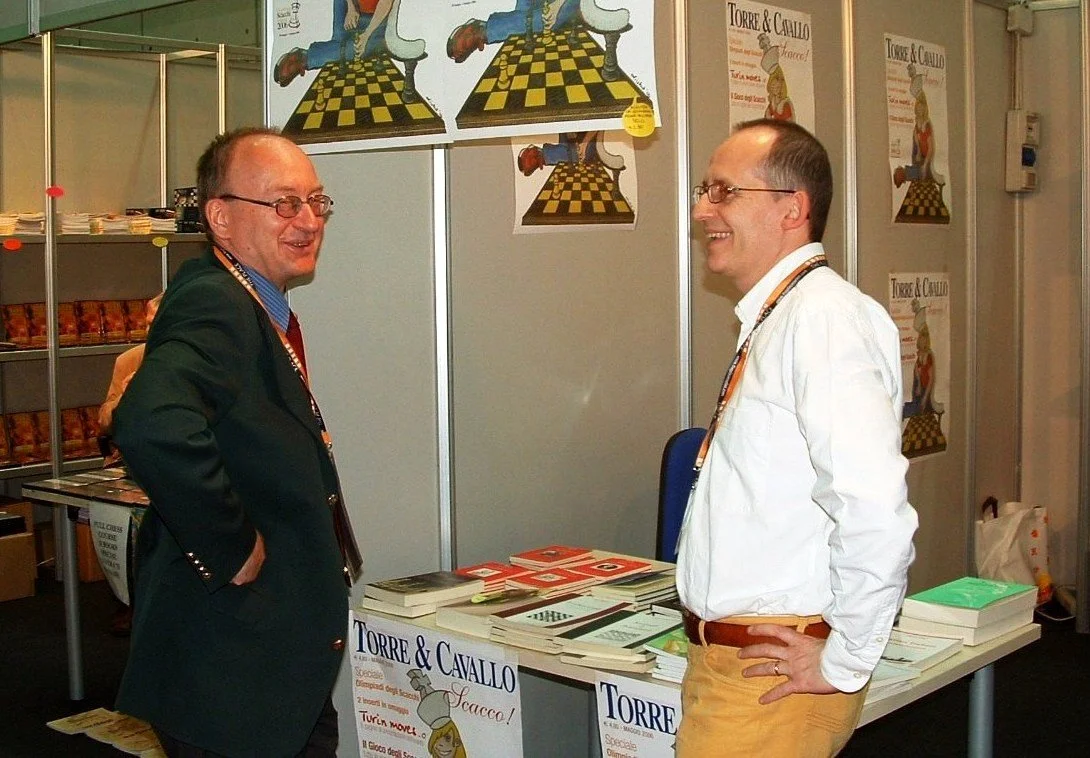
Woodpusher, CC BY-SA 3.0 Photo of GM Adrian Mikhalchisin and IM Roberto Messa at Turin 2006 Olympiad.
Introduction
Adrian Bohdanovych Mikhalchishin belongs to a distinctive category in modern chess history: the strong Soviet grandmaster whose deepest historical significance lies not only in his tournament record, but in the way he carried the methods, habits, and educational ideals of late Soviet chess into a long international career as trainer, author, organizer, and institutional reformer. Born in Lviv on 18 November 1954, educated as a physicist, awarded the grandmaster title in 1978, and later registered with FIDE under Slovenia, he stands at the intersection of several chess cultures: the Lviv school, the Soviet training system, post Soviet Ukrainian chess, and the transnational coaching world that emerged after 1991.
For readers of chess history, Mikhalchishin deserves attention for three linked reasons. First, he was a genuine representative of the unusually fertile Lviv environment that also produced players such as Oleg Romanishin and Alexander Beliavsky. Second, he became part of the internal working world around Anatoly Karpov and later the Soviet national team, which gave him a front row place in elite chess culture without turning him into a world title challenger himself. Third, he spent decades converting that experience into pedagogy, books, and federation level work, especially through the FIDE Trainers’ Commission. His later public writing and interviews show a man consciously trying to preserve chess memory as well as chess skill.
Early Life and Chess Formation
Much of what is known about Mikhalchishin’s family background comes from his own later recollections, and it should be treated as first person testimony rather than as fully archivally verified family history. In a long interview, he said that he was born in Lviv as one of three sons of refugees from eastern Poland, that one grandfather died in Berlin in 1944 after forced labor for the German Reichsbahn, and that another grandfather, a priest and chess enthusiast, had been persecuted and forced to flee. In the same interview, he recalled that his mother taught him chess when he was seven, and that chess entered the household through that grandfather’s enthusiasm. A later interview summary added that his father worked as an engineer and his mother as an English teacher.
His formal education was unusually serious even by Soviet master standards. He graduated from Lviv University in 1976 with a degree in theoretical physics, and later spoke with obvious pride about the intellectual discipline of Soviet technical education. He linked this background to the high level of the university environment in Lviv and to the fact that many strong Soviet grandmasters came from mathematically or scientifically demanding studies. The Ukrainian encyclopedia entry confirms both the university graduation and the date.
The decisive formative influence on his chess was the Lviv school around trainer Viktor Kart. Mikhalchishin repeatedly described Kart as a major teacher, and he also described the larger local chain of influence that ran through Leonid Stein. In his account, he trained alongside Oleg Romanishin, Alexander Beliavsky, and Marta Litynska, all future leading figures in Ukrainian chess. He later identified Stein as the local hero who inspired that whole generation, while Bent Larsen and Mikhail Botvinnik shaped him as models of independent thought and classical study. These claims are important because they place Mikhalchishin inside a very specific microculture: not generic Soviet chess, but the combative and ambitious Lviv version of it.
One episode that he himself singled out as a turning point came in 1976, when he, Beliavsky, and Romanishin trained with Viktor Korchnoi in Lviv. Mikhalchishin later said that the session taught him how much work was required to become a real grandmaster. The timing was dramatic, because Korchnoi defected from the Soviet Union only months later, and Mikhalchishin recalled that the KGB then questioned the Lviv players who had been around him. Even if one brackets the anecdotal color, the episode is revealing: Mikhalchishin’s generation in Lviv learned not only from books and coaches, but from direct contact with first rank practitioners at a politically charged moment.
Rise in Competitive Chess
Mikhalchishin’s emergence as a nationally significant player was concentrated in the second half of the 1970s. The Encyclopedia of Modern Ukraine records that he won the All Union tournament of young masters in 1977, helped the Soviet team win world youth team titles in 1977 and 1980, and was part of the Ukrainian team that won the Spartakiad of the Peoples of the USSR in 1979. The same source also lists a series of important international results, including top finishes in Rome in 1977, Vrnjačka Banja and Pécs in 1978, Leipzig in 1979, Copenhagen in 1980, Cienfuegos in 1981, Vienna in 1982, and Hastings in 1985-86. This was not the profile of a brief sensation. It was the profile of a player who rose through one of the hardest competitive systems in the world and then stabilized at strong grandmaster level.
His grandmaster title came in 1978, and Mikhalchishin himself later associated that period with entry into the highest Soviet competitive echelon. The Ukrainian encyclopedia gives 1978 as the year of the title and links it to the Vrnjačka Banja success. In the broader Soviet context, that date is telling. To become a grandmaster in the late 1970s Soviet Union was not merely to be strong in the abstract. It meant surviving a dense ecosystem of internal competition, qualification events, school rivalries, and relentless theoretical work.
His Soviet Championship record shows both his achievement and his ceiling. OlimpBase credits him with four appearances in the Soviet Championship finals, in 1978, 1981, 1984, and 1985, with a best result of fourth place. Mikhalchishin himself consistently cited fourth place in the 1984 Soviet Championship as his best result in that arena. That finish deserves emphasis. In the Soviet chess world, a top four placing in the national championship was a serious credential, even if it did not automatically propel a player into the world championship cycle. It indicates that he was more than a useful master or a future coach who happened to play well. He was an authentic member of the Soviet grandmaster class.
If one wants a concise historical judgment on the player alone, the record suggests something precise. Mikhalchishin was not one of the handful of Soviet stars around whom the world title narrative revolved, but he was plainly stronger than the label “secondary figure” would imply. He accumulated serious international results, team successes, and elite domestic appearances, and he did so in an era when the Soviet middle and upper grandmaster ranks were extraordinarily crowded. That distinction is important for historical fairness.
Major Career Achievements
The single most visible shift in Mikhalchishin’s career came when high level players and institutions began to value his analytical and educational skills as highly as his over the board strength. He later said that he served as a second for Oleg Romanishin in the mid 1970s, helped Maia Chiburdanidze prepare for her 1978 world championship match against Nona Gaprindashvili, and in 1980 was invited by Igor Zaitsev into Anatoly Karpov’s team. Mikhalchishin explained that he was already known as a top opening expert, and that work with Karpov exposed him to figures such as Efim Geller, Mikhail Tal, Lev Polugaevsky, and Yuri Balashov. On any historical reading, that move from strong grandmaster to trusted analyst was one of the central turning points of his life.
His own descriptions of the Karpov years are especially useful because they reveal how he understood the trainer’s craft. He stressed the importance of opening preparation, psychological calibration, and atmosphere inside the camp. One of his most vivid recollections concerns the preparation for game 27 of the first Karpov-Kasparov match, a game he later called one of the best of the match. Whether every detail is remembered exactly as it happened is less important than what the account demonstrates historically: Mikhalchishin was not a peripheral helper. He was part of the decision making and emotional management that elite match chess required.
By 1989 he had reached another level of authority. Both the Encyclopedia of Modern Ukraine and his own 2009 interview state that he was trainer of the Soviet national team that year. Independent team records from OlimpBase confirm that the USSR won the 1989 World Team Championship and the 1989 European Team Championship, matching the achievement he later referenced. This convergence of autobiographical and external evidence is useful: it shows that Mikhalchishin’s reputation as a trainer of national teams was not retrospective self promotion but part of a documented institutional record.
Style and Reputation
As a player, Mikhalchishin is best understood through the culture that formed him and the teaching philosophy he later articulated. He described the Lviv school as one of fierce internal competition, with players trying to win every training game against one another. He also described himself as a student of Stein, Larsen, and Botvinnik, and later insisted that strong players should study the classics not as museum pieces but as a working storehouse of typical plans, structures, and technical models. His books and instructional media on classical study, isolated pawns, hanging pawns, planning, pawn structures, and endgame technique reinforce that picture. The simplest careful formulation is that Mikhalchishin’s chess identity centered on strategic understanding, pattern recognition, and classical positional literacy, even when backed by sharp opening preparation.
Documented evidence also suggests that contemporaries valued him for openings and for practical team work. He explicitly said that Karpov’s side recruited him because he was seen as a top opening expert. Yet his later comments on training place even more weight on fitting openings to the individual player, analyzing one’s own games, and avoiding narrow imitation. In other words, even when he entered elite chess through opening knowledge, he seems to have distrustful of reducing chess to opening knowledge alone. That combination helps explain his later reach as a teacher.
It is also reasonable, and I think historically fair, to say that Mikhalchishin’s deepest strength may not have been the solitary pursuit of a candidates level playing career, but the capacity to build strong players, camps, and working methods around him. That is an interpretation rather than a directly documented verdict, but it follows from the contrast between his own very respectable playing record and the much wider institutional footprint of his coaching, authorship, and trainer education. His career after 1980 kept pulling him toward collaborative influence.
Publicly, he also developed a reputation as a vivid and energetic lecturer. A ChessBase review quoting Matthew Sadler described him as “an entertaining and lively host” whose enthusiasm carries instructional content. That comment comes from the world of video training rather than tournament praxis, but it fits the larger body of evidence. Mikhalchishin was not just a repository of Soviet methods. He was unusually successful at presenting them.
Contributions Beyond Tournament Play
Here Mikhalchishin’s historical weight becomes unmistakable. His own interviews and official encyclopedia profile attribute to him work with an unusually broad range of players: Maia Chiburdanidze, Anatoly Karpov, Alexander Beliavsky, the Polgar sisters, Alisa Marić, Arkadij Naiditsch, Richard Rapport, Mateusz Bartel, and others. The point is not that he alone “made” these players. That would be too simple. The point is that for decades he was repeatedly entrusted with the development, preparation, or support of major talents across several countries and generations.
His Lviv work with Iosif Dorfman in the mid 1980s is one of the more overlooked episodes. Mikhalchishin later said that they established a training academy in Lviv in 1985, and that some of its students later became notable trainers themselves. In the same interviews, he identified serious self analysis, individual tailoring of opening repertoires, and the disciplined study of classical games as key features of that culture. This is one reason his significance exceeds his own tournament statistics. He transmitted methods.
After 1991, he became a particularly clear example of how Soviet chess expertise was redistributed internationally. The Ukrainian encyclopedia records that he served as vice president of the Lviv regional federation from 1990 to 1994, president from 1994 to 1998, and vice president of the Ukrainian Chess Federation from 1998 to 2002. It also records his later work with the national teams of Slovenia, the Netherlands, and Turkey. His 2009 interview adds more detail, including his work with the Dutch “Young Orange” project and, with Georg Mohr, a successful junior program in Slovenia that produced several grandmasters. Historically, this makes him a bridge figure in post Soviet chess globalization.
Institutionally, his most durable contribution may be his work for trainers as a professional class. FIDE documents show that in 2009 he became chairman of the FIDE Trainers’ Commission. Reports from 2009 and 2010 describe the commission under his chairmanship as expanding seminars, pushing procedures for trainer titles, building academy endorsement systems, and creating trainer awards and a hall of fame. Later FIDE award records show that he himself received the Euwe Max juniors trainer award in both 2008 and 2009, the Boleslavsky author award for 2014, and the Yuri Razuvaev award for contributions to trainers education in 2018. Those honors are important not as decorations, but as evidence that his peers and the federation recognized him in the very fields, youth work, writing, trainer education, to which he had devoted his post playing life.
His literary output also deserves notice. The Ukrainian encyclopedia lists not only his memoir Za kulisami shakhmatnoy imperii but also books on intuition, the Sicilian, hanging pawns, the isolated pawn, Magnus Carlsen, and endgame technique. The recurrent themes are telling. Mikhalchishin’s bibliography is not the work of a mere opening hack. It is the work of a trainer who kept returning to structures, technique, historical memory, and methods of study. His public comments on the need to interview veterans and preserve chess stories show the same impulse in another form.
Historical Legacy
Mikhalchishin’s legacy rests on continuity. He is one of the figures through whom the Lviv and Soviet training traditions remained alive after the disappearance of the Soviet state. He did not preserve them unchanged. Instead, he translated them into books, DVDs, seminars, academy programs, and federation structures that could function in Slovenia, the Netherlands, Turkey, and wider Europe. Current ECU materials still place him in educational and advisory roles, including as honorary chairman within the ECU Trainers’ Commission and as a lecturer in the ECU annual training program. FIDE seminar schedules from 2023 also show him still teaching trainer certification content.
His legacy is also local, not only international. In 2023 the European Chess Union reported that the “Adrian Mikhalchisin Cup” youth tournament in Lviv drew 120 participants during an ECU visit to Ukraine, with Mikhalchishin present as adviser to the ECU president. That same year, Ukrainian public broadcaster Suspilne showed him participating in a charity simultaneous display in Lviv to raise funds for the armed forces, alongside other veteran Lviv grandmasters. These episodes do not determine his place in classical chess history, but they do show that he has remained a civic presence in the city and chess culture that formed him.
The concise historical assessment is this: Adrian Bohdanovych Mikhalchishin deserves attention today because he embodies a form of chess importance that standard winner lists do not fully capture. He was a real Soviet grandmaster, a product of the Lviv school, a trusted elite second and national team coach, a prolific teacher of strategic method, and an institutional advocate for trainers. He is significant not only for what he won, but for what he transmitted.
Notes and Sources
The core factual basis for this profile comes from a hierarchy of sources. For fixed biographical and institutional data, the most useful were the Encyclopedia of Modern Ukraine, FIDE profile and commission documents, ECU materials, and OlimpBase team and championship records. For first person testimony, especially on family history, formative influences, and the internal life of Karpov’s camp, Mikhalchishin’s long interviews with ChessBase are primary sources and have been treated as such. Where a claim comes chiefly from his own recollection, the text identifies it as recollection or testimony rather than treating it as independently verified archival fact.
Readers should also be aware of transliteration issues. His name appears in English language sources as Adrian Mikhalchishin, Mikhalchischin, Mihalcisin, and Mihalčišin, while Ukrainian language sources use Адріан or Адріян Михальчишин. Searching across those variants is necessary to recover the full record. That very instability is part of the historical story of a player whose life crossed Soviet, Ukrainian, Slovenian, and wider European chess worlds.
