Alexey Dreev
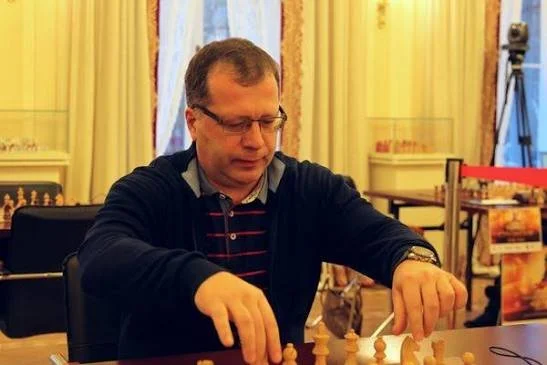
Source: ruchess.ru
Introduction
Alexey Sergeyevich Dreev (Алексей Сергеевич Дреев), born on 30 January 1969, belongs to a small group of grandmasters whose careers connect the final generation of Soviet chess education with the very different professional culture that followed the dissolution of the USSR. His surname appears in English as Dreev, while his given name is variously rendered Alexey, Aleksey, or Alexei. FIDE currently uses “Aleksey.”
Dreev was a double world under-16 champion, a Candidate for the world title in his early twenties, and one of the strongest tournament players of the mid-1990s. He won three Chess Olympiads with Russia, twice won the World Team Championship, reached the quarterfinals of the 1997 FIDE World Championship, and remained a 2700-level player into his forties. His professional record also includes major achievements in rapid and blitz chess, an extensive body of opening literature, and later work as a trainer.
The shape of that career is historically revealing. Dreev benefited from exceptional Soviet coaching, encountered the system’s administrative constraints, and entered his prime just as its institutions were disappearing. He then built a long international career around preparation, positional judgment, technical accuracy, and unusual competitive durability. His historical identity rests on more than three decades near the upper levels of elite chess.
Early Life and Chess Formation
Dreev’s autobiographical account places his birth in Stavropol and his childhood home in Zheleznovodsk, a spa town in the northern Caucasus. Some federation profiles compress the two locations and describe him simply as born and raised in Zheleznovodsk. His mother was Nina Mikhailovna; his father, Sergei Sergeyevich, was an engineer by training, a strong amateur player, and later a children’s coach; and he had an elder sister, Tatyana. His father taught him chess at six. Dreev recalled learning notation from 64 labeled paper squares and becoming absorbed in Alekhine’s games. The family recognized his aptitude early and supported his development, which soon moved beyond ordinary school competition.
Vasily Vlasov was the first to formally assess him. His first sustained coach was Vladimir Saigin, a Belarusian international master then living in the region. Dreev also attended the All-Union Smyslov School, organized through the Burevestnik sports society under Boris Postovsky. The school exposed gifted provincial juniors to leading trainers, including Yuri Razuvaev, and placed Dreev within a national development network while he still lived in Zheleznovodsk.
Sources differ in separating norms from formal titles, though they agree on the speed of his rise. Dreev had reached candidate-master strength by eleven and made a Soviet master norm at thirteen. In a strong 1982 tournament for young masters, where many opponents were considerably older, he finished second behind Semen Dvoirys. He met Mark Dvoretsky in Kislovodsk in 1980, when he was eleven. Much of their early work crossed the roughly 1,600 kilometers between Zheleznovodsk and Moscow by post, through exercises, annotated games, and returned analysis.
Dreev’s work with Dvoretsky began in early adolescence. Alexander Filipenko later became his long-serving trainer and second. Their roles were complementary. Dreev recalled that Filipenko constructed much of his durable opening repertoire, including the Caro-Kann, the Meran, the Moscow systems, and the Richter-Rauzer. Dvoretsky concentrated on calculation, positional decision-making, endgames, and the habits of professional analysis. This division of labor helps explain a central feature of Dreev’s mature play: opening preparation formed part of a broad technical education.
The junior results were extraordinary. Dreev won the World Under-16 Championship at Bucaramanga in 1983 with 10 points from 11 games. He retained the title at Champigny-sur-Marne in 1984, scoring 8½ from 11 and finishing ahead of a field that included Viswanathan Anand and Jeroen Piket. In the same year, he took silver at the World Junior Championship in Kiljava, half a point behind Curt Hansen. At fifteen, he was already succeeding against the best players several years above his age group. He later finished second to Vasyl Ivanchuk in the 1986 USSR Junior Championship and won the 1988/89 European Junior Championship in Arnhem. He and Boris Gelfand both scored 10½ from 13 there, with Dreev placed first after winning their individual game.
His progress also exposed him to a less admirable feature of late Soviet sporting administration. In separate memoirs, Dreev and Dvoretsky recalled that the authorities abruptly stopped permitting him to compete abroad in the mid-1980s. Dreev wrote that he never learned the reason. Dvoretsky documented at least two thwarted trips and a restriction lasting several years. He later recalled that a KGB officer alluded to Dreev having earned money from simultaneous exhibitions when he was still very young. Dvoretsky inferred that this had produced a damaging entry in the player’s file, though no released archival document has established the reason. His explanation is therefore testimony, not a proven documentary finding. According to the same memoir, the economist and chess official Leonid Abalkin eventually intervened at a high level; the restriction was lifted late in 1988, in time for Dreev’s European junior victory.
The educational cost of such intensive specialization is harder to measure. Dreev recalled using self-study and individual examinations during long tournament absences, which brought his father into conflict with school and local officials. A municipal record identifies him as a 1985 graduate of Zheleznovodsk School No. 1. The consulted sources do not document higher education. Dvoretsky believed the boy’s general schooling had suffered. The comment is a retrospective judgment by his coach and lacks independent academic corroboration. In a 2022 interview, Dreev said that he never seriously selected an alternative profession because, by the time such a choice would normally have arisen, his course was already set.
Rise in Competitive Chess
FIDE awarded Dreev the international master title in 1988 and the grandmaster title in 1989. That year he appeared in the USSR Championship final at Odesa and scored 7 from 15, an even result in one of the strongest national championships in the world. More consequentially, he shared first place in the 1990 Soviet zonal tournament at Lviv and qualified from the Manila Interzonal with an unbeaten 8 from 13. He had reached the Candidates at twenty-one.
His preliminary Candidates match against Anand took place in Madras in January 1991. Dreev lost the first game, drew the second, and equalized by winning the third. Anand then won three consecutive games to take the match 4½-1½. The score is worth stating accurately because several biographical summaries misidentify the stage as a quarterfinal and reproduce an impossible game tally. The match was Dreev’s only appearance in the traditional Candidates cycle. It also paired two former junior rivals whose senior careers soon followed different trajectories. Dreev later spoke of Anand with respect and described their relationship as professional.
The Soviet Union ended within the year. For Dreev, the transition coincided with the start of his most productive team career. Representing Russia, he won Olympic team gold in 1992, 1994, and 1996. He also helped Russia win the European Team Championship in 1992 and the World Team Championships in 1997 and 2005. OlimpBase records five Olympiad appearances in all, with 26½ points from 44 games; at the 2004 Olympiad he was undefeated on 6½ from 9 as Russia took silver. In 1998 he played first board for Russia II, not for the gold-medal Russian first team, another detail frequently blurred in short biographies.
These team selections place Dreev’s reputation in context. Russian lineups of the period had exceptional depth, so repeated inclusion signaled more than individual rating. He was valued as a dependable scorer with a well-prepared repertoire and relatively low volatility. His World Team Championship record was similarly durable: bronze in 1993, gold in 1997, silver in 2001, and gold again in 2005. At Lucerne in 1993, he scored 5 from 6 as first reserve, a result listed by OlimpBase as a 2782 performance.
Major Career Achievements
Dreev’s clearest individual breakthrough came in 1995. At Wijk aan Zee, where the Hoogovens tournament used a knockout format that year, he defeated Evgeny Bareev 2½-1½ in the final. A few months later, he won the Biel Grandmaster Tournament outright with 9 from 13, remaining undefeated and finishing a full point ahead of Alexei Shirov. He also shared first at Reggio Emilia 1995/96 with Yuri Razuvaev and Vladimir Epishin. On the January 1996 FIDE list, he stood at world number eleven with a rating of 2670, his highest career ranking.
His deepest run in an individual world championship came in the inaugural FIDE knockout event at Groningen in 1997. Dreev reached the quarterfinals before losing 2½-1½ to Boris Gelfand. He then reached the last sixteen at four consecutive FIDE championships, losing respectively to Michael Adams in 1999, Veselin Topalov in 2000, Anand in 2001, and Leinier Domínguez in 2004. At the 2002 FIDE World Cup in Hyderabad, a separate event with group and knockout stages, he reached the semifinals and took Anand to rapid tiebreaks. The sequence shows sustained presence near the top without converting that presence into a world-title match.
In Russian championship play, Dreev shared second in the 1996 championship, earned bronze in the 1997 knockout edition, and placed third in the prestigious 2004 Moscow Superfinal. He scored 5½ from 10 there, behind Garry Kasparov and Alexander Grischuk. Across the international circuit, he won or shared first in events at St Petersburg, Dos Hermanas, Reykjavik, New Delhi, and elsewhere. The range and duration of these results give a clearer picture of his career than a complete catalog of tournament prizes could provide.
Dreev also excelled at faster controls. He won the European Blitz Championship at Neum in 2000, taking the title on tiebreak after he and Ivan Sokolov each scored 25½ from 40. In Warsaw in 2012, he became European rapid champion with 9½ from 11, prevailing on tiebreak in a field of 753. That victory formed part of a remarkable rapid season in which he also won three Russian Grand Prix qualifiers and the series final. His success in these formats fits his practical strengths: quick structural recognition, a stable repertoire, and refined technical instincts.
His peak published rating, 2711, arrived in July 2011, fifteen years after his highest world ranking. The gap offers a concise measure of his longevity and of rating inflation across the period. He continued to produce elite results well beyond the normal span of a player’s prime. In the 2016 Tata Steel Challengers, at forty-seven, he tied B. Adhiban and Eltaj Safarli on 9 from 13, finishing third on tiebreak. In 2024, aged fifty-five, he qualified for and played in the Russian Championship Superfinal. FIDE’s rating record shows continued classical activity in 2026.
Club chess provides another, often overlooked, index of his professional value. OlimpBase records twenty European Club Cup appearances, 79½ points from 116 games, three team gold medals, and three individual board golds. His team victories came with CSKA Moscow in 1989/90, TatTransGaz-Itil Kazan in 1996, and Ural in 2008. The succession of affiliations gives concrete form to the changing institutional base of elite post-Soviet chess, from the army club structure to regional and corporate sponsorship.
Style and Reputation
Dreev is usually described as an active positional player. Here “positional” means purposeful and energetic. He preferred sound structures, coordinated pieces, and positions whose long-term demands he had studied in depth. Within those positions he could calculate sharply and attack with considerable force. His best games often developed from a small structural advantage or an apparently modest improvement in piece placement, followed by increasingly concrete pressure.
Three strengths recur in assessments of his play. The first is opening preparation. Filipenko helped establish a repertoire that Dreev retained, revised, and eventually documented in specialist books. The second is judgment in strategically complex middlegames, especially in positions where pawn structure determines the proper exchanges and piece routes. The third is endgame technique. Dvoretsky recalled that endgames had initially been a weakness, then became one of Dreev’s strongest areas through systematic work. This development is a useful example of how training can change the profile of an already gifted player.
Dvoretsky called Dreev his most talented pupil and believed his early results showed potential comparable with the leading players of his generation. That was a mentor’s assessment, inevitably subjective and shaped by knowledge of obstacles in Dreev’s development. It still carries evidentiary weight because Dvoretsky trained many elite grandmasters and knew Dreev’s work up close. The adult record supports a more measured conclusion: Dreev possessed exceptional talent and reached the edge of the world elite, though he did not sustain the match results needed for a championship challenge.
Alexander Khalifman offered related evidence from inside Dreev’s peer group. In a published recollection, he described Dreev, Gelfand, and Ivanchuk as the three “geniuses” of their generation. The term is personal and retrospective, yet it shows that Dreev’s junior reputation survived among contemporaries who themselves reached the highest level.
His coach also identified a revealing vulnerability. After years of intensive opening work, Dvoretsky thought Dreev could become uneasy when surprised early, simplify prematurely, or trust stored analysis more than his own intuition. This was a specific observation about decision-making, not a general claim that Dreev lacked creativity. It may help explain the difference between his outstanding tournament and team consistency and his less successful record in short elimination matches, where one disrupted preparation or one bad sequence could decide the contest.
Dreev’s own reflections add another dimension. In 2022, he described chess primarily as an art and spoke critically of the amount of modern play conducted from computer-assisted home analysis. He also emphasized the personal cost of a professional career: time, nervous energy, and the risk of allowing competitive chess to consume the rest of life. Such comments came from a player who had adapted successfully to the computer era and read as an experience-grounded warning.
Contributions Beyond Tournament Play
Dreev’s opening work became a substantial second career in print. His autobiographical My One Hundred Best Games appeared in 2007. He then published detailed monographs on the Moscow and Anti-Moscow variations, the Meran and Anti-Meran, approaches to the Benoni, the Cozio Defence, the Caro-Kann, and Queen’s Gambit and Slav structures. Later volumes on practical middlegame and endgame play broadened the project from repertoire instruction to general decision-making.
These books are historically relevant because they preserve the working knowledge of a specialist who tested his systems for decades at grandmaster level. The Caro-Kann, Meran, Moscow, and Richter-Rauzer were among the openings Filipenko had helped him build as a young player. In his Meran monograph, Dreev used the name “Dreev-Filipenko Variation” for one scheme developed through their collaboration. This is Dreev’s own terminology for their joint analytical work; broader usage is uncertain. His authorship carried a training lineage from late Soviet analytical practice into the database era, with an emphasis on recurring plans, move-order precision, and positions he understood from direct experience.
Training gradually became a more visible part of his work. FIDE awarded him the title of Senior Trainer in 2016. That year he captained Azerbaijan’s first men’s team at the Baku Olympiad, having already worked with Shakhriyar Mamedyarov and Rauf Mamedov. Dreev later accompanied Mamedyarov as a second at the 2018 Candidates Tournament in Berlin. These appointments show that elite players valued the same opening expertise and practical judgment visible in his own career.
His work with younger players has left a clearer public record than is usual for private coaching. Marina Nechaeva credited Dreev’s opening preparation and advice as an important foundation for her victory in the 2017 Russian Women’s Higher League. He also helped prepare Aleksandra Maltsevskaya for her victory in the 2018 World Junior Girls Championship, work recognized by the Russian Chess Federation’s Mark Dvoretsky coaching award. In 2024 he served as head coach of the Uzbekistan women’s team at the Budapest Olympiad. He described preparing the players through online sessions and in-person camps; the team finished twelfth after entering the event seeded thirty-first. Coaching had become an additional expression of his analytical method while he remained an active tournament player.
Historical Legacy
Dreev’s career resists the shorthand often applied to players just outside the world-title succession. Junior dominance created expectations that were perhaps impossible to separate from Dvoretsky’s belief in his talent. Administrative interference complicated his late-teenage development, and the Soviet chess structure that had trained him vanished as he entered adulthood. He nevertheless became a central supporting figure in Russia’s first decade of international team success and a persistent individual presence in FIDE’s championship events.
His legacy also lies in continuity. He carried a methodical coaching tradition into an era of engines and enormous databases, then translated much of that knowledge into books and training. His highest world ranking came in 1996, his highest rating in 2011, his European rapid title in 2012, and another national Superfinal appearance in 2024. Few careers show so clearly how a player can remain recognizably himself while revising the tools of preparation around him.
Alexey Dreev deserves attention today as one of the strongest and most durable grandmasters produced in the final Soviet generation. His record illuminates elite coaching, state restriction, institutional change, team culture, opening scholarship, and competitive longevity through the experience of a single player. His historical standing rests on the cumulative quality of that contribution: a prodigy who became a world-class professional, a trusted team player, a serious theoretician, and a coach whose work extended the discipline that first formed him.
Notes and Sources
Alexey Dreev, My One Hundred Best Games (Chess Stars, 2007), pp. 8–24. The biographical introduction is summarized in Paul Kane’s contemporary review for Compulsive Reader. See also the Russian edition record. Family details and the Stavropol birthplace come from Dreev’s first-person account; the Russian Chess Federation gives Zheleznovodsk as both birthplace and childhood home.
Mark Dvoretsky, For Friends & Colleagues, Volume I: Profession: Chess Coach (Russell Enterprises, 2014), especially the chapter on Dreev. See the publisher’s edition page and the Russian chapter “Невыездной” (“Forbidden to Travel”). Dreev independently recalled the unexplained restriction in “Невосполнимая потеря” (“An Irreparable Loss”). No archival security-service file is cited, so Dvoretsky’s explanation has been treated as provisional.
Dmitry Kryakvin, “Формула успеха Алексея Дреева” (“Alexey Dreev’s Formula for Success”), Russian Chess Federation, 28 December 2012. This interview is the principal source for Dreev’s description of Saigin, Dvoretsky, Filipenko, his early repertoire, and his 2012 rapid results.
“Алексей Дреев: Магнус Карлсен будет недолго чемпионом мира” (“Alexey Dreev: Magnus Carlsen Will Not Be World Champion for Long”), Sovetsky Sport, 14 December 2022. The interview supplies Dreev’s later reflections on his coaches, professional chess, computer preparation, and the absence of an alternative career plan.
FIDE profile for Aleksey Dreev. FIDE records the IM title in 1988, the GM title in 1989, and the Senior Trainer title in 2016. Dreev loosely recalled in 2022 that his GM title may have come in 1990; this article follows FIDE’s formal title record.
Russian Chess Federation biographical profile. This is useful for the broad career outline, while several details require correction from event records. In particular, Dreev did not win the 1988 USSR Championship, and his 1991 match with Anand was the preliminary Candidates round, not a quarterfinal.
The junior results have been checked against event records for Bucaramanga 1983, Champigny-sur-Marne 1984, Kiljava 1984, and Arnhem 1988/89.
For the 1990 Interzonal and 1991 Candidates match, see OlimpBase’s complete cycle record for Dreev and Ian Rogers’s contemporary report, “Chess”, Australian Financial Review, 8 February 1991.
The 1995 results are documented by the official Tata Steel historical archive and the contemporary report on Biel in The Week in Chess 44. Dreev’s January 1996 rating and world ranking appear in OlimpBase’s historical FIDE list.
FIDE’s archived knockout records document the last-sixteen results at Las Vegas 1999, New Delhi 2000, Moscow 2001, and Tripoli 2004. OlimpBase’s 1997 Groningen record confirms his quarterfinal run; a contemporary ChessBase report covers the 2002 World Cup semifinal.
OlimpBase provides Dreev’s complete records in the Chess Olympiads, World Team Championships, European Team Championships, and European Club Cups. These records correct the recurring claim that Dreev won Olympic gold in 1998; he represented Russia II that year.
The 2004 Russian Championship result is confirmed by the contemporary ChessBase final-round report. Dreev scored 5½ from 10 and placed third.
For the faster time controls, see The Week in Chess 309 on the 2000 European Blitz Championship and FIDE’s official report on the 2012 European Rapid and Blitz Championships.
Dreev’s mentor discusses his talent, endgame development, and dependence on opening preparation in “Mark Dvoretsky’s Final Interview, Part I”, ChessBase, 2016. Dvoretsky’s comparison of Dreev’s talent with that of world champions is presented here as the coach’s opinion.
Representative publication records are available through WorldCat’s record for My One Hundred Best Games, the catalog description of The Meran & Anti-Meran Variations, and the publisher’s page for Improve Your Practical Play in the Endgame. The Meran book uses “Dreev-Filipenko Variation” for one analyzed scheme. The name represents the authorship claim in Dreev’s monograph; universal usage has not been established.
For contemporary reputation, see Mark Glukhovsky, “Борис Гельфанд: служение и достоинство” (“Boris Gelfand: Service and Dignity”), Lechaim, no. 7 (243), July 2012. The description attributed to Khalifman is a published retrospective recollection.
For Dreev’s training work, see Marina Nechaeva’s Russian Chess Federation interview, “Dreev, Regular Hours, and a Good Neighbor Form a Recipe of Success”; the Russian Chess Federation’s 2019 notice on his work with Aleksandra Maltsevskaya; AZERTAC’s 2016 interview on his Azerbaijan role; ChessBase’s 2018 Candidates report, which identifies him as Mamedyarov’s second; and the 2024 interview “У нас есть шахматистка с потенциалом чемпионки мира” (“We Have a Player with the Potential to Become World Champion”), Gazeta.uz, on his work with the Uzbekistan women’s team.
On Dreev’s schooling and early Soviet institutions, see Dvoretsky’s memoir chapter “Школа”; Sergei Shipov’s interview with Boris Postovsky, “Шахматисты для меня как дети”; and Arina Kozhemyakina, “Школьные годы: далёкие и близкие”, Железноводские ведомости, no. 6 (1310), 5 February 2025.
