Isaac Lipnitsky
Introduction
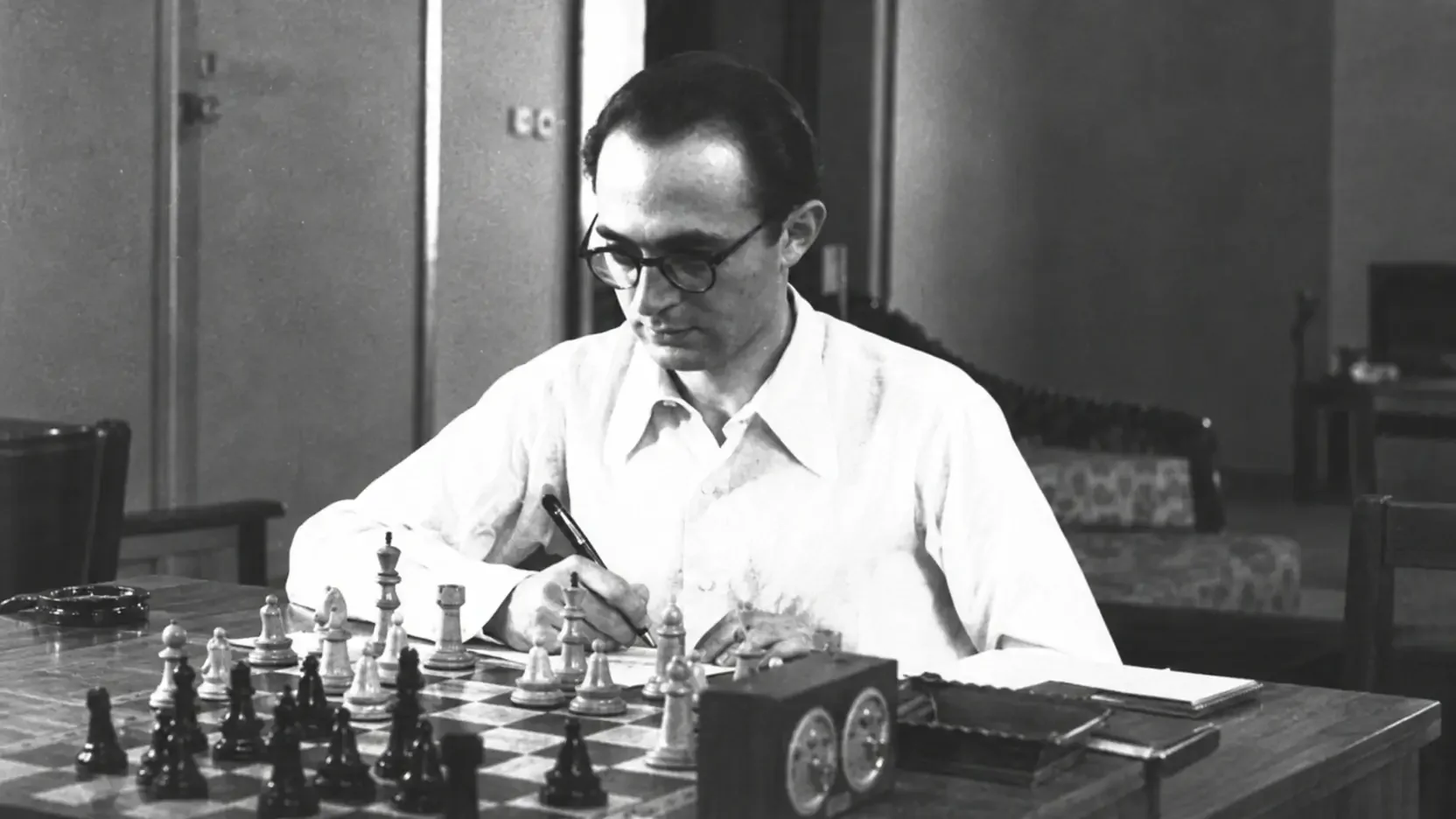
Isaac Oskarovich Lipnitsky was born in Kyiv on 25 June 1923 and died there on 25 March 1959, aged only thirty-five. In that brief life he became a two-time Ukrainian champion, shared second place in one of the strongest Soviet championships of the postwar period, served with distinction during the Second World War, organized chess in occupied Berlin, taught a generation of Kyiv players, and wrote an unusually thoughtful book about how chess theory should be understood.
Lipnitsky is often introduced through one of two facts: his result in the 1950 USSR Championship, or the later popularity of his theoretical writing with Bobby Fischer. Both are important, but neither adequately describes him. His historical significance lies in the combination of competitive strength, analytical independence, and sustained work within Ukrainian and Soviet chess culture.
His name appears in English as Isaac or Isaak Lipnitsky, Lipnitski, Lipnitskiy, and occasionally Lipnitzky. The Russian form is Исаак Оскарович Липницкий; the Ukrainian is Ісаак Оскарович Липницький. This article uses “Isaac Lipnitsky,” the form familiar from the English edition of his principal work. (Notes 1 and 2.)
Early Life and Chess Formation
Lipnitsky was born into a modest Jewish family. His father worked as an accountant, and Isaac learned chess at about eight from his father and an older brother. The family does not appear to have belonged to Kyiv’s cultural elite. His route into serious chess came through the new network of Soviet children’s institutions rather than private tuition or an established chess household.
In the autumn of 1935 he joined the chess circle at the Kyiv Palace of Pioneers. The institution’s dedicated chess-and-draughts club, formally opened in 1936, has been described in its own histories as the first of its kind in the Soviet Union. Its chess instructor, Alexander Konstantinopolsky, was an exceptionally important teacher. His pupils included David Bronstein, Anatoly Bannik, Abram Khasin, Boris Ratner, and Lyubov Yakir, alongside Lipnitsky.
This was a remarkably productive group. Its members learned through organized competition, collective analysis, lectures, and close contact with a strong master. Lipnitsky’s later insistence that a player should understand the ideas connecting openings and middlegames, rather than memorize variations in isolation, is consistent with that formative environment.
At sixteen he reached the final of the 1939 Ukrainian SSR Championship in Dnipropetrovsk. He scored 8 points from 15 games and finished seventh, half a point ahead of Bronstein. The result should not be exaggerated, but it established that Lipnitsky already belonged among the stronger young players in Ukraine. (Notes 3 and 4.)
Lipnitsky studied history at Kyiv State University shortly before the German invasion of the Soviet Union. The surviving records are inconsistent. His Soviet military-administration personnel entry says that he had completed three university courses by 1941, whereas recent biographical research places his matriculation in 1940. The discrepancy has not been satisfactorily resolved. It is safest to say that he studied history before the war, later attempted to resume university studies, and left without completing a degree in order to concentrate on chess.
He entered the Red Army in 1941 and trained at the Second Tomsk Artillery School in 1942. He subsequently served in artillery and corps intelligence, eventually becoming a senior assistant to the intelligence chief of the 32nd Rifle Corps. His wartime route extended from the fighting around Stalingrad to Berlin. He attained the rank of major and received four orders: two Orders of the Red Star and Orders of the Patriotic War in both the first and second class, in addition to campaign medals. A frequently repeated claim that he won a Tomsk chess championship in 1942 has not been substantiated by a surviving table or contemporary report. (Notes 1, 2 and 5.)
Rise in Competitive Chess
Lipnitsky remained in Germany after the war as an officer of the Soviet Military Administration. His precise position was more specific than the vague description “representative of the Soviet command” found in some later accounts. From 31 October 1945 he headed the fire-inspection section within the administration’s housing and economic apparatus.
Chess nonetheless became a substantial part of his Berlin life. At the Central Club of the Soviet Military Administration he organized a chess circle, mass tournaments, a qualification commission, and a seminar on theory. He played first board in a 1946 match against representatives of the American occupation administration, won 10-0 by the Soviet team. In the championship of the Soviet administration he scored 11½ points from 13 games and finished half a point behind Rashid Nezhmetdinov. A contemporary report recorded German master Kurt Richter’s opinion that both men already possessed fully developed master strength. (Notes 2 and 6.)
During his service in Germany, Lipnitsky’s wife, the actress Lyalya Markovna Leshchinskaya, joined him, and their daughter Liana was born there. The family returned to Kyiv in 1947. Lipnitsky tried to resume university study but increasingly devoted himself to tournament play, teaching, writing, and club organization.
His first major postwar success came in the 1949 Ukrainian SSR Championship in Odesa. He scored 15½ from 19, with fourteen victories, three draws, and two defeats. He finished two points ahead of a field that included Efim Geller and Mikhail Pogrebysky. The size of the margin made this more than a narrow championship victory: Lipnitsky had established himself as one of the republic’s leading masters.
In 1950 he finished second to Geller in the Ukrainian championship. Later that year he shared first place with Vitaly Tarasov in the All-Union Spartak individual championship at Dzintari and met the Soviet master norm. He then shared first place in a USSR Championship semifinal in Kyiv. Formal confirmation of his title as Master of Sport came only after the ensuing Soviet final. (Notes 1 and 7.)
Major Career Achievements
The 18th USSR Championship, played in Moscow in November and December 1950, was the defining competitive achievement of Lipnitsky’s career. He scored 11 points from 17 games and shared second through fourth places with Alexander Tolush and Lev Aronin, half a point behind Paul Keres.
With four rounds remaining, Lipnitsky stood alone in first place. He eventually scored two points from those final four games, enough to remain in the group immediately behind Keres. His victories included games against Vasily Smyslov and Tigran Petrosian, both future world champions, as well as Geller and Yuri Averbakh. He drew his game with Keres.
These individual results are significant because they show that his final standing did not arise from fortunate pairings or victories confined to the lower half of the table. Lipnitsky competed successfully against players who were already, or would soon become, central figures in Soviet chess. Under the domestic qualification system, the result also earned him a point toward the Soviet grandmaster rank. This was not a FIDE title or norm, and Lipnitsky should not be described as an international master or grandmaster. (Note 7.)
He qualified for two further USSR Championship finals. In 1951 he scored 6½ from 17 and in 1952 scored 7 from 19, both considerably below his 1950 result. Yet the intervening record does not support the idea that his strength disappeared after a single exceptional tournament. He won the 1952 semifinal in Minsk outright with 11 points from 17 games. His difficulty was consistency at the very highest domestic level, not an inability to qualify for it.
Lipnitsky was also a valuable team player. At the 1953 USSR team championship he represented the Ukrainian SSR on first board and went undefeated, scoring 5 from 7, the best result on that board. Ukraine finished fifth. This event is sometimes confused with the separate 1954 Soviet sports-society team cup, in which Lipnitsky’s Spartak team took first place. In the 1955 championship for teams of the union republics, Ukraine won bronze; Lipnitsky scored 6½ from 9 on second board, behind only Viktor Korchnoi’s exceptional score on that board. (Notes 8 and 9.)
His last major individual triumph was the 1956 Ukrainian SSR Championship. Lipnitsky finished undefeated with 15 points from 19 games, one point ahead of Bannik and three ahead of the next finisher. He had first won the title in commanding fashion in 1949; seven years later, in a period when his health was already becoming a concern, he won it again without losing a game. These two championships frame his mature career more accurately than the 1950 Soviet result alone. (Note 10.)
Lipnitsky never played in an individual international tournament outside the Soviet sphere. His reputation was consequently formed almost entirely through Soviet championships, Ukrainian events, team competitions, periodical literature, and teaching. This restricted competitive record helps explain why his standing was less familiar abroad than that of Soviet contemporaries who accumulated international titles and appearances.
Style and Reputation
Contemporary assessments of Lipnitsky resist a simple label. Vyacheslav Ragozin described a theoretically knowledgeable player inclined toward combinational struggle and equipped with good technique. Vladas Mikėnas emphasized positional maneuvering, persistence, composure, and extensive theoretical preparation. Grigory Levenfish considered him versatile, praising his objective evaluation, attacking inventiveness, and tenacious defence. Peter Romanovsky stressed the rational and logical basis of his positional play, together with his readiness to take serious risks when a tournament situation required them.
These descriptions are not contradictory. Lipnitsky’s strongest chess arose from accurate strategic planning supported by concrete calculation. He did not seek combinations independently of the position, but he was alert to tactical possibilities once the position justified them. His best games show broad opening knowledge, a willingness to defend difficult positions, and an ability to change the character of a struggle rather than adhere rigidly to a preferred style.
His limitations were also recognized. Levenfish, writing after the 1950 championship, thought that some aspects of Lipnitsky’s opening and endgame play still required improvement. His performances in the 1951 and 1952 Soviet finals were uneven, particularly when compared with the discipline of his 1950 campaign. The evidence does not justify assigning those results to the illness that later curtailed his career. They are better understood as part of the normal variation in the record of a strong Soviet master competing in exceptionally demanding fields.
The most revealing feature of Lipnitsky’s chess personality was perhaps his refusal to separate calculation from general understanding. His writings repeatedly returned to the point that strategic principles are useful only when tested against the specific position. This was both a description of his method and an implicit criticism of mechanical chess instruction. (Notes 1 and 11.)
Contributions Beyond Tournament Play
Lipnitsky worked within several of Kyiv’s principal chess institutions. He directed chess activity at the Kyiv District Officers’ House, was associated with the Burevestnik and Spartak sports societies, and led the chess club at the October House of Culture. He gave lectures and simultaneous exhibitions and worked with younger players. Efim Lazarev, later a writer and master, was among the clearest documented examples of a pupil who also became an analytical collaborator.
In 1952 Lipnitsky and Boris Ratner published the Ukrainian-language Вибрані партії шахістів України (Selected Games of Ukrainian Chess Players). The volume combined an account of chess in Ukraine with fifty games by twenty-five Ukrainian players. Its use of the Ukrainian language and its attention to the republic’s own chess tradition are noteworthy. Many later bibliographies date the book to 1953, but contemporary cataloguing and the book’s publication data support 1952.
Lipnitsky’s principal work, Вопросы современной шахматной теории (Questions of Modern Chess Theory), appeared in Kyiv in 1956. The original edition ran to approximately 432 pages and had a print run of 15,000 copies. It consisted of two distinct parts: a general investigation of opening and middlegame theory, followed by an extensive treatment of the Ragozin Defence.
The book had begun as a specialized Ragozin monograph, following articles Lipnitsky published in 1953. His planned introduction expanded until it became the intellectually important first half of the volume. It addressed the purpose of the opening, the relation between centre and flanks, mobilization, evaluation, initiative, planning, gambit play, opening novelties, and the transition from opening to middlegame. It also developed the concept of “critical positions,” moments at which a player must undertake fresh analysis rather than continue by routine.
Lipnitsky did not reject principles. He rejected their use as automatic rules. General concepts, in his formulation, were working guides whose validity had to be tested against concrete features of the position. Opening study should therefore include the plans, pawn structures, and characteristic middlegames produced by a variation, not merely its memorized sequence of moves. This explains why the general chapters retained their interest long after much of the detailed Ragozin analysis became dated.
The work was collaborative in its preparation. Lazarev assisted with research and analysis. Berta Vaisberg, a seven-time Ukrainian women’s champion, typed the manuscript. According to later testimony, her son Semyon read it critically and raised a conceptual objection that prompted Lipnitsky to rewrite part of the text. These details show Lipnitsky’s theory emerging from Kyiv’s shared analytical culture rather than from solitary authorship alone.
Mikhail Beilin reviewed the book favorably in Шахматы в СССР in 1956 under the title “A Necessary Book,” although he questioned the somewhat artificial union of a general methodological treatise with a specialized opening monograph. Anatoly Karpov later recalled its high standing among Soviet masters and trainers. Such later testimony establishes the book’s reputation, although it should not be converted into claims of direct influence that the evidence cannot demonstrate. (Notes 11, 12 and 13.)
The book received a revised Russian edition in 2007 and an English edition from Quality Chess in 2008, translated by John Sugden and edited by Ilya Odessky. The English volume is an adaptation, not a complete translation. Approximately 120 pages of dated Ragozin analysis were removed, and twelve annotated Lipnitsky games were added. German and Spanish editions followed.
John W. Collins recalled that Lipnitsky’s book was among the young Bobby Fischer’s earliest chess books, that Fischer read it repeatedly, and that he carried it with him. Fischer later cited “Lipnitzky” twice in My 60 Memorable Games. This is good evidence that Fischer studied and valued the work. The stronger story that he learned Russian specifically in order to read Lipnitsky remains an unverified legend and should not be repeated as fact. (Note 14.)
Lipnitsky also wrote regularly for Шахматы в СССР from 1949 and contributed to the Ukrainian magazine Україна. One of his lesser-known interests was the relationship between chess and machines. He researched Wolfgang von Kempelen’s celebrated chess automaton and planned a book on the subject that was never completed. His article “Can a Machine Play?” appeared in 1958. It represents an intriguing extension of his interest in human calculation, judgment, and the limits of rule-based thought.
Later Life and Legacy
A serious blood disorder progressively limited Lipnitsky’s career. Later accounts variously describe the illness as leukemia, chronic leukosis, blood cancer, or polycythemia. A hematologist consulted by his biographers concluded that the surviving information was insufficient for an exact retrospective diagnosis. “A fatal blood disorder” is therefore more responsible than assigning a particular subtype.
His 1956 Ukrainian championship was his final major tournament success. Lipnitsky continued writing and occasionally competing. His last known tournament game, a victory over Yuri Sakharov in December 1958, was annotated by Lipnitsky and published beside his obituary in Шахматы в СССР. His final article appeared in the magazine’s February 1959 issue. He died in Kyiv the following month and was buried in Baikove Cemetery.
Ukrainian memorial tournaments were held in his name in 1967, 1976, 1979, and 1981. His longer literary recovery came later: a biographical booklet by Isaac Teplitsky appeared in 1993; Questions of Modern Chess Theory was reissued in Russian in 2007 and translated into English in 2008; Mykola Fuzik and Alexei Radchenko published a full Russian-language biography in 2018; and an expanded English edition, Critical Theory: A Chess Biography of Isaak Lipnitsky, appeared in 2024.
The renewed interest has corrected several distortions. Lipnitsky was not merely the author of a book admired by Fischer, nor a player preserved by one exceptional Soviet championship. He was a product and a builder of Kyiv’s chess culture: pupil of its pioneering youth school, Ukrainian champion, teacher, club director, journalist, and theorist. His military record and postwar organizational work also place his chess activity within the institutional realities of his generation, without reducing him to those circumstances.
Historical Assessment
Isaac Lipnitsky deserves attention today because he united high-level practice with an unusually mature account of how chess knowledge works. His tournament record demonstrates genuine master strength against the Soviet elite. His larger legacy lies in teaching players to connect opening preparation with evaluation, planning, and the demands of the concrete position. Illness prevented a longer career, but the work completed before his death remains a distinctive contribution to twentieth-century chess thought.
Notes and Sources
Mykola Fuzik and Alexei Radchenko, Critical Theory: A Chess Biography of Isaak Lipnitsky (Elk and Ruby, 2024). This expanded English biography is the principal modern study and draws on military files, contemporary periodicals, interviews, and family material.
Fuzik and Radchenko’s earlier Russian-language biography, Исаак Липницкий: звезды и тернии (Odesa: VMV, 2018), is recorded in the Vernadsky National Library of Ukraine catalogue. Mykola Fuzik’s ChessPro historical essay reproduces substantial research from the project.
David Nudelman, history of the Kyiv Palace of Pioneers chess school. For Lipnitsky’s first Ukrainian final, see the 1939 championship crosstable.
The Ukrainian Chess Federation’s centenary notice on Lipnitsky confirms the accepted birth and death dates. A September birth date found in one Ukrainian encyclopedia conflicts with both this record and the gravestone.
Советская военная администрация в Германии, 1945–1949: Справочник (Moscow: ROSSPEN, 2009), p. 864, official State Archive of the Russian Federation PDF. This is the strongest source for Lipnitsky’s military education, rank, intelligence appointment, and precise postwar administrative position.
The 1946 Berlin chess activities and contemporary reports are examined in “Шахматная жизнь в Берлине после войны”, which reproduces material from the Soviet chess press.
Tournament records: 1949 Ukrainian SSR Championship, 1950 USSR Championship semifinal, and 1950 USSR Championship final.
For Lipnitsky’s later Soviet championship record, see the 1951 semifinal, 1951 final, and 1952 semifinal.
Team competition records: 1953 USSR team championship individual results, Ukraine’s 1953 team record, and Spartak’s 1954 Soviet team cup record.
For the 1956 Ukrainian title, see the complete crosstable and the Ukrainian Chess Federation’s historical championship record.
Isaac Lipnitsky, Вопросы современной шахматной теории (Kyiv, 1956): repository record and complete digitization. The title page, contents, publication data, and structure can be checked directly against the original edition.
Publication history and recollections concerning the preparation of the book are documented in Fuzik’s ChessPro study. Anatoly Karpov’s retrospective assessment, “Книга, ставшая легендой,” is available from Наука и жизнь.
The official record for the English edition is maintained by New in Chess; an official sample includes the contents, editorial material, and Lipnitsky’s introduction.
John W. Collins, My Seven Chess Prodigies (1975), p. 53, Google Books record and page reference. Fischer’s two references to “Lipnitzky” can be located in the searchable text of My 60 Memorable Games.
