Mikhail Yudovich
Introduction
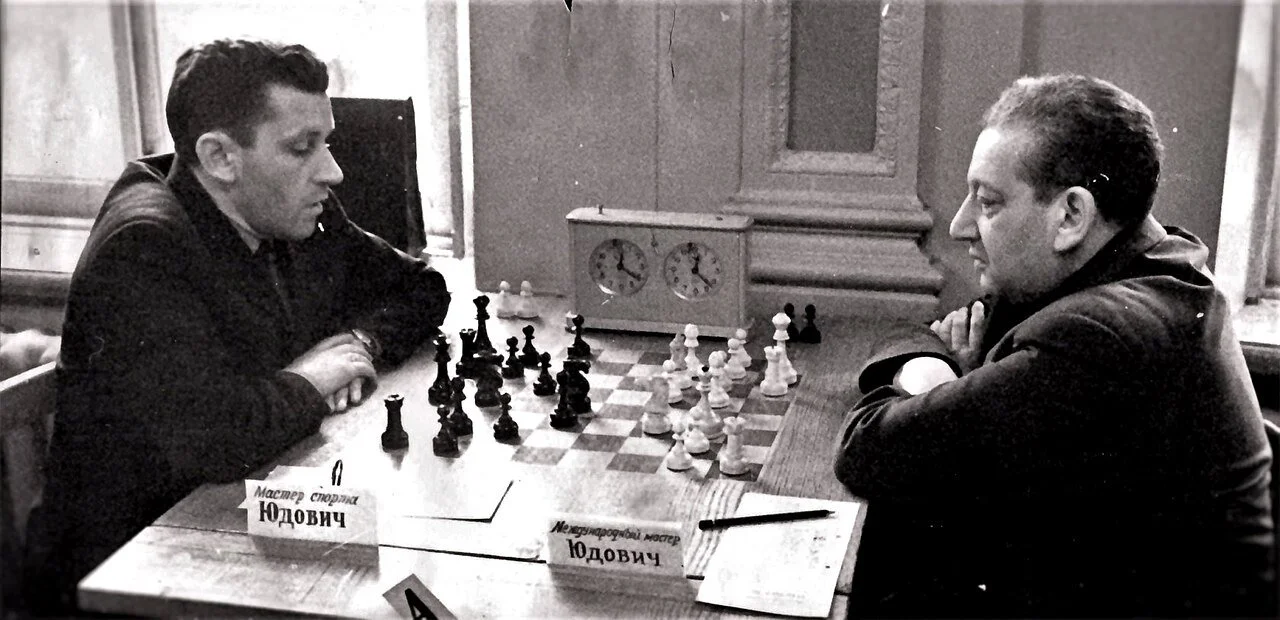
Mikhail Mikhailovich Yudovich (Russian: Михаил Михайлович Юдович; 1911-1987) occupied an unusually broad place in Soviet chess. At the board, he was one of the leading Moscow masters of the 1930s, played in six USSR Championship finals, shared third through sixth in the 1931 championship, and defeated Reuben Fine in 1937. Away from conventional tournament play, he became a correspondence grandmaster, senior editor, arbiter, coach, television instructor, and author and compiler of a substantial body of chess literature. For forty-two years, from 1945 until his death, he served as deputy editor-in-chief of Shakhmaty v SSSR (Chess in the USSR).
Yudovich joined competitive strength with sustained analytical and institutional work. He carried the habits of serious chess inquiry into magazines, books, youth programs, correspondence teams, television lessons, and teaching plans. His tournament results establish him as a strong Soviet master. The historical significance of the full career lies in his influence on the institutions through which chess knowledge was transmitted.
One preliminary caution is essential. His son, Mikhail Mikhailovich Yudovich Jr. (1932-1992), also became a Soviet master and an important trainer. Online biographies sometimes assign the younger man’s pupils and results to his father. This profile concerns Yudovich Sr.; the birth year or the designation “Sr.” is indispensable when checking Russian records because father and son had the same patronymic.
Early Life and Chess Formation
Standard chess references give Yudovich’s birth as 8 June 1911 in Roslavl, in the Smolensk Governorate of the Russian Empire. His grandson Anton Yudovich reports that a rabbinical register found during family research gives 1 June instead. Because the register itself is not reproduced on the family site, 8 June remains the conventional published date, while 1 June should be recorded as a plausible family-archival correction rather than an established replacement. The surviving biographical record identifies his family as Jewish. A signed entry by Nikolai Mitrofanov for the Moscow Union of Journalists describes Yudovich’s father as a specialist in the protection and regeneration of forest lands. Details about the parents’ names and his father’s later life vary among family and reference sources, so greater precision would outrun the evidence.
Yudovich’s formal education is similarly unclear. Some modern sports-history profiles state that he graduated from Moscow State University, yet accessible sources do not supply a faculty, degree, year, or university record. The claim therefore remains provisional. Education details for his namesake son are well documented and may have encouraged later conflation.
The formation of Yudovich the chess player is much better attested. In Smolensk he developed alongside his school friend Sergei Belavenets under Konstantin Vygodchikov, Belavenets’s uncle and a strong master of the older Russian school. Specialist writers later called the two boys the “Smolensk twins.” Yudovich’s own recollection describes meetings at Vygodchikov’s apartment where the pupils held private tournaments, tested variations, and analyzed the games of leading masters. He affectionately called it their Smolensk chess “academy.” The account records a formative culture of testing and comparison, habits later echoed in the independent-thinking maxim attributed to Yudovich’s teaching.
The relationship with Belavenets lasted beyond their provincial apprenticeship. By 1930, Yudovich was competing successfully in Moscow, where he shared fifth through ninth in the city championship. In 1931 he finished fourth in Moscow and earned the Soviet master title. A provincial chess education had carried him into the Moscow master ranks.
Rise in Competitive Chess
Yudovich’s national breakthrough came at the seventh USSR Championship in Moscow in 1931. At twenty, and in his first national final, he scored 10 points from 17 games and shared third through sixth with Boris Verlinsky, Vladimir Alatortsev, and Fedir Bohatyrchuk. Mikhail Botvinnik won the event and Nikolai Riumin finished second. Some crosstables place Yudovich fifth after tie-breaking conventions, but the historically accurate description is a four-way tie for third through sixth. It remained his best result in a USSR final.
The following decade established him as a durable member of the Moscow master group. He shared second and third in the 1933/34 Moscow Championship, finished fourth in 1935, shared third through fifth in 1936, and took clear third in 1937. His record in the USSR Championship was less consistent. He played six finals between 1931 and 1947, finishing in the middle or lower part of the field after his debut success. In the 1937 final, he led after nine rounds before falling to ninth place. The contrast in his results is revealing: he could compete evenly with the strongest domestic masters over long stretches, yet he did not reliably reproduce his best Moscow form in national finals.
The most famous single result of his conventional tournament career came in the Moscow international tournament of March 1937. Reuben Fine, then one of the strongest players in the world, won the event with 5 points from 7. Yudovich scored 3 and shared fifth and sixth, with a victory over Fine that proved to be the winner’s only defeat. Their game entered the literature because Yudovich met Fine’s ambitious play with accurate tactics in a sharp position. It supplies firmer evidence of tactical resourcefulness than any broad label such as “attacking player” or “positional player.” The sources consulted do not assign Yudovich a simple stylistic category, and one should not be manufactured from a small sample of surviving games.
War interrupted this competitive phase. Russian biographical and official commemoration sources report that Yudovich enrolled in the Moscow people’s militia after the German invasion in 1941. The Red Army’s Main Political Directorate then assigned him to the editorial staff of Voennaya Mysl (Military Thought). No contemporaneous personnel document was located for this article, so the account is best understood as a consistently reported service record rather than independently reconstructed wartime history.
Yudovich returned to the USSR Championship final in 1947 and scored 8 from 19. In the inaugural USSR team championship of 1948, he placed first on the ninth board for the victorious Moscow team, as recorded in the event archive. FIDE included him among its International Masters in 1950, followed by the international arbiter title in 1951. He continued to compete for many years. At Baku in 1964, his last international tournament, the fifty-three-year-old master scored 7 from 12 and shared fourth and fifth. Domestic club records document later appearances, so Baku marks the end of his international schedule only.
Major Career Achievements
Yudovich’s strongest late competitive achievements came by correspondence. This discipline rewarded qualities already visible in his apprenticeship and professional work: methodical research, opening knowledge, accurate calculation, and the patience to revisit an analysis. The International Correspondence Chess Federation awarded him the correspondence International Master title in 1961 and the grandmaster title in 1972. The official ICCF register gives 1972, whereas 1973 appears in some secondary English-language references.
He won the seventh USSR Correspondence Championship, played in 1965-66. He was also a remarkably persistent member of Soviet correspondence Olympiad teams. Across six finals, the USSR won gold in the third, fourth, sixth, seventh, and eighth Olympiads and silver in the fifth. Yudovich achieved three individual first-place board results during that sequence, including 5½ from 8 on first board in the sixth Olympiad final. The official ICCF records therefore support the description “five-time world team champion” more precisely than a generic claim of correspondence strength.
His individual international high point was the seventh World Correspondence Championship final, which began in 1972. Yudovich scored 9½ from 16 and finished sixth on the Sonneborn-Berger tie-break, level on points with fifth-placed Jerzy Krzysztoń. He lost only once. This result, achieved after his sixtieth birthday against a specialist field, ranks among the clearest demonstrations of his analytical endurance.
Yudovich himself identified his 1939 USSR Championship victory over former Soviet champion Grigory Levenfish as a particularly memorable over-the-board game. When he annotated it for the Latvian magazine Shakhmaty in 1966, his notes emphasized concrete alternatives, changing plans, and the practical logic of the position. Those annotations and the correspondence record support a cautious characterization: he valued disciplined analysis but remained willing to enter tactical complications when the position required them.
Style and Reputation
Yudovich’s playing identity was broader than a stock stylistic label. The Fine victory shows alertness in complications; his Moscow results show that this was not an isolated upset; his correspondence career shows the depth and persistence of his analysis. His instructional writing repeatedly returned to openings, planning, and the relationship between strategic ideas and concrete calculation. These subjects illuminate his conception of chess, though they cannot by themselves prove that every tournament game followed the same pattern.
His competitive limitation was consistency at the highest domestic level. The shared third-place group in 1931 suggested the possibility of an over-the-board grandmaster career, while his five later USSR finals produced no comparable finish. He never received the FIDE grandmaster title. Colleague Mikhail Beilin later interpreted that outcome as a consequence of how Yudovich distributed his energy across editing, writing, administration, training, and correspondence play. This is a contemporary’s retrospective judgment rather than a demonstrable explanation. It nevertheless fits the scale of Yudovich’s non-tournament work.
Beilin remembered the elder Yudovich as possessing an “inexhaustible reserve of energy.” He described an editor who was demanding toward subordinates, worked without apparent strain, and used humor without malice. The recollection fits Yudovich’s forty-two-year editorial tenure and the number of projects bearing his name. It also helps explain his reputation as an institutional worker whose presence was felt across several parts of Soviet chess at once.
That editorial regime also attracted criticism. Peter Romanovsky’s private letters of 1952 and 1954, first published in Shakhmatnyi Peterburg in 2002 and 2003 and later reproduced by chess historian Sergey Voronkov, attacked the magazine’s bureaucratic culture and accused chief editor Vyacheslav Ragozin and Yudovich of interfering in instructional work. Romanovsky also faulted the methods of several instructional authors, Yudovich among them. These letters document one serious professional conflict from Romanovsky’s point of view; they cannot establish a wider consensus.
Contributions Beyond Tournament Play
Yudovich began teaching young players before the war. When the chess section of the Moscow City House of Pioneers was established in 1936, he and Belavenets were among its first instructors. Yudovich later recalled that they had to devise their own curricula and lesson plans. Their stated aim was to cultivate lasting respect for chess; immediate results were secondary. Yuri Averbakh, who went on to become a grandmaster, endgame authority, and editor, explicitly named Yudovich as one of his teachers. A later institutional biography attributes to Yudovich a simple and rigorous maxim: accept nothing on faith and reach conclusions through one’s own thought.
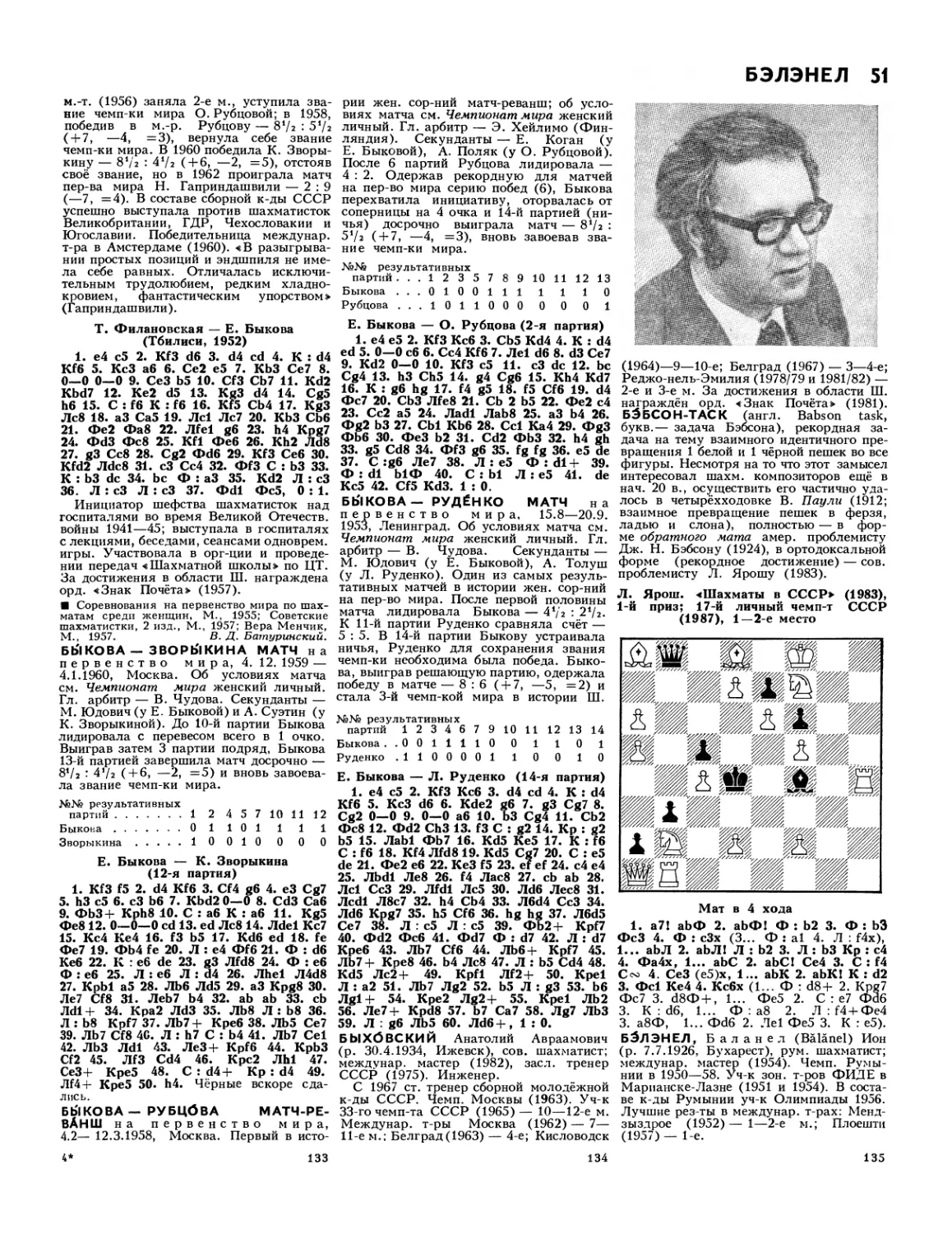
This early educational work continued in several forms. Yudovich received the title Honored Coach of the RSFSR in 1958. The Karpov-edited Chess Encyclopedic Dictionary (1990) identifies M. Yudovich as Elizaveta Bykova’s second in her successful 1959/60 women’s world championship match against Kira Zvorykina. The Great Russian Encyclopedia corroborates the identification by naming the Honored Coach of the RSFSR, M. M. Yudovich, among Bykova’s seconds. He later taught the advanced class on Central Television’s long-running program Shakhmatnaya shkola (Chess School). Russian federation and state sports sources also credit him with organizing Belaya ladya (White Rook), the influential school-team competition. A surviving founding-committee document has not been located, so “one of the organizers” is the appropriate formulation.
His central professional position was at Shakhmaty v SSSR. From 1945 to 1987 he was deputy editor-in-chief, never chief editor. The distinction matters, as does the duration. The magazine was a principal vehicle for tournament reports, annotated games, opening analysis, historical writing, and instruction. Yudovich’s four decades in its senior editorial staff placed him at a junction between elite analysis and the mass readership. According to Mitrofanov's biographical entry, he also served on the presidium of the USSR Chess Federation.
His books show the same range. With Ilya Maizelis he produced Fundamentals of Opening Strategy (1940) and a Textbook of Chess (1948). With Alexander Kotov he wrote The Soviet School of Chess (1951; revised 1955), an influential synthesis of history, instruction, and Soviet institutional self-description. The book remains useful, while its claim that Soviet success expressed a unified and superior “school” reflects the official rhetoric of its period. Its instructional and ideological aspects both merit attention.
Yudovich also compiled tournament books and accounts of major matches, wrote the accessible Entertaining Chess (first published in 1962), surveyed the King’s Indian Defense in 1967, and coauthored Chess School with Averbakh and Kotov in 1976. Shortly later, manuals such as The Gambit (1980) and The Plan in a Chess Game (1982) distilled difficult subjects for club players. His Mikhail Chigorin: Life and Work (1985) demonstrates a sustained interest in chess biography and historical memory.
One lesser-known publication reveals how systematically he approached chess education. In 1984, the Znanie Society issued his Foundations of Chess Culture, a model two-year syllabus and organizational guide for public “universities of chess culture.” It was designed to prepare instructors, coaches, and arbiters as well as players. This small booklet connects his teaching, editorial, theoretical, and organizational work more clearly than any single tournament result.
His output also clarifies the relationship between chess theory and popularization in his career. Yudovich wrote about openings and planning, edited current tournament material, taught children and adult competitors, and designed programs for future instructors. His published record locates his theoretical contribution in explanation, synthesis, and circulation.
Historical Legacy
Yudovich died in Moscow on 19 September 1987. He had remained deputy editor of Shakhmaty v SSSR through that year. His death closed a career that extended from the regional chess circles of the 1920s to the mature educational and publishing system of late Soviet chess.
His legacy has sometimes been obscured by the tendency to measure importance mainly by world-championship proximity and over-the-board grandmaster titles. Yudovich’s 1931 result and long Moscow record establish genuine competitive stature, while his later correspondence record reached grandmaster level in its own right. Confusion with his son creates another problem. The younger Mikhail Yudovich trained several later elite players; those pupils should not be transferred to the father. The elder man’s documented students and educational influence already form a substantial record, beginning with Averbakh and the first generation of the Moscow House of Pioneers.
Mikhail Yudovich deserves attention today because he joined high-level play to the patient work by which a chess culture sustains itself. He tested ideas in tournaments and correspondence play, explained them in books and periodicals, taught them to children and adult competitors, and helped build institutions that passed them on. His shared third place in the 1931 USSR Championship confirms his playing strength, and his correspondence titles document analysis that remained formidable past sixty. Four decades of editorial and educational work explain the unusually long reach of his influence.
Notes and Sources
Russian Chess Federation, “Mikhail Yudovich”. The strongest concise institutional overview of his tournament, correspondence, editorial, literary, youth, and White Rook work.
Russian State Sports Encyclopedia, Yudovich entry. Confirms titles, six USSR finals, editorial tenure, coaching distinction, correspondence championship, and organizational roles.
Anton Yudovich, Yudovich-Adaskin family history. Family testimony for the proposed 1 June 1911 birth date and family background. The underlying rabbinical record is not reproduced, so the date remains uncorroborated.
Russian Chess Federation, Sergei Belavenets profile. Includes Yudovich’s own recollections of Vygodchikov’s Smolensk “academy” and the early House of Pioneers teaching program.
Moscow Palace of Pioneers, “Origins and Traditions,” PRO_DOD special issue (2022), p. 263. This institutional history says Yudovich Sr. and Belavenets were among the chess club’s first coaches after it opened in 1936. See also the Moscow city government’s school history.
OlimpBase, 1931 USSR Championship crosstable. Gives Yudovich’s 10/17 score and the four-player tie on 10 points. See also the later USSR final crosstables in OlimpBase’s Soviet championship archive.
Alexey Popovsky’s Russian Chess Base, Moscow international tournament 1937. Crosstable confirming Fine’s 5/7 victory and Yudovich’s win over him.
Official Moscow People’s Militia portal, Yudovich personnel entry. Supports the reported militia service and records his prewar occupation as a chess-circle instructor.
ICCF player register, Mikhail Mikhailovich Yudovich. Authoritative for the correspondence IM title in 1961, GM title in 1972, and Olympiad record. Its estimated biographical death date is erroneous and has not been used here.
ICCF, seventh World Correspondence Championship final. Official crosstable giving Yudovich 9½/16 and sixth place on tie-break.
Google Books catalogue, Kotov and Yudovich, The Soviet School of Chess. Bibliographic record for the expanded 1955 Russian edition; the first edition appeared in 1951. The work should be read with attention to its instructional content and its official cultural argument.
Russian State Public Scientific Technical Library, Averbakh and Chess School. Documents Averbakh’s early training under Yudovich, attributes to Yudovich the maxim about independent thought, and records his television teaching.
Mikhail Beilin, memoir excerpt on Yudovich Sr. and Jr., from Moi vstrechi v shakhmatnom korolevstve (Moscow: Terra-Sport, 2003), pp. 305-306. Firsthand evidence for Yudovich’s editorial character, energy, humor, and contemporary reputation.
Douglas Griffin, “Yudovich-Levenfish, 11th USSR Championship, Leningrad 1939”. Reproduces and translates Yudovich’s 1966 annotations. Griffin’s surrounding biographical note understates the number of USSR finals and gives the secondary 1973 correspondence-GM date; only the primary game commentary is relied upon here.
Nikolai Mitrofanov, Moscow Union of Journalists biographical entry. A signed Russian biographical account supporting the family occupation, wartime service, federation-presidium role, and death details.
Yudovich, Foundations of Chess Culture (1984), digitized copy. Primary bibliographic and content evidence for his two-year public teaching syllabus. The Russian State Library catalogue records the expanded 2000 edition of the coauthored Chess School.
Sergey Voronkov, “‘Bu-bu-bu’ dereviannogo chelovechka”. Reproduces and discusses Peter Romanovsky’s private correspondence, first published in Shakhmatnyi Peterburg in 2002 and 2003. The letters criticize the editorial culture of Shakhmaty v SSSR, the interventions of Ragozin and Yudovich, and methodological faults Romanovsky perceived in several authors’ instructional work.
Chess Encyclopedic Dictionary, ed. Anatoly Karpov (Moscow: Sovetskaya entsiklopediya, 1990), p. 51. The entry “Bykova-Zvorykina Match” identifies M. Yudovich as Bykova’s second and Alexey Suetin as Zvorykina’s; the relevant scan is image 53. This is an authoritative retrospective reference, not a contemporary appointment record.
Editorial note on names and dates
Russian and international catalogues use Mikhail Yudovich, Mikhail Yudovitch, and M. M. Iudovich. Searches should include “Sr.” or Russian “старший” to exclude his son. This article follows the conventional birth date of 8 June 1911 while recording the family claim for 1 June. It follows the official ICCF register in dating his correspondence grandmaster title to 1972.