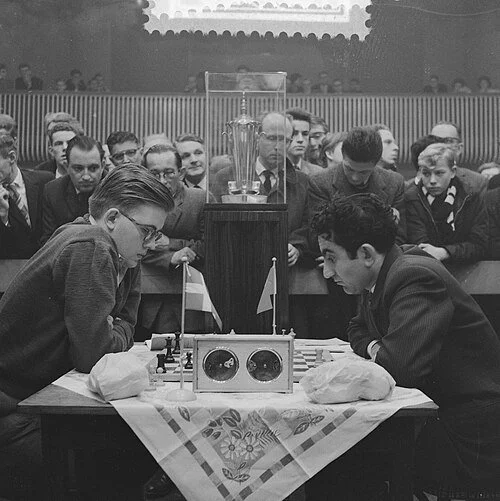
Bent Larsen in play against Tigran Petrosian. By Herbert Behrens / Anefo
On January 17, 1960, Bent Larsen sat down in Beverwijk needing a draw to win the Hoogovens chess tournament. Across the board, Tigran Petrosian needed to beat him. Dutch photographer Herbert Behrens caught the two men leaning over the pieces, each resting his cheek on one hand. Between them, beyond the clock, stood the trophy in a glass case. Behind it, spectators had crowded in several rows deep. Petrosian won in 45 moves. He and Larsen shared first place with 6½ points from nine games.1
Neither man had been on the original list of players. The field changed after Max Euwe, Friðrik Ólafsson and Gideon Ståhlberg withdrew. In their places came Larsen and two grandmasters from the Soviet Union, Petrosian and Salo Flohr. It was the first time Soviet representatives had played in the premier group. All three replacements entered the last three rounds with a chance to win.2
A steel town’s January tournament
The tournament that chess players now associate with Wijk aan Zee was still held in Beverwijk in 1960. The grandmasters played at the Kennemer Theater on the Zeestraat. The Dutch steel company Hoogovens backed the event, and its chess club organized the first edition in 1938. The club was part of a wider experiment in the industrial district around IJmuiden. The company helped finance local sport, and people with no connection to the works could join the clubs. Chess players from abroad first entered the main tournament in 1946. By the time Petrosian arrived, the organizers were staging their twenty-second edition.3
Larsen left an unusually practical account of what it cost to play there. Writing for the Copenhagen Chess Union, he told Danish players that a trip to Beverwijk need cost little more than playing in an Easter tournament at home. The journey was dearer, but the visitors lodged in private homes. He counted fifteen groups of ten players, with another eighty people playing in groups of four over the final three days. About fifty visitors had come from roughly fifteen countries. To Larsen’s surprise, he was the only Scandinavian.4
The players Beverwijk invited
Petrosian arrived as the reigning Soviet champion. A year earlier he had won the national title in his native Tbilisi. That autumn he finished third in the Candidates Tournament in Yugoslavia, behind Mikhail Tal and Paul Keres. He was thirty. Flohr, at fifty-one, had a Dutch chess history of his own. In 1932, when he represented Czechoslovakia, he had played a sixteen-game match against Euwe. It finished 8–8. By 1960 he was also familiar to Soviet readers as the chess columnist for the illustrated weekly Ogonyok.5
Larsen was twenty-four and already a grandmaster, a title he had earned playing first board for Denmark at the 1956 Moscow Olympiad. His previous visit to Beverwijk had gone poorly. In 1959 Ólafsson won the tournament with 7½ out of 9. Larsen scored four and finished eighth. Several men who had taken points from him that year were back, among them the Dutch champion Jan Hein Donner, who had drawn with him, and Johan Barendregt, who had beaten him.6
The ten invitees played a single round robin from January 7 to 17, each facing every other player once. The field included Yugoslavia’s Aleksandar Matanović, who had won at Beverwijk in 1957, and the Spanish master Román Torán. Theo van Scheltinga and Hans Bouwmeester joined Donner and Barendregt among the Dutch players. On January 7, Anefo photographer Joop van Bilsen recorded Petrosian’s meeting with Van Scheltinga, who held the Soviet champion to a draw. Donner’s opening opponent was Hoan Liong Tan, an Indonesian mathematics student. They drew. A year later he beat Donner in the first round of the Dutch championship and went on to win the title.7
Larsen recovers from an opening loss
Matanović beat Larsen in the first round and beat Tan again. Three draws followed, and after five rounds he was still undefeated on 3½. Flohr had the same score, with wins against Donner and Tan. Larsen had already caught both of them. In the four games after his opening loss, he had beaten Van Scheltinga, Tan and Torán, conceding only a draw to Bouwmeester. Petrosian trailed the three leaders by half a point. Barendregt was the only opponent he had beaten.8
The Danish federation’s magazine, Skakbladet, picked out the Torán game as an example of what made Larsen difficult to prepare for. He opened by advancing his king’s bishop’s pawn and, two moves later, pushed his b-pawn two squares. The magazine called the mixture a “Bird-orangutan,” after the two openings Danes would have recognized in it. Torán thus faced an unfamiliar problem by his third move. When Larsen wrote his own account, he said that setting his opponents difficult problems was the part of his play that had pleased him.9
Flohr’s game against Larsen in round seven gave the tournament one of its sharpest turns. Playing Black, Larsen again varied his opening play early. According to Skakbladet, Flohr used up his time and lost on his thirty-first move. It was Flohr’s only defeat in Beverwijk. Petrosian had meanwhile beaten Tan and Bouwmeester in succession. With two rounds left, Larsen led him by half a point.10
Larsen then beat Donner. Petrosian drew with Flohr, and the gap widened to a full point. The tournament still had a third possible winner. Matanović, who had yet to lose, beat Barendregt to reach 5½, level with Petrosian. If Petrosian beat Larsen and Matanović beat Donner, all three men would finish on 6½. The spectators gathering around the trophy had reason to keep an eye on Donner’s board as well.11
Two games settle first place
Larsen had Black against Petrosian. He chose an Old Indian Defense and found his pieces short of room. The game turned on a decision in the middlegame. Larsen gave up a rook for a knight and obtained a pawn as well. Petrosian still had both rooks. He doubled them on the open c-file, then sent one into the seventh rank. His surviving rook returned to c7 on move 45. Larsen resigned. In the American magazine Chess Review, Hans Kmoch later chose the game for instruction. His title, “A Game for the Wallboard,” suggests how readily a teacher could show a roomful of players what Petrosian had achieved.12
Donner beat Matanović, who finished alone in third with 5½. Donner’s victory brought him level with Flohr on 5. Van Scheltinga scored 4½, Bouwmeester 4, Torán 3, and Barendregt and Tan 2½ each. Petrosian had won four and drawn five. Larsen had won six games, more than anyone else in the field. His two losses came in the first and last rounds. Bouwmeester was the only player to draw with him.13
A sixteen-year-old wins the women’s tournament
In the women’s group, Katarina Jovanović of Yugoslavia won outright at sixteen. Her 7 out of 9 included victories over both of her closest rivals, Corry Vreeken and Rie Timmer of the Netherlands. Vreeken finished a point behind her. Jovanović also defeated France’s Chantal Chaudé de Silans and drew with the experienced Dutch champion Fenny Heemskerk. She went through the tournament undefeated.14
The Soviet editors who printed the decisive Petrosian game devoted the last lines of their Beverwijk report to Jovanović. What caught their attention was her age and the company she kept. Readers who followed women’s chess would encounter her again under her married name, Katarina Blagojević. At the 1963 Women’s Chess Olympiad in Split she scored 3 out of 4 as Yugoslavia won silver on home ground.15
Beverwijk in print
The Dutch-language Amigoe di Curaçao carried the result the day after the final round. Its sports column singled out Petrosian’s unbeaten score. In Copenhagen, Larsen noticed how much space the leading Dutch newspapers had given to chess and wished the Danish papers would do the same. Of the result itself he wrote, “I had actually intended to take first place alone.” Given Petrosian’s Soviet title and his third place in the Candidates, Larsen saw little disgrace in sharing.16
Petrosian defeated Mikhail Botvinnik for the world championship in 1963. A year later two more Soviet players, Paul Keres and Iivo Nei, shared first at Beverwijk. For Larsen, the sequel came sooner. The man who had finished eighth in 1959 and come back as a replacement in 1960 returned the following January. He shared first again, this time with Borislav Ivkov.17
Notes
Herbert F. Behrens, “Beslissing Hoogovenschaaktoernooi,” Beverwijk, January 17, 1960, Nationaal Archief, Fotocollectie Anefo, 2.24.01.03, negative 910-9525. For the result and the complete final game, see “Петросян и Ларсен” [Petrosian and Larsen], Шахматы в СССР [Chess in the USSR], no. 4 (April 1960), 123. Nationaal Archief photograph · Original Russian report, p. 123.
“Beverwijk-turneringen,” Skakbladet 56, no. 2 (February 1960), 18–19, names the original invitees who withdrew and the three grandmasters who took their places. “Петросян и Ларсен,” 123, identifies Petrosian and Flohr as the first Soviet entrants. Danish tournament report, pp. 18–19 · Original Russian report, p. 123.
Jan de Wildt, Hoogovens als werkgemeenschap: Over de invloed van Hoogovens op de samenleving (Beverwijk: Museum Kennemerland, 2019), 7–8. For the Kennemer Theater, the first international edition and the 1968 move to Wijk aan Zee, see the account by Toeristen Informatie Punt Wijk aan Zee, reproduced by the Rob Scholte Museum. Museum Kennemerland study · Dutch account of the venue and move.
Bent Larsen, “Turneringen i Beverwijk,” K.S.U.-Nyt 6, no. 1 (January–February 1960), item 10, final page of the issue. The group sizes, approximate number of visitors and remarks on lodging are Larsen’s own. Larsen’s signed account, scan 8.
ChessPro, “Тигран Петросян” and “Макс Эйве,” career records. The Russian State Public Scientific and Technical Library’s Center for Chess Culture and Information records Flohr’s work for Ogonyok from 1951. Petrosian’s career record · Euwe’s match record · Russian library profile of Flohr.
Dansk Skak Union, “Bent Larsen er død,” September 10, 2010. For Larsen’s 1959 opponents and results, see Belgian Chess History, “21st Hoogoven Tournament, Beverwijk,” drawing its crosstable from Československý šach, no. 4 (1959). Danish Chess Union biography · 1959 Beverwijk results.
Belgian Chess History, “19th Hoogoven Tournament, Beverwijk,” January 1957. For Tan, see Max Euwe Centrum, “Geschiedenis NK Schaken 1909–1970,” entry for 1961. The 1960 Soviet report lists him as representing Indonesia. Joop van Bilsen, opening of the 22nd Hoogovens tournament, January 7, 1960, Nationaal Archief, Anefo 910-9240. 1957 Beverwijk results · Max Euwe Centrum championship history · Opening-day photograph · Original Russian report, p. 123.
Tata Steel Chess historical archive, “Hoogovenstoernooi 1960,” round results, rounds 1–5. The intermediate totals are calculated from the individual results. Contemporary confirmation of Matanović’s opening win appears in Skakbladet, 18. OlimpBase preserves the game scores. Its file breaks off during Donner versus Bouwmeester and omits Donner’s win. Both 1960 magazines give his correct total. Danish tournament report, pp. 18–19 · Game scores (PGN).
“Beverwijk-turneringen,” 18, identifies the opening against Torán as a “Bird-orangutan.” Larsen, “Turneringen i Beverwijk,” describes his choice of problems for his opponents. Danish tournament report, pp. 18–19 · Larsen’s signed account, scan 8.
“Beverwijk-turneringen,” 18–19. The annotations end with Flohr exceeding his allotted time on move 31. The Soviet report records the half-point gap after the seventh round. Danish tournament report, pp. 18–19 · Original Russian report, p. 123.
Tata Steel Chess historical archive, “Hoogovenstoernooi 1960,” rounds 7–9. The possibility of a three-way tie follows from the scores before the last round. For the two leaders’ penultimate-round results and the concluding game, see “Петросян и Ларсен,” 123. Original Russian report, p. 123 · Game scores (PGN).
Hans Kmoch, “A Game for the Wallboard,” Chess Review 28, no. 4 (April 1960), 119. The April Soviet report also prints the full score through Petrosian’s last rook move. Kmoch’s annotations, p. 119 · Original Russian report, p. 123.
“Петросян и Ларсен,” 123, and “Beverwijk-turneringen,” 18. Both contemporary reports give Donner and Flohr 5 points. The counts of wins, losses and draws agree with the organizers’ round results. Original Russian report, p. 123 · Danish tournament report, pp. 18–19.
Belgian Chess History, “22nd Hoogoven Tournament, Beverwijk,” women’s crosstable, citing Magyar sakkélet, no. 2 (1960), and the tournament bulletin. For the Dutch names Corry Vreeken and Rie Timmer, see the Dutch championship register. Women’s tournament results · Dutch championship register.
“Петросян и Ларсен,” 123, closing paragraph. OlimpBase, “2nd Women’s Chess Olympiad, Split 1963,” Yugoslav team scorecard, lists Jovanović-Blagojević as reserve and gives her individual results. Original Russian report, p. 123 · Yugoslav team and individual scores at Split.
“Sportvaria,” Amigoe di Curaçao, January 18, 1960, 8. Larsen, “Turneringen i Beverwijk,” item 10. The quoted sentence is translated from the Danish. Dutch newspaper, p. 8 · Larsen’s signed account, scan 8.
OlimpBase, “23rd Hoogovenstoernooi, Beverwijk 1961.” Armenian Museum of Moscow, “«Железный Тигран»,” June 17, 2020. Belgian Chess History, “26th Hoogoven Tournament, Beverwijk,” 1964 crosstable. 1961 Beverwijk results · Armenian Museum of Moscow profile · 1964 Beverwijk results · Organizers’ roll of winners.
