Leonid Stein
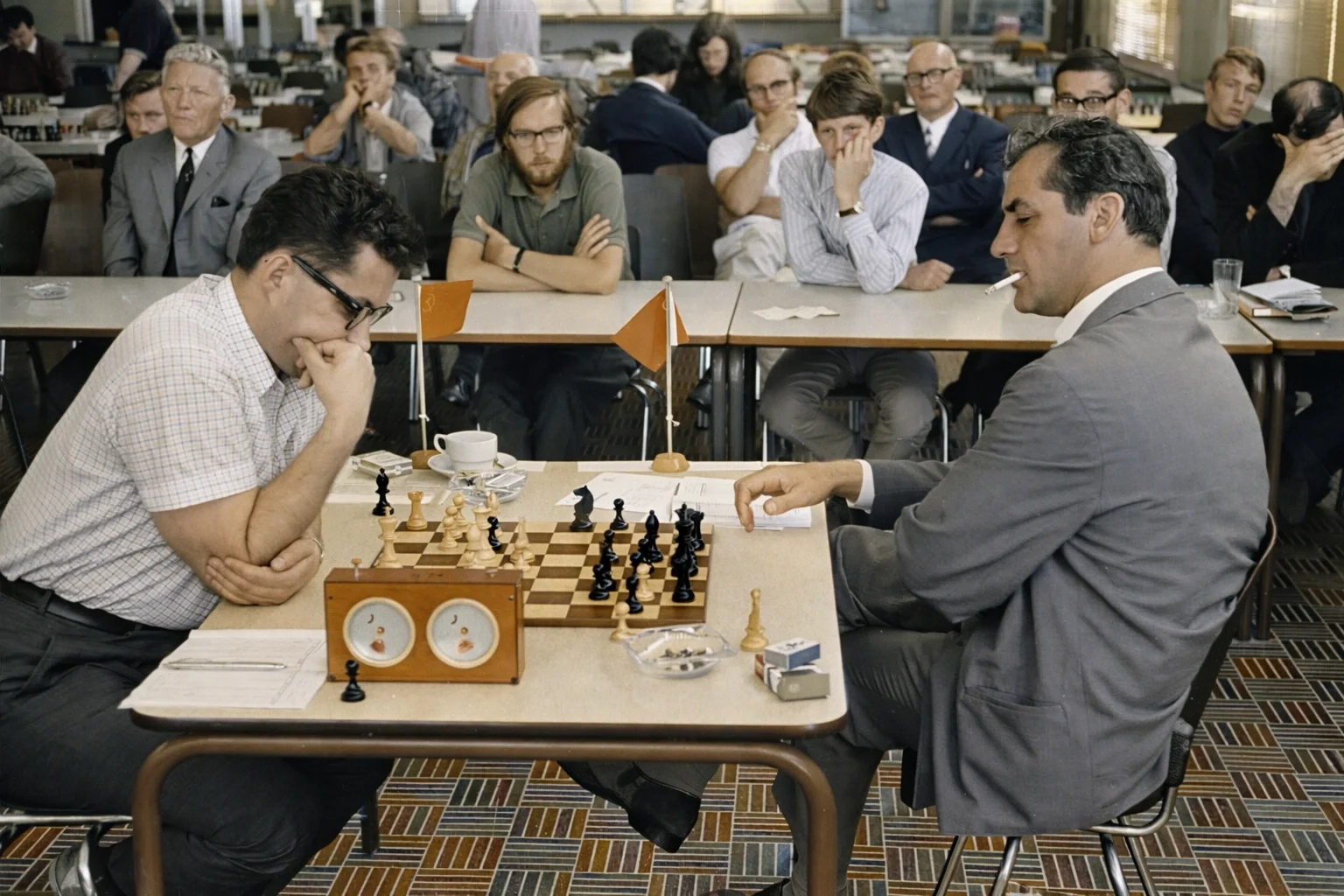
(Luděk Pachman?) left, and Leonid Stein (right)
Leonid Zakharovych Stein (1934–1973) was a Soviet chess grandmaster from Ukraine and one of the world’s leading players of the 1960s. He won the USSR Championship three times (1963, 1965, 1966) during that decade, an achievement that underscored the depth of his talent in the Soviet chess arena. Renowned for his dynamic attacking style, Stein was a fixture among the global top ten players of his era. Despite his success, he never got the opportunity to play for the World Championship – a fate largely due to external factors and his untimely death at age 38. Nevertheless, Stein’s name endures as a symbol of unfulfilled potential and brilliant chess artistry in the history of the game.
Early Life and Chess Beginnings
Leonid Stein was born on November 12, 1934, in Kamianets-Podilskyi, in the Ukrainian SSR (Soviet Union). As a young man he served in the Soviet Army, where his chess skills developed relatively late by elite standards. In both 1955 and 1956, Stein tied for first in the USSR’s Army Championship, demonstrating considerable talent even before formally achieving master status. He earned the national Master title at the age of 24 – unusually late for a future grandmaster – but quickly proved that he belonged among the best. By 1959, Stein had qualified for the finals of the USSR Championship, and in the following years he twice won the Ukrainian national championship (1960 in Kyiv and 1962). His ascent continued with international team experience: in 1961, Stein played top board for the Soviet student team at the World Student Olympiad in Helsinki, scoring +8 −1 =3 and helping the USSR secure the team gold. These early successes marked Stein as a rising star in the intensely competitive Soviet chess scene.
National and International Successes
Stein’s breakthrough on the national stage came in the 1961 USSR Championship in Moscow, where he tied for third place, notably defeating Tigran Petrosian (who would soon become World Champion) along the way. The next few years saw Stein dominate Soviet chess. He captured his first USSR Championship title at Leningrad 1963 after a playoff, having finished tied for first with Boris Spassky and Ratmir Kholmov. He went on to win two more Soviet titles – outright at Tallinn 1965 and again at Tbilisi 1966 – making him a three-time Soviet champion in just a four-year span. Such a hat-trick was a remarkable feat given the depth of competition in the USSR, and it firmly established Stein among the country’s chess elite.
Stein proved equally formidable in international events. In 1967 he famously won the super-strong Moscow International Tournament, held to mark the 50th Anniversary of the October Revolution. In doing so, Stein topped a field that included the reigning World Champion Tigran Petrosian, two former World Champions (Vasily Smyslov and Mikhail Tal), as well as other legends like Boris Spassky and Paul Keres. A few years later, he triumphed again in Moscow at the 1971 Alekhine Memorial, tying for first place with a young Anatoly Karpov. These Moscow victories were considered among the strongest tournaments ever held up to that time. Beyond Moscow, Stein amassed an impressive list of tournament wins across Europe: he took or shared first place at Sarajevo 1967, Hastings 1967–68, Kecskemét 1968, Tallinn 1969, Pärnu 1971, and Las Palmas 1973 (the latter tied with former World Champion Petrosian). From the mid-1960s until his death in 1973, Stein was consistently at or near the pinnacle of international chess.
Team competitions also highlighted Stein’s career. He represented the Soviet Union in two Chess Olympiads, contributing to team gold medals at Tel Aviv 1964 and Havana 1966. At Tel Aviv, Stein scored an excellent 10/13 and earned an individual gold medal on the reserve board, while in Havana he posted 9/12 on board four (earning an individual silver) – performances that helped the Soviet team secure victory in both events. Stein was equally effective in European team play, aiding the USSR’s wins at the European Team Championships of 1965 in Hamburg and 1970 in Kapfenberg. He even took part in the iconic 1970 USSR vs. Rest of the World match in Belgrade as an alternate; although he only played one game (a loss to Grandmaster Bent Larsen), his inclusion in the squad reflected the high regard in which he was held. In sum, Stein’s list of achievements – national titles, international tournament victories, and team golds – place him among the most successful players of the 1960s.
World Championship Aspirations
Despite his outstanding tournament record, Stein’s road to the World Championship was fraught with frustration. In the 1962 Stockholm Interzonal (the qualifying tournament for the Candidates), Stein delivered a strong performance, finishing tied for 6th–7th – a position normally sufficient to advance. However, a FIDE rule in effect at the time limited the number of players from any single country who could qualify, and three of Stein’s fellow Soviets (Petrosian, Geller, and Korchnoi) placed just ahead of him, filling the quota. Consequently, Stein was denied a spot in the Candidates’ Tournament despite his high finish. A similar misfortune befell him at the Amsterdam Interzonal in 1964: Stein scored 16½/23 for clear fifth place, which would have qualified him under usual circumstances, but again three Soviets (Tal, Smyslov, and Spassky) occupied the top slots, blocking his advancement under the same quota rule.
Stein came heartbreakingly close yet again in the Sousse Interzonal of 1967. There he tied for 6th–8th, which led to a three-way playoff in Los Angeles against Samuel Reshevsky (USA) and Vlastimil Hort (Czechoslovakia) for a single Candidates spot. Stein was considered the favorite, but after the round-robin tiebreak match ended deadlocked, Reshevsky was awarded the final Candidates berth on tiebreak points. Thus, for the third time in a row, Stein’s world title ambitions were dashed at the final hurdle. By the early 1970s, however, his continued elite results made him a serious contender in the next championship cycle. He duly qualified for the 1973 Interzonal in Petropolis, Brazil, and many observers believed Stein could win the Candidates and challenge for the crown. Tragically, fate intervened – in July 1973, just weeks before the Interzonal, Leonid Stein died of a heart attack at age 38, cutting short his world championship aspirations forever. His premature death meant that one of the era’s most formidable grandmasters never got his shot at the title, a fact still lamented in chess circles.
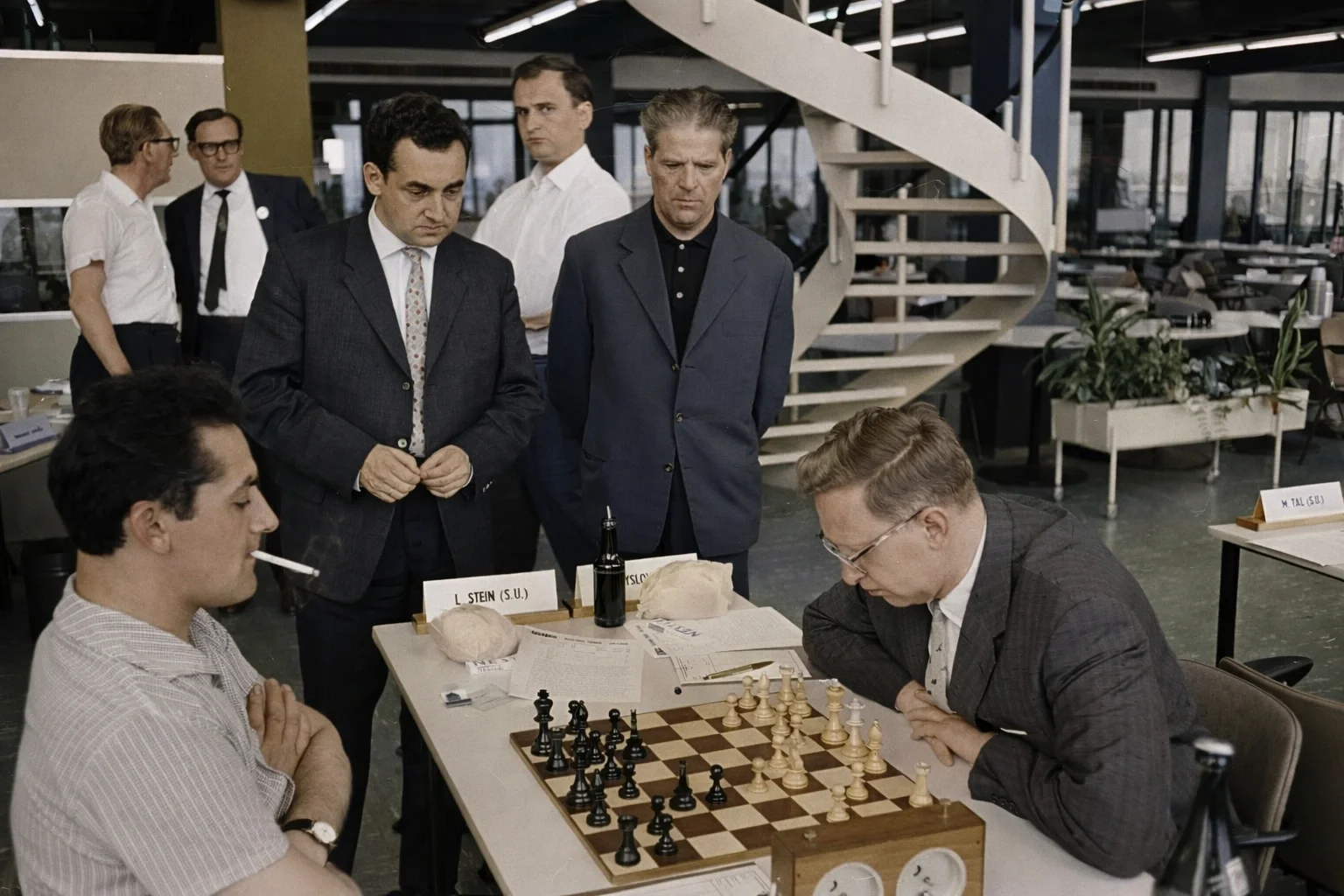
(Left to right) Stein, Taimanov, Ivkov, Lilienthal, Smyslov - Interzonal, Netherlands, 1964
Playing Style and Reputation
Stein’s playing style was a blend of creative aggression and sound calculation. He was influenced by the bold attacking traditions of past masters like Mikhail Chigorin and Alexander Alekhine, and he developed a reputation as a brilliant attacking genius who nonetheless knew how to pick his spots. Stein excelled in sharp, complex positions and had a particular affinity for dynamic openings. He was a noted expert in the King’s Indian Defense (which he handled with either color), and frequently employed the Grünfeld Defense and various lines of the Sicilian Defense, all fighting openings that lead to unbalanced play. His intuitive feel for the initiative often led him to launch daring attacks, though unlike the ultra-combinative Mikhail Tal, Stein was somewhat more restrained – he was “less willing than Tal to complicate [matters] with unforeseeable results,” as one account noted. In practice, this meant Stein’s tactical flair was tempered by a healthy respect for positional solidity, making him an extremely dangerous but not reckless competitor.
Among his peers, Stein was both admired and feared. His career record against other top grandmasters was extraordinary: he was one of the few players with an even lifetime score against World Champions Vasily Smyslov, Tigran Petrosian, and Mikhail Botvinnik, and he even achieved plus (winning) records against Mikhail Tal, Boris Spassky, and Paul Keres. Such results were virtually unheard of outside the world championship incumbents, and they speak to Stein’s ability to go toe-to-toe with the best of the best. It was not uncommon for the leading Soviet players to regard Stein as a potential equal – at the time of his death in 1973, he was still considered one of the main contenders for the World Championship by those in the know. This universal respect from fellow grandmasters solidified Stein’s reputation as a formidable force, a player capable of beating any champion on a given day.
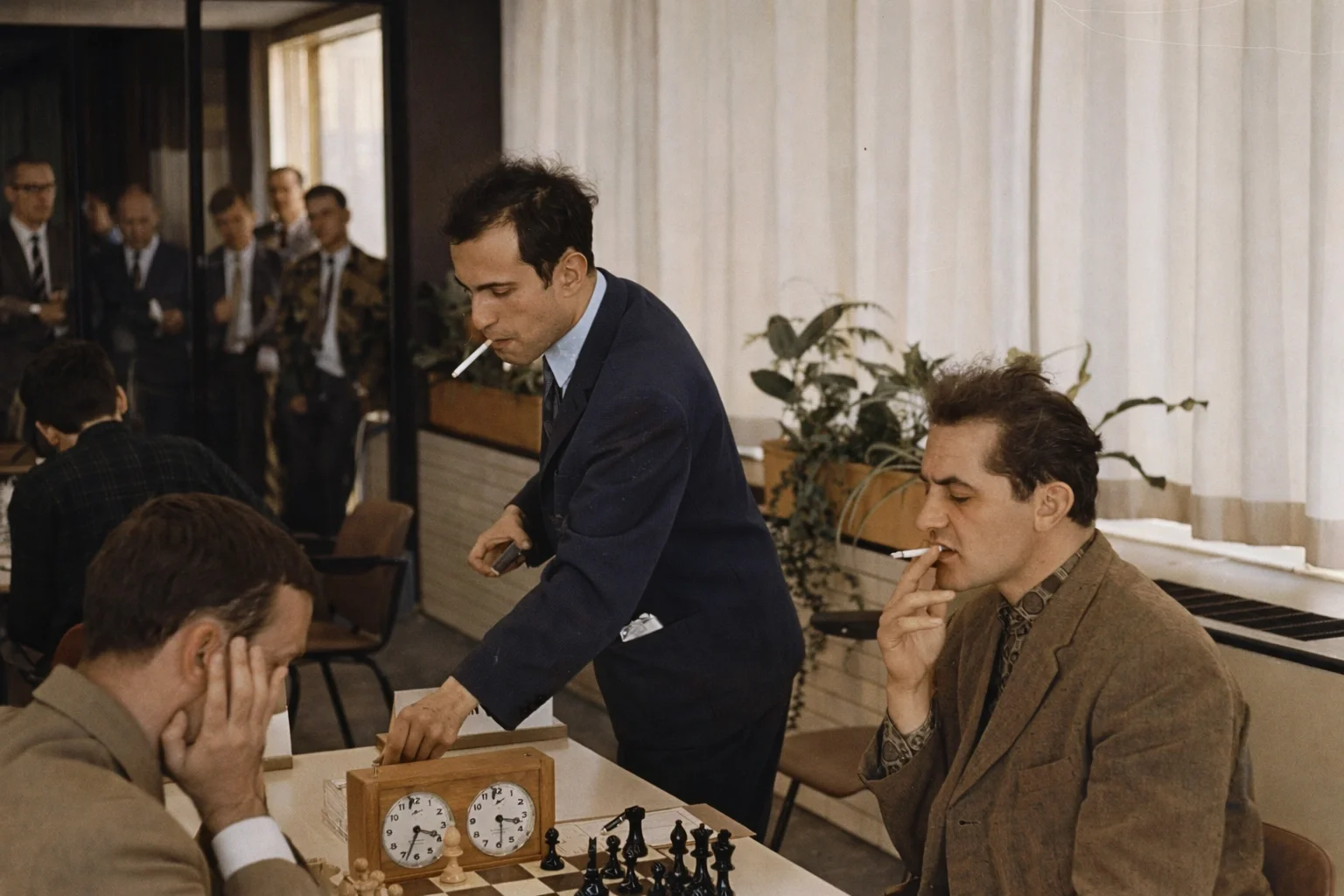
Mikhail Tal and Leonid Stein
Legacy and Anecdotes
Stein’s persona off the board was as colorful as his attacking play on it. He had a charismatic, competitive streak and a love for games of chance. In fact, Grandmaster Vlastimil Hort once quipped that had Stein been born in an earlier era, “Dostoyevsky might have chosen him as the main character of The Gambler,” alluding to Leonid’s penchant for high-stakes bets and risky ventures. Stein was known to eagerly join his colleagues in late-night card games (particularly bridge), often chain-smoking cigarettes as he played. This fearless, all-in attitude to competition mirrored his approach at the chessboard, where Stein never shied away from complications and fights. Anecdotes from Soviet chess circles portray him as a lively character who enjoyed life and contest in equal measure – qualities that made him popular among peers and spectators alike.
Tragedy struck on July 4, 1973, when Leonid Stein died suddenly of a heart attack in a Moscow hotel, just as he was preparing to travel for an international tournament. He was only 38, and at the peak of his powers, which led many to wonder how far he might have risen in the chess world had he lived longer. Indeed, Stein is often remembered as one of the greatest players never to compete in a World Championship match. His legacy has been recognized by later generations: former World Champion Garry Kasparov praised Stein (alongside Tal and a young Spassky) as a pioneer of “modern, ultra-dynamic chess” whose games were ahead of their time. Leonid Stein left behind a wealth of brilliant games that continue to inspire enthusiasts, and he remains a revered figure – an ill-fated legend who demonstrated just how dazzling and competitive chess could be in the golden age of Soviet dominance.
Sources & Further Reading
ChessBase: Leonid Stein Remembered (Vlastimil Hort)
[Garry Kasparov, My Great Predecessors, Vol. IV (Everyman Chess, 2004)]
Edward Winter, “Leonid Stein’s Legacy” — Chess Notes
