Lev Alburt
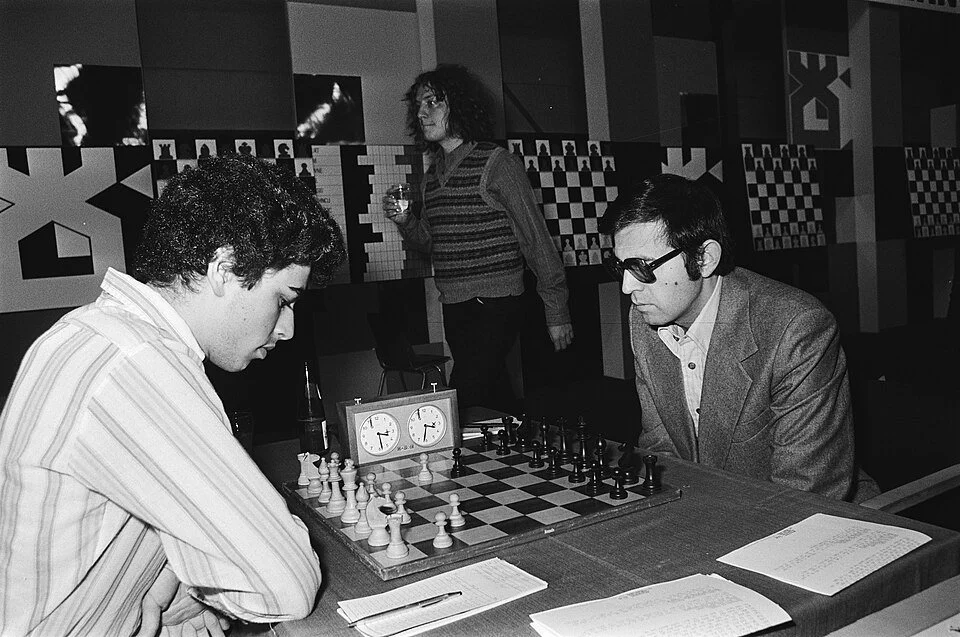
Pereira, Fernando / Anefo
Introduction
Lev Osipovich Alburt, usually rendered in English as Lev Alburt and in Russian as Лев Осипович Альбурт, occupies a distinctive place in modern chess history. He was formed inside the Soviet system, won the Ukrainian Championship three years in a row, competed in five USSR Championships, earned the international master title in 1976 and the grandmaster title in 1977, then remade himself in the United States after seeking asylum in 1979. In America he became a three time U.S. champion, a major teacher and author, a long serving public voice in Chess Life, and a FIDE Senior Trainer. His career therefore connects several worlds at once: Odessa chess culture, the late Soviet grandmaster milieu, Cold War emigration, and the broad popularization of Soviet training methods for English language readers.
Alburt deserves attention not because he was a world championship contender of the first rank, but because he was a very strong grandmaster whose significance widened after emigration. The documentary record shows a player who reached international prominence over the board, then exercised a second influence through writing, teaching, organizing, and translating one chess culture into another. That double career is the best frame for understanding his historical place.
Early Life and Chess Formation
Alburt was born on August 21, 1945, in Orenburg. Russian chess federation biographical material states that his parents were wartime evacuees from Odessa and that he returned to Odessa at around age two, which is why Odessa, not Orenburg, is the city most closely associated with his formative years. The same source and the World Chess Hall of Fame agree that he later graduated from the physics faculty of Odessa University, and Russian federation material adds that he spent two years in postgraduate study before turning his attention fully to practical chess. Published details about his wider family background are comparatively sparse in accessible sources, so the wartime evacuation and Odessa upbringing are the most securely documented early biographical facts.
His own retrospective testimony gives a sharp sense of the political atmosphere in which he matured. In a 2016 first person essay, Alburt wrote that he had disliked the Soviet regime from youth, that he took pride in avoiding Komsomol membership, and that chess gave him a rare avenue for earning a living without total ideological compliance. This is self description rather than neutral archival description, but it fits the later arc of his life and helps explain why chess, for Alburt, was never only a game. It was also a route to personal autonomy and eventually to emigration.
On the chess side, a Russian interview snippet attributed to Alburt states that when he began school he went to the Odessa Palace of Pioneers, where the chess club was led by Samuil Kotlerman. Separate reference material on Kotlerman identifies him as the long time head of that Odessa youth program and lists Alburt among his pupils, alongside several other future masters and grandmasters. This places Alburt inside one of the recognizable channels through which Soviet urban chess culture reproduced itself: early institutional instruction, then advancement through local and republican competition.
Rise in Competitive Chess
Alburt’s rise was substantial even by Soviet standards. By the early 1970s he had become one of the strongest players in the Ukrainian republic, winning the Ukrainian Championship in 1972, 1973, and 1974. He also reached five USSR Championship finals, which is a serious achievement in itself given the density of elite Soviet competition. The World Chess Hall of Fame and the Russian Chess Federation both list those milestones, while Russian biographical reference summaries identify his best Soviet Championship result as a shared fifth to seventh place in Leningrad in 1974. That profile suggests a player who stood clearly above the mass of Soviet masters, even if he did not become a permanent member of the very narrow Karpov era inner circle.
His formal titles followed in sequence. FIDE records show Alburt becoming an international master in 1976 and a grandmaster in 1977. By that stage he was also accumulating team successes. The World Chess Hall of Fame credits him with European Cup victories in 1976 and 1979, while Russian federation material adds that he won the European Team Championship with the Soviet national side and the European club title with Burevestnik. Taken together, these records locate him as a successful Soviet representative in both individual and team settings during the second half of the 1970s.
A useful measure of his later competitive strength comes from the FIDE lists after emigration. A reproduced January 1981 FIDE rating list places Alburt on 2575, tied for world number 22 and rated above every other American on that list, including Walter Browne and Yasser Seirawan. A reproduced July 1981 list gives him 2580. These are secondary reproductions of historical FIDE lists rather than the original printed booklets, but they align with the broad view of Alburt’s peak as that of an internationally strong grandmaster who, for a time, stood at the head of U.S. chess by rating.
Emigration and American Reinvention
The decisive career break came in 1979. Alburt later wrote that he had long intended to leave the Soviet Union and that, while traveling with a Soviet chess team to West Germany, he went to the Cologne police headquarters and requested asylum. Russian federation material states more briefly that a trip for a European club event became the last trip of his Soviet career. Alburt’s own account is the primary source for motives and immediate experience, while federation biographies establish the public fact of the break.
Afterward he moved to the United States and settled in New York City. In his Guardian essay he wrote that he reached JFK with very little money, became a U.S. citizen in 1985, and had lived in New York since 1980. Over the board, the transition was remarkably successful. Institutional U.S. sources and tournament summaries agree that he won the U.S. Championship in 1984, 1985, and 1990, and the World Chess Hall of Fame adds U.S. Open victories in 1987 and 1989. This was not a symbolic second act. It was a fully competitive one.
The speed of his American ascent is one reason Alburt became such a visible figure in 1980s U.S. chess. A 1984 newspaper feature by Fred Waitzkin described him as having become the highest ranked player in the United States in 1980 and 1981, which corresponds to the January and July 1981 rating evidence. In practical terms, Alburt arrived as a ready made top American rather than as a respected émigré veteran easing into a new chess scene.
His American career also altered his place in chess culture. In the Soviet Union he had been one strong grandmaster among many. In the United States he became both a champion and an interpreter of Soviet chess knowledge for a different audience. That change in audience is one of the deep themes of his life. It explains why his later legacy rests less on a single tournament performance and more on what he represented and transmitted after 1979.
Style and Reputation
The World Chess Hall of Fame characterizes Alburt as a player “known for a somewhat unorthodox style of play,” and that formulation fits the rest of the record. He became closely associated with the Alekhine Defense, to the point that the Alburt Variation in that opening carries his name. Russian federation biographical material also calls him a noted specialist in the Alekhine and highlights his coauthored Pirc Alert! with Alexander Chernin. This evidence points toward a practical taste for asymmetry, counterattack, and positions in which early imbalance could be converted into long term strategic pressure. That is an interpretation, but it is a well grounded one.
His opening preferences also shaped how contemporaries remembered him. Alburt was not primarily identified with the most classical and symmetrical parts of opening theory. Instead, he was linked with systems that ask Black to provoke, absorb, and later challenge White’s center. That kind of repertoire does not in itself prove a player’s whole style, but in Alburt’s case it harmonizes with the broader institutional description of him as unorthodox and with his reputation as a resourceful fighting grandmaster.
The limits of his playing career are also part of a fair assessment. Alburt was strong enough to win major national titles in two countries and to rank among the top players in the world in the early 1980s, but his record does not place him among the stable world championship elite of his generation. A reasonable historical reading is that he belonged to the formidable stratum just below that very top level: stronger than the ordinary grandmaster, dangerous to elite opponents, nationally dominant in the United States for stretches, but not a sustained Candidates level force in the way of Karpov, Korchnoi, or later Kasparov.
Contributions Beyond Tournament Play
Alburt’s long term influence probably lies here more than anywhere else. The World Chess Hall of Fame states that from 1985 to 1988 he served on the Board of Directors of the U.S. Chess Federation, with the stated aim of promoting chess and growing membership. The same profile credits him with more than twenty books, the bestselling Comprehensive Chess Course series, and the long running “Back to Basics” column in Chess Life. FIDE’s own records confirm that he received the Senior Trainer title in 2004. This is the profile not simply of a former champion, but of a public educator.
His bibliography reinforces that image. Russian federation material lists major collaborations with Alexander Chernin, Roman Dzindzichashvili, Eugene Perelshteyn, Nikolay Krogius, and Jon Crumiller, among others. Google Books descriptions of Secrets of the Russian Chess Masters present the project explicitly as an adaptation of Russian instructional methods for American readers. That formulation can sound promotional, but it captures something real about Alburt’s role. He helped package Soviet and post Soviet training habits into a durable English language teaching style that proved accessible to ambitious club players.
Some of his instructional work received contemporary recognition. The Chess Journalists of America gave Just the Facts, the endgame manual associated with Alburt, Al Lawrence, and Nikolay Krogius, first place in its 2000 best new book category. That award does not settle the book’s historical value on its own, but it demonstrates that Alburt’s writing career was not merely prolific. It was noticed, reviewed, and institutionally rewarded.
There are also smaller, often overlooked traces of educational work in archival material. A World Chess Hall of Fame exhibition packet on Jacqueline Piatigorsky records that the Piatigorsky Foundation funded a seminar for skilled junior players during the 1983 U.S. Open conducted by Bruce Pandolfini and Lev Alburt, and that Alburt later wrote thanking Piatigorsky for her support of seminars for junior players. A US Chess delegates’ call from 2012 likewise thanked Alburt for donating chess sets, clocks, and books to deployed U.S. service personnel. These fragments are useful because they show a pattern of public service and educational effort that ran alongside the better known books and columns.
Alburt also intersected with major figures in broader chess culture in ways that deserve notice. Russian federation material states that he seconded Viktor Korchnoi, another famous Soviet non returnee, and that he took part in organizing the New York portion of the fifth Kasparov Karpov match after introducing Kasparov to the businessman Ted Field. Those episodes did not define Alburt’s whole career, but they show that his post Soviet life extended into the organizational and political edges of elite chess, not only its instructional center.
Legacy and Historical Assessment
Alburt was inducted into the U.S. Chess Hall of Fame in 2003, which is an institutional acknowledgement of both his American championship record and his later service as teacher, author, and advocate. Yet his legacy is not entirely simple. In his 2016 Guardian essay he described himself as culturally both Russian and American and expressed admiration for Vladimir Putin. The Russian Chess Federation’s 2025 profile similarly noted that his support for Russian policy in later years surprised many who knew him as an earlier dissident. This does not erase the historical reality of his anti Soviet self understanding or his 1979 asylum decision, but it does complicate any attempt to fit him into a simple, linear dissident narrative.
That complexity is one reason Alburt is historically interesting. He was not merely “the defector who became U.S. champion,” although that summary is already notable. He was a product of Odessa’s Soviet chess institutions, a nationally important player in both the USSR and the United States, a transmitter of training culture, and a figure whose political self presentation changed over time. The record supports viewing him as a bridge figure, though not always a comfortable one, between Soviet chess formation and American chess pedagogy.
A concise assessment would be this: Lev Alburt deserves attention today because he shows how chess talent, once formed in the Soviet system, could be recontextualized rather than exhausted by emigration. He did not leave behind a legacy centered on a single immortal game or a world title match. He left behind something different and, in its own way, enduring: a serious competitive record in two chess cultures, a recognizable playing identity, and a large body of teaching that helped carry Soviet methods into mainstream English language chess instruction. For a history of Soviet chess and its afterlives, that is a legacy worth taking seriously.
Notes and Sources
This profile relies first on institutional and primary or near primary materials: FIDE’s player record for titles and trainer status; the World Chess Hall of Fame biography for U.S. honors and major milestones; the Russian Chess Federation’s 2025 biographical page for Soviet era context and quotations; Lev Alburt’s own 2016 Guardian essay for first person testimony about youth, dissent, defection, citizenship, and later political self presentation; archival U.S. Chess and World Chess Hall of Fame materials for board service and instructional work; and reproduced historical FIDE lists for his early 1980s rating peak.
A few points require extra caution. Publicly accessible documentation on Alburt’s family beyond wartime evacuation and Odessa upbringing is limited. His early training under Samuil Kotlerman is supported by interview material and reference summaries, but the available evidence is not as strong as the institutional documentation for his later titles and championships. One widely repeated anecdote, that after his defection his name was removed from the forthcoming book on the 1978 Kiev International, appears in a Russian biographical reference entry citing Boris Berdichevsky and Pavel Reifman; because I have not independently inspected that tournament book here, it should be treated as a well sourced secondary claim rather than as a directly verified archival fact.
