Siegen Chess Olympiad
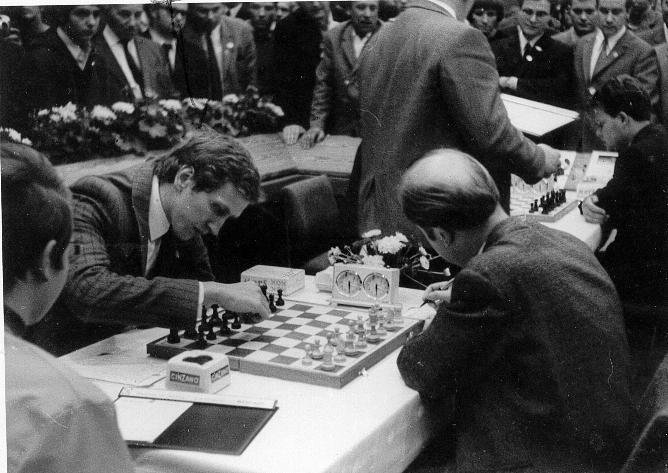
Siegen, 1970. Image source: Doulgas Griffin
Introduction
The 19th Chess Olympiad, held in Siegen in the Federal Republic of Germany in September 1970, occupies an unusual place in chess memory. One game, Boris Spassky against Bobby Fischer, came to represent the event. Its fame is understandable: the reigning world champion defeated the player who would challenge him two years later, and the point decided a close Soviet victory over the United States. Yet the Olympiad’s historical significance is larger. Siegen exposed the practical limits of FIDE’s old preliminary and final round-robin format, produced the Soviet Union’s narrowest winning margin since its Olympiad debut, and combined a major public chess spectacle with a consequential FIDE Congress.
The Olympiad is conventionally dated 5 to 27 September 1970, at the Siegerlandhalle. An advance 1970 program scheduled the final playing day for 25 September and the banquet for 26 September; the Keene-Levy title page gives 5 to 26 September, while the official commemorative volume and modern records use 5 to 27 September. These are overlapping dating conventions, not evidence of separate events.[1]
The Soviet Union won with 27½ board points in Final A. Hungary finished one point behind, Yugoslavia another half-point back, and the United States fourth on 24½. The result was the USSR’s tenth consecutive Olympiad gold medal. Its significance lay in the scale of the resistance. Two years earlier at Lugano, the Soviet margin had been 8½ points. In Siegen, the title was not secured until the last round.[2]
Historical Setting
Siegen followed a period of emphatic Soviet control of the Olympiad. Since entering the event at Helsinki in 1952, the USSR had won every Olympiad it contested. Its 1970 squad repeated the six-player roster used at Lugano: Boris Spassky, Tigran Petrosian, Viktor Korchnoi, Lev Polugaevsky, Vasily Smyslov, and Efim Geller. Every member was a grandmaster, Spassky was the reigning world champion, Petrosian and Smyslov were former champions, and all six had appeared in the USSR versus Rest of the World match earlier in 1970. Soviet strength in Siegen therefore rested on proven elite depth across every board.[3]
The principal challengers gave the event unusual competitive weight. The United States fielded Fischer and Samuel Reshevsky together for the first and only time in an Olympiad, supported by Larry Evans, Pal Benko, William Lombardy, and Edmar Mednis. Fischer’s return to regular competition had made the American team a credible title contender. Hungary brought Lajos Portisch, Levente Lengyel, István Bilek, Győző Forintos, István Csom, and the young Zoltán Ribli. Yugoslavia’s team, headed by Svetozar Gligorić and Borislav Ivkov, had exceptional strength through the fourth and reserve boards. The presence of East and West German teams gave the host country an additional point of interest, although relations among the players were less dramatic than later Cold War shorthand sometimes suggests.[2][4]
There was no common international player-qualification system. National federations nominated their teams. Hans-Joachim Hecht later recalled that his victory in the 1970 West German championship secured his Olympiad place, a method he considered imperfect because some strong candidates had skipped the national event. Robert Hübner, already one of West Germany’s leading players, was the most notable host-country absentee. The DSB’s 1971 minutes gave study commitments as the reason. Hübner later described several additional factors, including his relations with Willi Fohl, the possibility that he would be used as a reserve, and his wish to prepare for the Palma de Mallorca Interzonal.[4]
The Soviet delegation arrived as the favorite, although its own world champion voiced an unusually sober view of the future. In an interview conducted during the Olympiad, Spassky told Keene and Levy that the Soviet Union’s younger players no longer enjoyed the same clear superiority over their foreign contemporaries. He named Karpov, Balashov, and Tukmakov while emphasizing how difficult it was for younger players to displace an established generation. Asked whether another country might win a future Olympiad, he answered: “Perhaps the next time we can lose our title.” His timing was premature, yet the one-point margin at Siegen gave the warning immediate credibility.[5]
Organization, Format, and Field
Siegen received the Olympiad after Budapest withdrew and FIDE awarded the event to the West German bid at its 1968 Congress in Lugano. City and Kreis Siegen served as the local hosts; the Deutscher Schachbund was the formal organizer in dealings with the federal and North Rhine-Westphalian governments and was responsible for technical execution and accounting. Willi Fohl served as tournament director and the Dutch international arbiter Harry de Graaf as chief arbiter. Federal Interior Minister Hans-Dietrich Genscher formally opened the Olympiad on 5 September. Federal President Gustav Heinemann was its patron and appeared at the prize-giving. A retrospective history of the Siegerland Orchestra states that it first performed the new FIDE anthem during the Olympiad ceremonies.[1][6]
The scale was formidable for a comparatively small host city. Sixty teams were entered, and published records list 360 registered players, among them 35 grandmasters and 66 international masters. A few listed players did not ultimately arrive. The Siegerlandhalle contained the playing floor, workrooms, press facilities, and public areas, while the absence of centralized accommodation required many teams to stay in nearby towns and travel by shuttle bus. Hecht, whose West German team stayed in Freudenberg, later remembered the transport as efficient and the dispersed lodging as an obstacle to the informal social life associated with an Olympiad.[2][4]
The competition used a two-stage, four-board round robin. Six preliminary groups contained ten teams apiece. The top two in each group entered the twelve-team Final A; the next two entered Final B, and so on through Final E. Results between two teams that advanced from the same preliminary group were carried into the final, so each finalist played ten new matches rather than meeting all eleven opponents again. Placings were determined first by total board points, with match points used only as the second criterion. The time control was 40 moves in two and a half hours, followed by one hour for each succeeding 16 moves.[2]
The field had reached the schedule’s fixed ceiling. The surviving records describe the entry problem with different totals because they count applications at different stages. The DSB minutes record sixty timely entries plus seven late applications. A later event reconstruction identifies four principal late cases, Argentina, Ecuador, France, and Venezuela, and explains that Panama’s withdrawal allowed Argentina to take the vacant place. France, Ecuador, and Venezuela were refused. Yuri Averbakh and Boris Turov reported that 70 teams initially figured in the applications, that 63 had arrived by the opening, and that the late applications of Venezuela, France, and Ecuador were refused. The secure conclusion is that demand exceeded the sixty-team structure and that three teams which had traveled to Siegen could not play. Latin American delegates criticized the decision at the FIDE Congress.[7]
The organizers supported the event with a large civic and commercial apparatus. The DSB’s post-event accounting recorded 239 helpers and employees, roughly 800,000 A4 sheets used, and expenditure of 806,800 Deutsche Mark. The federation reported that the Olympiad imposed no cost on its own budget and credited the city and Kreis, North Rhine-Westphalia, and the federal authorities with its financial support. Contemporary German reporting described projected demonstration boards, a Philips computer and operator, Xerox Rank copying equipment, Rotaprint machinery for the daily reports, sixteen Volkswagen buses, food supplied by REWE, and sound-dampening carpets. Averbakh and Turov added that a computer helped seed the preliminary groups from results of the five preceding Olympiads. Their early report deserves notice, although the exact procedure requires further archival confirmation.[3][7][8]
Two unusual incidents deserve precise treatment. Albania refused to play South Africa as a protest against apartheid and lost the preliminary match 0 to 4 by forfeit. Albania remained in the Olympiad, and the result later carried into Final D when both teams qualified for that section. Accounts claiming that Albania was expelled are incorrect. In another preliminary group, England’s Jonathan Penrose collapsed after a blunder against Olaf Ulvestad of Andorra. England captain C. H. O’D. Alexander wrote that Penrose had suffered a similar episode earlier that year and withdrew on health grounds. England then missed Final A by 1½ points. The incident belongs in the event’s history as a medical withdrawal with competitive consequences, not as a sensational anecdote.[9][10]
Main Course of the Olympiad
The preliminary stage established the event’s scale without settling its hierarchy. The USSR won Group 1 despite two striking lapses. Korchnoi overslept and forfeited against Spain, while Geller lost over the board to Poland’s Jacek Bednarski. Korchnoi later confirmed the oversleeping in his memoir and described the supposed protest against Franco as a joke circulating at the Olympiad. Yugoslavia produced the strongest preliminary score, 31½ points, in Group 2. East Germany finished ahead of the United States in Group 3, while Hungary, Romania, Argentina, Czechoslovakia, Bulgaria, and West Germany also reached Final A.[2][11]
Hungary set the early pace in the championship final. After three final rounds it had eight points, with the USSR on 7½ and Yugoslavia and the United States on seven. The Soviets drew their direct encounters with Hungary and Yugoslavia 2 to 2. Those results kept all four leading teams close and placed extra value on the size of victories against the lower half of Final A.[3]
The sixth final round, on 20 September, paired the USSR with the United States. Spassky defeated Fischer, Petrosian drew Reshevsky, and the difficult adjourned games Polugaevsky against Evans and Geller against Lombardy were also drawn. The Soviet Union won the match 2½ to 1½. Averbakh and Turov credited the Soviet analytical effort with saving the lower-board positions. German reports likewise considered the match result fortunate for the USSR. The defensible historical point is narrower: Spassky supplied the only decisive result, while Soviet preparation during adjournment preserved the team victory.[2][3][12]
The lead changed in the next round. Gligorić defeated Portisch and Yugoslavia beat Hungary 2½ to 1½. The USSR simultaneously defeated East Germany 3 to 1, moving alone into first place. Two rounds later Argentina held the Soviets to a 2 to 2 draw when Miguel Quinteros defeated Polugaevsky; Geller’s win against Jorge Rubinetti prevented a Soviet match loss. With two rounds remaining, the USSR had 22 points, while Hungary and Yugoslavia had 21 and the United States 20½.[12][13]
The decisive separation came against Canada. The USSR won 3½ to ½ as Spassky, Korchnoi, and Geller scored victories and Petrosian drew. Hungary beat the United States 2½ to 1½, and Yugoslavia also remained close, yet the Soviet lead had grown to two full board points. Four draws against Bulgaria proved sufficient once the other final-round results were known. Hungary’s 3 to 1 victory over East Germany cut the final gap to one point, while Yugoslavia’s 2½ to 1½ win against Argentina secured bronze.[12]
Winner and Key Contenders
The Soviet Union’s 27½ points brought a tenth successive gold medal. Its official Final A match record was seven wins and four draws, including the carried preliminary victory over Spain. Across the entire Olympiad the six players scored 55½ points from 76 board results. Spassky led the first-board standings with 9½ from 12 and no defeats. Petrosian scored 10 from 14 without losing; Smyslov was also unbeaten. Korchnoi scored 11 from 15, with the Spanish forfeit recorded as his only loss. Polugaevsky contributed nine from 12, and Geller eight from 12.[3]
These figures show how the title was won. The USSR did not overwhelm the other medal contenders in direct play. It drew Hungary and Yugoslavia, and its victory over the United States rested on one decisive game. Its advantage came from maintaining elite strength across six players, saving inferior positions, and producing the tournament’s largest late match score when Canada had to be beaten heavily. Soviet depth remained decisive even as the overall gap narrowed.
Hungary’s 26½ points earned silver, its strongest Olympiad result for decades. Portisch gave the team a world-class first board, Forintos and Csom scored heavily, and Ribli’s successful reserve appearance represented the younger generation that Spassky had discussed. Yugoslavia finished third with 26 points and supplied the event’s clearest scoring-system paradox. It went undefeated in Final A and accumulated 19 match points, one more than both the USSR and Hungary. Under a match-point-first system Yugoslavia would have led. The published rules prioritized board points, so its smaller margins against individual opponents left it in third place. This was a consequence of the regulations, not a disputed result.[2]
The United States finished fourth. Fischer scored 10 from 13 and lost only to Spassky; Lombardy led the reserve-board standings with 11 from 14. Contemporary American reporting also recorded a scheduling difficulty: Fischer and Reshevsky observed religious restrictions from Friday evening to Saturday evening, and both were unavailable on three occasions when the timetable could not be adjusted. Larry Evans argued that the constraint harmed the American campaign. Its precise effect cannot be measured, and it should not be converted into a counterfactual claim that the United States would otherwise have won.[14]
West Germany finished sixth, behind Czechoslovakia. The host team lost 1½ to 2½ to each of the five teams above it. Lothar Schmid’s strong 9 from 12 on board two and his best-game prize for defeating Anton Kinzel were notable individual successes, while Hübner remained the notable omission from the host roster.[4]
Critical Games and Turning Points
Spassky against Fischer remains the essential game of Siegen because its competitive and public meanings coincided. It provided the winning margin in the Soviet-American match, gave Fischer his only loss of the Olympiad, and helped Spassky edge him for the first-board prize. The surviving scoresheet, preserved by the FIDE Museum, confirms the game’s institutional afterlife; German accounts record that Spassky received a made-to-measure suit as his board prize. The game requires no extended analysis in an event history. Its result, 1 to 0, is the relevant fact.[15]
Portisch’s loss to Gligorić the following day had a more direct effect on the lead. It turned Hungary’s match with Yugoslavia and allowed the USSR to move ahead. Quinteros’s victory over Polugaevsky then interrupted Soviet momentum and kept three teams within one point with two rounds left. The 3½ to ½ result against Canada, rather than any single celebrated combination, finally created a secure margin.[12][13]
The final Soviet match against Bulgaria was significant for its restraint. With a two-point lead, the USSR sought security rather than a large score. The Canada result had created breathing room without mathematically clinching the title; four draws against Bulgaria secured it in the final round and completed an undefeated Final A campaign.
Contemporary Reception
Siegen’s public response was exceptional by the standards of a chess team event. The DSB Congress stated before the finish that attendance had exceeded expectations. Peter Sartorius, writing contemporaneously in the Stuttgarter Zeitung, described dense, unusually quiet crowds close to the boards, with additional spectators following transmitted moves in a demonstration room. Officials placed Fischer’s table somewhat farther inside the playing area after his request for greater distance from the close spectator barrier. The adjustment was a practical compromise, not a separate-room dispute. The marquee Spassky-Fischer round produced conflicting estimates. Theo Schuster’s contemporary German report gave roughly 4,500 spectators; Averbakh and Turov later wrote that the largest rounds drew about 3,000, with ordinary attendance between 1,000 and 2,000. The estimates cannot be reconciled from the available records; the secure conclusion is that several thousand attended the marquee round.[3][15][16]
The organizers turned play into a daily media product. Moves were relayed to projected boards, experts commented in a separate room, and the press center produced bulletins containing the games. Local archive photographs show both the crowd and the labor involved in preparing the daily report. A surviving silent 8mm film preserves local footage of the Olympiad. These materials preserve the Olympiad as a civic event as well as a set of results.[16][17]
Press interest also generated friction. At its 25 September meeting, the DSB Congress collectively condemned a Bild article attacking Lothar Schmid after he declined a draw against Ivkov and later lost. Hecht remembered the coverage as personally hurtful to Schmid. The incident illustrates the sharper tone that could accompany the event’s unusual visibility. Alfred Diel’s contemporary verdict in Deutsche Schachblätter emphasized the record field, the closeness of the struggle, and exemplary organization. His judgment is useful evidence of German reception, while its celebratory tone reflects the host federation’s understandable pride.[4][16]
Contemporary Soviet press coverage treated the finish as difficult. Mark Taimanov’s dispatch in Вечерняя Москва on 24 September described missed chances, adjourned positions, and a lead that still required defense. A further indication of Soviet-bloc reception came from an interview with the Hungarian leader János Kádár, published in Советский спорт and reprinted in 64. Kádár called the Soviet victory deserved while stressing that international team competition had become appreciably closer. These accounts fit the score better than later narratives of automatic Soviet supremacy.[18]
Keene and Levy’s Siegen Chess Olympiad is itself evidence of the event’s reception. Its authors completed the manuscript within three weeks, used annotations supplied by participants, drew on several European publications, and had material from the Soviet newspaper 64 translated. They included 127 of the 2,274 games actually played. General editor Baruch Wood warned that the speed of production had created errors and printed corrections. The book is therefore invaluable as a near-contemporary compilation, particularly for the interviews with Euwe and Spassky and Alexander’s account of Penrose. Numerical details still require comparison with official records.[5]
The total of 2,274 played games also resolves an apparent discrepancy. Modern records list 2,280 board results, including six forfeits. Subtracting those forfeits gives the number printed by Keene and Levy and later by Averbakh and Turov.[2][3][5]
Institutional Role and the FIDE Congress
The 41st FIDE Congress met alongside the Olympiad. Folke Rogard retired after 21 years as president, and former world champion Max Euwe was elected his successor. Contemporary British commentary treated the transition as both an acknowledgment of Rogard’s service and a vote of confidence in Euwe. The Congress also approved the new Elo-based rating and title framework, part of FIDE’s response to a rapidly expanding international calendar.[19]
The tournament’s entry crisis gave Euwe’s organizational concerns immediate force. In his Siegen interview with Keene and Levy, he argued that the first stage paired the strongest teams with opponents too weak to produce useful competition and that a sixty-team event had become difficult to administer. He suggested divisions with promotion and relegation. FIDE did not adopt that exact plan at once, yet the diagnosis was accurate: the old group-and-final structure had reached its practical limit.[5]
Albania’s refusal to play South Africa brought the apartheid dispute into the competition itself. It occurred during the same Olympiad in which the FIDE Congress debated apartheid. Archival finding aids identify Federal Foreign Office files on the participation of Rhodesia and South African players, together with Federal Presidential Office records on Heinemann’s patronage and attendance. These descriptions establish where the official paper trail survives. They do not disclose the files’ full contents, which would require direct archival consultation.[9][17][19]
Legacy and Historical Assessment
Siegen confirmed Soviet supremacy and redefined its appearance. The winning team remained extraordinary: three world champions, two leading challengers, and Geller produced an undefeated match record in the championship final. Its one-point margin exposed the growing capacity of Hungary, Yugoslavia, and the United States to contest the full distance. The Soviet victory signified durable depth under pressure rather than effortless separation.
Spassky’s comments about the Soviet succession problem give the event an especially revealing internal perspective. The champion saw that a crowded hierarchy of established grandmasters could slow the promotion of younger players. His warning did not predict an immediate defeat, yet Hungary’s eventual Olympiad victory in 1978 gave it retrospective weight. Siegen captured the moment when the Soviet system was still strong enough to prevail and self-aware enough to recognize a narrowing lead.
For Germany, the Olympiad demonstrated that a regional city could stage an event of global chess importance through public funding, federation management, commercial equipment, and a large local workforce. Later claims that Siegen directly caused the West German chess boom are difficult to prove. Contemporary records support a more restrained conclusion: the organizers and federation already believed the event had enlarged press attention and public interest, and the Spassky-Fischer crowd provided visible evidence.
The event’s archival legacy is unusually rich but dispersed. DSB congress minutes document planning, criticism, staffing, and finance. The Kreisarchiv preserves photographs and film, while federal finding aids point to records on patronage, FIDE relations, Rhodesia, and South Africa. Russian-language accounts add the Soviet team’s sense of difficulty, and the Keene-Levy book records interviews and eyewitness testimony soon after the games. Used together, these sources correct several persistent errors, including the claim that Albania was expelled and the assumption that the official final table also reflected match-point superiority.
Siegen deserves attention today because it joined three historical processes in one event: the last phase of an old Olympiad format, the closest challenge yet to the Soviet winning sequence, and the rise of chess as a large public and media spectacle in West Germany. Spassky’s victory over Fischer supplied the emblem. The Olympiad’s deeper meaning lies in the collective contest around it, where Soviet gold survived by one board point and FIDE confronted the consequences of a game that had outgrown its inherited machinery.
Notes and Sources
Presidium of the XIX Chess Olympiad and Arthur Formalski, XIX. Schach-Olympiade: 5.-27. September 1970 in Siegen, Siegen, 1970, bibliographic record at the Kórnik Library Digital Platform; OlimpBase event information; Deutscher Schachbund, contemporary 1970 Congress report, especially the planned final playing day and closing banquet.
OlimpBase, 19th Chess Olympiad information and review, based in part on Schach-Express nos. 18, 19, and 20 (1970); Final A standings. OlimpBase is used for format, pairings, scores, and modern reconciliation, while qualitative judgments in its review are treated as later interpretation.
Yuri Averbakh and Boris Turov, Шахматные олимпиады (Moscow: Физкультура и спорт, 1974), pp. 79-85 and 297. See the Russian chess-book archive catalogue and direct DjVu scan; OlimpBase Soviet team record.
Johannes Fischer, “Siegen 1970”, including the retrospective interview with Hans-Joachim Hecht; Deutscher Schachbund, 1971 Congress minutes, especially pp. 4-6 and 9 of the PDF; ChessBase, “Schach in den Medien 1970”, including Hübner’s later first-person explanation.
R. D. Keene and D. N. L. Levy, Siegen Chess Olympiad: September 5th to September 26th 1970 (Sutton Coldfield: Chess Ltd., 1970), consulted in the copy supplied by the site editor: title page; authors’ and general editor’s prefaces; Euwe interview, pp. 18-19; Spassky interview, pp. 22-25; C. H. O’D. Alexander, “The Penrose Incident,” p. 28. Bibliographic description: Chess Collector Shop.
Deutscher Schachbund, short minutes of the 1969 Gießen Congress, section 11; DSB chronicle, 1966-1970; Kreisarchiv Siegen-Wittgenstein, opening photograph identifying Genscher, Hermann Schmidt, and Karl Althaus; ChessBase, 2023 reconstruction of the Olympiad film and ceremonies; history of the Siegerland Orchestra, p. 7 of the PDF, a retrospective source for the anthem.
Deutscher Schachbund, extraordinary Congress minutes, Siegen, 25 September 1970, pp. 1-2; OlimpBase event review. The DSB record and later reconstruction use different application totals and are cited separately.
Deutscher Schachbund, 1971 Congress minutes, pp. 4-5; Fischer, “Siegen 1970”, quoting Deutsche Schachblätter 10/1970, p. 226, on technical and commercial support.
OlimpBase, South Africa versus Albania, 8 September 1970; Albania team record. These records confirm one 0 to 4 forfeit and Albania’s continued participation.
OlimpBase, England versus Andorra, 12 September 1970; Alexander’s eyewitness account in Keene and Levy, p. 28, cited in note 5.
Viktor Korchnoi, Шахматы без пощады: Секретные материалы Политбюро, КГБ, Спорткомитета (Moscow: АСТ, Астрель, Транзиткнига, 2006), ch. 8, online transcription. The forfeit is corroborated by the results record; Korchnoi’s later mistaken reference to the Americans as runners-up is not used.
OlimpBase Final A round records: USSR versus United States, round 6; Hungary versus Yugoslavia and East Germany versus USSR, round 7; USSR versus Canada, round 10; final round. The date of the Soviet-American match is corroborated by the Associated Press photograph reproduced with its 20 September 1970 caption in the AP report on Spassky’s death.
OlimpBase, Final A round 9, including Quinteros-Polugaevsky and Argentina’s 2 to 2 draw with the USSR.
Larry Evans, contemporary report in Chess Life & Review, November 1970, pp. 608-609, available through the US Chess digital archive and its direct issue PDF. Evans’s assessment of the competitive effect is treated as advocacy by an American team member.
FIDE Museum, Spassky-Fischer scoresheet from Siegen; Fischer, “50 Jahre Schacholympiade Siegen”, drawing on contemporary Deutsche Schachblätter reports.
Peter Sartorius, “Gedankenakrobatik auf der Flüster-Olympiade”, written in mid-September 1970 for the Stuttgarter Zeitung and preserved in a later reprint facsimile hosted by ChessBase; DSB, extraordinary Congress minutes, especially the discussion of press cooperation and the protest against Bild.
Kreisarchiv Siegen-Wittgenstein, photo archive selection; archival film description; Federal Archives and Foreign Office holdings guide. The holdings guide is a finding aid, and this article does not claim direct examination of the listed government files.
Mark Taimanov, “Нелегко быть лидером,” Вечерняя Москва, no. 224, 24 September 1970, p. 3, scanned issue and searchable OCR; János Kádár, interview by Andor Lilienthal, “Я. Кадар о шахматах и шахматистах,” Советский спорт, 24 October 1970, reprinted in 64: еженедельное приложение к газете «Советский спорт», no. 44, 30 October 1970, p. 2, scanned issue and OCR.
Fred Cramer, report on the 41st FIDE Congress, Chess Life & Review, January 1971, pp. 24-25, US Chess archive and direct issue PDF; Edward Winter, “Chess: The History of FIDE”, citing Harry Golombek’s report in the December 1970 British Chess Magazine; FIDE Museum, Max Euwe biography; Harry Schaack, “Eine ruhige Hand in stürmischer See”, KARL 2/2025, discussing Henrik Malm Lindberg’s archival history of FIDE.
