Bukhuti Gurgenidze
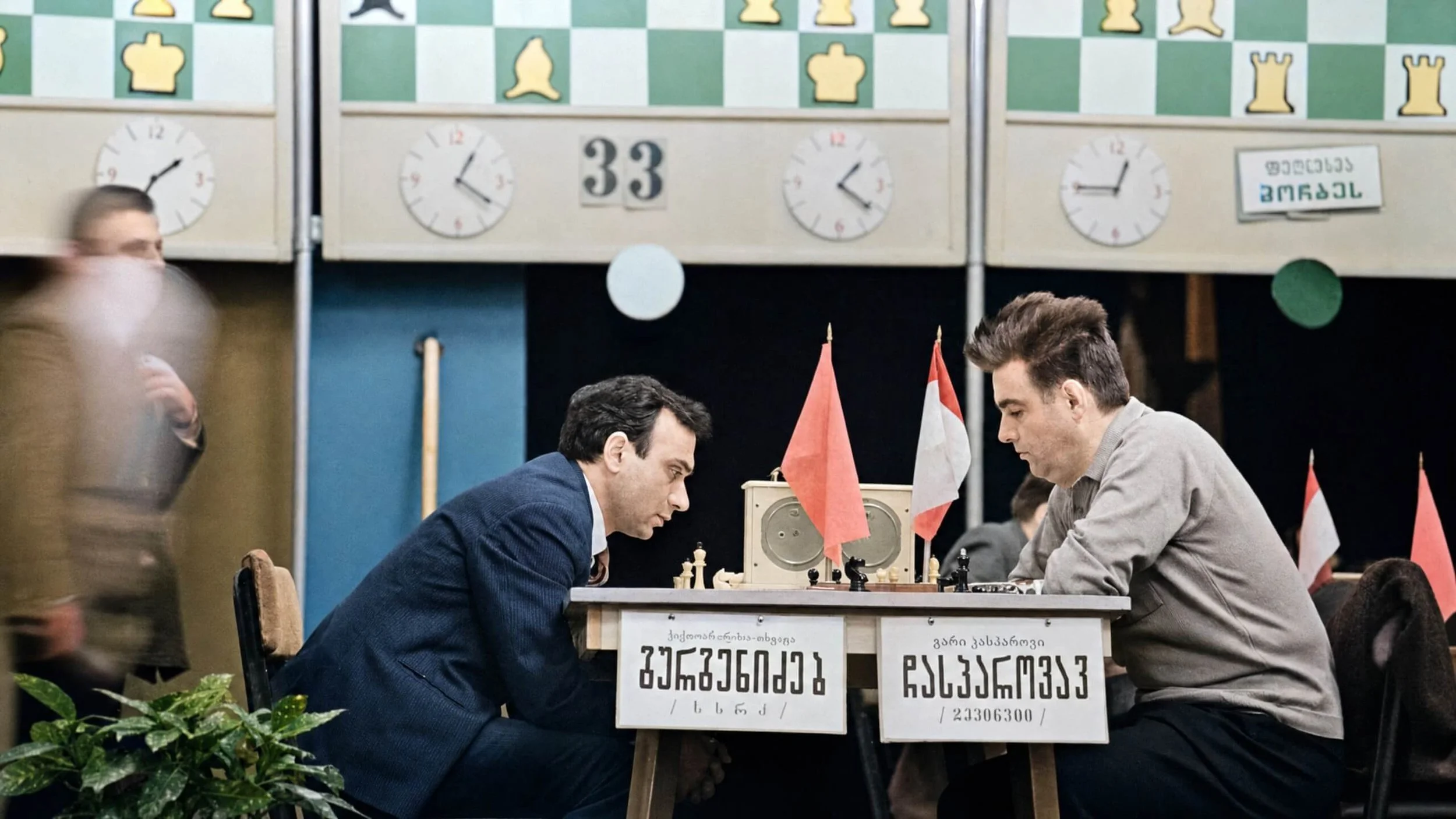
Image source: Douglas Griffin
Introduction
Bukhuti Gurgenidze occupies an important, and still somewhat underappreciated, place in twentieth-century chess history. He was the first Georgian international grandmaster, awarded the title in 1970, and for roughly two decades he stood at the center of Georgian men’s chess as a national champion, recurrent Soviet finalist, opening innovator, and later as a trainer and administrator. His historical significance does not rest on a world championship challenge or on a single celebrated masterpiece. It rests on a broader combination of roles: elite national competitor, original theoretician, bridge figure between Georgian and all-Soviet chess culture, and mentor to several of the women who made Georgia the most famous republic in women’s chess.
His relative obscurity today has understandable causes. Soviet chess produced an unusually crowded field of grandmasters, and Georgian chess history is often told through the achievements of Nona Gaprindashvili and Maia Chiburdanidze. Yet the documentary record shows that Gurgenidze was not a peripheral figure standing beside those developments. He was inside them. Contemporary Georgian and later institutional sources present him as the country’s leading male player of his generation, a creator of named opening systems, and a long-serving coach and adviser within the Georgian chess establishment.
Early Life and Chess Formation
The securely documented outline of Gurgenidze’s early life is thinner than one would like, and that itself is worth stating plainly. The strongest reference sources agree that he was born on 13 November 1933 in Surami, in Georgia, and that he later studied geology in Tbilisi. Beyond that, the surviving public record is far richer about his chess formation than about his family background. A careful profile therefore has to resist filling those gaps with folklore. What can be stated with confidence is that he emerged from the Georgian chess environment of the late 1940s and early 1950s and developed under the guidance of M. Shishov, who is identified in a Georgian retrospective as his trainer.
A 2003 Georgian newspaper retrospective places his first notable appearance at the Tbilisi championship of 1949, where he appeared as a pupil of the honored trainer M. Shishov. A later Russian Chess Federation profile adds that Gurgenidze first drew wider Soviet notice in a 1951 Tbilisi tournament, where he beat the experienced Ukrainian champion Anatoly Bannik in a game that received a beauty prize. Taken together, these sources suggest a young player who announced himself not through slow bureaucratic accumulation, but through memorable, combative play that immediately marked him as unusual.
His path was not that of a full-time chess ascetic from childhood. He studied geology at Tbilisi State University and was later widely described as a geologist by profession. That parallel identity is historically revealing. Like many strong Soviet masters outside the narrowest professional elite, Gurgenidze came of age in a system where high-level chess often coexisted with advanced technical education and a non-chess profession. The available evidence suggests that this dual formation, scientific training on one side and practical tournament invention on the other, was part of the texture of his mature chess personality.
Rise in Competitive Chess
By the mid-1950s Gurgenidze had become a serious figure in Soviet competition. A contemporary Georgian newspaper report from early 1958 notes that he had qualified from the Sverdlovsk semifinal for the USSR Championship and emphasizes how significant that achievement was, since he finished ahead of such experienced players as Yuri Averbakh, Georgy Borisenko, Vladimir Simagin, and Ratmir Kholmov. The same report already presents him as Georgia’s chief representative for the forthcoming national final.
His best result in the USSR Championship came in Riga in 1958, where the Georgian Encyclopedia records a shared seventh to eighth place. A Russian Chess Federation profile adds useful texture: in that event he defeated Aivars Gipslis, Boris Spassky, Mark Taimanov, and Alexander Tolush. That combination of result and opposition explains why Gurgenidze was taken seriously inside Soviet chess even though he never became a regular candidate-cycle figure. He could defeat elite players in the hardest domestic tournament structure in the world.
At the same time, he was becoming an international representative of Soviet student chess. The Georgian Encyclopedia states that he played four times in the World Student Team Championships and twice won team gold with the USSR, in 1957 and 1958. OlimpBase’s team records corroborate four participations between 1957 and 1960 and two gold-medal team finishes. This is a useful reminder that Gurgenidze’s rise did not occur only in Georgian or republican settings. He was also trusted as part of one of the Soviet Union’s most prestigious international team structures.
By the 1960s he had plainly become, in practical terms, the leading male chess figure in Georgia. A 1961 Georgian newspaper piece discussing promising local players placed Gurgenidze first in its list of talented Georgian chess youth, above even other notable names. That judgment, made before his grandmaster title, now reads as an accurate forecast.
Major Career Achievements
The strongest Georgian institutional source describes Gurgenidze as an eleven-time champion of Georgia, with titles in 1958 through 1965, then 1968, 1970, and 1973. FIDE’s 2008 obituary also gives him eleven national titles. Some later database-style sources count twelve by adding a 1955 championship, so the exact total is not entirely uniform across the literature. The weight of the Georgian Encyclopedia and FIDE obituary favors eleven, and that is the more cautious figure to use in a historical profile. Either way, he was one of the dominant national champions in Georgian history.
His most important career breakthrough came at the first Goglidze Memorial in Tbilisi at the end of 1969. Contemporary Georgian coverage celebrated the event as a major success for the Georgian chess school and stated that Gurgenidze both earned the necessary result for the grandmaster title and played the kind of chess spectators longed to see. Later Russian Chess Federation coverage adds the key sporting detail that he defeated Mikhail Tal in sparkling fashion and shared the lead at the event. The exact distribution of prizes in surviving summaries is not entirely uniform, but there is no ambiguity about the historical point: the Goglidze Memorial was the tournament that transformed Gurgenidze from a powerful Georgian master into Georgia’s first international grandmaster.
His international standing after that breakthrough was genuine, not honorary. The July 1971 FIDE rating list placed him on 2540, tied for world number 39. That ranking put him in the company of established grandmasters such as Furman and Unzicker, and just alongside the young Anatoly Karpov. It would be wrong to read too much into a single rating list, but it accurately captures Gurgenidze’s status at his peak: not a Soviet outsider, but a firmly credible international grandmaster.
His later tournament career remained substantial. The Georgian Encyclopedia lists strong results in Sofia, Tbilisi, Batumi, Olomouc, the V. Karseladze Memorial, and Hradec Králové. Olomouc in 1976 and Hradec Králové in 1977-78 stand out as later first-place or shared first-place finishes. He also remained competitive into the senior years. A Russian Chess Federation retrospective on the World Senior Championship identifies him as a silver medalist at Bad Wildbad in 1993, tied in the leading group behind Mark Taimanov.
Style and Reputation
The most consistent description of Gurgenidze in both contemporary and retrospective sources is that he was an original. A Georgian retrospective written for his seventieth birthday says his play was always distinguished by richness of ideas and creative content. The Russian Chess Federation profile is even more explicit, calling him a player of original style who often chose extravagant continuations in the opening and stubbornly defended his own novelties. Those judgments align well with the historical record of his named opening systems and with the particular games by which he was remembered.
Two games are especially useful as markers, without requiring detailed analytical detours. The first is the prize-winning 1951 victory over Bannik, because it shows how early Gurgenidze’s taste for unusual, energetic play had become visible. The second is the 1969 win over Tal at the Goglidze Memorial, because it became the emblem of his grandmaster breakthrough. In other words, Gurgenidze’s reputation was not built on dry accumulation. It was built on games that seemed unmistakably his.
His most durable theoretical legacy lies in the openings that still bear his name. Multiple reference sources connect him with a gambit treatment in the Sicilian and with two lines in the Caro-Kann, especially the system with ...g6 and the counterattack with ...b5 against 1.e4 c6 2.d4 d5 3.Nc3. The importance of this fact is not that opening nomenclature flatters him. It shows that other players and analysts recognized his ideas as distinct enough, and influential enough, to become part of shared chess vocabulary. Few grandmasters of his exact historical tier leave that kind of trace.
If one moves from documented fact to reasonable interpretation, the record suggests a player whose originality outstripped his consistency. He was strong enough to place near the top of the USSR Championship, to enter the world top forty by rating, and to beat first-rank Soviet grandmasters, but he did not convert that strength into a stable place among the absolute Soviet elite. That pattern helps explain both his historical appeal and his partial eclipse. He was feared, interesting, and creative, but not continuously dominant at the very summit.
Contributions Beyond Tournament Play
Gurgenidze’s contribution to chess extends far beyond his own tournament record. The Georgian Encyclopedia states that he coached Nana Alexandria from 1966 to 1976 and later served as coach or trainer for leading Georgian players including Nona Gaprindashvili, Maia Chiburdanidze, and Nana Ioseliani. FIDE’s obituary from 2008 repeats that broad coaching role. ChessBase’s obituary correctly frames the historical significance: he worked with the leading figures of Georgian women’s chess during the very period when that school dominated the world game.
Primary memoir evidence adds specificity. In Nona Gaprindashvili’s recollections, she states that before her match with Elisaveta Bykova her consultants included David Bronstein and Bukhuti Gurgenidze. In another passage of the same memoir cycle, Gaprindashvili recalls that after the exhausting 1975 Alexandria-Levitina candidates match, Gurgenidze argued publicly that the women’s challenger should be decided not through a punishing sequence of matches but in a compact match tournament. That evidence is useful because it shows him not merely as a trainer behind the scenes, but as an active second, adviser, and public thinker about the structure of women’s top-level competition.
His influence also reached beyond women’s chess. A Russian Chess Federation profile of Tamaz Giorgadze states that after the death of Giorgadze’s previous coach, Vakhang Karseladze, he trained with his older friend, Grandmaster Bukhuti Gurgenidze. That detail complicates the oversimplified picture of Gurgenidze as only a trainer of women champions. He was a wider mentoring presence within Georgian chess culture.
Institutionally, too, he was more than a player. The Georgian Encyclopedia records that he served as Vice-President of the Georgian Chess Federation and as Director of the Chess Palace from 1989 to 1994, and that he received the Order of Honor in 1996. FIDE’s Trainers’ Commission later placed him in its Hall of Fame. These honors and offices show that his standing within chess was not only retrospective or sentimental. It was formal, sustained, and recognized at national as well as international levels.
Historical Legacy
In later life Gurgenidze remained visibly attached to competitive chess. A 2003 Georgian retrospective notes that he was still active in senior events and intended to continue playing that year. FIDE tournament reports place him in rated events in Georgia as late as 2007. He died in Tbilisi in late May 2008 after illness, though the exact death date is not completely uniform in surviving reference sources, a point discussed below.
His memory continued institutionally after his death. FIDE rating records show a Bukhuti Gurgenidze Memorial Under-18 event in Tbilisi in 2010 and a second edition in 2011. A Bukhuti Gurgenidze Cup also appears in FIDE’s Georgian tournament records for 2022. Memorial events alone do not prove historical stature, but in this case they fit the larger evidence. Georgian chess did not remember him merely as a colorful veteran. It remembered him as a figure worth attaching to youth development and public competition.
The most persuasive historical assessment is that Gurgenidze deserves attention today because he embodied a type of chess importance that later memory often downgrades. He was a first rank national grandmaster without being a world title contender, an opening innovator without becoming a mass-market author, and a teacher whose legacy lived most visibly through the achievements of others. To study him is to see how chess culture is actually built: not only by champions, but by creators, transmitters, and institutional anchors. In Georgian chess, and especially in the Georgian path from strong local tradition to world-class status, Bukhuti Gurgenidze was one of those anchors.
Notes and Sources
The core biographical and career facts in this profile rely most heavily on the Georgian Encyclopedia entry issued under the Georgian National Academy of Sciences, on contemporary and retrospective Georgian newspaper material preserved by the National Parliamentary Library of Georgia, on FIDE’s official records, and on OlimpBase’s event and rating compilations for team competitions and historical Elo lists. For his training work and place in Georgian women’s chess, Nona Gaprindashvili’s memoirs are especially valuable because they preserve direct evidence of his consulting role and of his views on women’s championship structures. Russian Chess Federation biographical essays were also useful for reconstructing his early reputation, style, and later mentoring work.
A few details remain unstable across the literature, and they should be handled openly. The Georgian Encyclopedia and FIDE’s 2008 obituary give Gurgenidze’s death date as 23 May 2008, while FIDE’s later grandmaster list and many database-style references give 24 May 2008. His total number of Georgian championship titles is likewise given as eleven in the Georgian Encyclopedia and FIDE obituary, but some later chess databases count twelve by including 1955. Because the Georgian Encyclopedia is the most authoritative national reference consulted here, and because FIDE’s obituary agrees with it on both points, this profile has followed the more conservative figures in the main text while noting the alternatives here. For a dedicated Georgian book-length study, the Georgian Encyclopedia cites Tengiz Giorgadze’s Bukhuti Gurgenidze 60/45 (Tbilisi, 1993).
If one asks, finally, why Gurgenidze deserves renewed attention, the answer is concise. He was the first Georgian international grandmaster, a multiple national champion, an inventive theoretician whose name survived in opening literature, and a trainer and administrator who helped sustain the Georgian chess culture that the world later admired. That combination makes him more than a strong player from the Soviet period. It makes him a historical hinge in Georgian chess.
