Groningen 1946
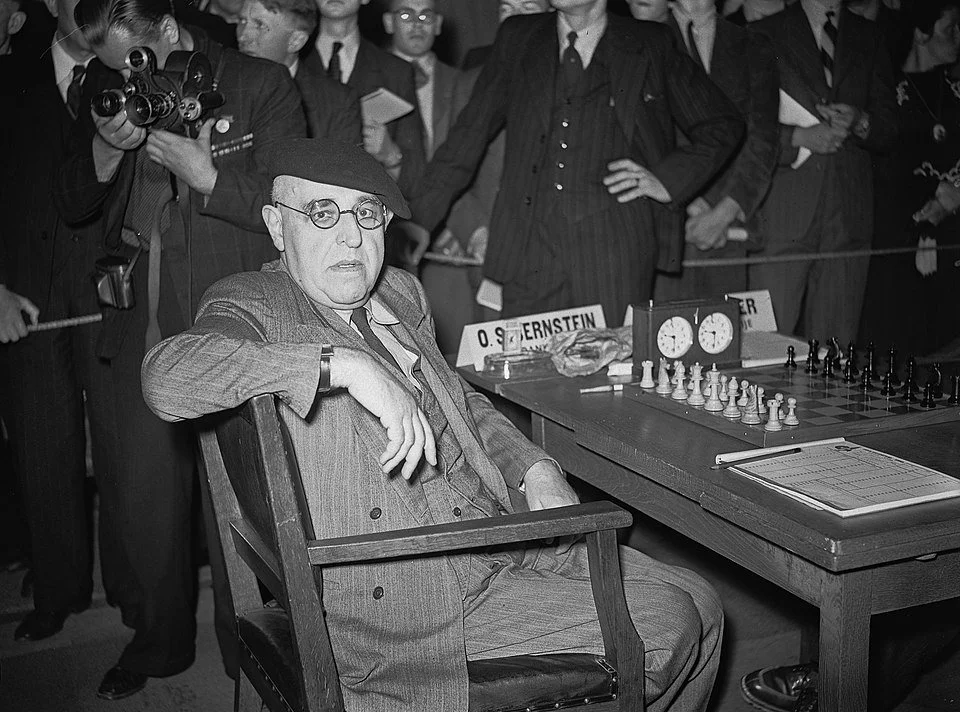
Ossip Bernstein, Groningen, 1946. Source: Nationaal Archief / Anefo
In September 1946, Mikhail Botvinnik won the international tournament at Groningen by half a point over Max Euwe. The result followed an unusually unsettled finish: Botvinnik had surrendered a substantial lead, recovered it, and then lost his final game. Euwe also lost in the last round, leaving Botvinnik first with 14½ points from nineteen games, Euwe second with 14, and Vasily Smyslov third with 12½.
The tournament brought twenty players from twelve countries to the northern Netherlands during the difficult recovery from the Second World War. Five Soviet competitors appeared together, giving an international audience an opportunity to assess a considerable part of the USSR’s leading chess talent. With the world championship vacant after Alexander Alekhine’s death, their encounters with Euwe and the other international masters took on particular significance. Groningen offered evidence about the emerging competitive order at a moment when the institutions responsible for organizing it were still being rebuilt.
A Dutch anniversary with international ambitions
The event was known in Dutch as the Staunton Wereldschaaktoernooi, the Staunton World Chess Tournament. The tournament celebrated the seventy-fifth anniversary of Groningen’s Staunton chess club, founded in 1871. Competition began on 13 August and ended on 7 September 1946. The principal playing venue was the Harmonie building. The term “world tournament” expressed the organizers’ international ambitions; the competition awarded a tournament victory, with the world championship still to be decided separately.
Staunton’s retrospective history traces discussion of an ambitious anniversary celebration to the wartime years and records a decision, at a club meeting in September 1945, to organize an international tournament. It identifies cooperation between the club and the northern regional chess organization, NOSBO, while acknowledging uncertainty about the initiative’s precise beginnings. Johannes Hollander became a central organizer, and Euwe’s international contacts helped shape the invitations. The undertaking depended on a local chess community whose ambitions extended well beyond its own membership.
Contemporary newspaper material shows how that community sought wider support. An advertisement in the Overijsselsch dagblad of 10 August 1946 appealed for contributions to the tournament and supplied several banking channels through which supporters could donate. The appeal documents public fundraising shortly before play began. It also gives practical substance to the often-repeated description of Groningen as an achievement of postwar reconstruction: assembling a field of this strength required people to raise money, arrange travel, and sustain an event lasting almost four weeks.
Promotion had started months earlier. On 3 April, the Nieuwsblad van het Noorden announced a weekly regional radio feature, Meesters, die komen, presented by Hollander. Beginning that Friday, it would introduce the approaching tournament and its participants. The announcement also reported that Čeněk Kottnauer and the Canadian Daniel Yanofsky had accepted invitations, with Yanofsky's name appearing in a contemporary spelling variant. The organizers were cultivating an audience while the field was still taking shape.
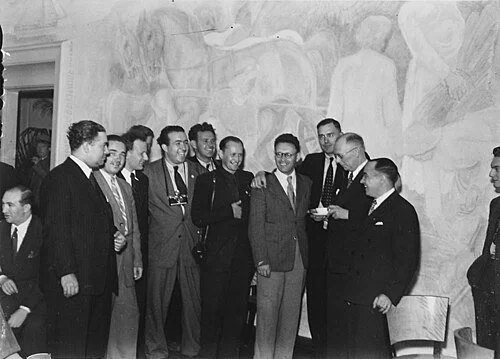
Staunton-tournooi (schaken) in Groningen. Russische deelnemers, w.o. Botwinnik, Max Euwe (3de van rechts), en wedstrijdleider Hans Kmoch, Hotel Frigge, Herestraat 72, 10 augustus 1946 Foto Ben van Meerendonk / AHF, collectie IISG, Amsterdam
The field and the problem of twenty-one players
Groningen was an invitational, nineteen-round, single round-robin tournament. Each player met every other player once, with one point for a win and half a point for a draw. Its 190 games imposed a sustained test of concentration and endurance. Hans Kmoch and Flentge served as tournament officials; the tournament-book-based record gives a first-time control of forty moves in two and a half hours, followed by sixteen moves an hour. Adjournments remained part of the competition and could leave the published standings temporarily incomplete.
The Soviet contingent comprised Botvinnik, Smyslov, Isaac Boleslavsky, Salo Flohr, and Alexander Kotov. Douglas Griffin identifies Groningen as the first foreign tournament to which the Soviet authorities sent such a group. Botvinnik and Flohr already possessed substantial prewar international experience. Smyslov, Boleslavsky, and Kotov were making their first appearances in the West, bringing reputations established largely through Soviet competition into a broader setting.
Euwe, world champion from 1935 to 1937, was the host country’s leading contender. Arnold Denker, then the United States champion, and Herman Steiner represented American chess. Miguel Najdorf and Carlos Guimard represented Argentina. Hungary’s László Szabó and Sweden’s Erik Lundin and Gösta Stoltz added considerable competitive depth. France was represented by Ossip Bernstein and Savielly Tartakower; the remaining competitors were Milan Vidmar of Yugoslavia, Kottnauer of Czechoslovakia, Yanofsky of Canada, Albéric O’Kelly de Galway of Belgium, and Martin Christoffel of Switzerland. The field brought together established prewar masters and younger players whose international careers were still developing.
Several leading contenders were absent, including Paul Keres, Reuben Fine, and Samuel Reshevsky. Their absence limited the tournament’s ability to provide a complete comparison of the strongest players. The available evidence does not justify treating the final standings as an exhaustive ranking of world chess strength.
An organizational dispute further altered the field. Twenty-one players assembled for an event intended to accommodate twenty, and the Dutch master Lodewijk Prins was ultimately excluded. The contemporary Swedish account reports that an offer of compensation had failed to produce a voluntary withdrawal. Later accounts disagree over how the excess invitation arose, making the familiar story of an unexpected additional Soviet entrant unsafe to repeat as an established explanation. The club’s historical research records subsequent litigation and compensation proceedings. For Prins, the dispute meant losing an important international opportunity; for the hosts, it left Euwe as the sole Dutch participant.
The vacant world championship
Groningen’s relationship to the world title requires precision. At its congress in Winterthur on 25–27 July 1946, FIDE proposed a championship tournament involving Euwe, Botvinnik, Keres, Smyslov, Fine, and Reshevsky. Its provisional arrangements also allowed an additional participant through the forthcoming Groningen and Prague tournaments. If both winners came from outside the six nominees, they would contest a qualifying match; if only one did, that player would qualify directly.
Botvinnik’s victory at Groningen consequently created no additional qualifier, since he was already nominated. Smyslov, too, had been named before Groningen began. His third place strengthened his case for inclusion. The arrangements were revised in 1947, and the eventual championship took place in 1948. Edward Winter’s examination of the congress minutes and contemporary reporting establishes these distinctions, which later summaries sometimes obscure.
Soviet international success also had an immediate prehistory. The USSR had beaten the United States 15½–4½ in their 1945 radio match and Great Britain 18–6 in another radio contest in 1946. Those results had already attracted attention to Soviet strength. Groningen brought several leading Soviet players into sustained competition with an international field in the same playing hall, under a common schedule.
Botvinnik establishes the pace
Botvinnik opened with five consecutive victories. His opponents in that sequence included Smyslov, alongside Szabó, Lundin, Steiner, and Vidmar. An early report in the inaugural issue of Chess Life, dated 5 September, recorded his perfect start, with Euwe on 4½ points and Denker and Stoltz on four. The report’s publication date also shows the delay overseas readers faced in receiving tournament news.
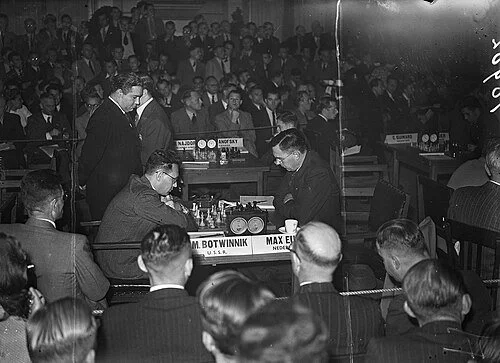
Denker held Botvinnik to a draw in their next encounter, but the leader continued accumulating wins. Euwe’s progress stalled with a defeat against Smyslov. When the two principal contenders met on 24 August, Botvinnik had established enough of a lead for their direct encounter to carry exceptional weight.
Euwe obtained the better prospects, and the game was adjourned in a rook ending. In annotations published in 1949, Botvinnik recalled that he initially considered his position lost. During the ninety-minute interval, however, he discovered a defensive possibility and subsequently secured the draw. This account comes from the player’s relatively early published analysis, available in Douglas Griffin’s translation. It shows how the tournament’s playing conditions could influence its outcome: work during an adjournment formed part of the competitive contest.
The draw preserved Botvinnik’s advantage. After the first ten scheduled rounds, he had nine points, Euwe 7½, and Smyslov and Denker seven each. The eventual results of the first thirteen games gave Botvinnik 11½ points, against Euwe’s 10½. The distinction between scheduled rounds and completed games is useful here because unfinished encounters continued to affect the running scores.
Euwe takes the lead
The decisive reversal began on 30 August. Kotov defeated Botvinnik in the fourteenth round, while Euwe beat Bernstein. Once Botvinnik’s outstanding draw with Flohr was included, the two leaders stood level on 11½ points. Kotov’s contemporary annotations in Shakhmaty v SSSR document the victory that reopened the tournament. His eventual middle-of-the-field finish would give an incomplete impression of his influence on first place.
In the next round, played on 2 September, Yanofsky defeated Botvinnik. Euwe’s victory over Vidmar put him a full point ahead, 12½ to 11½, with four rounds remaining. The Canadian’s achievement became one of Groningen’s enduring individual episodes. Yuri Averbakh annotated the game for the Soviet chess press, and his account records that it received the tournament’s third prize for beauty. Yanofsky had intervened directly in the contest for first place while earning recognition for an individual performance.
Botvinnik’s position now required a substantial recovery. He achieved it by winning against Kottnauer, Christoffel, and Guimard in succession. Over the same three rounds Euwe drew with Stoltz, Flohr, and Tartakower. Their accumulated results brought them level after seventeen rounds and restored Botvinnik’s half-point lead after eighteen: 14½ to 14. The sequence demonstrates the breadth of the competition’s influence. Opponents throughout the standings helped determine whether the leaders could maintain their scoring rate.
A final round in which both leaders lost
On 7 September, Botvinnik faced Najdorf and Euwe faced Kotov. Both leaders had the black pieces. Botvinnik could secure outright first place by winning; a draw would guarantee at least a share of first. Euwe still had a route to outright victory if he won and Botvinnik lost.
Neither leader added to his score. Kotov defeated Euwe, and Najdorf defeated Botvinnik. The contemporary Chess Review account reports that Euwe’s defeat was established first. Groningen therefore ended with Botvinnik on 14½ and Euwe on 14, exactly their totals before the final round. No tie-break or playoff was required to decide the winner. Kotov’s own contemporary notes to his game with Euwe provide a further primary account of the result that settled the contest.
Botvinnik’s thirteen wins supplied the scoring power needed to absorb three defeats; his other three games were drawn. Euwe finished with eleven wins, six draws, and two losses. The narrow margin emerged from their results across the entire field. Their drawn direct encounter had left the question of first place dependent on those wider performances.
Smyslov finished third with 12½ points, losing only to Botvinnik. His victory against Euwe and his sustained results gave his performance significance beyond his finishing position. Najdorf and Szabó shared fourth and fifth with 11½. Flohr and Boleslavsky shared sixth and seventh with eleven, followed by Lundin and Stoltz on 10½.
Kotov, Denker, and Tartakower shared tenth through twelfth with 9½. Kottnauer scored nine and Yanofsky 8½. Bernstein and Guimard finished on seven, Vidmar on 6½, Steiner on six, O’Kelly on 5½, and Christoffel on five. These shared places should be retained when describing the result, even where a source prints tied players in a particular order.
Public reception and the work of remembrance
Contemporary reporting treated Groningen as an event of substantial public interest. The Swedish magazine Tidskrift för Schack estimated approximately 1,800 spectators for Botvinnik’s encounter with Euwe. It reported that the prize presentation followed the final games in the playing hall, with more than 2,000 spectators, a special radio broadcast, and filming. These figures belong to the magazine’s account and should be understood as contemporary estimates. Botvinnik received Queen Wilhelmina’s honorary prize, a silver cigarette case bearing a monogram.
The same report preserves a revealing detail about the tournament’s commemorative culture. A prize established by Salo Landau’s brother rewarded the best score against the prizewinners by a player outside the prizewinning group. Bernstein and Kottnauer shared it. The award placed Landau’s memory within the event's competitive life and recognized performances that the leading positions alone would not capture.
Across the Atlantic, Chess Review emphasized the unusual finish, the strength of the field, and the demands of the schedule. Its assessment of Soviet performance was qualified, praising Smyslov’s steadiness while observing that the delegation’s results had varied. This contemporary perspective preserves the uncertainty of 1946: participants were judged by a tournament whose outcome remained open until the final day.
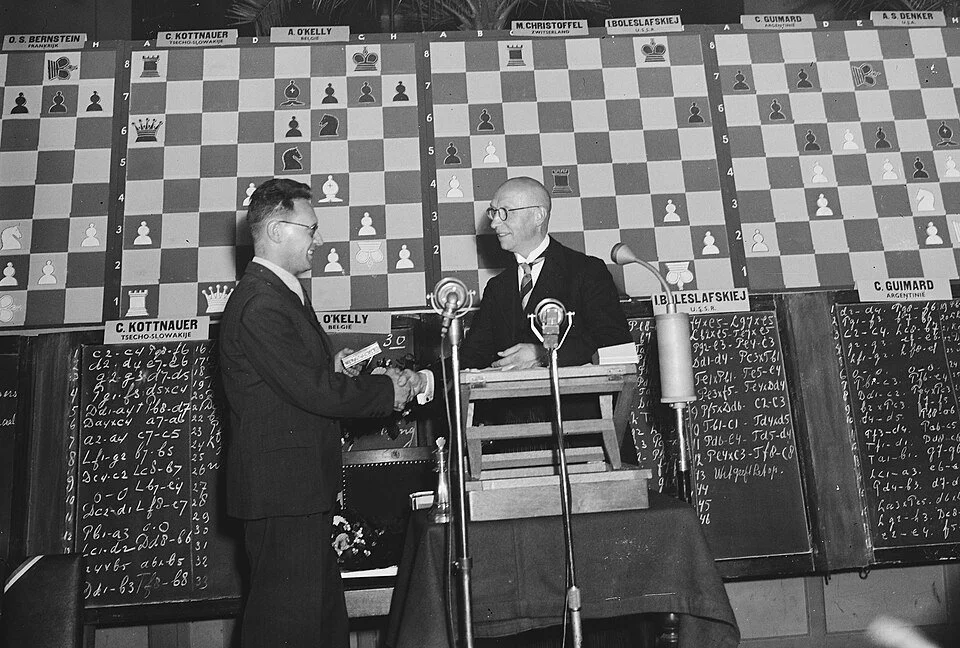
Botvinnik wins! Photographer Theo van Haren Noman
Historical assessment
Groningen strengthened Botvinnik’s standing at a crucial stage in his pursuit of the world championship. It also demonstrated Euwe’s continuing capacity to contend at the highest level and introduced a wider audience to Smyslov’s competitive strength. Kotov’s victories over the two leaders, Najdorf’s final-round success, and Yanofsky’s defeat of Botvinnik ensured that the tournament’s outcome depended on contributions from well beyond the first three finishers.
Its broader importance rests on the successful assembly of an international chess community after years of disruption. A Dutch club anniversary provided the occasion; local organizers, donors, broadcasters, and spectators helped give it substance. The games offered a demanding comparison between established international reputations and the strength developing within Soviet chess. Groningen deserves attention as a closely contested sporting event and as a documented example of how international chess resumed its public and institutional life after the war.
Notes and Sources
The article draws on contemporary periodicals, reproduced Dutch newspaper clippings, player annotations, and specialist historical research. The original Euwe–Kmoch tournament book was not available for direct consultation; its results and regulations were checked through the explicitly book-based Belgian Chess History transcription. Soviet annotations were examined in Douglas Griffin’s English translations. FIDE’s 1946 minutes were consulted through Edward Winter’s transcription and discussion.
1. Belgian Chess History, “Staunton world chess tournament, Groningen”, event record for 13 August–7 September 1946. Cites Max Euwe and Hans Kmoch, Groningen 1946: Het Staunton wereldschaaktoernooi (Groningen: Niemeijer, 1947). Used for identity, regulations, representation, and results; original book consulted indirectly.
2. Douglas Griffin, “Soviet players at Groningen, 1946”, 1 August 2021. Useful for Soviet participation and access to translated primary accounts. Its narrative chronology was cross-checked against the linked game records.
3. Edward Winter, “Interregnum”, 2003–04, subsequently updated. Includes the July 1946 FIDE congress minutes and discussion of Erwin Voellmy’s congress report, Schweizerische Schachzeitung, November 1946, pp. 169–171; also Chess Review, August 1947, p. 2, on the revised qualification arrangements. These originals are cited through Winter.
4. Schaakgezelschap Staunton, “Het Staunton toernooi van 1946”, undated historical account. Used selectively for the seventy-fifth anniversary, planning, venue, and organizing community.
5. Overijsselsch dagblad, 10 August 1946, tournament fundraising advertisement, reproduced by Staunton. The reproduced clipping does not establish the newspaper page number.
6. Nieuwsblad van het Noorden, 3 April 1946, announcement of Hollander’s tournament radio feature, reproduced by Staunton. Newspaper page number unavailable in the clipping. Programme title retained in Dutch; contents paraphrased from the Dutch text.
7. PGN Mentor, Groningen 1946 game collection. All 190 results were independently totalled and checked against source 1. The file mislabels Botvinnik–Euwe as round nine, leaving eleven games in that round and nine in round ten; the date and tenth-round identification in source 12 provide the stronger record. Numerical totals and win-draw-loss records are unaffected.
8. “Groningen 1946,” Tidskrift för Schack, vol. 52, nos. 8–9, August–September 1946, pp. 211–219. Unsigned contemporary report. Participant dispute: pp. 211–212; spectator estimate: p. 215; ceremony and special prizes: p. 218. Swedish text paraphrased; crowd figures attributed to this report.
9. Schaakgezelschap Staunton, “Joh. Hollander”, historical biography and reproduced documentation. The club’s retrospective accounts differ in their presentation of the Prins compensation amounts. No precise legal award is asserted here because the judicial record was not examined.
10. Douglas Griffin, “Botvinnik’s games v. Alexander (USSR v. GB radio match, 1946)”, 18 April 2025. Used for the immediately preceding Soviet radio-match results.
11. “Botvinnik Leads Groningen Meet,” Chess Life, vol. 1, no. 1, 5 September 1946, p. 1. Contemporary report of the first five rounds.
12. Mikhail Botvinnik, annotations to Botvinnik–Euwe, Izbrannye partii 1926–46 (Leningrad, 1949), translated by Douglas Griffin, especially PDF pp. 4–5. Original book pagination is not supplied in the translation.
13. “Groningen Grandmastery,” Chess Review, October 1946, pp. 7–8. Directly examined contemporary account. Its ninth-round label for Botvinnik–Euwe conflicts with source 12; its description of Najdorf as Polish is not used for his tournament representation.
14. Alexander Kotov, annotations to Botvinnik–Kotov, Shakhmaty v SSSR, nos. 11–12, 1946, translated by Douglas Griffin.
15. Yuri Averbakh, annotations to Yanofsky–Botvinnik, Shakhmaty v SSSR, nos. 11–12, 1946, translated by Douglas Griffin. The header identifies 2 September, three days after Botvinnik–Kotov; the two defeats occurred in successive rounds. The final paragraph specifies the third beauty prize.
16. Alexander Kotov, annotations to Kotov–Euwe, Shakhmaty v SSSR, no. 10, 1946, translated by Douglas Griffin. Sources 14–16 do not supply original magazine pagination.


