The 55th USSR Championship
Introduction
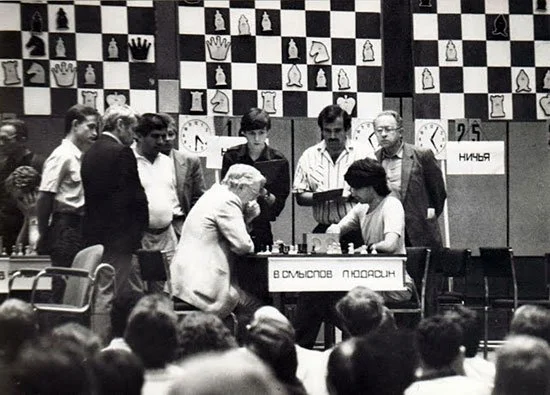
The 55th USSR Championship, played in Moscow from July 25 to August 19, 1988, ended with Garry Kasparov and Anatoly Karpov tied for first on 11.5 points from 17 games. Both completed the tournament unbeaten. On its face that sounds simple. In historical terms, it was anything but simple. The event brought together an extraordinarily concentrated Soviet elite, including four world champions in the starting field, and it ended with an unresolved first place that had to be settled institutionally only months later. For that reason, the championship occupies a special place in late Soviet chess history, less as a single tournament result than as a compressed portrait of Soviet chess power, prestige, internal rivalry, and administrative strain in the last years of the USSR.
Later writers, including Kasparov himself in retrospective memoir form, treated the 1988 event as the last Soviet championship to gather the full weight of the old system into one arena. That claim is interpretive rather than documentary fact, because Soviet championships continued after 1988. Still, it captures something real about Moscow 1988: the field looked less like an ordinary national championship than like a supertournament disguised as one.
Historical Setting
The broader framework is important, but only in the narrow sense that it explains why this particular championship felt so charged. The USSR Championship as an institution was organized by the USSR Chess Federation and had long been regarded as the strongest national championship in the world. By 1988 that reputation still had force. Moscow 1988 came after the Kasparov-Karpov world title wars of the mid-1980s and in the midst of a dense international calendar. Kasparov later recalled that the championship was inserted into a run of international supertournaments, which helps explain both the extraordinary strength of the field and the exhaustion, tension, and prestige surrounding it.
The immediate chess context was unusually rich. Kasparov entered as reigning world champion, Karpov as his predecessor and still his principal domestic rival. Andrei Sokolov had recently been a Candidates finalist, Artur Yusupov remained one of the central Soviet grandmasters of the Candidates generation, Valery Salov was emerging as a major force, and the youngest layer of talent was represented by players such as Vasyl Ivanchuk, Boris Gelfand in qualification, Alexander Khalifman, Leonid Yudasin, and Ilia Smirin. In other words, the tournament was not simply strong at the top. It also concentrated the succession problem of Soviet chess on the same crosstable. That is an inference from the field composition, but it is strongly supported by the range of veteran champions, current contenders, and recent qualifiers who appeared in the cycle.
Organization, Format, and Field
The championship final was held in Moscow, under chief arbiter Mikhail Botvinnik. Readily accessible reference sources consistently supply the city, dates, and arbiter. They are less consistent, at least online, about the exact hall. What is clear is that the Central Chess Club of the USSR stood close to the event institutionally, since the post-tournament information collection on the championship was published there under Yuri Averbakh’s editorship.
In format, the final was an 18-player round robin, with regulations that called for an additional match between co-winners if first place were shared. The tournament acquired an unusual statistical shape because Mikhail Tal withdrew after the first round through illness and was replaced by Vyacheslav Eingorn. As a result, some summaries list 18 participants, while others show 19 names and 154 games rather than the 153 games of a normal 18-player round robin. That discrepancy is not a contradiction. It reflects the original field plus the emergency substitution.
Qualification followed the layered late Soviet model. Semifinals were held in Norilsk and Pavlodar in August 1987, and two First League events were then staged in Lvov and Sverdlovsk in November 1987. Standard summaries agree that the top four from each First League qualified for the Moscow final. In Lvov, Ivanchuk, Yudasin, Gavrikov, and Gurevich advanced. In Sverdlovsk, Smirin, Khalifman, Malaniuk, and Kharitonov advanced. This route helps explain why the final was so historically interesting. It was not merely an invitational gathering of famous names. It was the apex of the Soviet championship pyramid, still exercising its old function of filtering fresh talent upward.
The starting field was remarkable even by Soviet standards. Kasparov later emphasized that four world champions of different eras, Kasparov, Karpov, Smyslov, and Tal, were in the lineup, while Botvinnik, the fifth, presided as chief arbiter. That formulation is retrospective, but it accurately conveys the event’s symbolic weight. Soviet chess was presenting both its lineage and its current elite at once.
Main Course of the Championship
The broad course of the tournament was shaped by the expected Kasparov-Karpov rivalry, but not only by it. Kasparov started quickly. In retrospective publication, he singled out his round two win over the 19-year-old Ivanchuk as an especially meaningful encounter, because it felt like a first direct clash with the rising generation. Kasparov also noted that by the time of their game Ivanchuk had already won the First League of this same championship cycle and the 1988 New York Open. The game entered tournament memory less because of its opening details than because it announced, in one sitting, both Kasparov’s current authority and Ivanchuk’s arrival.
Karpov, though, stayed close throughout. The direct Kasparov-Karpov encounter ended in a draw, which meant the championship would be decided by the two men’s harvesting of points against everyone else. That fact is central to understanding the event. Moscow 1988 was not won by a head-to-head knockout blow. It was won, or rather shared, through sustained precision over a long distance.
After 15 rounds, Kasparov led with 10.5 points, Karpov followed with 10, and Salov stood on 9.5. In round 16 the balance shifted. Karpov defeated Malaniuk, while Kasparov drew with Vaganian. That brought the two leaders level on 11. In the final round both leaders drew, Karpov with Ehlvest and Kasparov with Eingorn, locking first place at 11.5 each. The late race therefore had a clear narrative arc: Kasparov led deeper into the tournament, Karpov caught him in the penultimate round, and neither could separate in the finish.
Behind them, the standings reinforce how strong the championship really was. Yusupov and Salov tied for third and fourth on 10 points, only 1.5 behind the winners. Eingorn and Ivanchuk shared fifth and sixth on 9.5, ahead of Yudasin on 9 and Beliavsky on 8.5. A large middle grouping included Ehlvest, Smyslov, Gavrikov, Sokolov, and Vaganian on 8. In prose, that list says what the bare phrase “strong field” often obscures: in Moscow 1988, even players who finished outside the prizes belonged to the first rank of Soviet and international chess.
Winners, Challengers, and the Unplayed Playoff
The official tournament outcome and the political-institutional outcome were not the same thing. Over the board, Kasparov and Karpov had shared first place. Under the regulations, that should have triggered a four-game playoff match beginning on August 22, with sudden-death continuation if necessary. Reconstructing what happened next requires some source caution. Kasparov’s later memoir, republished by the Russian Chess Federation, states that the drawing of lots was held on August 19, that Karpov drew White for the first game, and that Karpov then declined to play. Neutral summary references frame the matter more sparingly, saying only that the playoff did not occur because of disagreements between the two winners. For historical writing, the safest formulation is to keep both layers visible: Kasparov gave a specific partisan recollection, while reference summaries confirm the broader fact of disagreement and non-performance.
The dispute was not settled at once. On October 22, 1988, the plenum of the USSR Chess Federation resolved the matter by declaring both Kasparov and Karpov champions. That decision turned a tied tournament into a shared title and guaranteed the event an afterlife larger than its crosstable alone would have produced. Shared first place had precedent in Soviet championship history, but here the tie was sharpened by the prominence of the players, the unplayed playoff, and the visibility of the rivalry.
For the winners, the formal consequences were distinct. For Karpov, the shared title was his third USSR championship. For Kasparov, it was his second. For both, the event extended the logic of their 1980s duel into the domestic arena. In that sense the championship did not close their rivalry. It domesticated it, then failed to settle it, and finally returned the solution to federation procedure. That is why Moscow 1988 is remembered not only as a great tournament, but as a championship whose result remained partly administrative after the last move had been played.
Contemporary Reception
The contemporary Soviet response captured both excitement and incompletion. One chess periodical celebrated the event in language that can be rendered as a “championship-dream,” a “championship to behold,” emphasizing that it had finally brought together all the stars of Soviet chess. That phrasing is valuable because it records how the event felt from inside the Soviet chess press in 1988, not only how it was remembered later.
At the same time, the unresolved finish quickly became the dominant public theme. An August 31, 1988 item in Sovetsky Sport wrote that, “using chess terminology,” the 55th championship had been left in an “adjourned position.” Another contemporary snippet from 64 stated that the first place had been shared, that the match between the winners had not taken place, and that the question of the champion remained open. Together those notices show that the issue was not treated as a technical footnote. It was a visible public problem in the Soviet chess press.
Institutionally, the championship also generated a substantial paper trail. A short official Moscow booklet was issued in 1988, and the post-event information collection Shakhmaty v SSSR devoted a substantial November 1988 issue to the championship, including games, commentary, and opening-theory notes. Those traces suggest a competition that the Soviet chess establishment expected readers to study closely, not merely note in passing.
Legacy and Historical Assessment
Later historical assessment has tended to converge on three points. First, Moscow 1988 was one of the strongest Soviet championships of the late period, and by some retrospective measures the strongest since 1973. Second, it was the last Soviet championship that genuinely resembled an “all-star” final, with reigning and former world champions, current elite challengers, and new-generation players all in one field. Third, its unresolved playoff turned it into a case study in how even the most powerful chess culture of the twentieth century could still produce a result that only an institutional ruling could finalize.
Its chess legacy is also broader than the shared title. Ivanchuk’s strong finish confirmed that his rise was not a one-tournament accident. Smirin’s presence testified to the continuing permeability of the Soviet qualification ladder for ambitious younger masters. Eingorn, inserted after Tal’s withdrawal, not only stabilized the field but finished tied for fifth, which turned a contingency into one of the tournament’s memorable subplots. Meanwhile, the veterans, especially Smyslov and Tal, gave the championship a historical depth that younger events could not reproduce.
The 1988 Moscow 55th USSR Championship deserves attention today because it condensed several histories into one tournament. It was a national championship that looked like a world-class invitational. It was a meeting place of generations. It was a late-Soviet institutional spectacle that still generated official booklets, extensive analytical coverage, and press debate. It was also a championship whose first place could not be settled over the board. For serious readers of chess history, that combination gives Moscow 1988 a durable significance. It stands as both a final flowering of the Soviet championship ideal and a revealing sign of the strains within it.
Notes and Sources
This article is based first on contemporaneous and near-contemporaneous Soviet materials that remain identifiable online: the official bibliographic record for the November 1988 Shakhmaty v SSSR information collection edited by Yuri Averbakh, snippets from 1988 Soviet chess periodicals, and a newspaper-archive reference from Sovetsky Sport. For standings, round-by-round race reconstruction, and the Tal-Eingorn substitution, I relied on OlimpBase and the event summaries derived from the championship record tradition. For retrospective interpretation, I used Kasparov’s published recollections as republished by the Russian Chess Federation, while distinguishing his memoir testimony from neutral summary references when discussing the failed playoff. Specialist contextual help on the qualification cycle and emerging players came from Douglas Griffin’s Soviet chess history work and related archival writing
