The 7th USSR Championship
Introduction
The 7th USSR Championship deserves attention as more than an early prewar Soviet national tournament. It was a large, institutionally staged championship cycle in Moscow in autumn 1931, organized on a scale larger than any previous Soviet championship, and it became the event in which Mikhail Botvinnik won his first national title. Later Soviet retrospectives treated it as a moment when the younger generation ceased to be a promising adjunct to the established masters and became the leading force in the field. The final standings support that judgment: Botvinnik won with 13½ points from 17 games, two points ahead of Nikolai Riumin on 11½, while the experienced and already well-known Boris Verlinsky, Vladimir Alatortsev, Mikhail Yudovich, and Fyodor Bogatyrchuk finished behind them.
The event also requires some source criticism. Standard summaries usually date the championship from 10 October to 11 November 1931, meaning the entire cycle in Moscow. More detailed reconstructions distinguish between the preliminary stage and the final, placing the 18 player final from 24 October to 11 November. A similar caution applies to the venue. Later summaries often place the final in the famous Hall of Columns, while Botvinnik’s own recollection places play in the foyer of the October Hall within the House of Unions complex. Treated carefully, these are not contradictions so much as signs that the championship was embedded in a broader congress-like setting inside one major Moscow venue.
Historical Setting
By 1931 Soviet chess was no longer simply a collection of city circles and occasional master events. The organizational framework had hardened. Recent scholarship and official retrospective material agree that the All-Union Chess Section under the Higher Council of Physical Culture functioned as the central governing authority for Soviet chess organizations in this period. The journal 64 served as an official organ of that structure, and the Moscow events of autumn 1931 unfolded within the orbit of the 7th All-Union Chess and Checkers Congress. That setting explains why the championship generated not only games and rankings, but speeches, resolutions, committees, and published bulletins.
This institutional setting also shaped the public language around the event. The congress itself was in session in Moscow in October 1931, and bibliographic evidence shows that a special Bulletin of the VII All-Union Chess and Checkers Congress was issued in twenty numbers between 10 October and 17 November, with a print run of 10,000. That kind of documentation suggests that the organizers conceived the championship as a national showcase of organized Soviet chess, not as a modest internal tournament. The staging of a parallel women’s championship in the same congress atmosphere points in the same direction.
Organization, Format, and Field
In purely sporting terms, the 7th championship was the biggest Soviet championship project so far. Standard references state that about 500 players took part in the preliminary process. By the time the final began, the field had been cut to 18 players for a 17 round all play all tournament, with 153 games in total. More detailed reconstructions describe eight semifinal groups, each a nine round all play all, feeding the final. Botvinnik’s own record confirms that he played a nine game semifinal in Moscow before reaching the championship final proper.
The field itself was one of the central features of the event. It brought together rising young masters and already established names from across the Soviet Union. Botvinnik was still only twenty. Riumin, only twenty three, had already won the Moscow championship earlier in 1931 and entered the national final as the foremost local hope. Verlinsky, the champion of 1929, added the prestige of an already crowned Soviet master. Bogatyrchuk represented the strongest Ukrainian tradition in the field. Alatortsev, Yudovich, Rauzer, Kan, Ilyin-Genevsky, Sozin, Kasparian, and others ensured that the final was not merely deep, but stylistically and regionally varied.
Yet the road into the final was not administratively clean. Later Russian historical work, drawing on contemporary documentation, reports that the All-Union Chess Section decided to enlarge the final by admitting four additional players, including Boris Verlinsky and Fyodor Bogatyrchuk, despite the fact that they had not advanced on normal semifinal results. The same accounts state that Pyotr Romanovsky and Solomon Gotgelf, both semifinal winners, protested these changes and refused to play in the final, after which they were pressured to submit penitential letters and faced disciplinary sanctions. Even if one focuses primarily on the tournament itself, this episode is impossible to ignore, because it shows that selection and institutional authority were part of the championship’s history, not merely background noise.
Main Course of the Championship
Botvinnik did not arrive in the final looking inevitable. In his semifinal he qualified only with difficulty, finishing behind Genrikh Kasparian after losses to Aleksandr Konstantinopolsky and Pyotr Izmailov. In his later recollection, he emphasized that he had already lost two games in the semifinal and only secured passage late. The shaky form continued at the start of the final. He lost in the opening round to Aleksandr Ilyin-Genevsky and then suffered a second defeat in round seven against Veniamin Sozin. In his memoir, Botvinnik remembered that after those early setbacks his position seemed hopeless.
That poor start allowed Riumin to seize the narrative of the tournament. He was the Moscow champion, the city favorite, and for much of the event the most visible challenger to Botvinnik’s hopes. According to Douglas Griffin’s reconstruction from Russian sources, after fourteen rounds Riumin remained undefeated and led Botvinnik by half a point, 11½ to 11, with Bogatyrchuk a distant third. Botvinnik, however, recovered with the kind of sustained run that later became one of the hallmarks of his tournament career. In his own account he summarized the turnabout starkly: after the bad beginning, he scored nine points from the next ten rounds and secured the title.
The final standings make the scale of that recovery clear. Botvinnik finished on 13½. Riumin ended on 11½. The group at 10 points included Verlinsky, Alatortsev, Yudovich, and Bogatyrchuk. That distribution of scores tells an important historical story. The championship was not a narrow escape by the winner on tiebreak, and it was not a triumph of veteran dominance. It became, rather, a clear first place by a young contender who had fought his way through organizational complexity, an uneven preliminary campaign, and a poor opening week in the final.
Winner and Key Contenders
For Botvinnik, this was the first unmistakably national success of his career. Later biographical notices understandably telescope his rise, but the 1931 championship was the point at which national promise became national authority. He was twenty years old, a Leningrad student, and his victory was later remembered in Soviet periodical literature as a generational breakthrough. A fiftieth anniversary retrospective in Shakhmaty v SSSR described the event as one in which youth gave a decisive fight to the tried masters and took the leading position. That retrospective specifically singled out Botvinnik, Riumin, Alatortsev, and Yudovich as the younger group that defined the tournament’s upper tier.
Riumin’s role in the event was nearly as important historically as Botvinnik’s. He did not merely take second place. He functioned as Botvinnik’s real rival for most of the event, carried the hopes of the host city, and brought the tournament to a genuine late race. His 11½ points remained his best result in a USSR championship final, and contemporary as well as later accounts consistently treat him as one of the strongest Soviet players of the early 1930s. Botvinnik himself wrote warmly of Riumin as a master of complicated and double edged positions and one of the strongest representatives of the younger generation.
The rest of the leading pack also deserves brief notice because their presence sharpened the championship’s significance. Verlinsky was not just another strong entrant, but the champion of 1929. Bogatyrchuk was a major force from Ukraine and, controversially, one of the players inserted into the final outside normal qualification. Alatortsev and Yudovich, both young and ambitious, finished level with those better known names. In other words, the 7th championship was not a shallow event inflated by a large preliminary ladder. Its upper half was crowded with serious competitive strength, which makes Botvinnik’s clear victory more impressive and more historically revealing.
Contemporary Reception and Critical Turning Points
Only a few games need to be mentioned to explain the tournament historically. The first is Botvinnik’s opening round loss to Ilyin-Genevsky. It remains important because it punctures any retrospective illusion that the future world champion simply arrived and took over. Botvinnik later wrote that Ilyin-Genevsky “simply made mincemeat” of him. The second is the loss to Sozin, which deepened the early crisis and left Botvinnik well off the pace before his comeback began. These defeats shaped the tournament’s narrative because they turned a potential coronation into a pursuit.
The one essential positive game is Botvinnik versus Riumin in the fifteenth round. Botvinnik himself called it a game played in a nervous atmosphere because it essentially decided the winner of the championship. His later note that he became champion by a margin of two points immediately after that game is borne out by the final standings. Griffin’s reconstruction adds the wider social detail that “all of chess Moscow” seemed to be on Riumin’s side before the decisive encounter. The championship’s reputation rests less on a single immortal brilliancy than on this late head to head decision between the Leningrad challenger and the Moscow favorite.
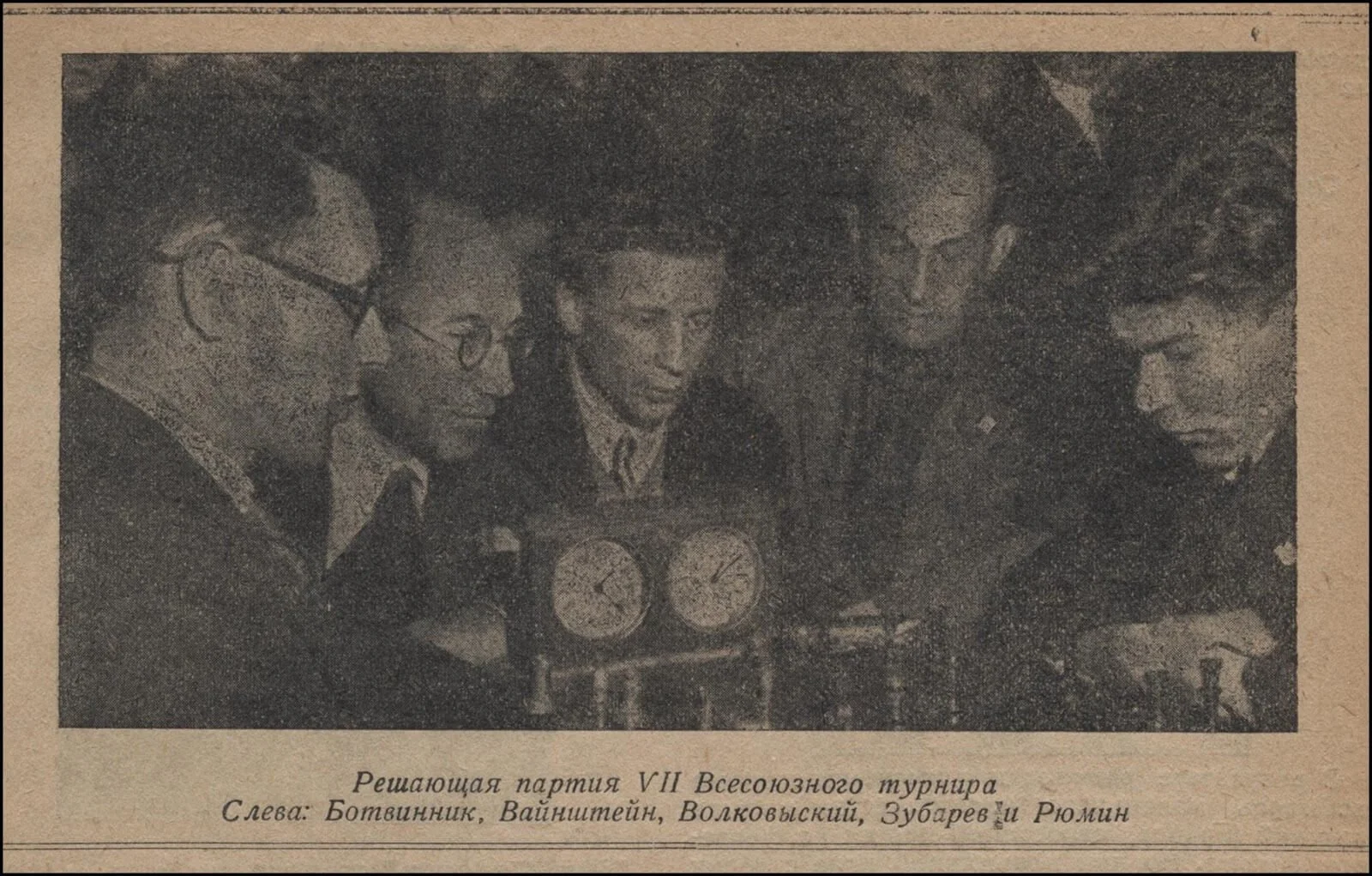
The opening and ceremonial framing also show how the event was received in its own time. Surviving press summaries report that the ceremonial opening in the Red Hall of the House of Unions featured remarks by N. D. Grigoriev and a recitation of the poem “Shakhmaty” by the proletarian poet Aleksandr Bezymensky. Archival photo captions from the opening further show not only players and organizers such as Krylenko, Zubarev, and Eremeev, but also participants in the women’s championship and a Vechernyaya Moskva chess observer. That is a revealing detail. The men’s championship was being presented as part of a broader Soviet chess public sphere in which official bodies, periodical culture, journalists, and parallel competitions intersected.
Legacy and Historical Assessment
Later historical judgment has been fairly consistent on the main point. The 7th USSR Championship was one of the events in which the Soviet championship ceased to be mainly a battle among a relatively stable older group and became the proving ground of a new hierarchy. The 1981 Soviet retrospective is useful here because it did not merely celebrate Botvinnik in hindsight. It stressed that much in the event was new, above all the decisive advance of younger players into the leading places. Botvinnik’s victory was therefore not just the first of his six Soviet titles. It was the first national championship in which his claim to future leadership became unmistakable.
At the same time, the tournament’s legacy is not reducible to the winner’s later fame. The 1931 championship also repays study because it illuminates the structure of Soviet chess in transition: the mass preliminary ladder, the authority of the All-Union Chess Section, the congress setting, the importance of the House of Unions as a symbolic venue, the increasingly public language around chess culture, and the possibility that administrative intervention could shape even a supposedly meritocratic championship field. Those elements make it historically richer than a bare crosstable suggests.
If one asks why the 7th USSR Championship deserves attention today, the answer is concise. It was the championship in which a vast and self consciously organized Soviet chess system staged one of its first truly large national tests, and the player who emerged from it was Botvinnik. The event’s combination of youth breakthrough, selection controversy, institutional choreography, and decisive late sporting drama makes it one of the most revealing Soviet championships of the interwar period.
Notes and Sources
This article relies first on primary or near-primary material. The most important individual witness is Botvinnik’s own later recollection in Half a Century of Chess, especially his account of the difficult semifinal, the poor start to the final, and the decisive importance of his game with Riumin. Douglas Griffin’s historical reconstruction is especially valuable because it draws explicitly on Botvinnik’s earlier collections, including Izbrannye partii 1926-36 and Izbrannye partii 1926-46, while also clarifying the relationship between the semifinal stage and the final.
For organization and institutional context, I have used Russian historical and scholarly sources on the All-Union Chess Section, the role of the Higher Council of Physical Culture, the congress setting, and the official press. Recent academic work on Soviet chess organization, Russian Chess Federation historical materials, congress references, and bibliographic evidence for the 1931 congress bulletin were especially useful here.
For standings and factual cross checks, I used standard reference compilations and summary sites cautiously, chiefly to confirm dates, scores, number of players, and placing. Where source traditions differ, especially on the exact dating of the final and the precise hall within the House of Unions complex, I have stated the discrepancy rather than smoothing it away. That is the most responsible approach for this championship, whose history survives in overlapping memoir, congress, journalistic, and later historical layers.
