Women’s Chess in Georgia
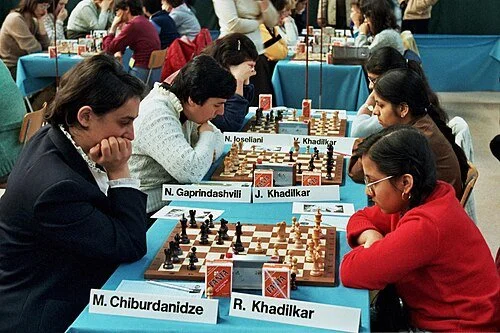
Soviet Women’s team in play against India, Luzern. Photo: GFHund
From 1962 until 1991, two Georgian players held the Women’s World Chess Championship without interruption. Nona Gaprindashvili won the title in 1962; Maia Chiburdanidze succeeded her in 1978 and held the title until 1991. During those years, Nana Alexandria and Nana Ioseliani also reached world championship matches. Georgia, then a republic within the Soviet Union, had developed an extraordinary concentration of leading female players.
Their achievements grew from a recognizable set of circumstances. Children encountered chess at home, entered school competitions, and found teachers who could guide them into stronger events. Famous players attracted families to the game. Experienced competitors remained active as younger women advanced. Surviving accounts suggest these connections between households, institutions, and generations helped turn individual success into a lasting tradition.
The foundations before the world champions
Organized women’s chess in Georgia preceded Gaprindashvili’s generation. Georgian educational researcher Megi Esebua dates the first Tbilisi women’s championship to 1927 and the Georgian women’s championship to 1935. These competitions established a setting in which women could gain experience and recognition well before a Georgian player contested the world title.
Youth chess institutions provided another foundation. In 1947, Vakhtang Karseladze took charge of the chess section at Tbilisi’s Palace of Pioneers and Schoolchildren. He became the first coach of both Gaprindashvili and Alexandria. The Georgian Sports Museum’s biographical record, preserved by the National Library of Georgia, identifies him as a founder of the Georgian women’s chess school.
The word “school” describes both a teaching tradition and a place. Karseladze worked with children over time, recognized promising players, and sought opportunities that would stretch them. The Russian Chess Federation’s account credits him with advocating regular participation by his female pupils in tournaments with men. His approach placed ambitious girls within the wider competitive life of Georgian chess.
This was demanding work with consequences beyond any single lesson. A local competition could reveal a child’s ability. A teacher could persuade a family to pursue it. The next stage required arrangements that made regular study possible. Gaprindashvili’s recollection of her childhood gives an unusually clear account of that process.

Nona Gaaprindashvili. Hans Peters for Anefo, CC0
A school team brings Nona to wider attention
In a Georgian interview published in 2017, Gaprindashvili recalled that her older brother Emzar learned chess from books and taught the family. Games at home in Zugdidi gave her an early competitive education. Then, in 1953, the town needed a girl for its team at the republic’s schoolchildren’s championship in Batumi. Her parents agreed that she could play.
Karseladze noticed her at that event and asked her parents to send her to Tbilisi. She recalled moving there in 1954, aged thirteen, to live with an aunt and uncle and attend the chess circle. Family hospitality made sustained instruction practical. The need for a girl on the school team had helped bring her ability to the attention of an experienced coach.
Her account also credits family support later in her career. Her mother accompanied her to tournaments and helped after the birth of her son; she emphasized her husband’s encouragement. These recollections reveal some of the everyday arrangements behind a professional chess career.
Karseladze was her formative teacher. Other specialists contributed as she advanced, including Mikhail Shishov, with whom she began working in 1956. Her development involved successive stages of instruction and competition.
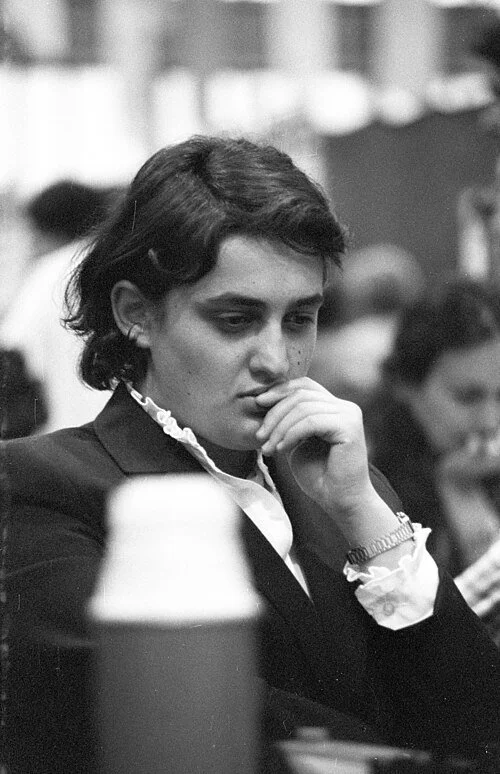
Maia Chiburdanidze. By Krtschil - Own work, CC BY-SA 4.0
The public effect of the 1962 championship
Gaprindashvili defeated Elisaveta Bykova in Moscow in 1962, winning the world title at twenty-one. Her success gave Georgian families a highly visible example of what a young woman could achieve through chess.
She later recalled the enthusiasm of her homecoming: people met the train with flowers, and crowds gathered at Tbilisi station. Speaking to journalist Sergey Lopatenok, she connected the growth of girls’ chess directly to that victory. During the 1960s, she remembered, sending daughters to chess clubs became fashionable.
Another witness described the public appetite that followed. Rimma Bilunova, who played in the 1964 USSR women’s championship in Tbilisi and later coached the Soviet women’s team, recalled that the event began in the Rustaveli Theatre's smaller auditorium. The chess audience became so large that the players moved into the larger hall. Spectators sat on the steps.
These are retrospective accounts, and they cannot supply a precise measure of the increase in participation. They nevertheless describe a consistent relationship between sporting achievement and public attention. A world champion made girls’ chess conspicuous. Parents could recognize an established activity with teachers, tournaments, and a celebrated Georgian representative.
That visibility acquired a permanent physical presence. Tbilisi’s Chess Palace and Alpine Club opened in Vera Park in 1973. The building was dedicated to Gaprindashvili, giving her achievements a place in the city’s public architecture. The palace became a venue for competitions such as the Karseladze Memorial, linking public recognition to opportunities for further play.
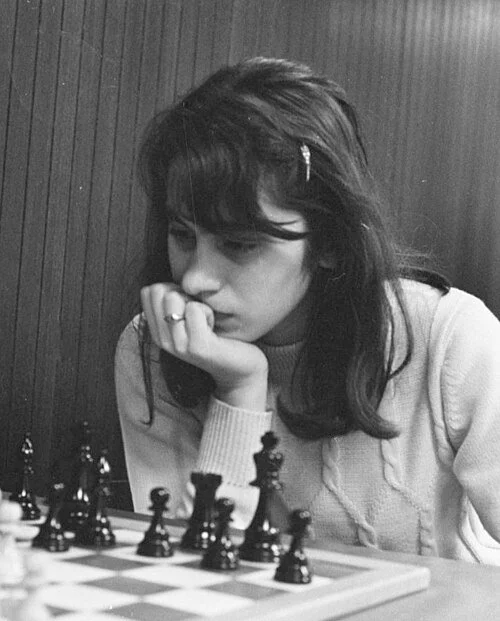
Nana Alexandria. By Verhoeff, Bert / Anefo
A school with several routes to the top
Nana Alexandria’s emergence demonstrated the depth of Karseladze’s teaching. She became Georgian champion at fifteen and won the USSR women’s championship in 1966, 1968, and 1969. In 1975 she challenged Gaprindashvili for the world title. Two of their teacher’s pupils had reached the final stage of the same championship cycle.
Alexandria remained a leading contender through the next generation. Her 1981 world championship match against Chiburdanidze finished 8–8, allowing the reigning champion to retain the title. Her career connected the early success of the Tbilisi school with the competitive strength that Georgia maintained into the 1980s.
Other cities and teachers contributed. In Kutaisi, Davit Chiradze taught at the House of Pioneers. The Russian Chess Federation’s biography of Tamaz Giorgadze records that both Giorgadze and, later, Chiburdanidze received early instruction from him. Georgia’s developing chess culture thus included regional centers whose pupils could advance to national and international competition.
The strongest players also drew on contacts across the Soviet Union. Ioseliani attended Mikhail Botvinnik’s school and received assistance from the Moscow trainer Vladimir Yurkov. Her career illustrates how a Georgian player could combine local formation with access to a wider network of expertise.
Tournament organization supplied further opportunities. Grandmaster Adrian Mikhalchishin, recalling his participation in the 1976 Karseladze Memorial, described the memorials as events intended to give young Georgian talents competitive experience. He remembered them alternating with international tournaments commemorating Viktor Goglidze. Visiting opponents and established venues shaped the environment in which promising players developed.
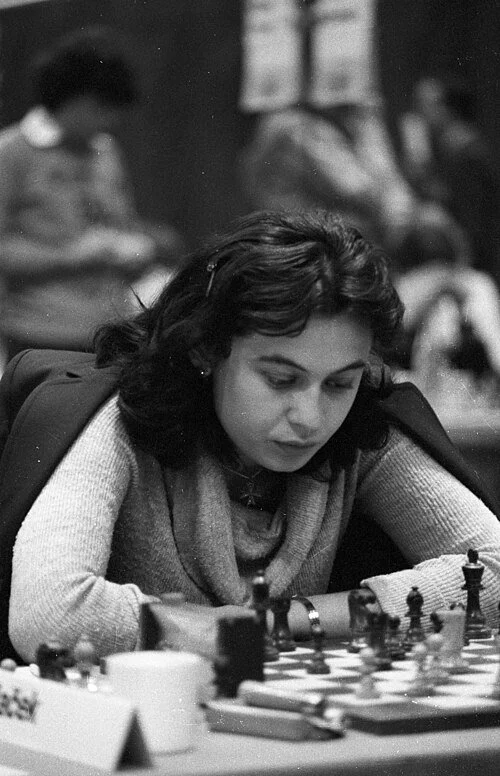
Nana Ioseliani. By Krtschil - Own work, CC BY-SA 4.0
Champions who helped make the next generation visible
A contemporary account captures the relationship between elite success and children’s participation. Writing in the Tbilisi newspaper Zaria Vostoka on 16 October 1976, Eduard Gufeld described young girls arriving with their mothers for Gaprindashvili’s championship celebration the previous December. Fourteen-year-old Chiburdanidze had been among those placing the laurel wreath on the champion.
Gufeld also reported that Alexandria presented chess programs on television and that leading women published articles. He singled out the teaching work of Karseladze and Bukhuti Gurgenidze. His account places public celebration, chess instruction, and communication with a wider audience within the same active community.
The article appeared in an official Soviet newspaper and expressed the period’s institutional optimism. Its specific observations remain useful evidence of what Georgian chess offered children: prominent women they could see, teachers they could approach, and activities through which they could begin learning.
In 1978, Chiburdanidze became world champion at seventeen. Gaprindashvili continued competing, and Alexandria remained a title challenger. Ioseliani contested the world championship against Chiburdanidze in 1988 and against Xie Jun in 1993. The strength of Georgian women’s chess extended across overlapping careers.
Gaprindashvili later offered her own explanation for that continuity. In a 2010 interview with Maria Fominykh, she emphasized that established players stayed active while younger women developed: “We kept playing, and the younger players were catching up.” Her observation describes a community in which newcomers could measure themselves against champions they already knew.
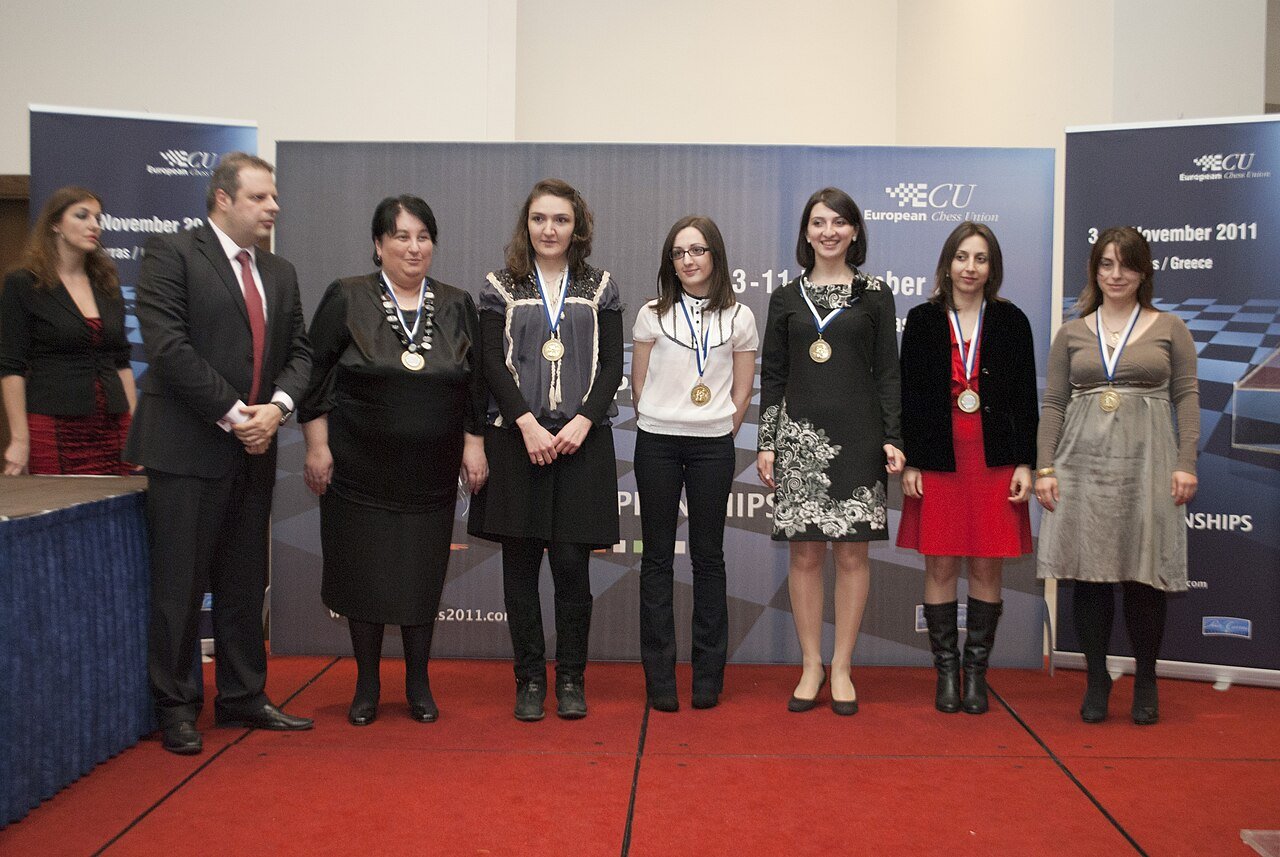
Porto Carras EchT 2011 - bronze medal for Georgian women's team. Andreas Kontokanis from Piraeus, Greece, CC BY-SA 2.0
Carrying the tradition into independent Georgia
Georgia’s first women’s Olympiad team after independence brought that accumulated experience directly into international competition. At Manila in 1992, Chiburdanidze, Gaprindashvili, Ioseliani, and Nino Gurieli won the gold medals. Two former world champions and a world championship challenger formed the core of the new national team.
Georgia won further Olympiad victories in 1994 and 1996. Georgia won again at Dresden in 2008, where Chiburdanidze played alongside a younger generation that included Nana Dzagnidze and Lela Javakhishvili. Gurieli, a member of the 1992 winning team, captained the 2008 side. Experienced players continued contributing through both competition and leadership.
Maintaining a tradition also required places where children and professionals could work. Batumi’s Club Nona, opened in 2013, provides a documented example of local support during this later period. In June 2017, Batumelebi reported that the municipally financed club had 350 members and six teachers. Most members were children.
Manager Marika Japaridze described inviting grandmaster coaches from Tbilisi and abroad. Local instructors received training alongside promising young players. The club maintained links with other Georgian towns and organized international exchanges. These arrangements show how public funding could support several stages of development, from children’s lessons to further teacher education.
The club served both boys and girls. Its connection to women’s chess was visible in its name, its leading players, and its competitive achievements. Support for a successful women’s team could exist within a wider program of local chess education.
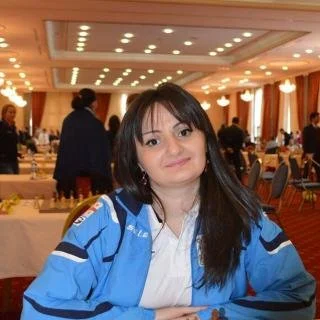
Miranda Mikadze
The experience passed from player to pupil
Miranda Mikadze’s testimony brings that later system into focus. In a 2015 Georgian interview, she recalled drawing a childhood simultaneous game against Gaprindashvili. Nona’s praise encouraged her. She also credited her coach, Leonid Neuronov, and explained that Club Nona’s assistance and financing helped her prepare regularly.
By the time of the interview, Mikadze was already teaching pupils. Her account follows the transmission of a tradition through concrete relationships: a child’s encounter with a champion, instruction from a dedicated coach, practical help from a club, and the player’s own work with younger children. The process depended on repeated contact and sustained effort.
The national team continued to demonstrate the depth produced by Georgian chess. Georgia won the Women’s World Team Championship in Chengdu in 2015 and again in 2023. Bela Khotenashvili, Meri Arabidze, Nino Batsiashvili, Lela Javakhishvili, and Salome Melia formed both winning squads.
Broadening access through schools
The relationship between chess and childhood education received a further institutional commitment in 2022. Georgia’s Ministry of Education and Science announced compulsory first-grade chess for the 2022–23 school year. A team assembled by the chess federation trained approximately 4,000 teachers during the summer, and the ministry prepared teaching resources.
Ioseliani supported the initiative and attended the ministry’s recognition of the trainers. Her participation connected a former world championship challenger with the practical work of introducing children to the game.
The programme broadened provision for introductory chess. Its long-term effect on the production of elite female players requires separate evidence. Its historical relevance lies in the continuing willingness of Georgian institutions to make chess part of children’s education and to involve accomplished players in that work.
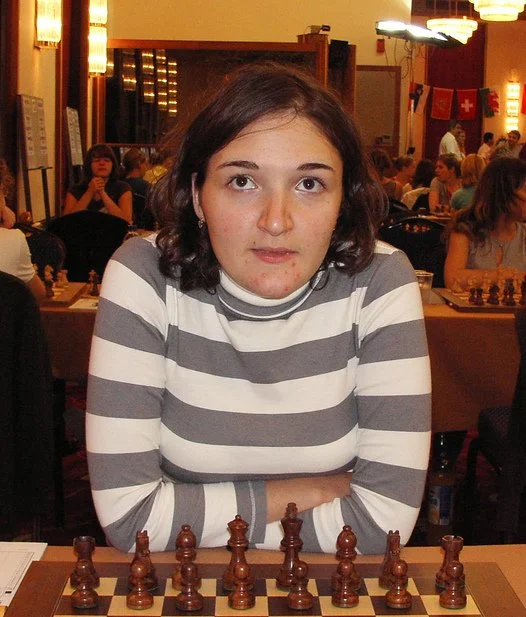
Nana Dzagnidze (Georgia), Heraklion 2007. karpidis from Piraeus, Greece, CC BY 2.0
A tradition sustained by people and institutions
The evidence points to several mutually reinforcing developments. Early competitions established opportunities for women to play. Youth institutions helped identify talent, while teachers and families made sustained study possible. Gaprindashvili’s success attracted public attention and encouraged participation. Alexandria, Chiburdanidze, Ioseliani, and their contemporaries gave that enthusiasm a succession of accomplished representatives.
Later clubs, coaches, teams, and educational programmes renewed those connections. The distinctive achievement of Georgian women’s chess was its capacity to sustain excellence across generations. Champions remained present in the sport, experienced players became teachers and advocates, and children could encounter a path from their first lessons to serious competition. That continuing exchange of knowledge and encouragement gives the tradition its historical substance.
Notes and sources
Georgian and Russian sources provide most of the testimony and institutional history. Recollections are identified in the text. The quotation in note 13 is translated from Russian for this article. Links checked on 1 October 2026.
FIDE, “World Champions”, official 2023 Women’s World Championship website. English. Used for the championship succession and title matches. The stated reign dates are 1962–1978 and 1978–1991.
Megi Esebua, “ჭადრაკის სწავლება ზოგადსაგანმანათლებლო დაწესებულებებში” [Teaching chess in general educational institutions], GESJ: Education Science and Psychology, 2014, no. 5(31), pp. 203–213, especially p. 207. Georgian. Used for the early women’s championship dates. Its separate statement that Georgia’s world-title succession began in 1961 is incorrect; the article follows FIDE’s 1962 date.
Georgian Sports Museum, “ვახტანგ ქარსელაძე”, National Library of Georgia, Iverieli collection. Georgian. See also the Russian Chess Federation’s “Вахтанг Карселадзе”, for his work from 1947, advocacy of stronger competitive opportunities, and Gaprindashvili’s subsequent work with Shishov.
Keti Pataraia, “ჭადრაკის ‘ოსკაროსანი’ | ნონა გაფრინდაშვილი”, National Geographic Georgia, May 2017. Georgian. First-person recollections of family chess, the 1953 schoolchildren’s event, the 1954 move to Tbilisi, and family support.
Sergey Lopatenok, “Нона Гаприндашвили о том, как играть с мужчинами. В шахматы”, Gorod 812, 16 August 2020; interview conducted in Tbilisi in 2017. Russian. Used for Gaprindashvili’s recollections of public enthusiasm and increased interest in girls’ chess.
Vladimir Barsky, interview with Rimma Bilunova, ChessPro, 2010. Russian. Her account of the audience at the 1964 USSR women’s championship is a participant’s later recollection.
Blue Shield Georgia, “შენობის ისტორია” [Building history], Tbilisi Chess Palace and Alpine Club conservation project. Georgian. Used for the 1973 opening, location, and dedication. The page’s stated age for Gaprindashvili at the opening is inconsistent with her birth year and is not used here.
Russian Chess Federation, “Нана Александрия”. Russian. Biographical reference for Karseladze’s teaching, her early Georgian title, and Soviet championship victories; title-match chronology also checked against note 1.
Russian Chess Federation, “Тамаз Георгадзе”. Russian. Identifies Davit Chiradze’s work in Kutaisi and Chiburdanidze’s early lessons with him.
Russian Chess Federation, “Нана Иоселиани”. Russian. Used for Botvinnik’s school and Vladimir Yurkov’s assistance.
Adrian Mikhalchishin, “А у нас режим”, ChessPro, 2012. Russian. Participant’s recollection of the 1976 Karseladze Memorial and the purpose of the memorial tournaments.
Eduard Gufeld, “Школа воспитания и мастерства”, Zaria Vostoka, no. 244, 16 October 1976, p. 3. Russian; digitized by the National Library of Georgia. Contemporary reporting on coaches, the December 1975 celebration, and Alexandria’s television work. Its official Soviet editorial setting is acknowledged in the article.
Maria Fominykh, interview with Nona Gaprindashvili, ChessPro, 2010. Russian. Source of the translated quotation on established players remaining active as younger competitors developed.
OlimpBase, Georgia at the 1992 Women’s Chess Olympiad. English. Team roster and results.
T. Giorgadze, “გურიელი ნინო დავითის ასული” [Nino Gurieli], Georgian Encyclopedia, Georgian National Academy of Sciences. Georgian. Records the 1992, 1994, and 1996 gold medals and her captaincy of the 2008 winning team. The 2008 team composition is also recorded in the official tournament results.
“კლუბი „ნონა“ საჭადრაკო ფესტივალისთვის ემზადება” [Club Nona prepares for a chess festival], Batumelebi, 12 June 2017. Georgian. Reporting with named club officials; membership, staffing, funding, and training arrangements refer specifically to 2017.
“ბათუმელი საერთაშორისო დიდოსტატი ჭადრაკში” [A Batumi international grandmaster in chess], interview with Miranda Mikadze, Batumelebi, 15 November 2015. Georgian. Used for her childhood encounter with Gaprindashvili, coaching, club assistance, and teaching.
FIDE, “Georgia wins Women’s World Team Chess Championship 2015”, 28 April 2015; David Llada, “Georgia wins FIDE World Women’s Team Championship 2023”, 12 September 2023. English. The later report identifies the same five-player lineup but incorrectly places the 2015 event in Sochi. The contemporary 2015 report establishes Chengdu.
Georgian Ministry of Education and Science, announcement recognizing the trainers who prepared teachers for school chess, 14 September 2022. Georgian. Official source for first-grade chess in 2022–23, approximately 4,000 trained teachers, teaching resources, and Ioseliani’s support.
