Pia Cramling
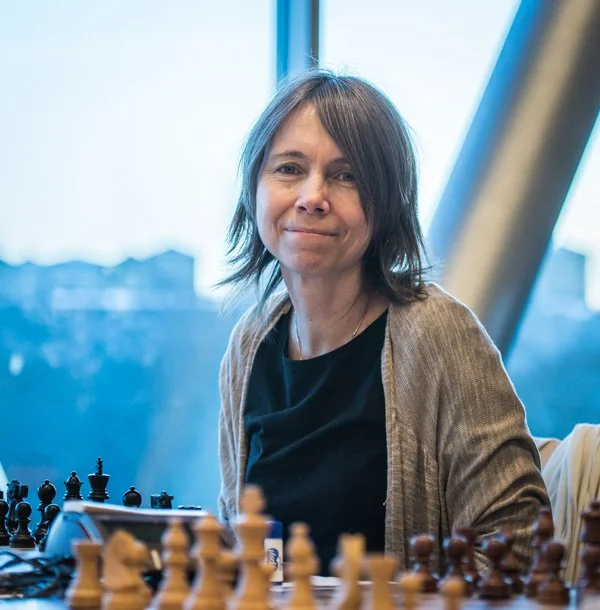
Kungsgambit (Lars OA Hedlund)[1], CC BY-SA 4.0
Introduction
In January 1984, twenty-year-old Pia Cramling topped the women’s world rating list. Six Soviet players followed, led by world champion Maia Chiburdanidze, Nana Alexandria, and former champion Nona Gaprindashvili. For a Swedish player who had learned the rules only a decade earlier, this was a substantial achievement. It also established her as a serious rival to the strongest representatives of Soviet women’s chess.
Cramling’s encounters with that generation form an essential part of her history. Her career later spanned the expansion of international women’s competition, two European championship victories, and decades of service to Sweden. Her sustained results, her preference for positional play and her practical work with women and girls give her a place in chess history that reaches well beyond a single ranking milestone.
Early life and chess formation
Pia Cramling was born on 23 April 1963 in Vantör, Stockholm. She grew up south of the city with her parents, Anna-Liisa and Inge, and her older brother Dan. In 1973, aged ten, she accompanied Dan to Schackklubben Passanten in Huddinge. There she learned how the pieces moved. Dan became her first model as a player, influencing her openings and introducing her to tournament life.
She also enjoyed football, but her girls’ team dissolved when she was twelve. Chess increasingly occupied her attention. At thirteen she won her age group in the Swedish schools championship. She later remembered that success as the moment she understood how much of her life she wanted to devote to the game.
Her early development depended heavily on playing. Cramling recalled belonging to three clubs and taking every available opportunity to compete. Gunnar Johansson occasionally supplied training material and accompanied her abroad as a second; Dan also helped with preparation. These recollections describe a development rooted in family assistance, local clubs and practical experience.
The social setting was important. At the Swedish championship camp in Motala in 1976, another girl, Julianna Miklos, helped her feel welcome. She won the girls’ championship held during that visit. In 1981 she entered the main Swedish championship group for the first time, drawing with Dan, who won the national title that year.
Cramling continued her education as her playing strength increased. After a natural sciences course at upper secondary school, she studied Russian at Stockholm University. In 1987 she undertook programming studies at Malmö Folkhögskola, including a three-month placement at Kockums. She later explained that this experience clarified her wish to devote herself to chess.
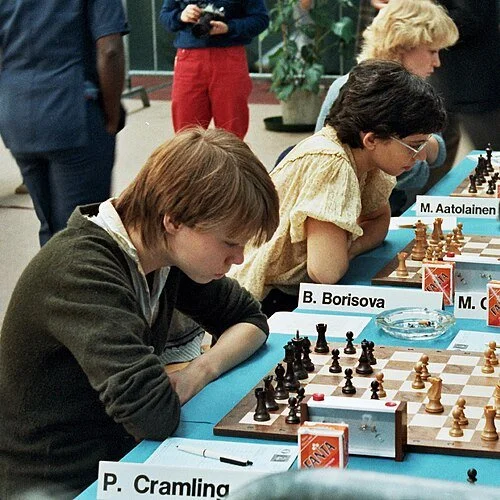
GFHund
An international breakthrough
At fifteen, Cramling represented Sweden in the 1978 Women’s Chess Olympiad in Buenos Aires. Playing on the reserve board, she scored 9/11 and won an individual silver medal. Four years later she occupied first board at Lucerne, where her 11/14 contributed to Sweden’s seventh-place finish. Her opponents included Chiburdanidze, against whom she drew. These results brought her into direct competition with the established international elite.
Another formative encounter came at the Lloyds Bank tournament in London in 1982. Cramling drew with Viktor Korchnoi, whose fighting spirit she had admired since studying a book about his 1977 match with Boris Spassky. She remembered the crowd of strong players gathering around their post-game analysis as an extraordinary experience. The game helped make her known on the international circuit. In 1984 she went further, defeating Korchnoi at Biel.
Korchnoi’s position requires care in any account of her Soviet connections. He had left the USSR and represented Switzerland during these encounters. For Cramling, he was an admired player formed in Soviet chess and a demanding opponent. Her direct rivalry with Soviet representatives developed through the women’s rating list, Olympiads and world championship qualification.
FIDE records date her International Master title to 1983. She also received the women’s Chess Oscar for her achievements that year, an award reflecting the international attention her results had attracted. By January 1984 her rating had reached 2405, ahead of Chiburdanidze’s 2385. The rating list documents the competitive significance of her emergence with unusual clarity.
Facing the Soviet contenders
Cramling’s most consequential early success against a Soviet contender came in the 1985 world championship cycle. After sharing third place in the Havana Interzonal, she entered a three-player playoff in Stockholm with Nana Ioseliani of the Soviet Union and Daniela Nuțu of Romania. Each player faced the others four times. Cramling finished first with 5½/8, a point ahead of Ioseliani, and secured the available Candidates place. Her four games against Ioseliani produced two wins, one draw and one loss.
The playoff marked her entry into the Candidates through a contest with a leading representative of the Georgian school within Soviet chess. It remains one of the clearest examples of her direct challenge to that generation of Soviet players.
At the 1986 Candidates tournament in Malmö, five of the eight participants represented the USSR. Cramling entered as the highest-rated player and finished tied fourth–fifth with Lidia Semenova on 7/14. Elena Akhmilovskaya won, followed by Alexandria and Marta Litinskaya. All five of Cramling’s victories came against Soviet opponents, including two against Semenova. The final standings also show the depth of the field she was trying to overcome.
Her strongest finish in the round-robin Candidates format came at Tilburg in 1994. She scored 8½/16 for third place behind Zsuzsa, later known as Susan, Polgar and Chiburdanidze. Mark Crowther’s contemporary report recorded her recovery through three consecutive victories at the end. Chiburdanidze and other players trained in the USSR remained central figures in her competitive world after the Soviet state’s dissolution.
These episodes establish both the level she reached and the limits of her challenge for the world title. Cramling became a leading contender and repeatedly defeated players from the Soviet tradition. She never became women’s world champion.
Professional life and the grandmaster title
Cramling met Spanish grandmaster Juan Manuel Bellón López at a tournament in Zürich in 1984. Their relationship became central to the practical organization of her career. She decided to become a chess professional at the end of 1987 and moved to Alicante in February 1988. Bellón helped prepare her openings and encouraged changes in her repertoire. She later credited their shared travel and companionship with making a long professional career possible.
She earned the Grandmaster title in 1992, after completing the required qualification at an open tournament in Bern. She became the fifth woman to receive the title and the first Swedish woman to do so. This was the unrestricted GM title, available to players of either sex. It formalized a level she had been pursuing through years of competition in open tournaments.
Her standing in Swedish chess also brought selection for the open section of the Olympiad in 1990, 1992, 1996 and 2000. At the 2000 Swedish championship, she shared the leading score and finished second on tiebreak. In a later interview, she singled out that championship as one of her finest performances. Her record belongs to the history of Swedish national competition as well as international women’s chess.
She eventually returned to Sweden with Bellón and their daughter Anna in June 2013. Cramling explained the move personally: she missed home, and her family supported the decision. Her club affiliations have included Wasa SK, which she joined for the 2016–17 season, and Cercle d’Échecs de Monte-Carlo.
European titles and later world championship challenges
Anna's birth in 2002 preceded another productive phase. At Silivri in 2003, Cramling tied with Viktorija Čmilytė on 8½/11 in the European Women’s Championship, then won their playoff 1½–½. At 40, she secured her first European title. At Rijeka in 2010, she won the championship again, scoring 9/11 and defeating Čmilytė in the final round.
Cramling later offered her own explanation for this improvement in major championships. She believed motherhood had helped her become more relaxed. Looking back on 2003, she remembered the pleasure of returning after a lengthy absence during pregnancy, the atmosphere of a large women’s event and Bellón’s presence. Her account of 2010 emphasized recovering from an early defeat and maintaining confidence and energy.
She reached the semifinals of the knockout Women’s World Championship twice. At Nalchik in 2008, she eliminated former world champion Antoneta Stefanova in the quarterfinal before Alexandra Kosteniuk ended her run. At Sochi in 2015, aged fifty-one, she overcame Anna Muzychuk in the quarterfinal and then faced Natalia Pogonina. Their classical games finished level; Pogonina advanced through the rapid playoff.
The two semifinal appearances demonstrate her capacity to compete successfully under the different demands of knockout play. Reaching the final four required a succession of short matches and, where necessary, rapid tiebreaks. Her presence at that stage seven years apart is an important part of her competitive longevity.
Club competition gave her another lasting setting for high-level chess. Monte-Carlo’s own history records her arrival in 2007 and her participation in its successful women’s teams, including the European Club Cup victories of 2016 and 2018. That affiliation connected her to an international group of leading players over many seasons.
Style and reputation
Cramling describes herself as a positional player. That assessment is supported by Swedish grandmaster Tiger Hillarp’s discussion of her play at the 2022 Olympiad. He emphasized her systematic handling of a position and the gradual improvement of her pieces. His commentary presents a player comfortable sustaining pressure through coordination and patient maneuvering.
Her own account is candid about the practical demands of this approach. In 2015, she identified deep concentration as a strength and difficulty making decisions as a recurring source of time trouble.
In a 2022 interview, she said she enjoyed thinking extensively, found blitz somewhat too fast, and especially liked rapid chess. Her preference for rapid adds a useful qualification to the familiar picture of Cramling as a patient positional player.
Her influence on other competitors is also documented. Writing in American Chess Magazine in 2023, Anna Zatonskih named Cramling, still competing at a high level at sixty, among the players who encouraged her belief in continued achievement later in life. This is direct testimony from a fellow international player to the example Cramling’s career provided.
Teaching and contributions beyond competition
Cramling’s work with Swedish women and girls has become a substantial contribution in its own right. Susanna Berg Laachiri, who collaborated with her, records that Cramling initiated women’s chess gatherings in 2015. These combined instruction with opportunities to meet other players. During the pandemic, teaching continued online. Participants described a calm, encouraging approach suited to groups with different experience levels.
She also provided coaching at Swedish events, discussing participants’ games and making herself available for questions. The federation’s account identifies her as an active organizer and teacher, repeatedly finding time for these activities alongside her own tournament schedule.
Her support for women’s events stems from her experience of often being the only woman in a tournament. In 2022, she argued for competitions where women and girls could gather in greater numbers, alongside the mixed events in which she had spent much of her career. She also pointed to the practicality of weekend championships for players who couldn't spend long periods away from home.
Anna’s development created another avenue for sharing chess. Cramling taught her daughter openings and supported the wider audience Anna reached through online content. In January 2020 they appeared together in commentary on the Ju Wenjun–Aleksandra Goryachkina world championship match. The Swedish federation also documented Pia’s commentary on Anna’s games at the 2026 Swedish championship.
The first Pia Cramling Cup took place in Stockholm on 2 January 2026 during the Rilton Cup. The FIDE Commission for Women’s Chess organized it with Cramling and the Stockholm Chess Federation. As a free-entry, rated rapid event for women and girls, it gave practical form to her longstanding interest in participation and companionship within chess.
Longevity and historical legacy
Cramling’s Olympiad results offer the clearest measure of the length of her competitive achievement. She won individual gold on first board in the women’s events at Thessaloniki in 1984 and 1988, scoring 10½/13 and 12½/14 respectively without a loss. In Chennai in 2022, at 59, she again took first-board gold with an unbeaten 9½/11. Thirty-eight years separated the first and third gold medals.
Her career continued beyond that widely reported success. At the September 2026 Olympiad in Samarkand, she remained on Sweden’s first board and again finished unbeaten, scoring 8/11. The Swedish federation’s report confirms her continuing contribution at sixty-three. In 2025, she was also inducted into the World Chess Hall of Fame.
Cramling deserves attention today because her career connects several generations of international chess through sustained achievement and direct participation. She rose to the top of the women’s rating list amid the strength of the Soviet elite, qualified against leading Soviet opponents, and continued winning major honors decades later. Her teaching and organization have extended that contribution to players beginning their own careers. For the history of Soviet chess and its rivals, she provides an essential Swedish perspective on how that formidable competitive tradition was encountered, studied, and challenged.
Notes and sources
FIDE, January 1984 women’s rating list, preserved by OlimpBase. Cramling appears first, followed by six Soviet representatives.
Calle Erlandsson, “Intervju med GM Pia Cramling”, Lunds Akademiska Schackklubb, 9 June 2015. First-person evidence for birthplace, education and self-assessment.
Ingemar Falk, “Pia Cramling om likheterna i ‘The queen’s gambit’: Jag var också ensam tjej”, Swedish Chess Federation, 25 November 2020. Family, early interests and formative relationships.
Niklas Sidmar, “Nu har Pia flyttat hem till Sverige”, Swedish Chess Federation, 4 July 2013. Childhood camp, national championship experience and return to Sweden.
André Schulz, interview with Pia Cramling, ChessBase, 22 June 2018. Training, Bellón’s assistance and the decision to become a professional.
OlimpBase, Cramling’s Women’s Olympiad record and Sweden’s Lucerne 1982 results. Used for scores, placings and the encounter with Chiburdanidze.
FIDE, player profile 1700030; Swedish Chess Federation, “Pia Cramling”. Title years, Bern qualification and Wasa affiliation.
Eduard Frey, “Ten Highlights in the Life and Career of Chess Grandmaster Pia Cramling”, ChessBase, 23 April 2023. Korchnoi encounters, Chess Oscar and open Olympiad appearances.
OlimpBase, Stockholm 1985 Interzonal playoff. Full results and qualification outcome.
OlimpBase, Malmö 1986 Candidates tournament. Full results establish the Soviet participants, Cramling’s wins and final placing.
Mark Crowther, The Week in Chess 3, 1 October 1994, section on the Women’s Candidates. Contemporary report and crosstable.
Mark Crowther, The Week in Chess 449, 16 June 2003, European Championships section; The Week in Chess, Rijeka 2010 event report. Contemporary results and title-deciding encounters.
Ingemar Falk, “Att bli mamma gjorde Cramling till fruktad mästerskapsspelare”, Swedish Chess Federation, 11 April 2019. Cramling’s retrospective explanation of her major championship successes.
Zsuzsa Verőci, chief arbiter’s report on the 2008 Women’s World Championship, 24 September 2008, FIDE Congress Annex 18, pp. 7–8; FIDE’s 2015 championship reports.
Cercle d’Échecs de Monte-Carlo, club history. Cramling’s arrival and participation in European championship teams.
Tatiana Flores, “A strong duo: An interview with Pia and Anna Cramling”, ChessBase, 31 January 2022. Positional style, family life, teaching Anna and online outreach.
Tiger Hillarp, “Summing up the Olympiad in Chennai”, 18 August 2022. Used for his assessment of Cramling’s play; Olympiad totals are taken from event records.
Ofelia Thörnqvist, interview with Pia Cramling before the women’s Swedish rapid and blitz championships, 18 August 2022. Time-control preferences and support for women’s events.
Susanna Berg Laachiri, “Sveriges schackstjärna Pia Cramling fyller 60 år”, Swedish Chess Federation, 23 April 2023. Firsthand accounts from collaborators and pupils.
Ingemar Falk, Swedish Chess Federation reports of 6 January 2020 and 30 June 2026. Cramling’s online commentary with and about Anna.
FIDE Commission for Women’s Chess, “The Inaugural Pia Cramling Cup Celebrates Women’s Chess During the Rilton Cup”, 5 January 2026.
OlimpBase, medal categories for the 1984 Women’s Olympiad and 1988 Women’s Olympiad; Ingemar Falk, “EXTRA: OS-guld till Pia Cramling”, Swedish Chess Federation, 9 August 2022.
Robert Okpu, “Svenska damlaget bäst i Norden”, Swedish Chess Federation, 27 September 2026; OlimpBase player record in note 6.
Anna Zatonskih, “Anna’s Comeback”, American Chess Magazine 34 (2023), pp. 20–27, especially p. 20.
Saint Louis Chess Club, press release of 27 October 2025, subsection “Hall of Fame Inductees Honored.” Confirms Cramling’s induction.
