Perkhushkovskaya Soviet Chess Set
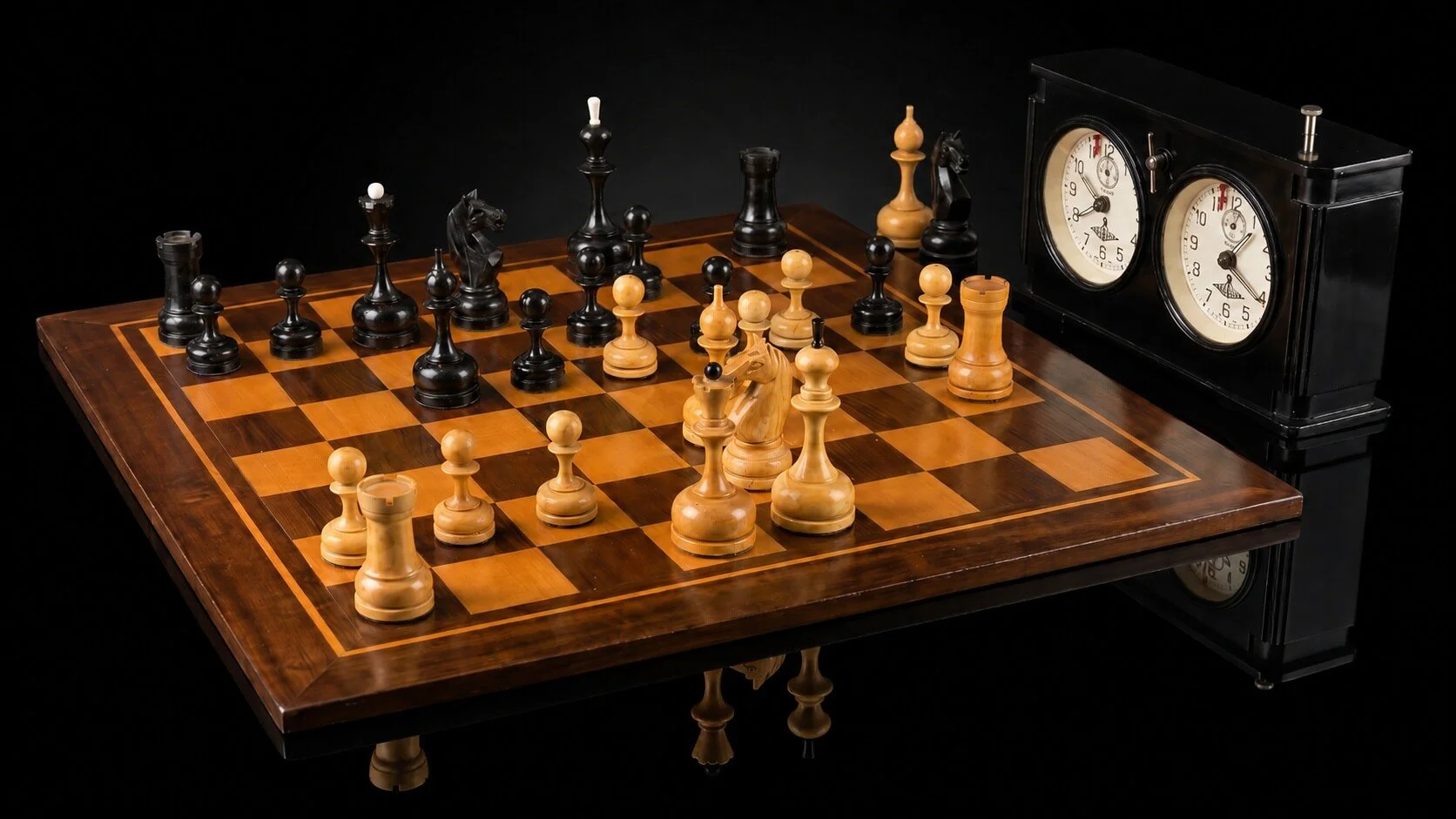
A Perkhushkovskaya Soviet Tournament Chess Set from the Late 1960s or Early 1970s
Some Soviet chess sets do not need a famous player’s name attached to them. The box, label, factory mark, and wear already tell enough of a story.
This Перxушковская ф-ка культтоваров tournament set is one of those objects. It was made for use, sold plainly as Шахматы турнирные, and priced for the Soviet chess public rather than for collectors.
The Box: Шахматы Турнирные
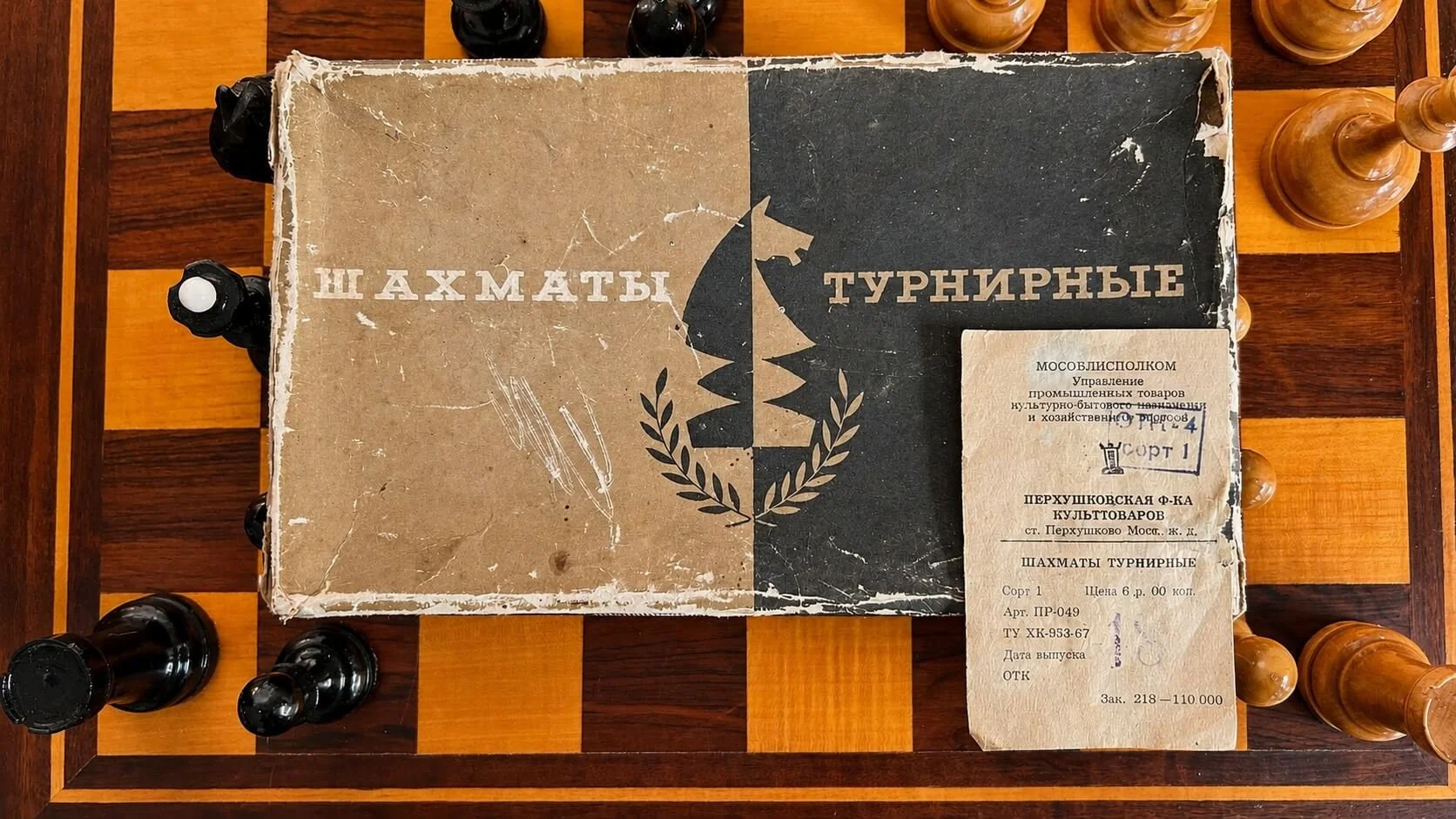
The cardboard box reads ШАХМАТЫ ТУРНИРНЫЕ, or “Tournament Chess.” The design is simple but strong: a two-tone box face, a central knight silhouette, and a laurel wreath. It is not luxury packaging. It is Soviet packaging with a job to do.
The paper label is more useful than the box art. It identifies the maker as:
ПЕРХУШКОВСКАЯ Ф-КА КУЛЬТТОВАРОВ
ст. Перхушково Моск. ж. д.
That is the Perkhushkovskaya Factory of Cultural Goods, located at Перхушково station on the Moscow Railway. The label also places the factory under МОСОБЛИСПОЛКОМ, the Moscow Oblast Executive Committee, through an administration connected with consumer and cultural goods production.¹
What the Label Says
The label gives the product name as ШАХМАТЫ ТУРНИРНЫЕ. It also lists:
Сорт 1
Цена 6 р. 00 коп.
Арт. ПР-049
ТУ ХК-953-67
In English, that means the set was first quality, priced at 6 rubles 00 kopeks, with article number ПР-049. The most useful dating clue is ТУ ХК-953-67. In Soviet manufactured goods, a ТУ number refers to technical specifications. The final 67 strongly suggests a specification connected with 1967, so the set should not be dated earlier than that without stronger evidence.²
That does not prove the exact year of manufacture. The Дата выпуска line is present, but no clear date is filled in. Still, the label gives enough evidence to place the set comfortably in the late 1960s or early 1970s.
The Pieces: A Soviet Tournament Workhorse
The pieces belong to the broad Soviet tournament family collectors often call Grandmaster 2, or GM2. The set is also often associated with the “Bronstein” label in collector circles, though the original Soviet paperwork did not use that name. The label simply says Шахматы турнирные. That is important. These were not marketed as romantic collector objects. They were sold as tournament chess pieces.³
The design is practical and immediately recognizable. The pieces have broad, rounded bases, compact stems, and a solid playing presence. The pawns are full and heavy-looking. The bishops use the rounded Soviet miter form. The knights are especially useful for identification: compact, carved in the late-Soviet tournament style, and less naturalistic than earlier hand-carved examples.
This is the kind of set that fits the visual world of Soviet chess clubs, schools, team events, and analysis rooms. It was not made to sit untouched in a cabinet. It was made for repeated games.
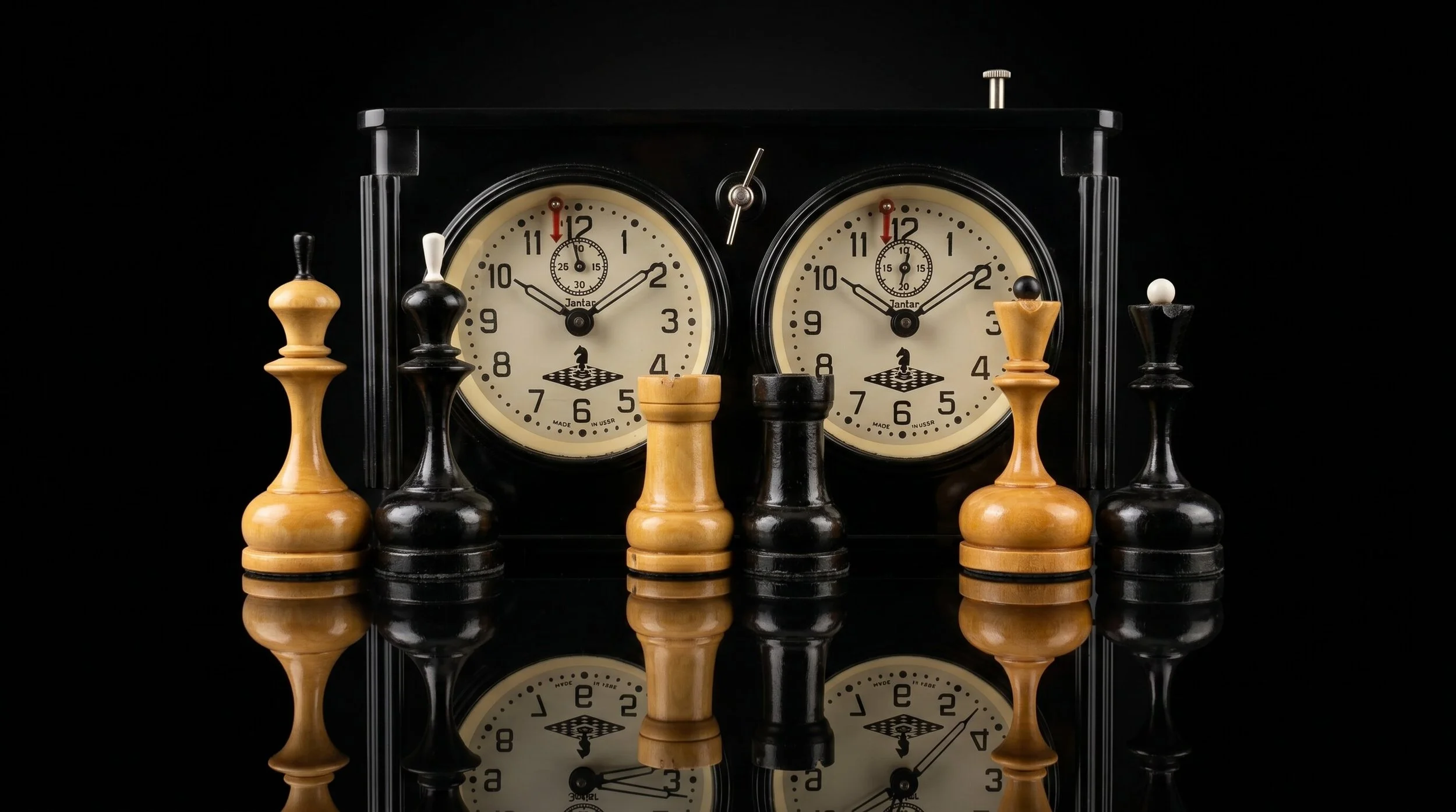
Jantar Bakelite chess clock and Soviet chess pieces
Perkhushkovskaya and Mass Production
The Perkhushkovskaya factory was part of the larger Soviet effort to produce chess equipment at scale. A circa-1970 Soviet article, translated by Nick Basmanov and preserved in Charles W. Grau’s research, describes the factory as a busy workshop with large numbers of newly varnished pieces awaiting packaging and shipment. The same account notes that turning chess pieces was still labor-intensive, even as some stages of production were being mechanized.⁴
That helps explain the character of this set. It is factory-made, but it is not anonymous in the modern sense. The pieces still show the hand and the workshop. The box is worn, the label is fragile, and the surfaces carry the marks of age, storage, and use. Those details are part of the evidence.
Why the Dating Is Likely Late 1960s or Early 1970s
Three details point toward a late 1960s or early 1970s date.
First, the label’s ТУ ХК-953-67 suggests a technical specification associated with 1967. Second, Grau identifies Perkhushkovskaya as a producer of GM2-style tournament sets by 1967, with surviving boxed examples described simply as “Tournament Chess.”⁵ Third, the set’s general appearance fits the period before later Soviet production became more visibly simplified and more dependent on plastic components.
The safest description is therefore:
Перxушковская ф-ка культтоваров, Шахматы турнирные, Сорт 1, Арт. ПР-049, likely late 1960s to early 1970s.
That wording avoids overclaiming while still giving the set a historically grounded date range.
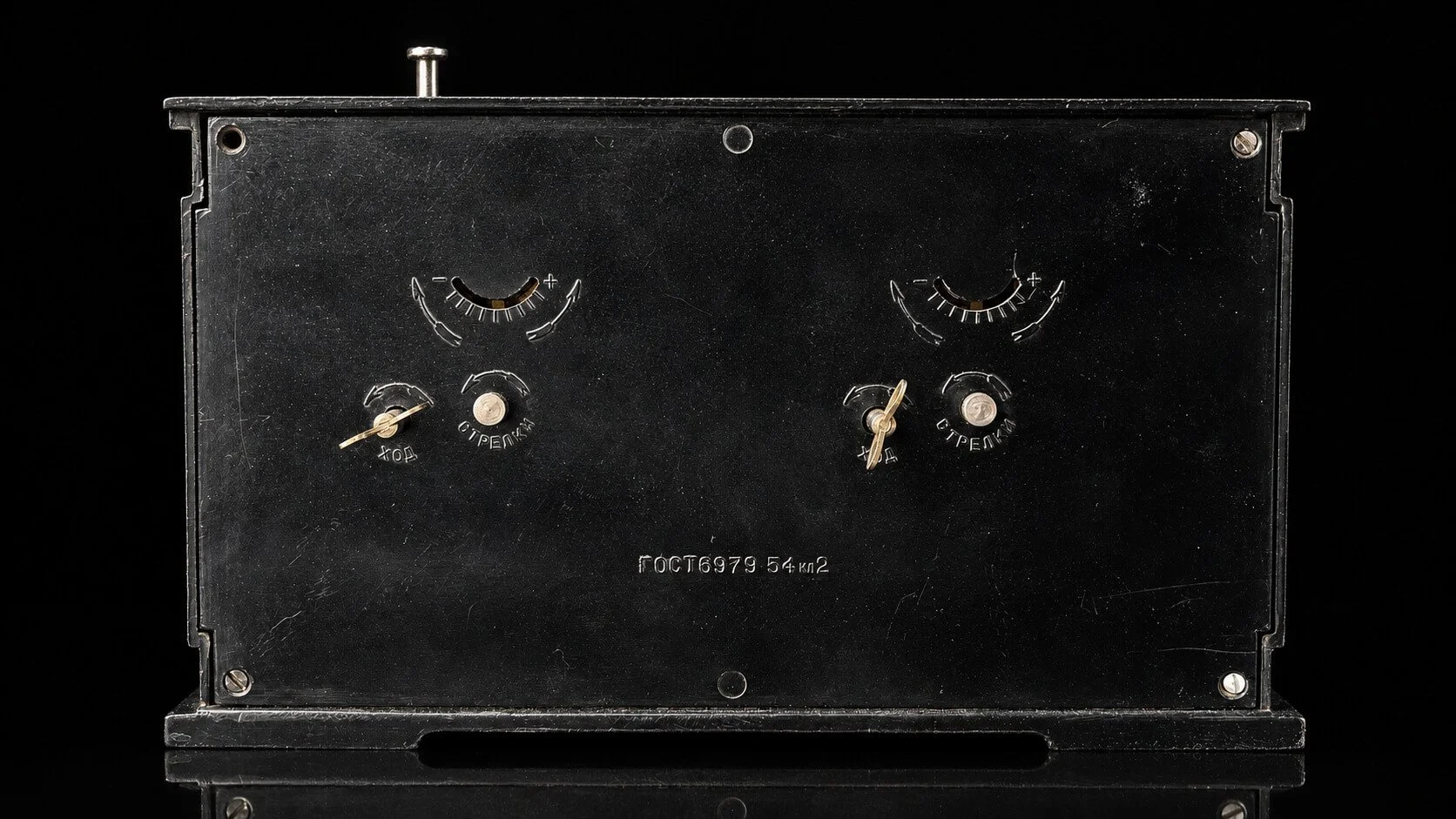
Jantar Bakelite chess clock
A Useful Survivor of Soviet Chess Culture
This Perkhushkovskaya tournament set is not rare because it belonged to a world champion. Its value is different. It shows how Soviet chess culture reached ordinary players through factories, railway stations, clubs, schools, and state distribution networks.
The label tells us where it came from. The box tells us how it was sold. The pieces tell us what Soviet tournament chess looked like away from the glamour of championship halls.
For collectors, the lesson is simple: do not ignore the paperwork. A battered label with ПР-049, ТУ ХК-953-67, Сорт 1, and Перxушковская ф-ка культтоваров can say more than a polished reproduction ever will.
Notes
Author’s collection, Perkhushkovskaya Factory of Cultural Goods label, Шахматы турнирные, Сорт 1, Арт. ПР-049, ТУ ХК-953-67, Цена 6 р. 00 коп.
Ibid. The dating inference is based on the visible ТУ ХК-953-67 marking. The label does not preserve a clear filled-in release date.
Charles W. Grau, “Four Styles of Grandmaster Chess Sets: GM2 ‘Bronstein’ Pieces,” Soviet and Late Tsarist Chess Sets, April 25, 2022, updated December 1, 2024.
Charles W. Grau, “Mass-Produced State Factory Wooden Sets 1950-1991,” Soviet and Late Tsarist Chess Sets, October 17, 2022, updated March 30, 2025. Grau reproduces Nick Basmanov’s translation of a circa-1970 Soviet article on Perkhushkovskaya chess production.
Grau, “Four Styles of Grandmaster Chess Sets: GM2 ‘Bronstein’ Pieces.”
