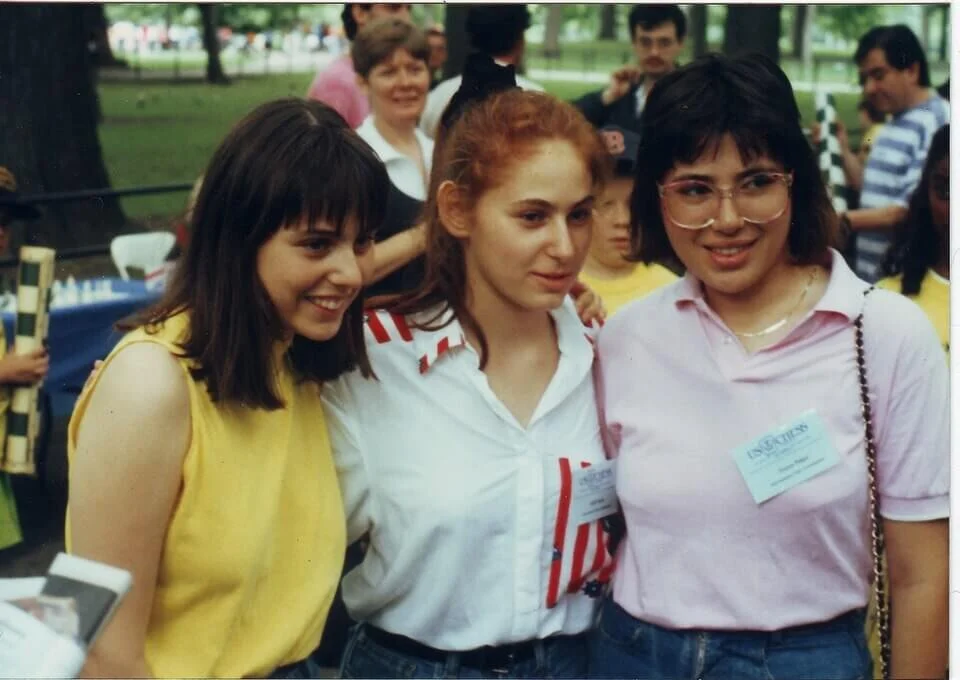
R. Cottrell, CC BY-SA 3.0, via Wikimedia Commons
On 18 November 1988, Hungary faced the Soviet Union in the fifth round of the Women’s Chess Olympiad in Thessaloniki. Susan Polgár drew with the reigning women’s world champion, Maia Chiburdanidze. Twelve-year-old Judit Polgár drew with Irina Levitina. On the third board, Ildikó Mádl defeated Marta Litinskaya, giving Hungary a 2–1 victory. The decisive win belonged to the fourth member of a team usually remembered for its three sisters.[1]
By the end of the Olympiad, Susan, Sofia and Judit Polgár had helped Hungary take gold ahead of the Soviet Union. Two years later, the same four players won again. Those shared victories connected careers that would carry Susan to the women’s world championship, Sofia to an extraordinary tournament triumph in Rome, and Judit into the world’s top ten.
A chess education in Budapest
The sisters grew up in a household where chess occupied much of the working day. Their parents, László and Klára Polgár, were teachers who educated their daughters at home. Susan, known in Hungarian as Zsuzsa, was born in 1969; Sofia, or Zsófia, in 1974; and Judit in 1976. Their seven-year age span meant that the youngest could follow an older sister already establishing an international reputation.[2]
László believed that exceptional achievement could be cultivated through an early start, sustained instruction and an environment that encouraged a child’s interest. In a 2017 Hungarian interview, he described chess as a field in which intellectual performance could be assessed through results. Klára explained that their aim was for the girls to compete at the same level as the strongest men.[3]
The household’s routine included physical exercise. According to the same interview, mornings could begin with table tennis, swimming or kickboxing before chess preparation with their father and other trainers. Both parents took part in their education, and the family also placed importance on languages. László recalled sending the girls to a Russian-language kindergarten, where learning to communicate gave them an early experience of progress through practice.[3]
Susan provided the first example of what this education could produce. In July 1984, at fifteen, she reached the top of the women’s rating list. Sofia later described the influence of her eldest sister in a sentence preserved by FIDE’s Open Chess Museum: “Susan was such a strong player that Judit and I wanted to be like her.”[4]
That relationship gave the younger sisters a model close at hand. They shared a training environment, watched one another’s results and entered international chess with a family member already familiar with its demands.
Four players win gold in Thessaloniki
Hungary had a substantial women’s chess tradition before the Polgárs joined its Olympiad team. The country had won team silver in 1969, 1978, 1980 and 1986. Mádl had played in the 1986 silver-medal side, alongside Zsuzsa Verőci, Mária Ivánka and Mária Grosch. The 1988 selection brought the sisters into a national team with an established record of success.[5]
The ages nevertheless made the new lineup remarkable. Susan and Mádl were nineteen, Sofia had just turned fourteen, and Judit was twelve. FIDE’s museum identifies all four in its account of the Olympiad, held in Thessaloniki from 12 to 30 November 1988.[6]
The competition used three players in each match, with a fourth available as reserve. Susan occupied the first board, Judit the second, and Mádl the third; Sofia was the reserve.[7]
Judit supplied Hungary’s largest individual total: twelve wins and one draw from thirteen games. Her only draw came against Levitina in the Soviet match. Susan also went undefeated, scoring 10½ from fourteen. Mádl contributed 5½ from eight and Sofia 4½ from seven.[7]
Hungary finished with 33 points, half a point ahead of the Soviet Union. Its match against the Soviets was one part of a fourteen-round competition in which Hungary won thirteen matches and lost only to Yugoslavia. The gold rested on the accumulation of points across the whole event.[8]
Judit received individual gold for her second-board score and another gold for the highest rating performance. At twelve, she had completed one of the most striking Olympiad debuts on record.[9]
Sofia’s eight victories in Rome
In 1989, fourteen-year-old Sofia entered the Magistrale di Roma. She won her first eight games and drew the ninth to finish with 8½ points. Her opponents included several experienced grandmasters.[10]
In her own account, Sofia identifies Semyon Palatnik as the first grandmaster she defeated in Rome, in the third round. Alexander Chernin, Mihai Suba and Yuri Razuvaev were among the others she beat. Sergey Dolmatov held the final game to a draw. She remembered concentrating on each position and each game, only gradually recognizing the scale of the result.[10]
Sofia later called Rome the most memorable achievement of her playing career. Her recollection also places the visit within a wider affection for Italy’s art, architecture and music. These interests became increasingly visible in her work as an artist and illustrator.[10]
Her competitive record continued well beyond that tournament. She earned the woman grandmaster and international master titles, and in 1994 scored an undefeated 12½ from fourteen on Hungary’s second board at the Moscow Olympiad. Hungary won silver, while Sofia took individual board gold. The Hungarian Coaches Association’s biographical database records both that performance and her peak rating of 2505 in July 1998.[11]
From 1999 to 2001, Sofia worked for the Israeli branch of Kasparov Chess Club, combining news editing, graphic design and chess instruction. She gave recorded and live online lessons, organized events and provided commentary, bringing her experience as a player into the developing world of internet chess.[11]
A second gold at Novi Sad
The sisters and Mádl reunited for the 1990 Women’s Olympiad in Novi Sad, then part of Yugoslavia. Susan and Judit retained the first two boards. Sofia moved to the third, with Mádl serving as reserve.[12]
Their encounter with the Soviet Union on 20 November produced a different result from Thessaloniki. Susan defeated Chiburdanidze, but Nona Gaprindashvili beat Judit and Alisa Galliamova beat Sofia. The Soviets won the match 2–1.[13]
Hungary still finished level with the Soviet Union on 35 game points. At that time, the standings were determined first by the sum of the players’ scores across their games. With the two leaders tied, the Buchholz calculation, based on their opponents’ results, decided first place. Hungary’s 344½ exceeded the Soviet total of 340½, securing a second gold.[14]
The three sisters each won the individual gold medal for her board. Susan scored 11½ from fourteen without a loss; Judit made 10 from thirteen; and Sofia contributed 11½ from thirteen. Mádl won both games she played. Susan’s two championship Olympiads together amounted to 28 games without defeat.[12]
Hungary had now finished ahead of the Soviet Union in two successive Olympiads. Its 1990 success came despite losing their direct encounter, through the points collected against the rest of the field and the tiebreak rules governing the championship.[14]
Susan becomes world champion
Susan earned the grandmaster title in 1991. As the Russian Chess Federation’s biography records, she was the third woman to receive it, following Gaprindashvili and Chiburdanidze. Her subsequent pursuit of the women’s world championship brought her into further contests with leading players from the Soviet chess tradition.[15]
The first attempt ended unusually. Susan won the 1992 Candidates tournament in Shanghai and advanced to a final match against Nana Ioseliani. Their contest remained tied after two sets of tiebreak games. A drawing of lots sent Ioseliani through to challenge for the title.[16]
Susan returned in the next cycle. After sharing first place with Chiburdanidze in the 1994 Candidates tournament, she won their playoff in St. Petersburg in 1995 by 5½–1½. In 1996, she defeated the defending champion, China’s Xie Jun, in Jaén, Spain, by 8½–4½. She won six games, drew five and lost two.[15][16]
The title gave the eldest sister a distinction she had pursued through successive qualification cycles. Her earlier years in open competition, two Olympiad team golds and victories against established champions had led to a world championship of her own.
Susan later built a substantial teaching and coaching career in the United States. Her foundation promoted chess among young people, particularly girls, and she coached at Texas Tech from 2007 to 2012 and Webster University from 2012 to 2021. The work carried the family’s interest in chess education into schools, youth events and university competition.[17]
Judit reaches the world’s top ten
Novi Sad was Judit’s last women-only tournament. Her subsequent competitive career concentrated on open events. In 1991, she won the Hungarian championship and became a grandmaster at fifteen years and four months, breaking Bobby Fischer’s longstanding age record.[18]
Her results against the world’s leading players accumulated over the following decade. In 2002, representing the Rest of the World against Russia in Moscow, she defeated Garry Kasparov in a rapid game. The event’s time control was twenty-five minutes per player, with ten seconds added after each move, and the Rest of the World won the overall contest 52–48.[19]
In classical chess, Judit reached a peak rating of 2735 in 2005 and a highest world ranking of eighth. She also competed in the 2005 FIDE World Championship. Her place in the elite rested on years of tournament results against the strongest available opposition.[20]
Hungary continued to benefit from her team play. She won silver medals with its open Olympiad team in Bled in 2002 and Tromsø in 2014. After retiring from competitive chess in 2014, she devoted more time to educational work, writing and commentary. Her foundation, established in 2012, developed programs around learning through chess.[21]
The sisters’ adult lives brought them back together at public events. On 24 June 2007, they gave a hundred-board simultaneous exhibition at Budapest’s Corinthia Grand Hotel. Reporting on the occasion, the Hungarian sports newspaper Nemzeti Sport spoke with all three about their families and work. Sofia described teaching chess and painting, and recalled the two victorious Olympiads among the happiest experiences of her life.[22]
Notes
Sources were consulted on 5 November 2026. Hungarian and Russian titles are followed by English descriptions where helpful.
OlimpBase, “28th Chess Olympiad (women): Thessaloniki 1988, fifth round”, 18 November 1988. Records the three individual results in Hungary’s 2–1 victory over the Soviet Union.
FIDE Open Chess Museum, “Susan Polgar”; Hungarian Coaches Association, “Polgár Zsófia (1974)”, Hajrá, magyarok! (Hungarian); Judit Polgár, official biography and press kit, 2026, pp. 1–2. These sources establish the sisters’ birth years and biographical background.
Fanni Czeglédi, “Polgár László: A feleségem például belőlem doktorált”, HVG, 8 May 2017 (Hungarian). Interview with László and Klára Polgár about their daughters’ education, training routine and language learning.
FIDE Open Chess Museum, “Susan Polgar”, biography and Sofia Polgár’s recollection in the “On Polgar” section.
Iván Bottlik, “A magyar sakkozás rövid története” [A Short History of Hungarian Chess], Hungarian Chess Federation, 2017, section on women’s Olympiad results (Hungarian). Lists the earlier silver-medal teams and the 1988 and 1990 champions.
FIDE Open Chess Museum, “Bulletin of the 28th Chess Olympiad”. Museum catalogue entry and historical description, including the Hungarian players’ ages.
OlimpBase, “Thessaloniki 1988: Hungary”. Board order, individual totals and round-by-round results.
OlimpBase, “Thessaloniki 1988: Final Standings”. Hungary’s 33 points, the Soviet Union’s 32½, and the teams’ match records.
OlimpBase, “Thessaloniki 1988: Information and Individual Medals”. Judit’s gold medals for second board and rating performance.
Sofia Polgár, “Rome Performance”, personal account of the 1989 Magistrale di Roma; and “About Me”, for her artistic work.
Hungarian Coaches Association, “Polgár Zsófia (1974)”, Hajrá, magyarok! (Hungarian). See the sections on her Olympiad results, international titles and July 1998 rating. Sofia’s own biography also records her undefeated 12½/14 at Moscow in 1994 and her subsequent work for Kasparov Chess Club.
OlimpBase, “Novi Sad 1990: Hungary”, and “Novi Sad 1990: Individual Medals”. Susan’s combined unbeaten record for the two gold-medal Olympiads is calculated from the 1988 and 1990 team scorecards.
OlimpBase, “Novi Sad 1990: Fourth Round”, 20 November 1990. Records Chiburdanidze–Susan 0–1, Gaprindashvili–Judit 1–0 and Galliamova–Sofia 1–0.
OlimpBase, “Novi Sad 1990: Final Standings”, and tournament information. Both teams finished on 35 game points; Hungary’s Buchholz score was 344½ and the Soviet Union’s 340½.
Chess Federation of Russia, “Сьюзан Полгар” [Susan Polgár], biographical profile (Russian). Covers her 1991 grandmaster title, Candidates playoff against Chiburdanidze and championship match against Xie Jun.
FIDE Open Chess Museum, “Susan Polgar”. Covers the 1992 Candidates tournament, the drawn match against Ioseliani, the 1995 playoff and the 1996 world championship.
Susan Polgár, “About”, official biography. Foundation activity and coaching appointments at Texas Tech and Webster University.
Chess Federation of Russia, “Юдит Полгар” [Judit Polgár], biographical profile (Russian); Judit Polgár, official biography, p. 1. Sources for the 1991 Hungarian championship, grandmaster age record and concentration on open events after 1990.
OlimpBase, “Russia vs Rest of the World: Moscow 2002”, event data, results and reports, including a first-person report by team coach Yasser Seirawan. Gives the rapid time control and Judit’s victory over Kasparov.
FIDE Commission for Women’s Chess, “Judit Polgar”. Peak rating of 2735, highest world ranking of eighth and participation in the 2005 FIDE World Championship.
Zsuzsa Verőci, “Polgár Judit a férficsapatunk új kapitánya” [Judit Polgár Is the New Captain of Our Men’s Team], Hungarian Chess Federation, 12 June 2015 (Hungarian); Judit Polgár, official biography, p. 1. Olympiad silver medals, retirement and educational work.
“A három sakknővér” [The Three Chess Sisters], Nemzeti Sport, 24 June 2007 (Hungarian). Contemporary report on the Budapest simultaneous exhibition, with comments from all three sisters.

