Vladimir Alatortsev
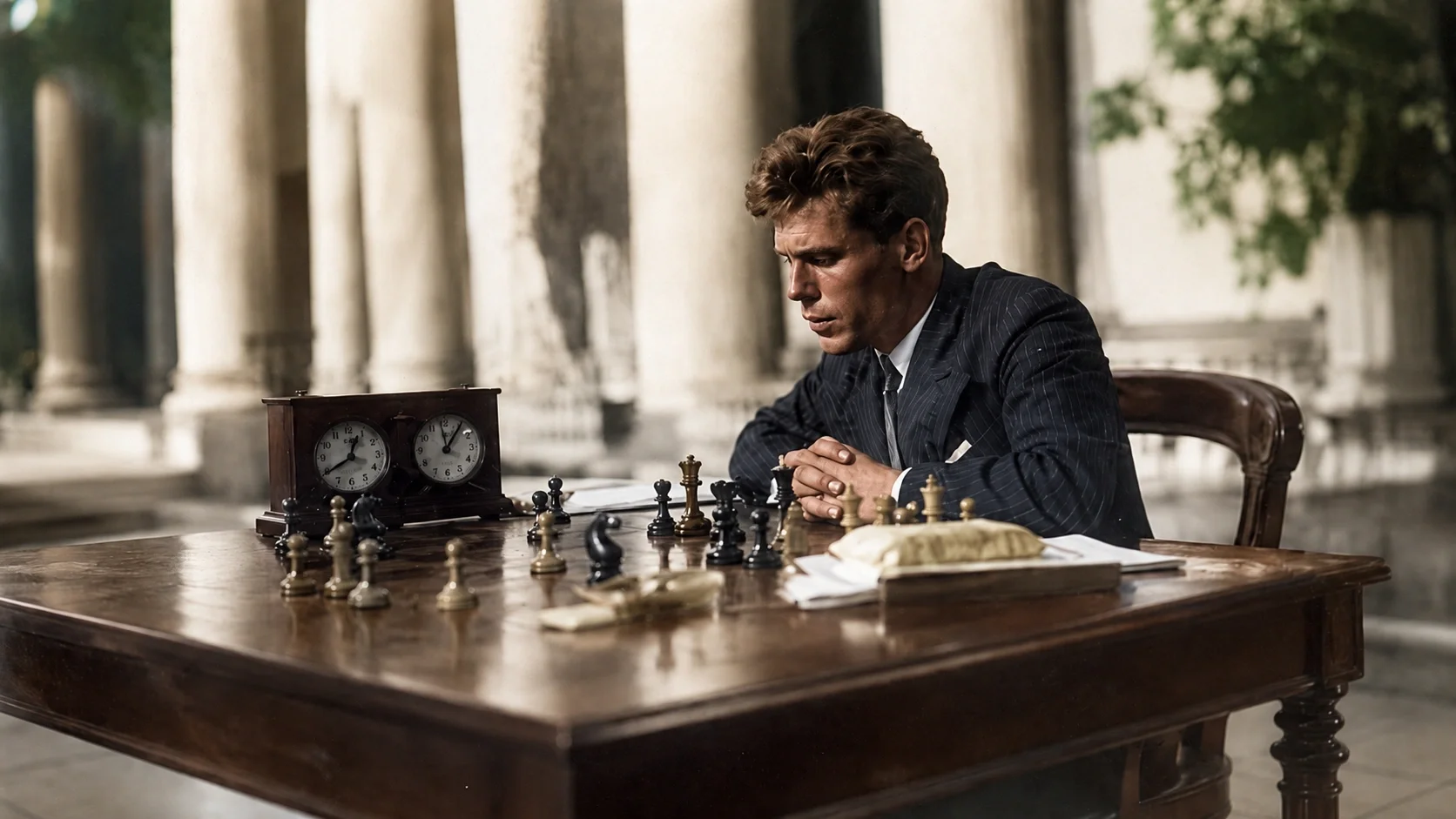
Vladimir Alexeyevich Alatortsev was one of those Soviet chess figures whose historical importance exceeds his public fame. He was a strong master, a rival of Mikhail Botvinnik in the early 1930s, a Moscow champion, a Leningrad champion, a trainer of Vasily Smyslov, a wartime chess organizer, a journalist, a theoretician, and later one of the administrators who helped shape Soviet chess during its postwar age of dominance. Modern Russian chess sources identify him as born on 14 May 1909 in Turki, Saratov province, and dying in Moscow on 13 January 1987, although a contemporary 1934 profile in Smena gave Samara as his birthplace, a useful reminder that even Soviet biographical details sometimes require careful cross-checking.
Alatortsev belongs to the generation between the old pre-revolutionary masters and the fully institutionalized Soviet school. He was younger than Romanovsky and Levenfish, slightly older than Botvinnik, and old enough to have formed his chess understanding before the Soviet training system became a machine. That position gave him a distinctive role. He was a product of the early Soviet chess boom, then became one of the people who helped convert that boom into method, pedagogy, theory, and bureaucracy.
Early Life and Formation in Leningrad
Alatortsev’s family moved to Petrograd in 1916. According to a Russian Chess Federation chapter based on Dmitry Oleinikov’s Rukovoditeli sovetskikh shakhmat, he learned chess from a distant relative, Sergei Popov, an artist connected with the Mariinsky Theatre, and eventually surpassed his first teacher. By 1925, he was studying under Peter Romanovsky, one of the great early Soviet chess teachers and a two-time USSR champion.
That Romanovsky connection is essential. Romanovsky represented a deeply educational conception of chess. He treated the game as an art of planning, harmony, and disciplined imagination. Alatortsev absorbed that tradition and later became associated with the phrase “deep strategist.” The Russian Chess Federation notes that by the mid-1930s, this reputation had already attached itself to him.
His rise was quick. In the 1930 or 1931 Leningrad championship, he finished third behind Botvinnik and Romanovsky, then entered the USSR Championship and shared third place. In the 1933 USSR Championship, he finished second behind Botvinnik, a result that became the clearest competitive marker of his peak as a practical player.
A contemporary Smena profile from December 1934 described him as one of the strongest representatives of the new Soviet chess generation and connected his chess awakening to the public excitement created by the great Moscow international tournament of 1925. That detail is historically valuable because it places him inside the broader cultural expansion of Soviet chess: major tournaments, newspaper coverage, mass interest, workplace chess circles, and the idea that chess could become a public intellectual pursuit rather than a private club habit.
Rival of Botvinnik, Without Botvinnik’s Destiny
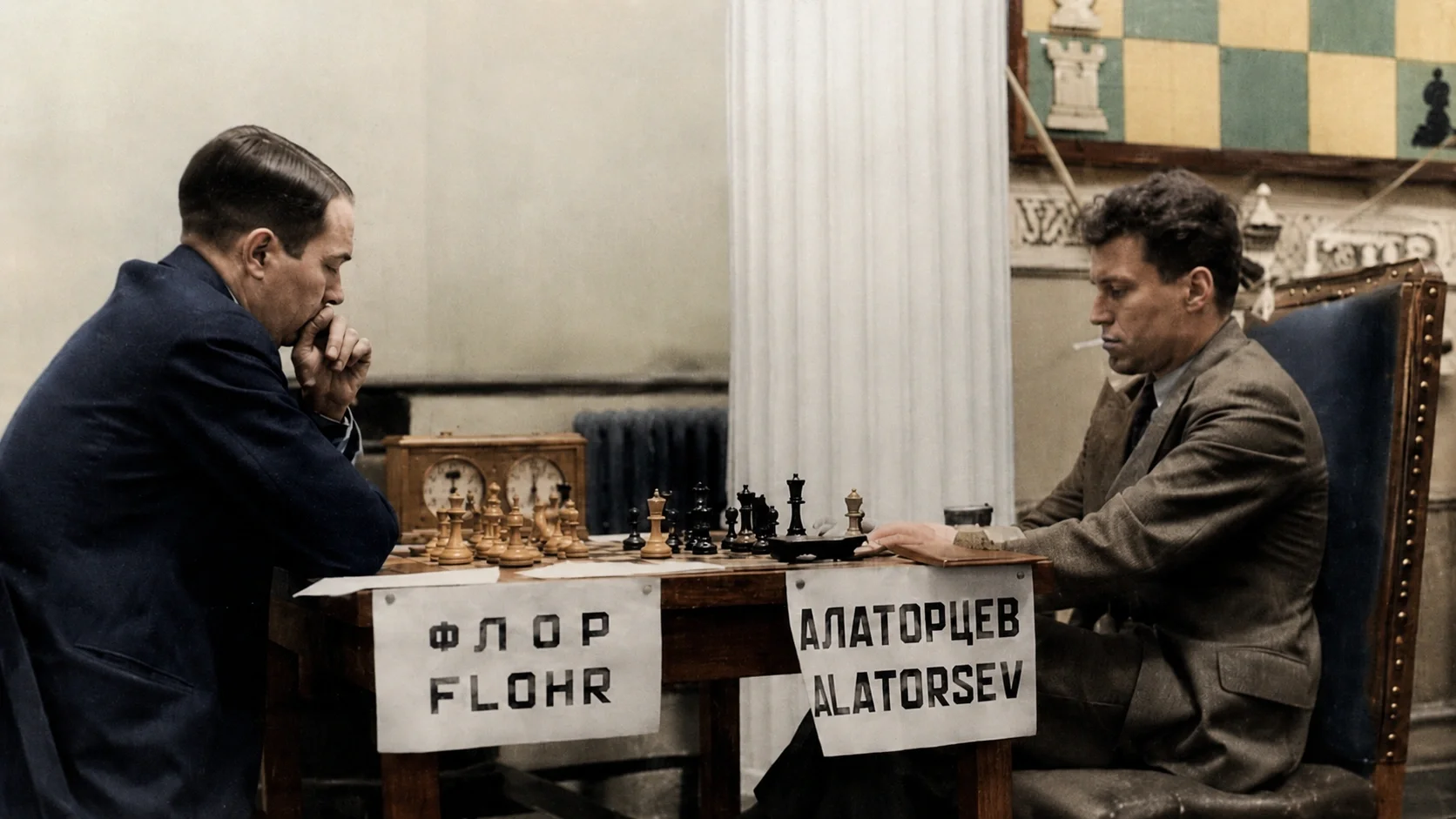
Alatortsev’s name is often associated with Botvinnik, which has shaped his historical visibility. He was one of Botvinnik’s serious domestic rivals in the early 1930s, especially in Leningrad and in the USSR Championship. Russian sources note that in 1933, after Botvinnik and Alatortsev finished first in the Soviet championship, they played an exhibition game broadcast on the radio, which Alatortsev won.
That episode is more than a curiosity. It shows Alatortsev at the center of Soviet chess culture just as the medium of chess was expanding. A game broadcast over the radio turned a board game encounter into a public performance. Chess was becoming part of Soviet mass communication, and Alatortsev was present during that transition.
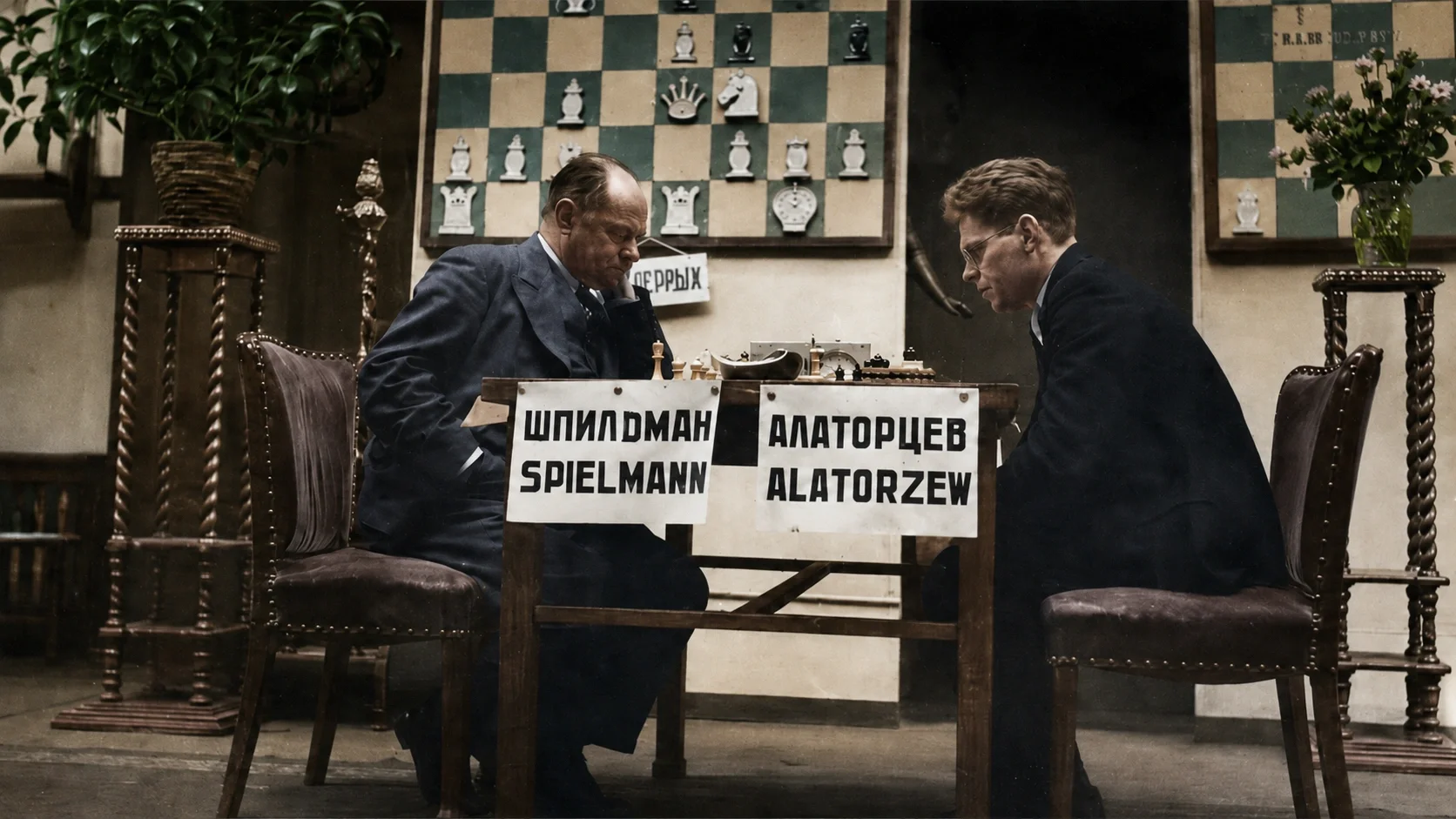
Botvinnik’s later world-championship career pushed many contemporaries into the shadows. Alatortsev was one of them. He never became a world-title candidate, never received the international opportunities that Botvinnik did, and never acquired the same political-symbolic force. Yet within the Soviet context of the 1930s, he was a leading master. In 1935, he played in the second Moscow International Tournament and drew with the first three prize winners: Salo Flohr, Botvinnik, and Emanuel Lasker. He then won, or shared first in, consecutive Moscow championships in 1936 and 1937 after moving permanently to the capital.
Alatortsev came close to formal recognition as a Soviet grandmaster before FIDE’s modern title system stabilized. The Soviet federation gave him a match with Andor Lilienthal, then among the world’s strongest grandmasters. After ten games, Alatortsev led 6-4 and needed only a draw in the final two games, but Lilienthal recovered to draw the match 6-6. In 1940, Alatortsev played Grigory Levenfish in another grandmaster title match, losing. His eventual grandmaster title came only much later, when FIDE awarded him an honorary grandmaster title in 1983 for his service to chess.
Style: Strategy, Closed Positions, and the Soviet Positional Tradition
Alatortsev’s playing style fits naturally within the strategic strand of Soviet chess. He was not primarily remembered as a sacrificial romantic or a tactical meteor. His reputation rested on positional understanding, the coordination of forces, and the slow accumulation of pressure. The Center for Chess Culture and Information preserves a recollection by Botvinnik that Alatortsev was particularly strong in complex, sharp positions, usually handled the opening well, and was difficult to face with Black.
That description is important because it complicates the simple label “strategist.” In chess writing, “strategist” can sometimes imply dryness. Alatortsev was not merely safe. His best chess appears to have combined opening discipline, positional clarity, and comfort in complicated middlegames. He studied structure and coordination, but he did not reduce chess to schematic play.
His theoretical legacy is partly preserved in the Queen’s Gambit Declined. The ECO classification identifies the Alatortsev Variation as 1.d4 d5 2.c4 e6 3.Nc3 Be7, a move order associated with avoiding certain Exchange Variation structures and steering the game into strategically distinct channels.
That opening detail is a small window into his mind. The Alatortsev Variation reflects an interest in move-order finesse, long-term piece placement, and practical prevention. It is not an opening system built on immediate confrontation. It is a positional tool for shaping the opponent’s options before the main battle fully begins.
The War Years: Chess as Discipline, Recovery, and Public Service
The Great Patriotic War changed Soviet chess life. Tournaments were disrupted, cities were under siege or evacuation, and the game’s cultural role took on a different tone. During these years, Alatortsev became an active organizer of chess life. The Russian Chess Federation credits him with helping to organize the Moscow Championship at the end of 1941 and with writing Shakhmaty v gospitale in 1943, which is described there as the only chess book published in the USSR during the war years.
This is one of the most important parts of his biography. Chess in the Hospital suggests a wartime conception of chess as mental therapy, morale-building, and disciplined recreation. Soviet chess was never only tournament chess. It belonged to clubs, newspapers, army units, schools, factories, and hospitals. Alatortsev’s wartime activity places him inside that broader social history.
He also continued to play in strong wartime and postwar events, including the 1942 Kuibyshev tournament and later Soviet championships. Yet by the late 1940s, his main contribution was shifting away from competition and toward training, writing, organization, and research.
Trainer of Smyslov and Influence on the Next Generation
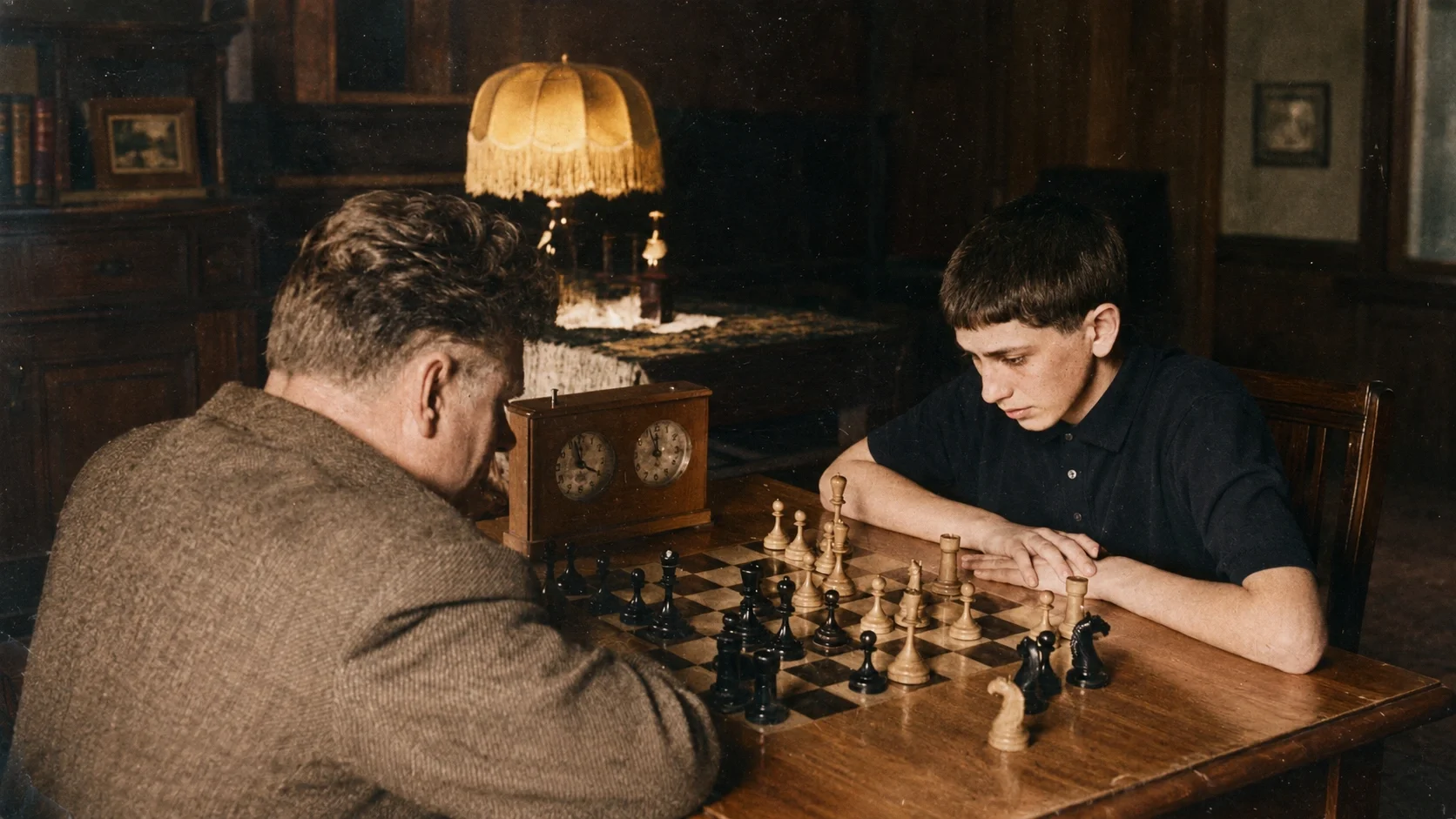
Alatortsev’s work with Vasily Smyslov deserves special emphasis. From 1946 to 1952, he served as trainer to the future world champion, and in 1948, he acted as Smyslov’s second during the world championship match-tournament.
Smyslov later credited Alatortsev with helping him deepen his understanding of closed positions and broaden his creative range in openings and middlegames. The Center for Chess Culture and Information preserves Smyslov’s recollection that they analyzed together closely and that Alatortsev’s advice, experience, and depth of positional understanding helped refine his style.
This may be Alatortsev’s most enduring influence over elite chess. Smyslov became world champion in 1957 and remains one of the great models of harmony, technique, and strategic restraint. Alatortsev did not create Smyslov’s genius, but he helped shape the professional tools around it. His influence worked through preparation, opening choice, structural understanding, and stylistic expansion.
Material from the Russian Chess Federation also says that Alatortsev later helped young players, including Boris Spassky. This places him in a chain of Soviet transmission: Romanovsky influenced Alatortsev, Alatortsev assisted Smyslov, and his teaching culture reached later champions and grandmasters.
Administrator of Soviet Chess
Alatortsev’s administrative career is central to his historical meaning. He chaired the Bureau of the All-Union Chess and Checkers Section from 1954 to 1959, then headed the USSR Chess Federation from 1959 to 1961.
These were years of enormous Soviet chess confidence. Botvinnik, Smyslov, Tal, Petrosian, Keres, Bronstein, Geller, Averbakh, Taimanov, and others formed a chess culture of unprecedented depth. Soviet teams dominated Olympiads. Women’s chess was also organized with exceptional seriousness. Alatortsev’s position placed him near the administrative center of this system.
One of his major institutional achievements was his role in securing and establishing the Central Chess Club of the USSR at Gogolevsky Boulevard 14 in Moscow. The Russian Chess Federation credits his efforts with the creation of the club in 1956, and another RCF report says the club was created largely through Alatortsev’s efforts.
The Central Chess Club became a symbolic and practical headquarters of Soviet chess life. It was a tournament venue, meeting place, archive, training center, and cultural salon. In its first year, it hosted the XXVII FIDE Congress during the Moscow Olympiad and became part of the Soviet presentation of chess as a national intellectual achievement.
Under Alatortsev’s leadership, Soviet chess periodical culture also expanded. The RCF notes the appearance of Shakhmatny Byulleten from 1955 and Shakhmatnaya Moskva from 1957 during his chairmanship.
Journalist and Public Educator
Alatortsev was a chess journalist, player, and organizer. Russian Chess Federation material lists him from 1941 as a member of the editorial boards of leading Soviet chess journals, and other Russian sources describe his long-running chess column work in Vechernyaya Moskva.
This journalistic side should not be treated as secondary. Soviet chess culture depended on print. Newspapers turned tournament results into civic events. Columns taught amateurs how to think. Annotated games created shared standards of taste and judgment. A figure like Alatortsev helped bridge elite chess and mass chess, the two poles of the Soviet project.
His writing also reflects the Soviet belief that chess could be taught systematically. Chess was not imagined merely as individual talent. It could be explained, organized, repeated, improved, and institutionalized. Alatortsev’s career is one of the clearest examples of that belief in practice.
Chess Science and the Psychology of Competition
In 1956, Alatortsev defended a dissertation titled “On Certain Questions of General Chess Theory” and received the degree of Candidate of Pedagogical Sciences. His later book Problems of Modern Chess Theory was published in 1960 and attempted to give chess theory scientific depth, though RCF notes that it provoked debate.
The book’s own description states that it examined modern chess theory through the “law of interaction of forces,” meaning the interaction of pieces and pawns, and drew from Alatortsev’s long experience as a master, teacher, and researcher.
From 1957 to 1981, Alatortsev worked in scientific research at the All-Union Research Institute of Physical Culture. He headed a sports psychology laboratory and later a chess laboratory, producing published and unpublished work on general chess theory and the psychology of chess creativity.
That laboratory work is one of the areas that many shorter biographies miss. It connects Alatortsev to the Soviet attempt to study chess as a high-performance cognitive domain. This included psychology, pedagogy, training methodology, and the preparation of leading players. It also fits the broader Soviet tendency to treat elite sport as a research problem involving physiology, psychology, and method.
Authorial Legacy
Alatortsev’s books show the range of his interests. Russian Chess Federation material lists works including Chess in the Hospital, Botvinnik-Smyslov: Toward the World Championship Match, The Interaction of Pieces and Pawns in the Chess Game, Problems of Modern Chess Theory, Questions of Training Methodology for Higher-Ranked Chess Players, A Chess Manual, and Creativity in Chess.
The titles alone reveal the arc of his intellectual life. He wrote for wartime recovery, world championship preparation, theoretical investigation, advanced training, general instruction, and creativity. Few Soviet figures connected so many layers of chess activity.
His most ambitious theoretical work, Problems of Modern Chess Theory, was published by Fizkultura i Sport in 1960 with 336 pages. Its description emphasizes the interaction of pieces and pawns as the foundation of chess development and links the book to his teaching and research practice.
Public Memory and Historical Reputation
Alatortsev was honored posthumously as a major figure in Soviet chess. In 2009, on the occasion of his centenary, a commemorative evening was held at the Central Chess House named for Mikhail Botvinnik, where a memorial plaque was unveiled. The RCF report describes the composition as showing Alatortsev thinking over a move with Botvinnik opposite him, a fitting image because Botvinnik was his great historical counterpart.
His daughter Irina Alatortseva later visited the Chess Museum of the Russian Chess Federation and donated chessmen that had belonged to him. The same RCF report again stresses that he was a strong practical player and trainer who led the All-Union Chess and Checkers Section and then the USSR Chess Federation.
A book-length treatment, Vladimir and Isaac Linder’s Two Lives of Grandmaster Alatortsev, was published in 1994. Its description frames him as one of the contributors to the development of the Russian chess school, one of the strongest Soviet players of the 1930s and 1940s, a major theorist, a wartime organizer, a federation president, and a scientist connected with the country’s first chess laboratory at the Central Research Institute of Physical Culture.
That “two lives” framing is apt. One Alatortsev was the master at the board: Botvinnik's rival, Moscow champion, Leningrad champion, theoretical specialist. The other was the builder: trainer, author, administrator, researcher, organizer of institutions, and transmitter of Soviet strategic culture.
Why Alatortsev Deserves More Attention
Alatortsev’s career resists the usual grandmaster biography. He did not become world champion. He did not produce a famous rivalry remembered by casual fans. He did not leave behind a single mythic tournament victory that defines him. His significance lies in accumulation.
He helped carry chess from the Leningrad school of Romanovsky into the Moscow-centered Soviet chess establishment. He tested himself against Botvinnik before Botvinnik became the central figure in Soviet chess. He helped Smyslov prepare for the world championship cycle. He contributed to Soviet wartime chess culture, as the game bolstered morale and recovery. He led the chess federation during a golden era for the institution. He helped create the Central Chess Club, one of the great physical homes of Soviet chess. He treated chess as a subject worthy of scientific study.
