Tatiana Zatulovskaya

Hoogovens tournament 1964. Left to right: Litmanowiczowa, Zatulovskaya, Vreeken. Harry Pot / Anefo
Introduction
Tatiana Yakovlevna Zatulovskaya, born in Baku on December 8, 1935, belongs in the front rank of Soviet women who never became world champion yet repeatedly stood close to the summit. She was a leading player of the 1960s and early 1970s, an Olympiad gold medalist for the USSR, a long-time contender in the women’s world championship cycle, later a senior world champion, and finally an Israeli representative in the last phase of her over-the-board career. Russian Chess Federation memorial sketches and specialist team records agree on the scale of that career, even when shorter biographical notices sometimes compress its details too loosely.
Zatulovskaya is historically significant for three reasons. First, she was one of the strongest products of the Baku chess milieu before the rise of Garry Kasparov’s generation. Second, she remained a credible challenger across several distinct eras of women’s chess. Third, her career shows the depth of Soviet women’s chess beyond the small group of players who actually reached world title matches. Her own retrospective formula, that she had played with “four generations” of women players, was not a rhetorical flourish but a concise description of an unusually long competitive arc.
Early Life and Chess Formation
Zatulovskaya’s early life was shaped by wartime Baku and by a family that was not itself a chess family. Russian Chess Federation biographical material states that her father went to the front in 1941 and returned disabled after a severe concussion, while neither her parents nor her older brother played chess. She learned the game from a neighbor and did not join a formal chess section in Baku until after she had turned fourteen, a relatively late start by Soviet standards.
Her progress after that late beginning was remarkably fast. Her first coach was Azer Zeynally, then only a few years older than she was and later known as an Azerbaijani champion, physics professor, and senior chess official. After her first successes, she worked with Suren Abramyan, a distinguished trainer at the Baku Palace of Pioneers, and later with Vladimir Makogonov, one of the most respected Soviet trainers of his generation. According to the Russian Chess Federation profile, only four years separated her arrival in the Baku section from her emergence as a finalist in the adult USSR women’s championship.
Education remained a serious part of her life. In Baku she completed the geological exploration faculty of the Industrial Institute and worked for about two years as an engineer geologist before elite chess effectively became her profession. That double identity, technical specialist and top competitor, appears consistently in the available biographies. It is also clear that Baku remained central to her self-understanding. When she returned there in 2011, she said she was happy to be back in the city “where I became a chess player,” a compact and revealing statement about the lasting weight of her formative environment.
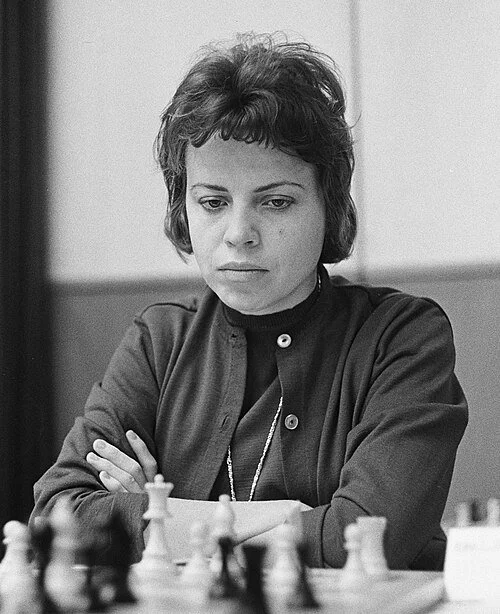
Tatiana Zatulovskaya. Harry Pot for Anefo
Rise in Competitive Chess
Zatulovskaya broke into the Soviet elite with unusual speed. Russian Chess Federation material notes that in her first all Union event she sensationally shared fourth place with world champion Elisaveta Bykova. The year by year tournament record places that debut in the 1954 USSR women’s championship, where she finished in the 4th to 6th cluster. For a player who had only recently entered organized chess, that was a striking arrival.
Her first major peak came in the 1960 USSR women’s championship at Riga. Contemporary event summaries show that after losing in the first round to Valentina Borisenko she reeled off six straight wins, led the main event for much of the tournament, and tied Borisenko for first on 13/18. Yet the playoff match for the title went to Borisenko by 4½ to 3½. That detail is essential for judging Zatulovskaya fairly, because it reveals both how close she was to national supremacy and how often a final barrier proved just out of reach.
The next three years established her as a permanent member of the Soviet top tier. She finished second in the January 1962 USSR women’s championship, then won the December 1962 championship in Riga outright with 13/19. That success brought not only sporting prestige but also public recognition in Baku, where, according to Russian Chess Federation biographical material, she was elected a deputy of the Baku city council. In 1963 she again tied for first in the USSR championship, this time with Maaja Ranniku, but lost the playoff match 4 to 2.
Major Career Achievements
One point requires careful handling. Many later summaries, including short biographical notices in English and Russian, describe Zatulovskaya as a three time Soviet women’s champion. The detailed championship records are more exact: in 1960 and 1963 she shared first in the main event but lost the ensuing playoff matches, while in December 1962 she won the championship outright. For historical precision, it is best to describe her as the 1962 USSR women’s champion and a repeated first place finisher who narrowly missed two additional official titles. The shorthand “three time champion” reflects later memorial usage, but the year by year tables present a more exact picture.
Her international team record was excellent. At the 1963 Women’s Chess Olympiad in Split, she helped the Soviet team win gold and took the individual silver medal on second board with 8/10. At the 1966 Women’s Chess Olympiad in Oberhausen she again won team gold and this time took individual gold on reserve board with 8½/9. OlimpBase’s aggregate Soviet women’s Olympiad record credits her with 16½ points from 19 games across her two appearances, an 86.8 percent score.
In the world championship cycle she was even stronger than her eventual title count suggests. She finished 4th to 6th in the 1961 candidates tournament, tied for 1st to 3rd in the 1964 candidates at Sukhumi before finishing third in the playoff at Moscow, shared second place in the 1967 candidates tournament at Subotica, and in 1971 qualified from the Ohrid interzonal in the 2nd to 3rd bracket before losing the semifinal candidates match to Alla Kushnir by the narrow score of 5½ to 4½. Russian Chess Federation summaries rightly present these repeated near breakthroughs as evidence that she stood for years among the strongest women in the world without ever quite securing the title match itself.
Her later career also had substantial content. In 1973 she moved to Moscow after her second marriage to sports journalist Valery Vinokurov. There she became Moscow women’s champion in 1975 and won the Evening Moscow blitz prize twice. She was also a five time champion of the Burevestnik sports society. After the Soviet period she remained active long enough to win the Women’s World Senior Championship in 1993 and again in 1997. In the early 2000s she emigrated to Israel and later represented Israel at the 2002 Chess Olympiad.
Style and Reputation
The clearest testimony about Zatulovskaya’s style comes from Zatulovskaya herself. In a Russian Chess Federation profile, drawing on her own recollections, she said that Vladimir Makogonov taught her a great deal “especially in the middlegame” and that only with him did she really understand which pieces should be exchanged and which should be kept. That is unusually specific evidence. It points to a player whose growth depended not on superficial sharpness alone but on the disciplined management of exchanges, piece quality, and middlegame plans.
The surviving record suggests, and here the point is interpretive, a player of strong practical judgment rather than a specialist defined by one opening complex or one easily summarized strategic formula. Her 1960 USSR championship run after an opening round loss, her repeated first or near first finishes in large Soviet fields, and her endurance across decades all indicate resilience, adaptability, and a capacity to handle both tactical and strategic complications under tournament pressure. That interpretation fits later Russian biographical characterizations of her as a genuine candidate to challenge at the very top.
Her reputation among contemporaries was high. Russian Chess Federation material says she was considered a possible rival to Nona Gaprindashvili and notes that she had a favorable or at least notably good personal score against the reigning champion, one reason her candidacy for a title match did not seem fanciful at the time. Her own remark that she had played with “four generations” of women players also helps place her historically. She listed older stars such as Bykova, Zvorykina, Rubtsova, and Volpert; mid career rivals such as Kushnir, Kozlovskaya, and Ranniku; then Nana Alexandria; and finally the younger group led by Maia Chiburdanidze, Nino Gurieli, and Nana Ioseliani. She specifically recalled defeating the fifteen year old Chiburdanidze in the 1976 USSR championship, an isolated game that is worth mentioning because it captures her unusual chronological range as a competitor.
Contributions Beyond Tournament Play
The public source base on Zatulovskaya emphasizes play far more than authorship, commentary, or formal coaching. I have not found strong evidence for a major body of books, theoretical writings, or a prominent training school built around her name. That absence should not be filled with guesswork. What the sources do show is a different kind of contribution, sustained representative presence in Soviet and later Israeli chess culture.
That representative role took several forms. In Baku she was important enough, after her 1962 title, to be elected to the city council. In Moscow she remained visible in capital competitions and team events. In Israel she carried Soviet era prestige into a new chess setting and continued to compete internationally as a senior player and Olympiad representative. Her 2011 return to Baku, where local chess and Jewish community figures honored her as a chess legend who had helped create Azerbaijan’s positive chess image, shows how durable that symbolic status remained. Several later notices also remember that she had been a gymnast as well as a geologist, details that reinforce the picture of an unusually versatile sporting and professional life.
Historical Legacy
Zatulovskaya’s legacy has often been softened by the fame of others. In standard narratives of Soviet women’s chess, the spotlight usually falls on world champions such as Nona Gaprindashvili and Maia Chiburdanidze, or on serial challenger Alla Kushnir. Zatulovskaya is easier to overlook because she never reached the decisive title match. Yet the record shows a player who kept reappearing at almost every critical threshold: Soviet title races, Olympiads, candidates tournaments, interzonals, Moscow championships, senior world events, and finally Israeli team representation. That kind of recurrence is itself a historical fact of weight.
She also deserves attention as a Baku figure. Before Baku became internationally associated with Kasparov, it had already produced a woman player of world class stature who remained deeply attached to the city in memory and identity. Her own 2011 statement about Baku as the place “where I became a chess player” and the local honors she received there underline that point. Soviet chess history can become too Moscow centered or too champion centered. Zatulovskaya complicates both habits of emphasis.
A concise historical assessment would be this: Tatiana Zatulovskaya deserves attention today because she exemplifies the strength, range, and human complexity of Soviet women’s chess just below the title winning stratum. She was a late starter who became an elite player, an engineer geologist who turned into an almost full time master, a Baku star who later became a Moscow champion and an Israeli representative, and a repeated near challenger whose career stretched from Bykova’s era to Chiburdanidze’s. To study her is to see how much of chess history is carried not only by champions, but by the strongest figures who repeatedly stood just one step from the very top.
Notes and Sources
The source base for Zatulovskaya is uneven but serviceable. The most useful public materials are Russian Chess Federation biographical notices and obituary material, specialist statistical records at OlimpBase, and year specific championship pages that synthesize Soviet era tables and contemporary magazine references. English language summaries often use the transliteration “Tatiana,” while Russian and some European references also yield forms such as “Tatyana,” “Zatulovskaia,” or “Zatulovskaja.”
The largest factual caution concerns her Soviet championship count. Later memorial and reference summaries often call her a three time Soviet champion. Granular championship records show a cleaner distinction: tied first and lost the playoff in 1960, outright champion in December 1962, tied first and lost the playoff in 1963. For a historical profile, that more exact formulation is preferable.
Key sources used here include the Russian Chess Federation’s jubilee and memorial profiles, the Federation’s “Person of the Day” biography, OlimpBase pages for the 1963 and 1966 Women’s Olympiads and Soviet team records, and detailed championship or candidates pages for the USSR women’s championships and the 1964, 1967, and 1971 world championship cycle events. These sources do not answer every question, especially on family life and non playing roles, but taken together they are sufficient for a careful historical profile grounded in documented results and contemporary institutional memory.
