The 1964 Interzonal at Amsterdam
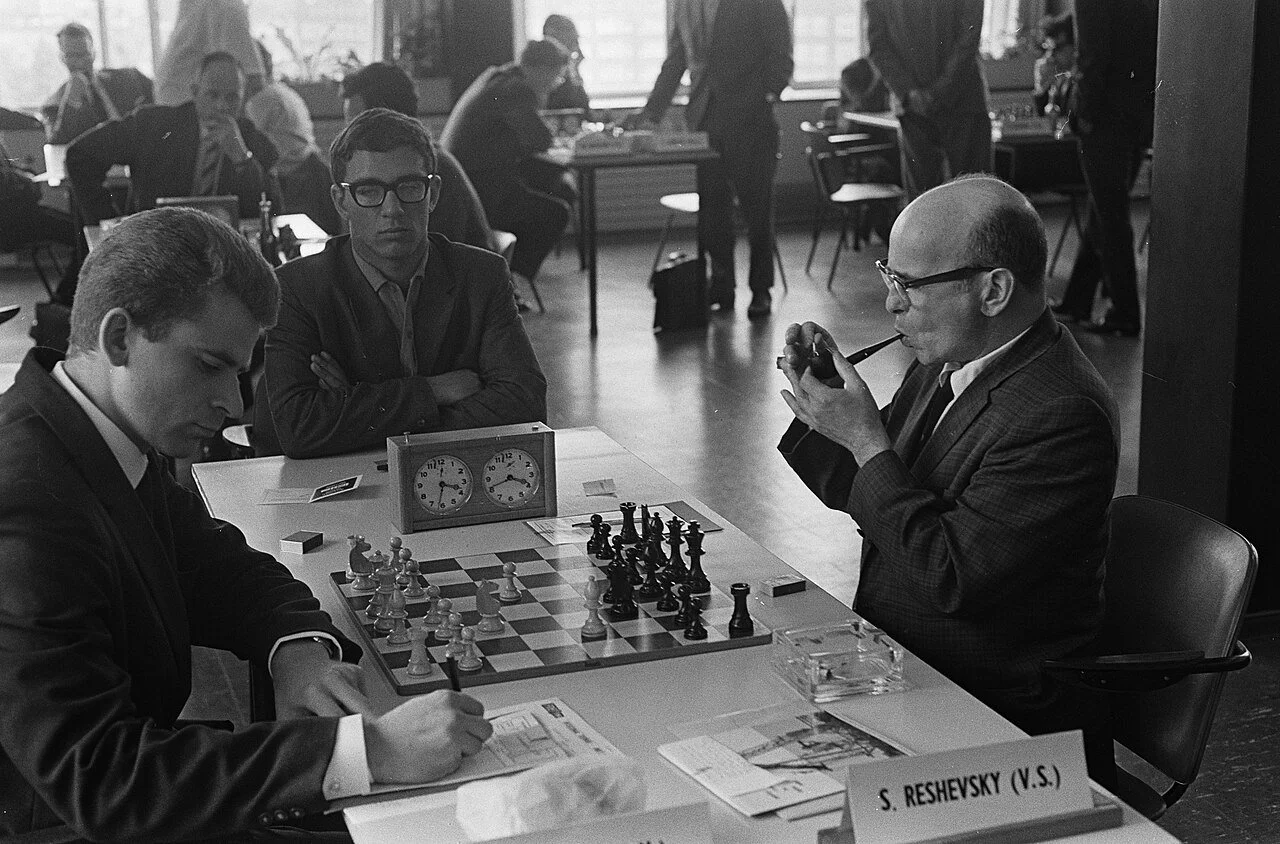
The great and powerful Harry Pot for Anefo
Introduction
The 1964 Interzonal in Amsterdam was one of the most revealing qualifying tournaments of the postwar world championship system. Played from 20 May to 21 June 1964 in Amsterdam’s GAK building, it was a 24 player, 23 round all play all that sent six players into the newly reconfigured Candidates matches. Its bare result was unusual enough: Bent Larsen, Vasily Smyslov, Boris Spassky, and Mikhail Tal shared first place on 17 points from 23 games. Its historical afterlife, however, rests just as much on what happened below the top line. Leonid Stein and David Bronstein finished fifth and sixth, yet were excluded from qualification by FIDE’s nationality cap, while Samuel Reshevsky lost a playoff for the last effective place to Lajos Portisch. In one tournament, Amsterdam condensed Soviet depth, Western resistance, Tal’s revival, Spassky’s rise, and one of the cycle’s sharpest eligibility controversies.
The event deserves attention not because it produced a single dominant winner, but because it exposed the structure of elite chess in the mid 1960s with unusual clarity. Contemporary observers already understood that point. Chess Life presented the tournament as one that could easily produce the next challenger, while A. O’Kelly de Galway called it “the strongest tournament ever played in Holland.” Later historians have treated Amsterdam as one of the decisive staging grounds for Boris Spassky’s climb to the summit and as a landmark in Bent Larsen’s emergence as the strongest West European challenger outside the Soviet system.
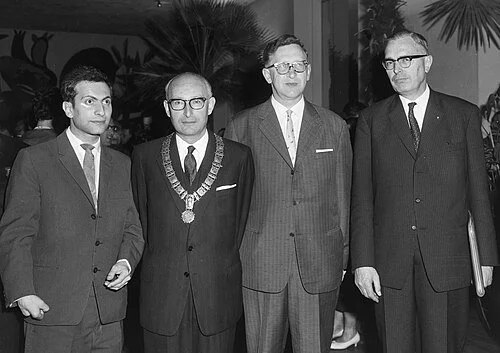
Joop van Bilsen for Anefo
Historical Setting
Amsterdam belonged to the first world championship cycle reshaped after the controversies of Curaçao 1962. FIDE’s official retrospective states that the Candidates stage moved into an era of matches in 1965, replacing the old large round robin structure. Contemporary American reporting linked that change directly to the criticisms that followed Curaçao. The 1964 Interzonal was therefore not just another qualifying event. It was the gateway into a new format, one designed to reduce the possibility of collusion and to create a more direct, match based road to the challenger’s seat.
For Soviet chess, the immediate background was unusually tense. The USSR did not simply send its representatives on the basis of the 31st Soviet Championship alone. Instead, an additional seven player zonal tournament was staged in Moscow in early 1964, and that decision provoked public criticism. Douglas Griffin’s translation of Igor Bondarevsky’s report in Shakhmaty v SSSR shows Bondarevsky arguing that the extra event had no clear advantage over the older practice and merely imposed unnecessary “jitters” on the leading grandmasters just before the interzonal. Korchnoi’s later memoir, also cited by Griffin, pushed the criticism further by portraying the arrangement as politically charged and especially contentious around Smyslov’s treatment. Whatever one makes of the memoir literature, the documentary point is firm: the Soviet road to Amsterdam was itself debated, improvised, and politically sensitive inside Soviet chess culture.
That setting is essential for understanding Amsterdam’s field. The reigning world champion, Tigran Petrosian, was not a participant because the interzonal’s purpose was to identify future challengers, not to include the champion. Keres and Botvinnik stood outside the field because of their cycle privileges, which is why only six interzonal places were available for the next stage. This arrangement helped make every half point in Amsterdam unusually heavy, and it made the later exclusion of Stein and Bronstein feel especially severe.
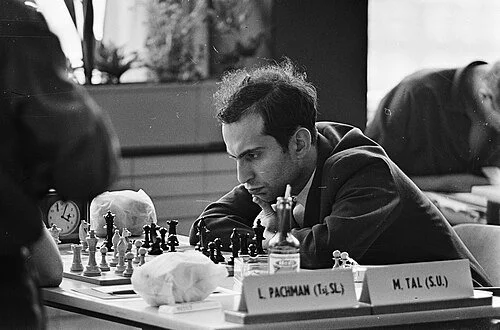
Mikhail Tal in play against Ludek Pachman. Harry Pot for Anefo
Organization, Format, and Field
The tournament was held under FIDE auspices in Amsterdam at the GAK building on Bos en Lommerplantsoen, then one of the most modern office complexes in the Netherlands. Contemporary and later descriptions agree on the venue’s distinctly modern character. Amsterdam’s municipal heritage service describes the GAK as a “revolutionary” office building of 1960 and a symbol of the expanding welfare state, while Griffin notes that it was among the city’s most modern office buildings when the interzonal arrived there four years later. The setting gave the event a recognizably postwar urban texture: chess was being staged not in a salon or resort, but in a large bureaucratic complex that embodied the institutional modernity of the period.
In formal terms, Amsterdam was a 24 player single round robin over 23 rounds. O’Kelly reported during the event that the field contained 18 grandmasters and six international masters, and he added a small but revealing period detail: participation in an interzonal automatically brought the IM title to players who did not yet hold it. He also noted that pairings were arranged so that countrymen met each other early, an anti collusion precaution that itself reflected the anxieties inherited from the previous cycle. Those mechanics are not marginal details. They show how strongly the organizers and chess public were already thinking about fairness, nationality, and the integrity of qualification.
The qualification system produced a field that was broad in geography but top heavy in prestige. Chess Life’s preview described the U.S. zone as sending Reshevsky and Evans through the 1962-63 national championship, with Benko defeating Bisguier in a playoff for another place. It also noted that Tal entered as a direct FIDE nominee from the 1962 Candidates event, while Smyslov came as a direct Soviet representative. Alongside them stood Soviet qualifiers Spassky, Stein, and Bronstein, with the non Soviet core including Larsen, Gligorić, Ivkov, Portisch, Pachman, Darga, and others. In practice, this meant that the event combined zonal qualifiers, seeded carryovers, and national federation choices in a way that made the field both representative and unmistakably elite.
One major absence shaped contemporary perceptions from the beginning: Bobby Fischer did not play. Chess Life’s coverage records that Fischer’s explanations shifted. He criticized the new short Candidates match format, at one stage had complained that the interzonal prize money was too small, and later argued that the full cycle demanded too many games for too little practical chance of reaching Petrosian. Because these motives changed over time, the safest historical judgment is that Fischer’s absence was real and influential, while the exact balance of motives remains interpretive. What is not interpretive is the effect: the strongest recent non Soviet interzonal winner from Stockholm 1962 was missing, and that changed the way Amsterdam was read in both Europe and the United States.
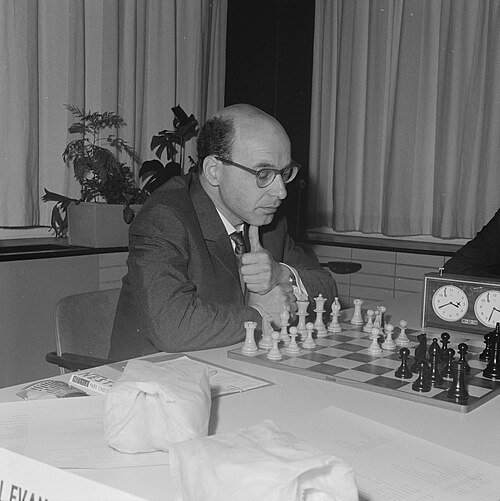
David Bronstein at the 1964 Interzonal. F.N. Broers / Anefo
How the Tournament Unfolded
Amsterdam did not begin as a straightforward Soviet march. O’Kelly’s in tournament account emphasizes several early shocks. Klaus Darga beat Boris Spassky in the opening round, partly avenging an earlier defeat at Varna. Bronstein defeated Stein in another striking early result after Stein, from a favorable position, launched an unsound sacrificial operation and lost the long ending. These results immediately gave the interzonal the feel of a genuine fight rather than a procession, and they also underline how sharp the internal Soviet battles already were once same nationality pairings were forced into the early rounds.
The broad pattern of the event then separated into several narratives. Spassky recovered from that first round loss with great force. Griffin notes that after the setback to Darga he won eight consecutive games from rounds eight through fifteen and thereby set the pace in the middle of the event. Larsen advanced more irregularly but more dramatically, to the point that contemporary American coverage described his showing as the sensation of the tournament. Ivkov, by contrast, qualified through what O’Kelly called a quiet accumulation of “precious points,” which is an apt summary of a campaign less vivid in recollection than those of the leaders but no less effective in its final consequence.
The two ex world champions in the field, Smyslov and Tal, gave the tournament additional historical depth. O’Kelly reported that both were in good form, though he thought fatigue cost Smyslov some valuable half points in long games. Tal’s own later memoir confirms the scale of his result, listing Amsterdam among his major achievements and noting that he shared first through fourth on 17/23. In historical perspective that finish was especially significant because it followed the health crisis that ruined his 1962 Candidates performance. Amsterdam restored Tal, unmistakably, to the inner circle of world championship competition.
By the finish, the tournament had produced a remarkable combination of compression and separation. Compression at the very top, where four players tied on 17/23. Separation just beneath, where Stein on 16½ and Bronstein on 16 had scores that ordinarily would have been good enough to qualify, but the rules turned their strong finishes into a dead end. Reshevsky and Portisch tied still further back on 14½, and that tie only acquired real significance because the Soviet quota pushed the effective qualification frontier downward.
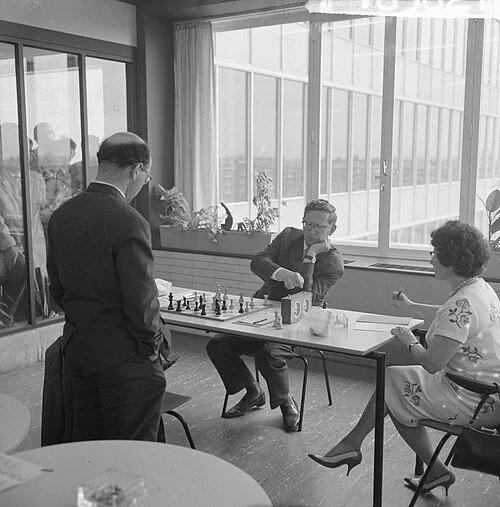
Larsen, Bronstein, and Smyslov. Jack de Nijs / Anefo
Winners, Exclusions, and Turning Points
The shared winners did not arrive there by the same route or with the same historical meaning. Larsen’s result had a distinct symbolic weight. Chess Life recorded that he scored 13 wins, drew eight, and lost only two, and declared his performance “the sensation” of Amsterdam and the finest West European showing in many years. That judgment was contemporary, not retrospective. It captured what made his success important: in a field loaded with Soviet prestige, Larsen did not merely survive. He posted a plus score against the Soviet players as a group, defeating Bronstein and Spassky, drawing Tal and Smyslov, and losing only to Stein. For readers outside the USSR, that was the central counter story of the tournament.
Spassky’s campaign was the most visibly ascendant. Griffin is right to treat Amsterdam as one of his first great successes. The tournament exposed both sides of the young Spassky at once: the vulnerability shown by his opening loss to Darga, and the sustained authority shown by his long winning run afterward. The critical blow to his hopes for sole first came late, when Larsen defeated him in the penultimate round. That game was not merely one attractive encounter among many. It directly changed the character of the final standings by denying Spassky a clean tournament victory and helping elevate Larsen into the shared lead.
Tal’s importance was slightly different. His shared first did not generate the same single narrative of ascent that attached to Spassky, yet his result was historically charged because of what it reversed. In The Life and Games of Mikhail Tal, he explicitly remembered Amsterdam as a first place tie and noted that the Soviet players who actually reached the Candidates were Spassky, Smyslov, and himself. That retrospective comment is useful because it joins success and exclusion in one sentence. Tal knew, as everyone in Soviet chess knew, that even a top Soviet result did not automatically secure passage if the numbers lined up the wrong way.
The harshest turning point came after the games, not during them. FIDE’s nationality restriction allowed no more than three players from a single country to advance from the interzonal, a carryover from the era when the Candidates stage had been a round robin and large Soviet representation was seen as an institutional advantage. Chess Life argued in July 1964 that, once the Candidates had become a series of matches, the restriction looked “unnecessary,” “unfair,” and “illogical.” That contemporary reaction is historically valuable because it shows that the criticism was immediate, not a later sentimental defense of Stein or Bronstein. Stein, in particular, suffered a repeat of the same kind of exclusion that had already cost him a place after Stockholm 1962.
The final practical consequence was the Reshevsky-Portisch playoff. Reshevsky had the higher Sonneborn-Berger score after the tournament proper, so under the rules he needed only two points from a four game match, while Portisch needed two and a half. Yet Portisch won the first game, drew the second, and won the third, making the fourth unnecessary. That match was a smaller appendage to Amsterdam in purely formal terms, but historically it completed the interzonal’s reshaping of the Candidates field. Without the Soviet quota, the playoff would have carried far less significance. With the quota in force, it became decisive.
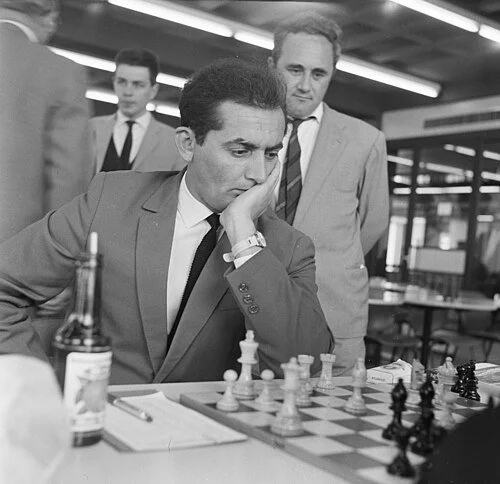
Efim Geller is watching as Leonid Stein ponders his next move. F. N. Broers / Anefo
Contemporary Reception
The tournament was followed closely in the chess press, and the pattern of coverage itself reveals its stature. In the United States, Chess Life previewed the event in May, reported the result prominently in July, and devoted analytical space to the tournament while it was still being played. O’Kelly’s running remarks, translated for American readers, treated Amsterdam as a major international spectacle and the strongest event ever staged in Holland. That kind of coverage placed the interzonal not in the category of routine qualification, but in the category of a world class tournament whose result could redefine the title race.
In the Soviet and wider Soviet bloc press, the attention was equally strong and more institutionally embedded. Griffin’s work shows that Shakhmaty v SSSR covered the Soviet qualifying controversy before Amsterdam and later published Spassky and Bondarevsky’s annotations from the event. A separate Riga periodical, Shakhmaty, issued a July 1964 number explicitly centered on the Amsterdam interzonal, with contributions by Salo Flohr and by N. Krogius and A. Sundukov. A bookseller’s archive listing for Soviet periodicals also records that the USSR Central Chess Club produced a ten issue Amsterdam interzonal bulletin series in 1964. These details are useful because they shift the picture from general “attention” to specific institutional publication. Soviet chess did not simply notice Amsterdam. It documented, analyzed, and archived it intensively.
One feature of the reception was overtly procedural and polemical. Bronstein did not quietly accept exclusion. Chess Life reported that he formally petitioned FIDE President Folke Rogard for major changes to the Candidate selection system, including an expansion of the 1965 Candidates field from eight to sixteen players. The proposal would have admitted not only himself and Stein, but also Fischer, Reshevsky, Geller, Gligorić, Darga, and Lengyel. Whether or not the proposal was realistic, its existence is historically revealing. The Amsterdam result was controversial enough that one of the greatest players in the world responded not with a memoiristic complaint years later, but with an immediate constitutional argument directed to FIDE.

Portisch, Flohr, and Bronstein. Jack de Nijs / Anefo
Legacy and Historical Assessment
Amsterdam’s legacy lies in the way later history vindicated the significance of its leading stories. Spassky moved from his shared first at Amsterdam into the 1965 Candidates matches and then into the 1966 world championship match against Petrosian. FIDE’s own history of the Candidates describes 1965 and 1968 as the “golden era” of Spassky’s match play, and Griffin sees Amsterdam as one of the first major signs that his rise to the summit had truly begun. On that point the contemporary and later perspectives align well. Amsterdam was not an isolated success for Spassky. It was the opening of a larger sequence.
For Tal, the event’s legacy is bound to recovery. After the physical collapse of his 1962 Candidates campaign, Amsterdam restored him to championship relevance and led directly to another deep Candidates run in 1965. For Larsen, Amsterdam was the great confirmation that his talent could be translated into title cycle success against the densest Soviet opposition. Chess Life already framed it as an exceptional West European performance, and later chess history has generally preserved that verdict. If one wants a concise answer to why Larsen’s Amsterdam result still resonates, it is because he did not merely qualify. He proved, in public and in score, that the Soviet wall could be climbed.
The deepest stain on the tournament’s memory remains the exclusion of Stein and Bronstein. Stein’s fifth place finish at Amsterdam, like his earlier case after Stockholm, became part of the standard historical indictment of nationality quotas in title qualification. Bronstein’s sixth place, no less real on the board, was transformed into an administrative non event. That judgment is not simply retrospective moralizing. It was already the logic of contemporary criticism in 1964, when the quota looked like an anachronism left over from the old round robin Candidates system. Amsterdam is therefore remembered not only as a triumph of elite chess, but also as a reminder that world championship qualification was governed by rules that could contradict the tournament table itself.
What gives the 1964 Interzonal its continuing force today is precisely this combination of excellence and tension. It was a superbly strong tournament, held in a setting that expressed postwar modernity, played under rules shaped by the anxieties of the previous cycle, and finished with a result that both launched future contenders and discredited part of the qualification apparatus. For readers interested in chess history rather than isolated brilliancies, Amsterdam offers something rarer than a famous game. It offers a complete historical scene: a field of extraordinary strength, a clear institutional purpose, a visible cultural infrastructure, and an ending that still invites argument.

Larsen and Portisch. F.N. Broers for Anefo
Notes and Sources
The principal primary and near contemporary sources used here are the May and July 1964 issues of Chess Life, especially its field preview, O’Kelly de Galway’s running report from Amsterdam, and the July result summary with Bronstein’s appeal to FIDE. These sources supply the tournament structure, much of the period language around the event, the significance contemporaries attached to Larsen’s result, and the immediate reaction to the Soviet quota rule.
For Soviet context and reception, the most useful source in English is Douglas Griffin’s work, because it reproduces and translates material from Shakhmaty v SSSR and related Soviet sources. The Riga journal Shakhmaty and the record of the USSR Central Chess Club bulletin series confirm that Amsterdam drew sustained publication attention in the Soviet world. Tal’s own memoir provides a valuable player retrospect, and FIDE’s official history of the Candidates helps locate Amsterdam within the structural shift from tournament Candidates to match Candidates. Tournament scores, dates, and playoff details have been checked against standard reference sites used only for factual confirmation of standings and game metadata.
