Netherlands vs. USSR Friendly Team Match
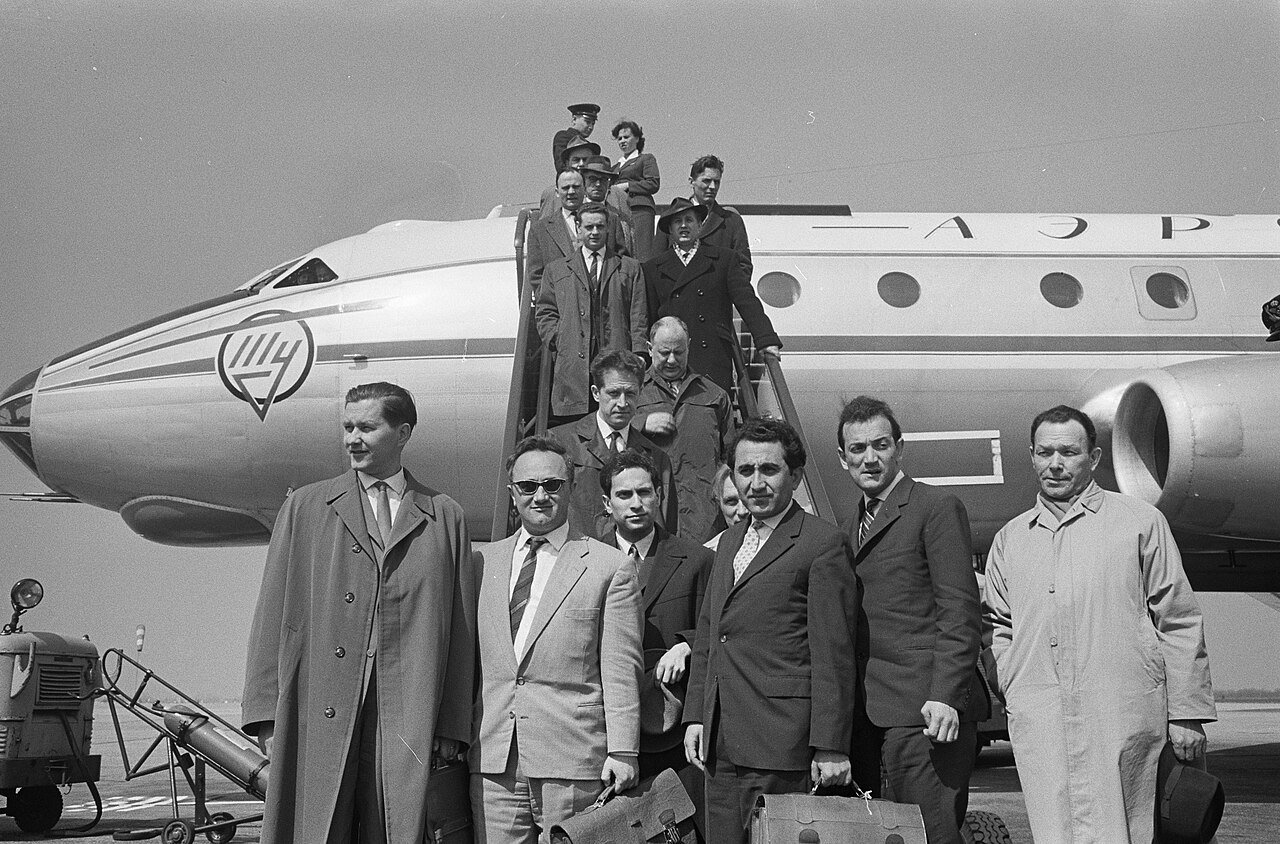
Harry Pot / Anefo
Introduction
The Netherlands vs. USSR friendly team match at The Hague, played on 3 and 4 July 1962, was a brief event in form but not in historical interest. It was a six board, double round team match, effectively a two day bilateral test between a leading Dutch national selection and a Soviet side fresh from the 1962 Candidates Tournament in Curaçao. The USSR won by 8½ to 3½, taking the first day 5 to 1 and the second day 3½ to 2½. Those bare figures, however, do not fully convey why the match deserves renewed attention. It offered Dutch spectators an unusually concentrated view of Soviet elite strength at the exact moment when Tigran Petrosian had just emerged as Botvinnik’s next challenger, while also preserving an instructive snapshot of the Dutch master generation around Donner, Prins, Bouwmeester, Langeweg, Kramer, and Van den Berg.
This was not a championship in the formal sense, and it should not be inflated into one. Its significance lies elsewhere. It functioned as a representative international encounter, part sporting test, part exhibition of national chess strength, and part artifact of organized Dutch Soviet chess contact. The Dutch booklet title that survives in catalog records, Tweede Landenontmoeting USSR - Nederland Den Haag 1962, shows that contemporaries treated it as a defined “countries’ meeting,” not merely a casual stopover.

Harry Pot for Anefo
Historical Setting
The timing is the first key to understanding the match. According to contemporary Dutch Caribbean press coverage, the Soviet team that came to The Hague was the same group of Soviet players that had participated in the Candidates Tournament in Willemstad. FIDE’s historical overview confirms the broader setting: the 1962 Candidates in Curaçao was the last great quadruple round robin of its kind, Petrosian won it without losing a game, and Tal’s worsening health forced him to withdraw before the finish. In other words, The Hague hosted the Soviet team at the precise moment when the world championship succession was shifting from Botvinnik and Tal toward Petrosian.
That proximity to Curaçao gave the friendly more weight than a routine exhibition. Petrosian, Geller, Keres, Tal, and Korchnoi were not simply strong Soviet masters passing through western Europe. They were, in different ways, central actors in the world title cycle of 1962. A Dutch audience was therefore watching, across six boards, something close to a portable cross section of top Soviet chess at one of its peaks. This helps explain why even a short bilateral match was preserved in special printed form and photographed for the press.
The event also belongs to a narrower and more specific Dutch setting. The Hague was already a city with deep chess associations, and Dutch chess culture had long valued international contact. What makes this match distinctive is not that it was the biggest event ever held there, because it plainly was not, but that it placed the Dutch national elite directly opposite a Soviet delegation of extraordinary density. Later memory of the encounter was partly shaped by what happened afterward: Viktor Korchnoi’s first visit to the Netherlands came here in 1962, and that fact gained retrospective force after the Netherlands became central to his later life and break with Soviet officialdom in 1976.

Harry Pot for Anefo
Organization, Format, and Field
The securely documented basics are straightforward. The match took place in The Hague on 3 and 4 July 1962. It was played over six boards, with two rounds and reversed colors. Accessible online records do not, however, allow the precise venue to be established with confidence, and it is better to leave that point open than to guess. The same caution applies to the exact organizing chain. The match was clearly mounted as an official representative encounter, and the surviving booklet title plus the long run of the Schaakbulletin Vereniging Nederland-U.S.S.R. indicate that it stood within a wider framework of structured Dutch Soviet chess and cultural exchange, but the exact division of labor between national federation, local organizers, and the friendship association is not stated plainly in the sources I could verify online.
The Soviet field was formidable even by Soviet standards: Tigran Petrosian, Paul Keres, Mikhail Tal, Efim Geller, Viktor Korchnoi, Yuri Averbakh, and Isaac Boleslavsky appeared in the tournament record, with Averbakh and Boleslavsky rotating on the sixth board. The Dutch team consisted of Jan Hein Donner, Hans Bouwmeester, Kick Langeweg, Lodewijk Prins, Haije Kramer, and Carel Benjamin van den Berg. That Soviet reserve usage is a small but revealing detail. Most countries would have considered Averbakh or Boleslavsky the headline attraction of a team match. The USSR could use them as interchangeable depth on one board.
No formal qualification system for the Dutch lineup has surfaced in the accessible evidence, and the event should therefore be understood as an invited representative selection rather than as the outcome of a qualifying competition. The names chosen make sense on those terms. The Dutch team drew from the country’s established postwar masters and international representatives, while the Soviet side brought players who had just been competing at or near the summit of world chess. The imbalance in international standing was real, but the Dutch side was not symbolic or token. It was a serious home selection asked to confront perhaps the deepest national chess reservoir in history.

The great and powerful Harry Pot for Anefo
Main Course of the Match
The first day largely decided the contest. The Soviet team won 5 to 1. Efim Geller defeated Kick Langeweg, Tigran Petrosian beat Jan Hein Donner, Viktor Korchnoi defeated Lodewijk Prins, and Mikhail Tal overcame Haije Kramer. Only two Dutch players held the line, Hans Bouwmeester with a draw against Paul Keres and Carel van den Berg with a draw against Yuri Averbakh. In practical terms, the Netherlands had already suffered the decisive strategic blow: its leading boards were not merely drawing too much, they were losing too often.
The second day told a more balanced story. The Netherlands steadied itself. Donner drew with Petrosian, Keres and Bouwmeester drew again, Korchnoi and Prins drew, Kramer held Tal, and Langeweg drew Geller. The only decisive game of the second round was Isaac Boleslavsky’s win over Van den Berg, which secured the day by 3½ to 2½ and the match by 8½ to 3½ for the USSR. That pattern is worth stressing because it rescues the match from being read as a simple rout from beginning to end. The Dutch team was badly outpunched on day one, but on day two it showed resistance on five of the six boards.
If one asks which specific games were most consequential to the result, the answer lies less in a single brilliant miniature than in the cluster of Soviet victories from the opening session. Petrosian over Donner, Korchnoi over Prins, Tal over Kramer, and Geller over Langeweg established the tone and the margin. The return games then became contests over dignity, balance, and local self respect rather than over the match lead itself. Bouwmeester’s pair of draws with Keres was especially creditable, and Kramer’s second day draw with Tal helped show that the Dutch team was more competitive than the aggregate score may first suggest.

Harry Pot for Anefo
Leading Participants and Competitive Significance
Petrosian’s presence gave the match its clearest historical silhouette. FIDE’s retrospective account identifies Curaçao 1962 as his breakthrough Candidates victory, achieved without a single loss. In The Hague, he immediately converted that prestige into a first round win over Donner, the best known Dutch name in the match. Petrosian’s draw in the return game changed nothing essential, because by then the Soviet team had already imposed the structure of the match. Seen from Netherlands, this was the new challenger in person, not in quotation or hearsay.
Tal’s significance was different but equally strong. He arrived not as reigning world champion, because Botvinnik had taken the title back in 1961, but still as the most magnetic Soviet chess celebrity of the day. FIDE’s summary of Curaçao notes that illness disrupted his tournament, which only sharpened the contrast between his uncertain Candidates campaign and the star aura he still carried into public appearances such as this match. His first round win over Kramer was therefore more than a board point. It was one of the games by which the event acquired its later photographic and anecdotal afterlife.
Keres, Geller, and Korchnoi added three more layers of significance. Keres remained one of the defining contenders of the age. Geller was among the world’s most respected Soviet grandmasters. Korchnoi, still years away from his later political and sporting drama, was making what the Max Euwe Center later identified as his first appearance in the Netherlands. That retrospective note gives the match an added documentary value. It was not only a Soviet victory in a friendly; it was the beginning of Korchnoi’s long and complicated Dutch chapter.
On the Dutch side, the real significance lay in collective representation. This was not Max Euwe’s Netherlands, nor yet the Timman generation. It was the intervening Dutch elite, strong enough to command respect but facing a Soviet side whose top six and reserve depth were qualitatively beyond what any western federation could usually field in one place. The match therefore reveals the scale of Soviet advantage more clearly than many larger tournaments do. In a long Swiss or round robin, Soviet superiority could disperse into standings and percentages. In a six board bilateral match, it became immediately visible.
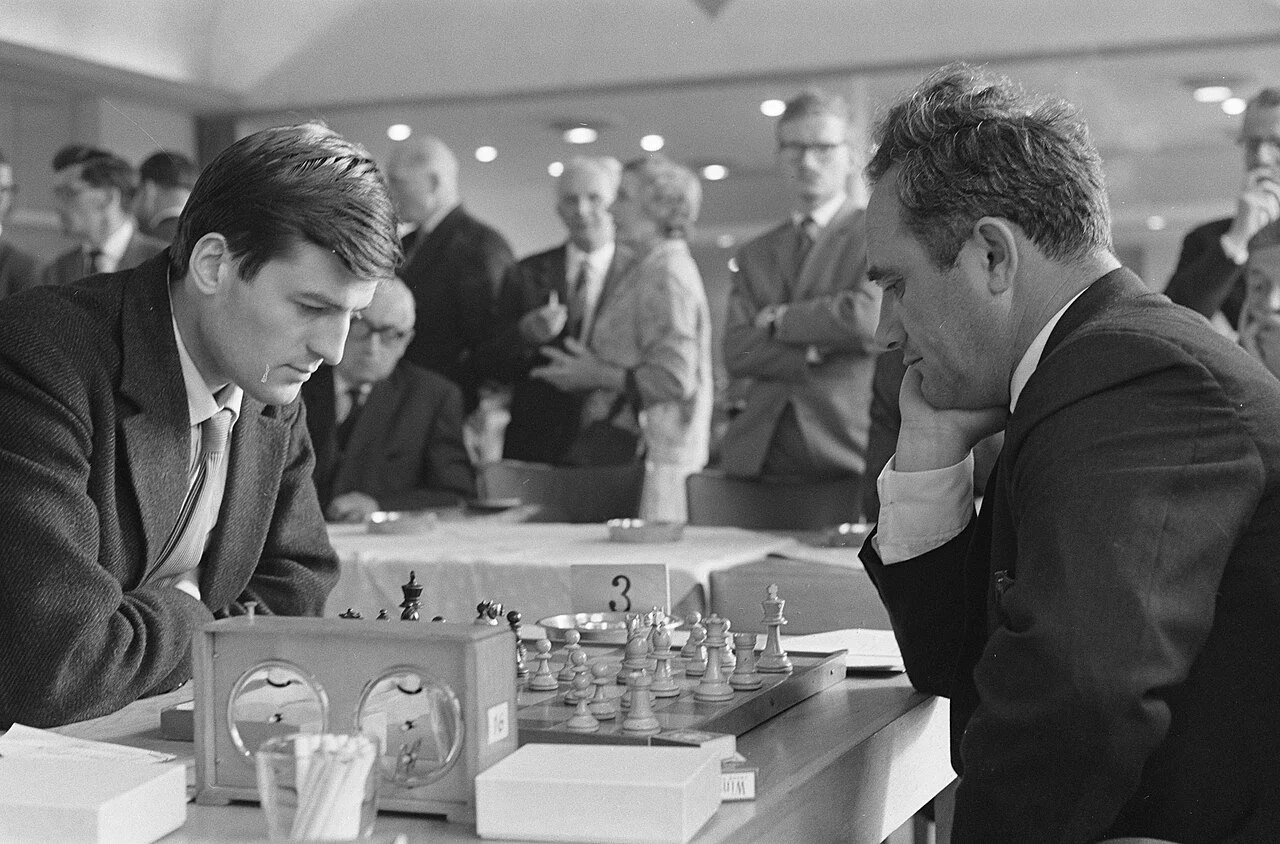
Harry Pot for Anefo
Contemporary Reception
Surviving contemporary evidence suggests serious interest, though not a level of public attention comparable to a world championship or a major Dutch international tournament. The Curaçao paper Amigoe di Curacao printed a photograph from the start of the match and identified the players shown, notably Prins against Korchnoi and Petrosian beside Donner. That is a small but telling piece of reception history. The game room itself became legible to readers through the national pairings they were most likely to recognize: the home stars and the newest Soviet celebrity names.
The existence of a dedicated eight page booklet is another clue. This was enough of an event to deserve its own printed trace, yet the slimness of the booklet also signals the scale of the occasion. It was documented, commemorated, and organized, but not monumentalized. That balance feels right. The match was not meant to stand alone as one of the great tournaments of 1962. It was meant to register a meaningful encounter, preserve the pairings, and mark a rare face to face contest between Dutch masters and the strongest chess nation in the world.
There is also an institutional point here. The Max Euwe Center’s catalog evidence that the Schaakbulletin Vereniging Nederland-U.S.S.R. ran from 1949 to 1969 places the match within a network of Dutch Soviet chess contact that was regular enough to sustain its own periodical culture. That does not prove every organizational detail of the 1962 match, but it does show that the encounter belonged to an established ecology of exchange rather than to an isolated improvisation.
Harry Pot for Anefo
Legacy and Historical Assessment
The match’s later obscurity is understandable. It was overshadowed at once by the far larger story of Curaçao 1962 and, in the longer run, by the Olympiads, world championship matches, and the better known Netherlands based tournaments that followed. Yet this obscurity is precisely why the event deserves more attention. Few small matches capture Soviet depth so economically. The USSR could present a team containing the new challenger Petrosian, the still luminous Tal, perennial contender Keres, Candidates player Geller, the rising Korchnoi, and reserves such as Averbakh and Boleslavsky, then win cleanly without needing to dominate every board on every day.
For Dutch chess history, the event marks a representative moment between eras. It preserves the shape of the national elite before the later Dutch revival associated with Timman and his contemporaries. For Korchnoi history, it acquires an added edge as the beginning of his Dutch relationship, one that would become historically charged after his 1976 break with the USSR. For historians of Soviet chess culture, the match offers a compact case study in how Soviet strength was displayed abroad: not only through winning major tournaments, but through bilateral team appearances that made superiority visible board by board. That final point is partly interpretive, but it is strongly supported by the lineup, the score, and the occasion’s timing.
The Netherlands vs. USSR friendly team match deserves attention today because it captures a world historical chess imbalance in an unusually concrete form. It was short, documented, and easy to overlook. It was also one of those moments when the abstract phrase “Soviet chess dominance” became visible across a handful of boards in one Dutch hall, over two summer days, just after the next challenger to the world title had emerged. That is reason enough to remember it.

Harry Pot
Notes and Sources
This article is based principally on contemporary and specialist sources. The most useful primary evidence located online was the Amigoe di Curacao report and photo caption of 7 July 1962, which explicitly states that the Soviet team came from the Candidates Tournament in Willemstad and played the Netherlands in The Hague. Core event data such as dates, lineups, board pairings, and game results were cross checked against the 365Chess tournament file for “NED-RUS m 1962” and the 1962 yearly chronicle at The Chesspedia. For later historical framing, I used FIDE’s history of the Candidates tournaments and the Max Euwe Center’s specialist material, especially MEC Magazine no. 105 on Korchnoi’s first visit to the Netherlands and the Center’s catalog entry confirming the long run of the Schaakbulletin Vereniging Nederland-U.S.S.R. The surviving booklet title, Tweede Landenontmoeting USSR - Nederland Den Haag 1962, was verified through specialist book catalog records. Where the online evidence remains incomplete, above all on the exact venue and detailed organizing chain, I have said so directly rather than fill the gap with unverified tradition
