Introduction
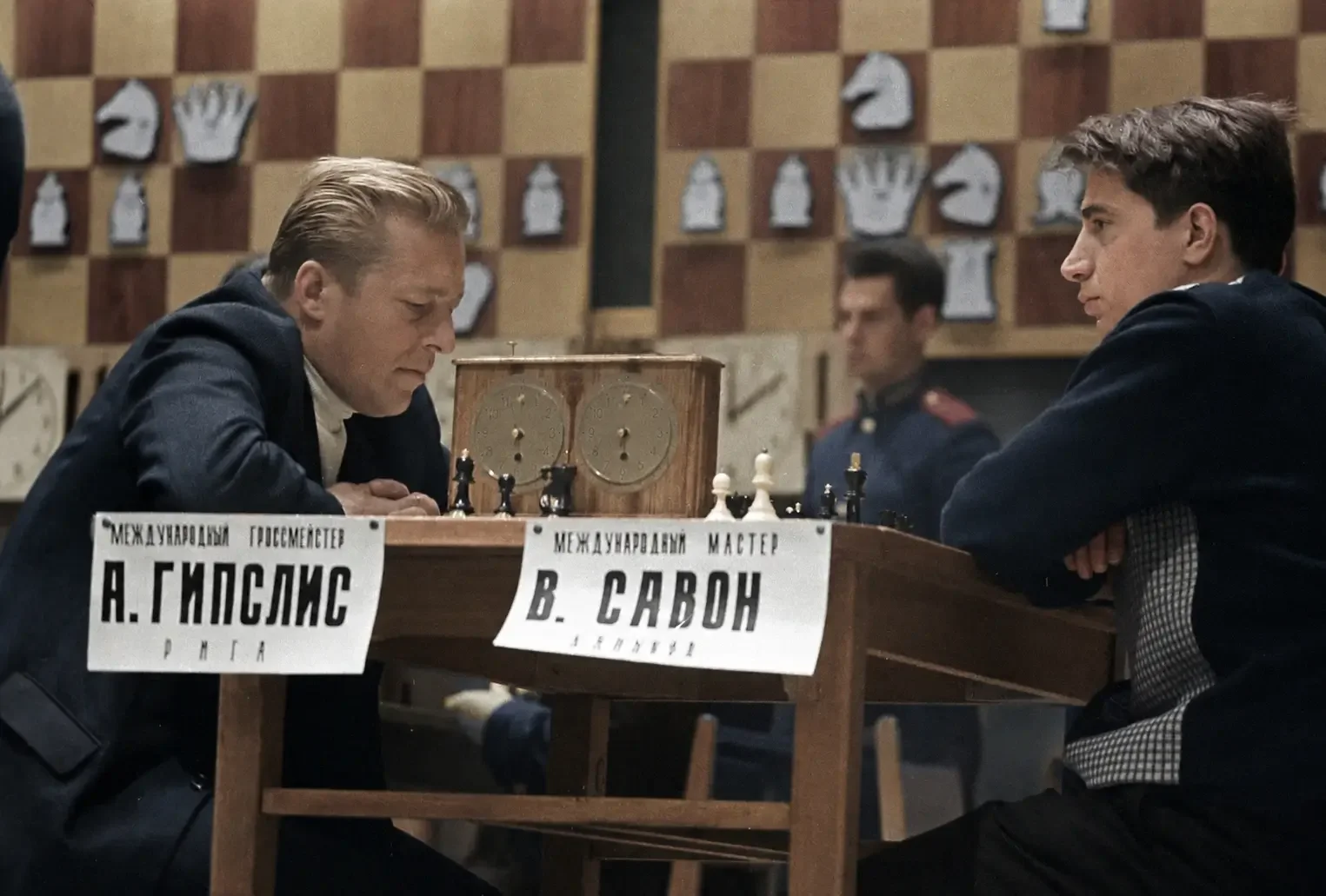
Aivars Gipslis, also found as Aivars Ģipslis in Latvian reference works and as Айварс Гипслис or Айварс Петрович Гипслис in Russian sources, belongs among the most substantial Latvian chess figures of the Soviet era, even if he never became a world title contender. He was born in Riga on February 8, 1937, died in Berlin on April 13, 2000, and built a career that combined high level tournament play with sustained work as an editor, trainer, opening specialist, and later correspondence grandmaster. In the strongest phase of his over the board career, especially from the early 1960s to the early 1970s, he was not merely a good republican player. He was a serious Soviet grandmaster who broke into the Interzonal, placed near the top in one of the great Moscow events of 1967, and represented the Soviet Union in major team competition.
He deserves attention today because his historical profile sits at the intersection of several underexplored strands of chess history. He was a leading Latvian master in the generation immediately behind Mikhail Tal, a durable performer in the crowded Soviet system, a builder of chess culture through the magazine Šahs, an important trainer of Nona Gaprindashvili and the Soviet women’s team, and a rare figure who achieved grandmaster distinction in both over the board and correspondence play. That combination makes him more than a footnote to Tal or to Soviet institutional chess. It makes him one of the people through whom Latvian and Soviet chess life actually functioned.
Early Life and Chess Formation
Published biographical sources are surprisingly thin on Gipslis’ parents and broader family background. What they do document with confidence is his Riga upbringing, specifically a childhood in the Grīziņkalns district, and a relatively late start in chess by elite standards. He began learning the game at age twelve in the Riga Pioneers’ Palace under Jānis Krūzkops, a trainer whom Gipslis himself later praised in unusually warm terms. That documentary silence on domestic family life is itself worth stating plainly, because it sets a limit on what can responsibly be claimed about his early milieu.
The Pioneers’ Palace setting placed him in one of the central nurseries of postwar Latvian chess. Latvian and Russian sources agree that he learned there at the same time as Mikhail Tal. Tal’s own autobiography helps anchor the broader environment: in describing the unexpectedly young Latvian team of the early 1950s, Tal recalled sixteen year old Tal and Gipslis, with seventeen year old Jānis Klovāns, under the senior leadership of Aleksandr Koblencs. That is a valuable corrective to retrospective mythmaking. Gipslis was not formed in isolation. He came out of the same Riga youth culture that produced Tal, but followed a different path, one less meteoric and more cumulative.
Outside chess, he completed a formal education that Soviet reference works note with some pride. The Latvian National Encyclopedia states that he graduated from the Latvian State University in 1959 as an engineer economist. Russian Chess Federation material gives the same profession. The combination is revealing. Gipslis belonged to the Soviet type of intellectually trained master who did not begin as a full time sporting celebrity, but who moved between professional education, high level competition, and later cultural work within chess institutions.
Rise in Competitive Chess
Gipslis’ rise was first a Latvian rise, then a Soviet one. He became an eight time champion of Latvia, winning in 1955 through 1957, 1960 through 1961, 1963 through 1964, and 1966. The Latvian National Encyclopedia notes that only Jānis Klovāns won the national title more often. These repeated victories indicate not only talent, but unusual staying power in a republic that produced a deep bench of masters. They also explain why later Russian and Latvian sources routinely describe him as, for many years, the strongest Latvian player after Tal.
His movement from republican prominence into all Soviet competition was gradual but clear. The Russian Chess Federation records that in 1957 he shared first in a qualifying stage for the Soviet Championship and reached the USSR final for the first time, earning the title of sports master. Team competition also sharpened his reputation. As a member of Soviet student teams, he helped win three World Student Team Championships. OlimpBase’s event pages show a perfect 7 out of 7 reserve board score for the Soviet gold medal team in Reykjavik in 1957, 5 out of 7 on fourth board for the title winning team in Varna in 1958, and 7.5 out of 10 on third board for another medal winning Soviet team in Budapest in 1959. These are not decorative results. They show a player who was already reliable in international team settings before he became a grandmaster.
A decisive step came in 1963, when he was sent abroad to East Germany. The Russian Chess Federation states that he immediately fulfilled the norm for the international master title there, sharing first with Lev Polugaevsky. In a Soviet career, that kind of first foreign success had institutional significance as well as sporting significance. It meant trust from officials, proof against non Soviet opposition, and confirmation that a strong Latvian player could also survive the much harder test of international title events.
Major Career Achievements
The core of Gipslis’ historical standing rests on a narrow but impressive band of results in the mid 1960s. In the 34th Soviet Championship at Tbilisi in 1966 and 1967, one of the strongest national championships ever staged and also a world championship zonal, he scored 12 out of 20 and tied for third through fifth with Viktor Korchnoi and Mark Taimanov, behind only Leonid Stein and Efim Geller. The playoff that followed in Tallinn is especially revealing. All three players finished the playoff tied on 2 points, but Gipslis and Korchnoi advanced to the Sousse Interzonal on superior Berger score from the main event. The result captures both the strength of Gipslis’ peak and the cruelty of Soviet competition, where even a player of this caliber could reach the edge of the Candidates cycle only through a statistical tiebreak after a cluster of elite rivals deadlocked behind Stein and Geller.
His best single tournament result over the board was probably the Moscow event of 1967, often referred to as the Alekhine Memorial or the 50th Anniversary tournament. There he scored 10 out of 17 and shared second place with Vassily Smyslov, Mikhail Tal, and Milko Bobotsov, a point behind Stein and ahead of players such as Boris Spassky and Tigran Petrosian. Russian Chess Federation material explicitly connects that result with his elevation to the grandmaster title in the same year. That is a reasonable historical reading. A player might win many good tournaments, but a shared second in a field of this stature established that Gipslis belonged in the top Soviet and near top world conversation, at least for that period.
The Sousse Interzonal later in 1967 did not lead to the Candidates, and on that point the Russian Chess Federation source is blunt. He “did not perform well” there and did not fight for a Candidates place. Even so, making the Interzonal at all was a substantial achievement for a Latvian player operating in a Soviet field crowded with Stein, Geller, Korchnoi, Tal, Spassky, Polugaevsky, Smyslov, and others. His historical problem was not lack of quality. It was that the bar for converting Soviet excellence into world championship relevance was unusually high.
His strength in this period was also recognized in team play. In the 1970 European Team Championship final at Kapfenberg, he represented the Soviet Union on second reserve and scored 4 out of 5 for an 80 percent result as the USSR won team gold. The Latvian National Encyclopedia additionally reports that his highest FIDE standing came in 1971, when a 2580 rating placed him eighteenth in the world. If one accepts that figure, and there is no obvious reason not to, it provides a concise measure of his stature at his apex: not a fringe grandmaster, but a very serious international player.
His later tournament career showed resilience rather than dramatic ascent. Latvian and Russian reference sources single out first places in the Paul Keres memorial events in Tallinn in 1976 and 1981, along with continued strong performances in difficult open and international events. The same sources also note that he remained active long after his editorial and coaching work expanded. That endurance is part of his profile. He was not a brief Soviet prodigy. He was a player who, even after his top breakthrough years had passed, stayed competitively dangerous.
Style and Reputation
The clearest stylistic description comes from the Latvian National Encyclopedia: Gipslis’ chess was positional, he knew opening theory extremely well, and he was a strong endgame player. That description is useful because it resists the lazy temptation to treat every talented Latvian contemporary of Tal as a Tal derivative. Gipslis grew up in the same Riga environment, but the reference tradition in Latvia presents him as more methodical, more theoretical, and more technically grounded than a simple “second Magician of Riga” stereotype would suggest.
At the same time, he was not merely dry or academic. The Russian Chess Federation credits him with developing an original setup for Black in the Paulsen Sicilian, the line that later carried his name. A much later grandmaster reader, Matthew Sadler, described him as a player of “sharp style” who produced many entertaining games, yet chose to illustrate Gipslis through a “smooth positional win” over Vladimir Bagirov from 1960. Put together, these sources support a careful synthesis: Gipslis was a well prepared universalist whose best work joined opening invention, positional pressure, and tactical alertness, rather than a specialist of only one mode of play.
His reputation among contemporaries was high, if somewhat overshadowed by Tal’s fame. Latvian and Russian biographical writing repeatedly place him just behind Tal within Latvian chess. Genna Sosonko, quoted by the Russian Chess Federation, called him “Latvia’s second player behind Tal for many years.” That formulation should not be read as condescension. In a republic that produced Tal, Klovāns, and later Shirov, being the long term number two behind Tal still implies a remarkable degree of distinction. It also explains part of Gipslis’ later historical fate. He was strong enough to be deeply respected, but not so singularly famous that later narratives centered themselves around him.
Contributions Beyond Tournament Play
If Gipslis had stopped being a major competitive player after the late 1960s, he would still retain an important place in chess history because of his editorial and training work. From 1963 he worked in the editorial office of the Latvian magazine Šahs, and in 1970 he became editor in chief, a post he held until the magazine ceased in 1990. The Latvian National Encyclopedia describes Šahs as one of the most popular chess journals in the world and states that by 1987 it was subscribed in fifty countries. The same source adds that Bobby Fischer praised its quality and counted it among the best chess magazines in the world. Even allowing for the fact that this point is transmitted through a later encyclopedic summary rather than directly from Fischer’s own pen, it captures something real about the magazine’s standing. Gipslis was not simply using print as a side activity. He was shaping one of the major chess periodicals of the late Soviet era.
His training career was equally substantial. The Latvian National Encyclopedia records that in 1966, when the women’s world title match was held in Riga, Gipslis was invited to work as trainer for Nona Gaprindashvili, and that he remained her trainer until 1979. It also states that from 1972 to 1984 he coached the Soviet women’s team, which won six Chess Olympiads during his tenure. Russian Chess Federation material broadly confirms the same chronology and notes that he received honored trainer titles in the Georgian SSR in 1972 and in the USSR in 1976. This is one of the strongest reasons to see Gipslis as an institutional figure, not just a tournament player. Through Gaprindashvili and the Soviet women’s team, he participated directly in one of the most successful sustained programs in postwar chess.
An overlooked contribution lies in chess infrastructure and theory. The Latvian National Encyclopedia credits him as one of the creators of Latvia’s opening card index, later used by Latvian and Soviet players. That is the kind of labor that often disappears from heroic chess storytelling, but it was central to Soviet chess culture, where organized preparation and shared analytical resources were part of competitive life. The same source notes that a Sicilian Paulsen line bears his name. In that respect Gipslis was not merely a consumer of theory. He helped build the machinery through which theory circulated.
He also wrote. The Latvian National Encyclopedia lists his autobiographical book 35 gadus draugos ar šahu, published in Riga in 1984, and Russian sources also refer to an autobiographical volume. That book form is significant. Gipslis joined the long Soviet tradition of players who turned tournament experience into didactic and reflective literature. In his later years he worked as a coach at the Riga Chess School, and the Latvian National Encyclopedia identifies Arkadij Naiditsch among his notable pupils. Once again, the point is broader than one student. Gipslis was transmitting knowledge across generations.
His final important chapter came in correspondence chess. Official ICCF records show him winning the correspondence Alekhine Memorial, played from 1991 to 1996, with 8 out of 12 in a field that included established correspondence grandmasters, while also achieving a GM norm in that event. ICCF’s player details page records him as an International Correspondence Chess Grandmaster, with the title year given there as 1995. The broader ICCF grandmaster list published in 2012 gives 1996, so the exact year should be treated with mild caution, but the substance is secure: in the mid 1990s, Gipslis reached grandmaster level in correspondence chess as well. That dual achievement, over the board and by correspondence, is rare enough to deserve more notice than it usually receives.
Historical Legacy
The last phase of Gipslis’ life carried both pathos and continuity. The Latvian National Encyclopedia states that on January 30, 2000, while playing in the German team championship in Berlin, he suffered a heart attack during the game and died after two months in a coma. He was buried in Riga’s Forest Cemetery. The story is stark, but it also shows something fundamental about him. He remained an active chess worker and competitor to the end, moving through the difficult open tournament and club circuit of post Soviet Europe rather than retiring into honorary status. Russian Chess Federation material, quoting Sosonko, explicitly places him within that hard late career reality of transfers, night buses, and financially modest tournament life.
His post Soviet role also deserves brief notice. He represented independent Latvia at the 1993 World Team Championship in Lucerne, where OlimpBase’s tournament review called him a “legendary Gipslis” included in the national squad led by Aleksejs Shirovs. That phrase is editorial, not archival, but it does reveal how he was already perceived in the early years of restored Latvian statehood: as a durable link between interwar Latvian memory, Soviet high chess culture, and the new national team era that Tal had not lived to serve.
His legacy, then, is larger than his best crosstables, though those remain strong. He left behind a named opening variation, a body of instructive games, a major editorial record at Šahs, a long coaching partnership with Gaprindashvili, team work that helped sustain Soviet women’s dominance, contributions to analytical infrastructure through the opening card index, a late correspondence triumph, and a place in Latvian chess memory that has continued through encyclopedia entries, federation retrospectives, and memorial tournaments in Riga. The historical assessment that best fits the evidence is this: Gipslis was one of the most consequential Latvian chess professionals of the second half of the twentieth century, not because he stood outside institutions as a lone genius, but because he excelled inside nearly all of them.
A concise final judgment follows from that record. Aivars Gipslis deserves attention today because he embodied a whole ecology of serious chess. He was strong enough to reach the Interzonal and contend with the Soviet elite, disciplined enough to become an editor and trainer of consequence, and adaptable enough to reinvent himself in correspondence play in the 1990s. For readers of Soviet and Latvian chess history, he is not peripheral. He is one of the figures through whom that history becomes concrete.
Notes and Sources
This profile is grounded chiefly in the Latvian National Encyclopedia entry by Andris Tihomirovs, the Russian Chess Federation’s biographical sketch, official OlimpBase team and championship records, ICCF player and event pages, and autobiographical or near contemporary testimony from Mikhail Tal and the Riga chess milieu. Those sources are especially strong on tournament results, institutional roles, coaching chronology, education, and later correspondence activity. They are notably weaker on Gipslis’ parents and private family life, which is why that part of the article has been treated cautiously rather than filled with guesswork.
One small technical uncertainty deserves explicit notice. Official ICCF sources do not fully agree on the year of Gipslis’ correspondence grandmaster title. ICCF’s current player details page gives 1995, while an official ICCF grandmaster list published in 2012 gives 1996. Because the existence of the title is not in doubt, this article refers to it in the mid 1990s and flags the discrepancy here rather than pretending the record is perfectly uniform. For name forms, the article has standardized on the common English form “Aivars Gipslis,” while noting the Latvian variant “Aivars Ģipslis” and the Russian form “Айварс Петрович Гипслис” found in Latvian and Russian reference sources.
Key works and databases consulted include Andris Tihomirovs’ entry in Nacionālā enciklopēdija; the Russian Chess Federation’s “Person of the Day” biography; OlimpBase crosstables for the 1957, 1958, and 1959 World Student Team Championships, the 1966 and 1967 Soviet Championship and playoff, the 1970 European Team Championship, and the 1993 World Team Championship; ICCF player and event records; Mikhail Tal’s autobiography; and the preview to Valentin Kirillov’s Team Tal: An Inside Story, which helps situate Gipslis within the wider Riga circle.
