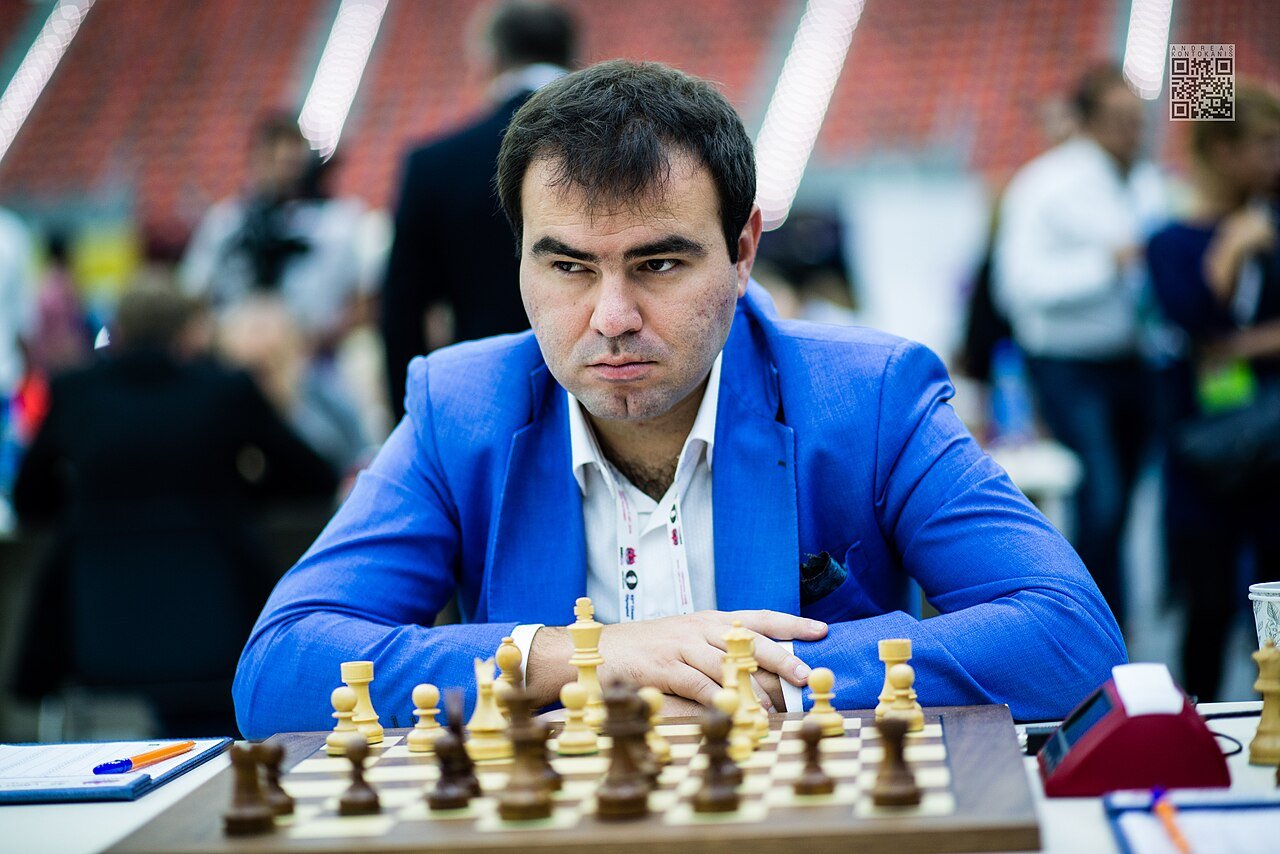
Andreas Kontokanis from Piraeus, Greece, CC BY-SA 2.0
Introduction
Shakhriyar Mamedyarov, in Azerbaijani sources often rendered as Şəhriyar Həmid oğlu Məmmədyarov and in Russian-language sources as Шахрияр Мамедъяров, was born on April 12, 1985, and came of age at a historical junction: he was born in Soviet Azerbaijan, but his real chess formation took place after the Soviet collapse, inside the institutions and competitive culture of independent Azerbaijan. That biographical position is central to understanding him. He is not best described as a late Soviet master in the older sense. He is better seen as one of the first fully international elite players produced by post-Soviet Azerbaijani chess, while still absorbing habits, pedagogies, and ambitions inherited from the wider Soviet chess world.
His historical standing is substantial. Mamedyarov became the only male player to win the World Junior Championship twice, in 2003 and 2005. He won the World Rapid Championship in 2013, reached the Candidates on three occasions, finished runner-up in 2018, and rose to official world number two with a peak FIDE classical rating of 2820. Those accomplishments do not make him a world champion, but they place him securely among the defining elite grandmasters of the early twenty-first century and among the most important Azerbaijani players ever to compete on the world stage.
Early Life and Chess Formation
Mamedyarov grew up in a family where chess was not an ornament but part of ordinary life. Russian Chess Federation biographical material states that his father, Hamid Mamedyarov, taught him the game in the summer of 1993 and that he then entered the chess school in Sumqayit, where Valida Bairamova became his first coach. A later Baku interview fills in the personal texture: Mamedyarov recalled first encountering chess in Zangilan at the home of his uncle Rashid, where childish play with the pieces turned serious once his father explained the rules. He also remembered that his older sister Zeynab initially outplayed him, an important detail in a household where chess development was collective rather than solitary. Contemporary summaries based on his official site also note that he completed School No. 23 in Sumqayit before choosing a professional chess career.
One of the most revealing facts about Mamedyarov is that he was not the earliest Azerbaijani prodigy of his generation. In the 2019 Baku interview, he explicitly described himself as a comparatively late starter, saying he came seriously to chess at nine, while Teimour Radjabov and Vugar Gashimov had developed much earlier. He added that at fourteen he still had no rating and that his rise afterward was unusually steep. That testimony helps explain a persistent feature of his career: he did not emerge as a polished system-player formed from early childhood, but as a player whose ascent involved dramatic acceleration, risk-taking, and creative self-construction.
His life outside the board also deserves notice because it complicates the stereotype of the purely instinctive attacker. In the same interview, Mamedyarov said that after his 2003 world junior success he served in the army through CSKA, continuing to train there, and later completed a higher degree in economics with honors. He also spoke openly about using psychological support during important events and about the need for everyday work, even while insisting that intuition is more important to a chess player than abstract mathematics. Those remarks are unusually valuable because they show that beneath the image of the born tactician stood a disciplined professional with a broad support structure and a reflective view of chess labor.
If one asks how a player from independent Azerbaijan became so strong in rapid and dynamic positions, Mamedyarov himself offered one answer after winning the 2013 World Rapid Championship. He recalled the weekend rapid and blitz events once regularly organized in Baku, with schools and leading players participating, and said that they helped a great deal. This is a small but significant historical clue: his chess was shaped not only by formal coaching, but by a local culture of repeated fast competition, exactly the sort of dense practical environment that could sharpen intuition, fighting instincts, and tactical readiness.
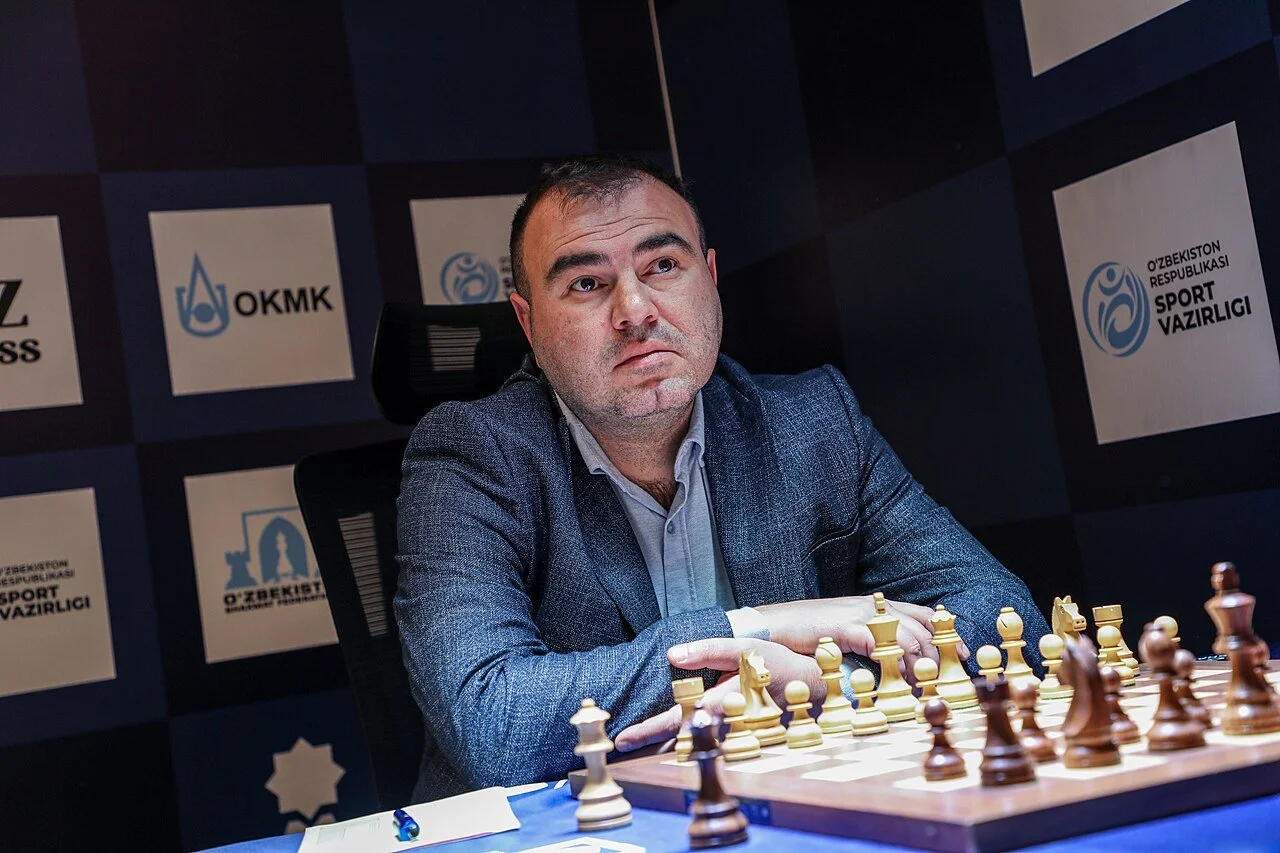
By TheBoburshokh - Own work, CC BY 4.0
Rise in Competitive Chess
Mamedyarov’s early rise was strong at the national level before it became international. Reference biographies agree that he won Azerbaijani youth titles in 2000 and became Azerbaijan champion in 2001 and 2002, which means that before he was a stable member of the world elite he had already established himself as one of the country’s most important young masters. There is also a small but real documentary discrepancy regarding his grandmaster title: FIDE’s current profile lists the title year as 2002, while leading chess reference biographies connect his rise to grandmaster rank with the 2003 World Junior Championship victory. The safest conclusion is that by 2002 to 2003 he had already crossed into grandmaster-level status, while 2003 was the year of unmistakable international breakthrough.
That breakthrough came with force. Russian Chess Federation material describes 2003 as his decisive turning point, noting consecutive successes at world youth and junior level and strong international tournaments afterward. Old FIDE reporting confirms his victory at the 2004 Dubai Open, and the broader sequence from 2003 to 2005 culminated in his second World Junior title. ChessBase’s 2005 coverage emphasized the scale of that achievement, while later biographical references correctly note that no other male player has won the World Junior Championship twice. The historical point is not simply that he scored junior titles, but that he converted them into elite adult relevance unusually quickly.
His ascent should also be placed beside the rise of the Azerbaijani generation around him. Contemporary Olympiad commentary in 2002 already highlighted that Azerbaijan was fielding unusually young talent, including Radjabov, Mamedyarov, Vugar Gashimov, and Gadir Guseinov. Mamedyarov was therefore part of a genuine cohort rather than a lone exception. Yet his own later recollection that Radjabov and Gashimov matured earlier indicates that he was the member of that cohort whose development curve was less linear and, in some ways, more dramatic. That makes his eventual peak especially striking.
Major Career Achievements
Mamedyarov’s adult career can be read in three broad phases. The first was his arrival among world-class players between the mid-2000s and 2010, when tournament victories and invitations to stronger closed events moved him from talented grandmaster to recognized elite competitor. The second was a period of consolidation from roughly 2011 to 2017, when he became a recurrent Candidates-level player, won the 2013 World Rapid Championship, and anchored Azerbaijani team successes. The third was his near-title peak in 2018, when he combined Candidates runner-up status with world number two and one of the strongest rating peaks in modern chess.
The Candidates record is especially important for historical assessment. In 2011 he entered the Candidates in Kazan as the wildcard and lost a close quarterfinal match to Boris Gelfand, who went on to win the event. In 2014 he returned for the Khanty-Mansiysk Candidates, remaining part of the elite championship cycle even though Viswanathan Anand dominated the tournament. In 2018, at Berlin, he came closest to a world championship match, finishing second on 8/14 behind Fabiano Caruana’s 9/14. That result is the clearest single measure of how near Mamedyarov came to the center of chess history.
Outside the classical championship cycle, his major titles are substantial. He won a stage of the 2012-2013 FIDE Grand Prix in Beijing, then captured the 2013 World Rapid Championship with 11.5/15. In his official press conference after that event, he explained that the situation had forced him to take risks in every game, because playing for wins came more naturally to him than playing for draws. That is both a result and a self-portrait. Later, OlimpBase records show him as the overall winner of the 2017 Grand Prix series, one of the achievements that sent him into the 2018 Candidates in prime form.
His tournament victories at Shamkir in 2016 and 2017 were also historically revealing. In 2016 he beat both Fabiano Caruana and Anish Giri in the final stretch, then defeated Caruana in a playoff to win the Vugar Gashimov Memorial. In 2017 he won the same event again, this time outright. Those results were important not only because Shamkir was a very strong tournament, but because the event carried national and emotional significance, being dedicated to his late teammate Vugar Gashimov. The repeat win in 2017 suggested that Mamedyarov was no longer just an explosive outsider. He had become a serious favorite in super-tournament conditions.
The best single-symbolic victory of his peak came at Biel in 2018. There he beat Magnus Carlsen and secured tournament victory with a round to spare. Chess.com and ChessBase both treated the game and event as confirmation that Mamedyarov, at his best, could defeat the reigning world champion in a classical game and win a first-rank event by force rather than accident. By the end of that season, his official FIDE peak rating stood at 2820, with world number two arriving earlier in February 2018.
His team record is nearly as important as his individual one. OlimpBase credits him with the individual gold medal on third board at the 2012 Olympiad in Istanbul, where he scored 8.5/10 with a 2880 performance. Standard biographical records also agree on Azerbaijan’s European Team Championship victories in 2009, 2013, and 2017. These results show that Mamedyarov was not merely a brilliant individual scorer. He was one of the principal faces of the Azerbaijani national team in its strongest era.
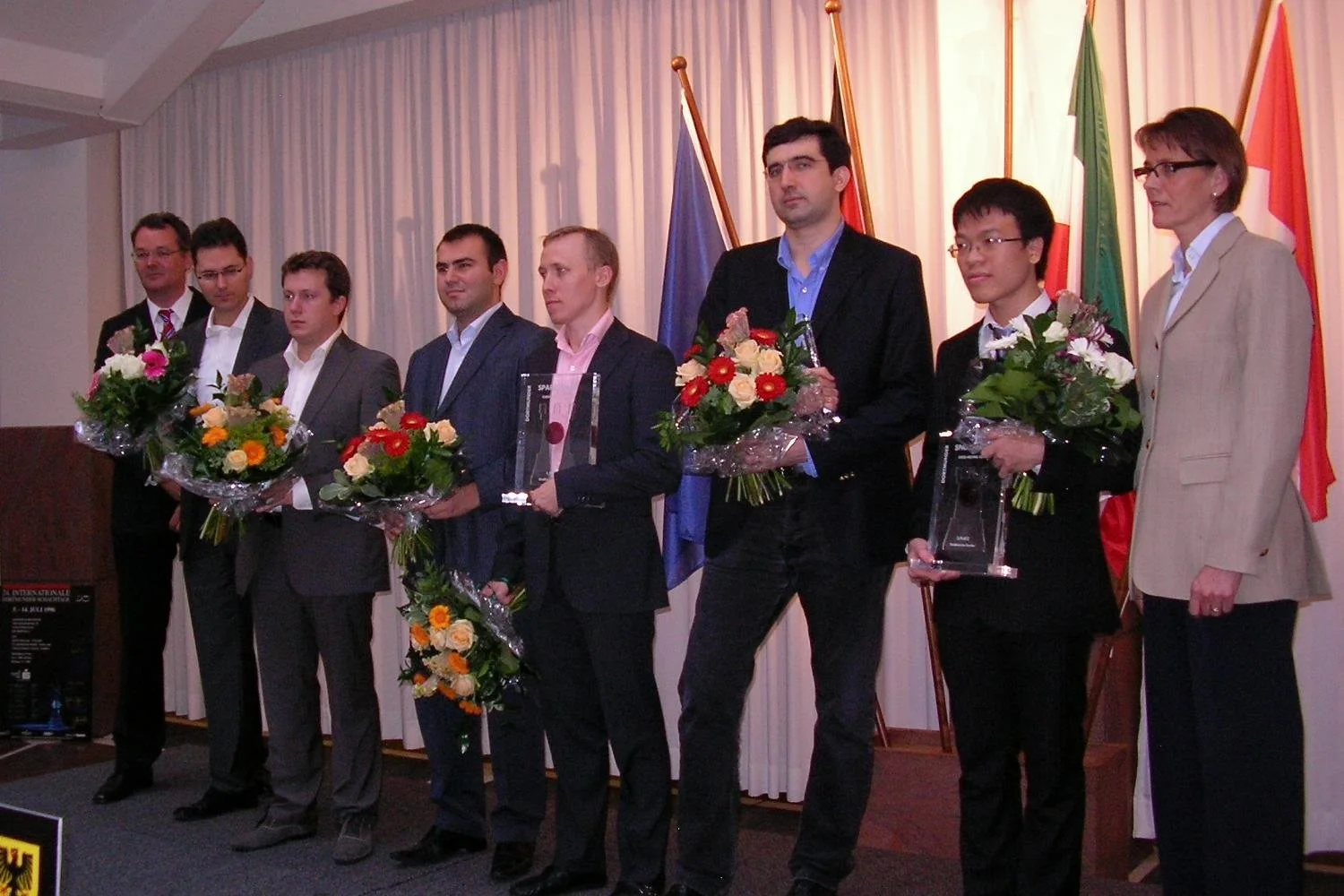
By GFHund - Own work, CC BY 3.0
Style and Reputation
Few elite players of his generation acquired a clearer stylistic reputation. Contemporary observers repeatedly described Mamedyarov as aggressive and creative. A ChessPro report on the 2010 Tal Memorial preserved Vladimir Kramnik’s concise contrast between the two of them: Kramnik called himself the more solid player and Mamedyarov the more aggressive one. Mamedyarov’s own interview language supports that view. In 2019 he said that defeat felt like a small death, but added that he was not afraid, because without risk he would not have won so much. Together, those sources point to a player whose competitive identity was built on tension, initiative, and emotional commitment.
Yet reducing him to a romantic attacker would miss the second half of the story. A later ChessBase review, citing an interview with Mamedyarov during his 2018 peak, reported his own distinction between the older, more aggressive version of himself and the newer player who tried to act more wisely. That formulation is persuasive because it fits the career record. The mature Mamedyarov remained willing to enter sharp positions, but his best years came when calculation, opening preparation, and tournament strategy better supported his natural aggressiveness. In that sense he evolved from a dangerous tactician into a true universal player with a tactical bias.
His comments on intuition are especially revealing. In the Baku interview, he argued that intuition was more important for chess than mathematics and suggested that the first thought is often correct. This helps explain why his best games often feel less like mechanical execution and more like guided pressure. It also helps explain why he was so formidable in rapid chess and why even his classical wins often carried a rapid-like sense of momentum. His 2013 world rapid title was therefore not an accidental departure from his classical identity. It was a natural extension of it.
The weaknesses were inseparable from the strengths. Mamedyarov himself admitted in interviews that he sometimes played too riskily, underestimated defensive resources, or mixed up opening lines. That honesty is useful. His career did include periods of volatility, and the same appetite for initiative that made him a feared attacking player could produce overextension or uneven tournament runs. But this should not be misread as simple instability. At his best, as the Shamkir victories, the Berlin Candidates run, and the Biel win over Carlsen all demonstrate, he could combine energy with precision at the absolute highest level.
Contributions Beyond Tournament Play
Mamedyarov’s public contribution to chess outside competition has been real, even if it has not centered on books or large institutional roles. He has produced instructional material for Chess.com, including lessons on dynamic pawn play and a series revisiting his games against leading champions. Those contributions are modest compared with the published instructional legacy of some older grandmasters, but they are useful evidence that he has tried to translate his practical understanding into teachable form.
More important historically is his emergence as a mentor to younger talent. Chess.com reported in 2024 that he had begun coaching the Turkish prodigy Yağız Kaan Erdoğmuş and quoted Mamedyarov describing him as a future 2800 player and possible world champion. Later reporting in 2025 and 2026 continued to identify Mamedyarov as one of the key figures in Erdoğmuş’s rise. That development is worth recording because it suggests that Mamedyarov’s practical inheritance may persist not through a body of writing but through direct transmission of style, ambition, and elite professional habits to the next generation.
His place in Azerbaijani chess culture also extends beyond wins and losses. In his 2014 remarks on the death of Vugar Gashimov, Mamedyarov said that the two had always been together, sharing both victories and defeats. The statement is poignant, but it is also historically useful because it reminds us that the great Azerbaijani team years were built on close personal and competitive bonds, not only federation policy. Mamedyarov’s repeated success in the Gashimov Memorial, together with his long service alongside Radjabov and others on national teams, made him both an heir to that generation and one of its custodians.
Historical Legacy
Mamedyarov deserves attention today because he occupies a distinctive place in recent chess history. He was not a world champion, but he was close enough to the summit that his absence from the title roll feels notable rather than marginal. His peak rating, his rise to number two, his Candidates runner-up finish, and his standing as the only male two-time world junior champion all point to a career of genuine historical weight. He belongs in the conversation about the strongest players of the modern era who never reached a classical world championship match.
Within the history of Azerbaijani and post-Soviet chess, his legacy is even clearer. He helped transform Azerbaijan from a country known for isolated prodigies into one of the most respected team cultures in world chess. He embodied a specifically post-Soviet synthesis: Soviet-style seriousness about training, national team discipline, multilingual movement through Russian and international chess worlds, and a distinctly modern readiness to compete across classical, rapid, blitz, over-the-board, and online formats. As of July 2026, FIDE still listed him as Azerbaijan’s top-rated active player, a sign that his relevance is not merely retrospective.
The concise historical assessment is this: Shakhriyar Mamedyarov deserves attention because he joined rare creative force to sustained elite achievement. He was a late-blooming prodigy, a central figure in Azerbaijan’s golden team years, a world rapid champion, a serious Candidates contender, and one of the clearest attacking personalities of modern top-level chess. His career shows that the post-Soviet chess story was not only about the continuation of old schools, but also about new national centers producing players who could inherit that tradition and reshape it in their own image.
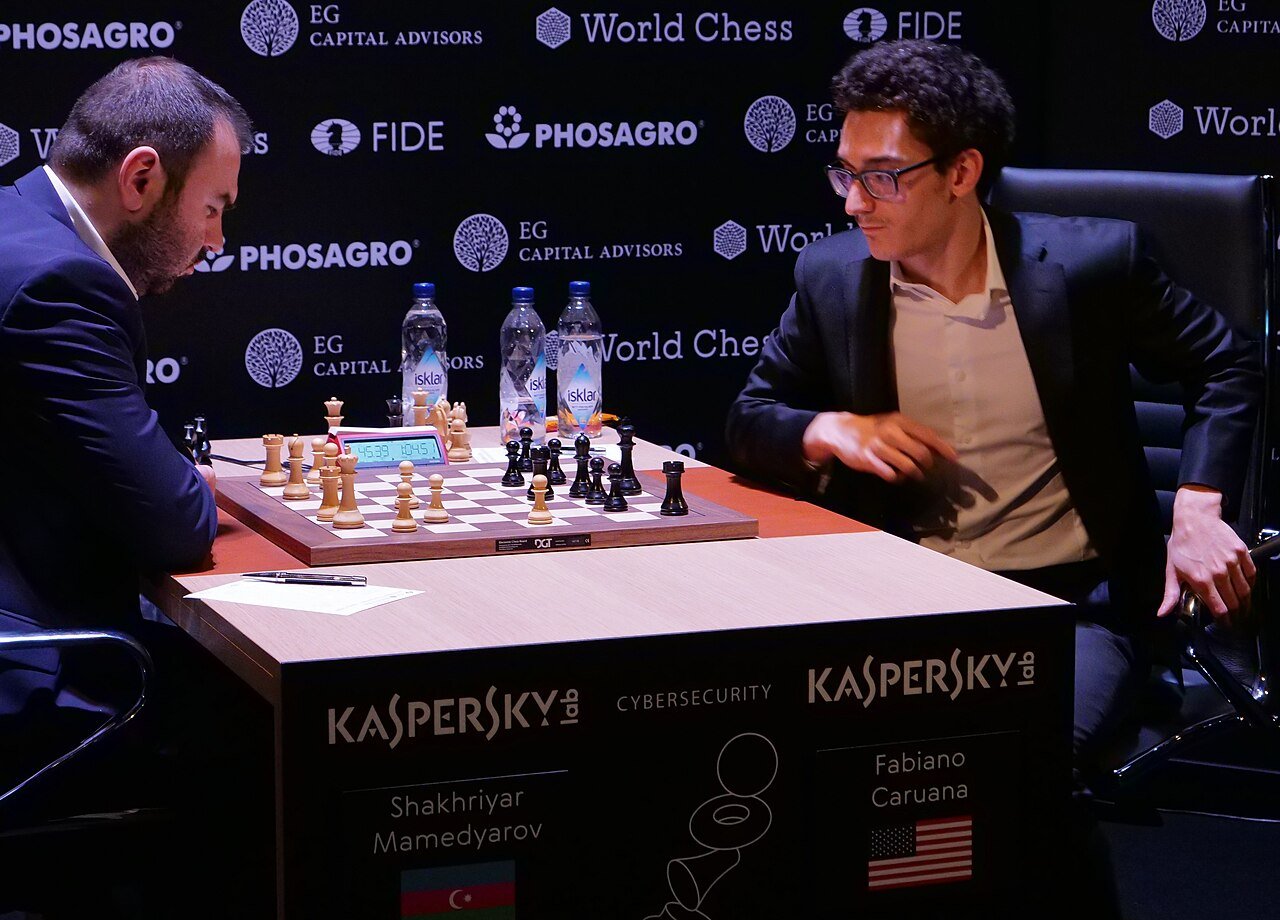
By Barnos - Own work, CC BY-SA 4.0
Notes and Sources
This profile relies chiefly on FIDE archival material and player records, official event coverage, and specialist chess reference sources. The most important factual scaffolding comes from FIDE’s player profile and Candidates history, the official 2013 World Rapid Championship press conference, old FIDE tournament reports, and OlimpBase records for Olympiads and Grand Prix series. For biographical color and self-description, the most useful sources were Mamedyarov’s interviews with Baku magazine and Chessdom, together with the Russian Chess Federation’s biographical entry. Secondary chess-historical confirmation came from ChessBase, The Week in Chess, and carefully used Chess.com player and coaching material.
One small documentary caution is necessary. FIDE’s current profile lists Mamedyarov’s grandmaster title as 2002, while 2700chess and standard chess biographies associate his rise to grandmaster rank with the 2003 World Junior Championship. Because those sources do not fully harmonize, the profile above treats 2003 as the decisive international breakthrough while leaving the formal title-year discrepancy visible rather than smoothing it over by guesswork. Alternate spellings in the source record include Şəhriyar Məmmədyarov, Shakhriyar Mamedyarov, and the Russian Шахрияр Мамедъяров
