Teimour Radjabov
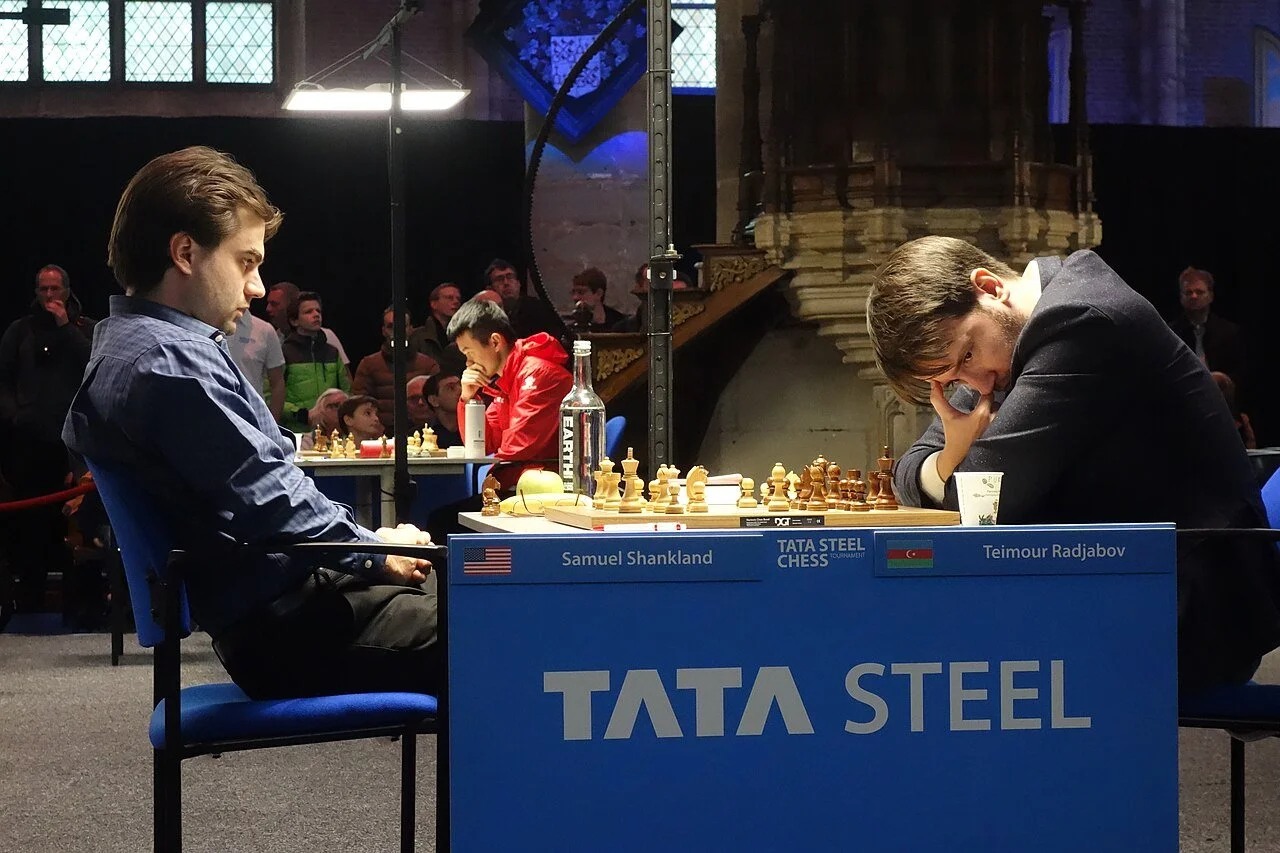
Tata Steel Chess Tournament in Leiden, the Netherlands, 23 January 2019. Samuel Shankland vs. Teimour Radjabov. By Vysotsky - Own work, CC BY-SA 4.0
Introduction
Teimour Radjabov, often rendered as Teymur Rəcəbov in Azerbaijani sources and Teimour Radjabov in English-language chess media, belongs to a rare category of players whose historical significance cannot be reduced to a single peak result. He was a child prodigy of exceptional precocity, a teenage giant-killer at elite level, a long-term member of the world top class, a central figure in Azerbaijan’s rise as a team power, and later a player whose most famous modern act was not a brilliancy but a principled withdrawal from the 2020 Candidates on public-health grounds. By July 2026, FIDE still listed him among the world’s leading active players, with a standard rating of 2689 and a world rank of 38, a reminder that his career has stretched far beyond the sensational headlines of his youth.
A careful historical profile of Radjabov has to hold several truths together. He was formed by the late Soviet and early post-Soviet chess culture of Baku, but he became a leading representative of independent Azerbaijan rather than a relic of Soviet institutional chess. He was known early for attack and nerve, later for dense preparation and resilient counterplay. He never became world champion, yet his place in modern chess history is secure because of the quality, longevity, and symbolic weight of his career. A reasonable historical reading is that Radjabov stands as one of the clearest bridges between the old Baku chess tradition associated with Garry Kasparov and the international success of Azerbaijani chess in the twenty-first century.
Early Life and Chess Formation
Radjabov was born on 12 March 1987 in Baku, then in the Azerbaijan SSR. Contemporary and retrospective biographical sources identify his father, Boris Sheynin, as a petroleum engineer and strong Soviet class player, and his mother, Leyla Radjabova, as an English specialist, described variously as a teacher, translator, or graduate of an institute of foreign languages. Russian and Azerbaijani sources also note a lesser-known family detail, that Teimour used his mother’s surname. His father’s own youth connected the family to Baku’s famed chess culture: Soviet and post-Soviet accounts recall that Boris Sheynin had gone to the Baku Pioneer Palace chess school in the early 1970s together with the young Garry Kasparov.
The earliest detailed profile available in English, published in Azerbaijan International when Radjabov was twelve, presents a picture of unusually rapid development. He learned the game from his father at about three and a half, was in organized chess training by age four, and soon played regularly against older children. The same profile describes a disciplined training routine centered on his father and coach Rahim Gasimov, with several hours a day devoted to analysis after school. It also reports a broad childhood reading habit and interest in other sports, especially football, tennis, and basketball, which fits a familiar pattern in elite Soviet and post-Soviet chess pedagogy where physical stamina was treated as part of serious preparation.
That early profile is especially valuable because it records not only results but self-understanding. Young Radjabov told the interviewer that his edge lay less in raw intelligence than in concentration and refusal to capitulate from difficult positions. The article also quotes a local referee describing his style as aggressively attacking, unusual for a child player. A later Russian profile in Nauka i Zhizn added a useful corrective by arguing that his early romantic, combinational approach had already begun to merge with stronger strategic and positional understanding. In other words, the old caricature of Radjabov as only a tactician is not supported by the best contemporary evidence, even from his teenage years.
On the youth circuit, Radjabov’s rise was startlingly fast. By the end of 1999, contemporaneous reporting credited him with four European youth gold medals, including the under-18 European title won at age twelve against much older opposition, and the 1998 world under-12 title. The same period saw him receive the international master title. FIDE’s rating archive confirms that he became an IM in 1999 and a GM in 2001. Public reporting from the period and later FIDE summaries agree that he was one of the youngest grandmasters in history at the time, and a ChessBase historical survey places him among the major “mini-grandmasters” of the era. A 2007 Nauka i Zhizn profile further reported that he was studying at the law faculty of Baku University, while a Baku school report identifies him as an alumnus of Gymnasium No. 160.
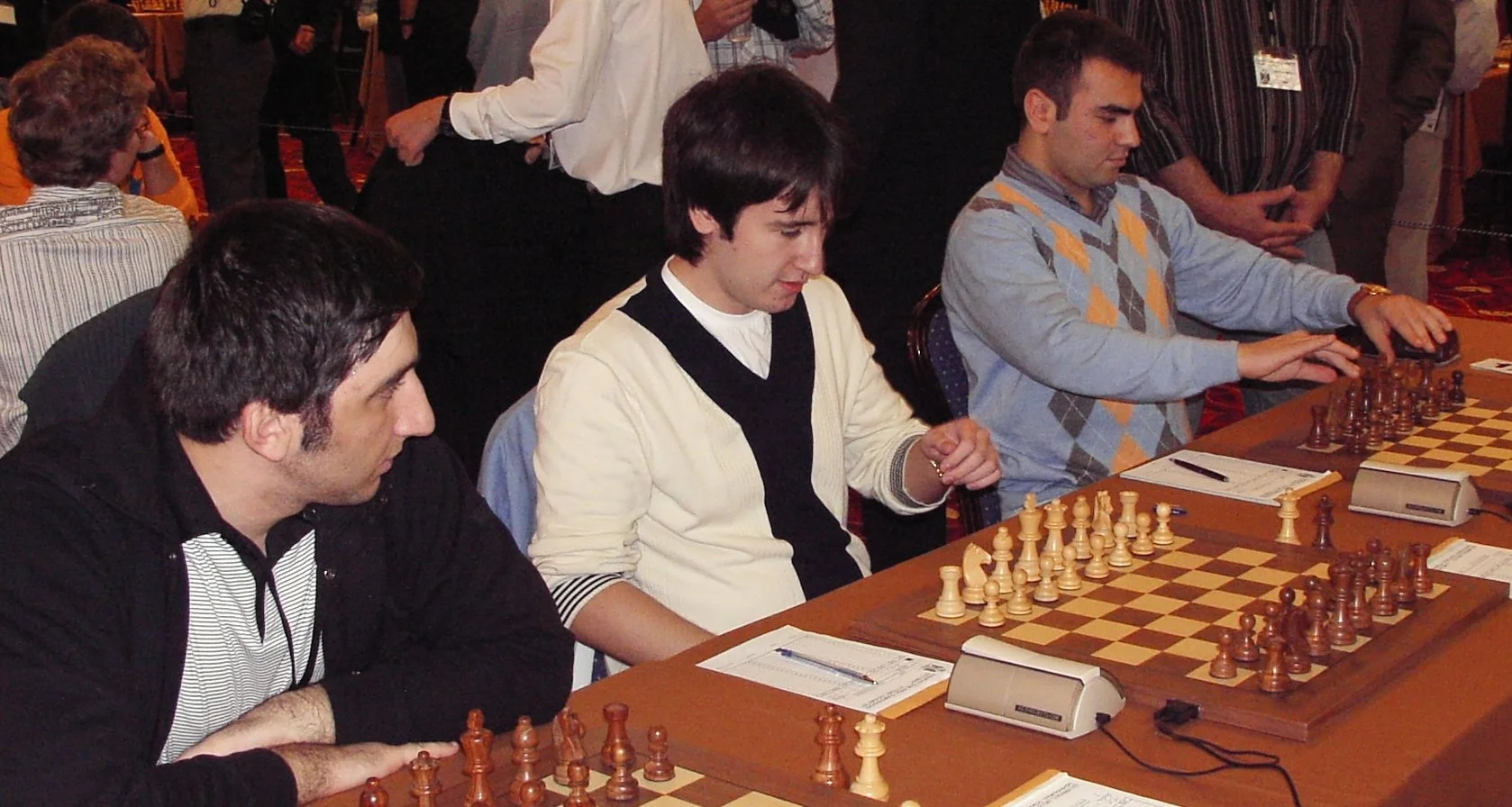
Azerbaijani Grandmasters Vugar Gashimov, Teimour Radjabov and Shakhriyar Mamedyarov at EuroChess 2007. By karpidis
Rise in Competitive Chess
Radjabov’s transition from prodigy to international contender was unusually abrupt. By 2001 he was already placing near the top in strong adult events, and by January 2002 he had broken into the FIDE Top 100 while still only fourteen, a landmark later ChessBase surveys described as the second-youngest such breakthrough after Judit Polgar. That same year he announced himself more widely in the rapid Grand Prix in Moscow, where he beat a sequence of major grandmasters before losing the final match to Kasparov. Contemporary Russian reporting treated that event as the moment when he ceased to be a merely local wonder and became a name in world chess.
The decisive breakthrough came in 2003. At Linares, aged fifteen, Radjabov defeated world number one Garry Kasparov with the black pieces. Leonard Barden described it at the time as one of the great upsets in chess history and emphasized its symbolic force, since Radjabov became the youngest player ever to beat a reigning world number one in tournament play. ChessBase’s tournament report treated the game as a landmark even while acknowledging the messy tactical character of the struggle. The result had special historical resonance not only because Kasparov was still the dominant player in world chess, but also because both men came from Baku, making the game feel like a generational handover staged within a single chess city.
The Linares win was not an isolated shock. Reputable reference compilations and player profiles agree that in 2003 Radjabov also beat Ruslan Ponomariov and Viswanathan Anand with Black, which helped create his reputation as a teenager already capable of defeating world champions on their own strategic territory. In 2004 he confirmed that 2003 had not been a fluke by reaching the semifinals of FIDE’s knockout world championship in Tripoli, where Michael Adams eliminated him. That result did not make him world champion, and the knockout format of the period remains historically controversial, but it did establish that Radjabov could go deep in world-championship events before he had fully entered his prime.
His role within post-Soviet and international chess culture also sharpened early. At the 2002 Olympiad in Bled, OlimpBase highlighted Azerbaijan’s “amazing team of teens” led by Radjabov, Shakhriyar Mamedyarov, Vugar Gashimov, and Gadir Guseinov, explicitly describing that cohort as a foundation for the next fifteen years. That observation proved prescient. Seen historically, Radjabov was not only an individual prodigy but also one component of a generation that transformed Azerbaijan from a country with strong chess tradition into one of Europe’s strongest team powers.
Major Career Achievements
Radjabov’s mature career can be divided into several phases. The first was his establishment as an elite tournament player from about 2005 through 2013. Important markers in that rise include winning Dos Hermanas in 2005, finishing near the top of the European Championship that same year, defeating Veselin Topalov at Linares/Morelia in 2006, winning the Cap d’Agde rapid event in 2006, and above all sharing first place at Corus 2007 in Wijk aan Zee with Levon Aronian and Veselin Topalov. The Tata Steel tournament’s own historical record still lists Radjabov as one of the 2007 champions, and later chess references routinely identify that result as one of the strongest classical performances of his career.
He then converted high-level consistency into world-championship relevance. FIDE and other reference accounts identify Radjabov as the runner-up in the 2008 to 2010 Grand Prix series, which qualified him for the 2011 Candidates. Within that same broad period, FIDE summaries credit him with winning the Elista Grand Prix in 2008. By November 2012 he had reached his career peak classical rating of 2793 and world number four, according to FIDE’s own player summaries. That peak rating is especially important in historical assessment because it places Radjabov not just among famous prodigies, but among the small group of players who sustained elite relevance long enough to enter the very top tier of the rating system.
The same period also contained his clearest setback. Radjabov qualified for the 2011 Candidates, where he lost a difficult quarterfinal match to Vladimir Kramnik after tie-breaks, and then played the 2013 Candidates Tournament, finishing at the bottom of the field. The raw result is beyond dispute. The interpretation is more delicate. It would be simplistic to write the event off as a collapse that defined his career. A better view is that 2013 interrupted, rather than ended, his candidacy as a world-championship-level player. FIDE and specialist profiles show that he remained strong enough to rebuild, even if the path afterward was less linear than observers once expected from the teenage phenomenon of 2003.
That rebuild was substantial. Radjabov helped Azerbaijan win the European Team Championship in 2009, 2013, and 2017, achievements specifically recognized in FIDE player introductions. Official event records from the 2009 and 2013 championships confirm Azerbaijan’s titles, and European Chess Union reporting from 2017 shows Radjabov scoring a major win over Levon Aronian in a key match against Armenia. These team successes belong near the center of his historical profile. They show Radjabov not only as an individual star but as a durable high-board player in one of the strongest national teams in modern European chess.
His late-career resurgence as an individual culminated in the 2019 FIDE World Cup. FIDE’s reports show that he beat Maxime Vachier-Lagrave in the semifinal to secure a Candidates place, then defeated Ding Liren 6:4 in the final, clinching the title and the largest success of his classical career. The World Cup triumph is central to any historical estimate of Radjabov because it came after years in which many outside observers had begun to see him as a former prodigy rather than a current force. Instead, he used one of the hardest events in world chess to reassert himself at the summit.
The next turning point was political in the broad institutional sense, not party-political. Radjabov withdrew from the 2020 Candidates before the first round, warning that the global spread of COVID-19 made the event unsafe and unfit for proper concentration. FIDE initially replaced him; then the tournament was in fact halted halfway through. In a subsequent interview, Radjabov argued that his concerns had been vindicated and requested fair treatment. FIDE ultimately granted him a direct place in the 2022 Candidates, explicitly reserving one qualification spot for him as 2019 World Cup winner. He rewarded that second chance with a strong tournament, finishing third in Madrid, and he had already shown formidable online form by winning the 2021 Airthings Masters over Levon Aronian. This stretch of years enlarged his legacy: he was no longer only the teenage slayer of Kasparov, but also an experienced elite player willing to act independently of institutional pressure.
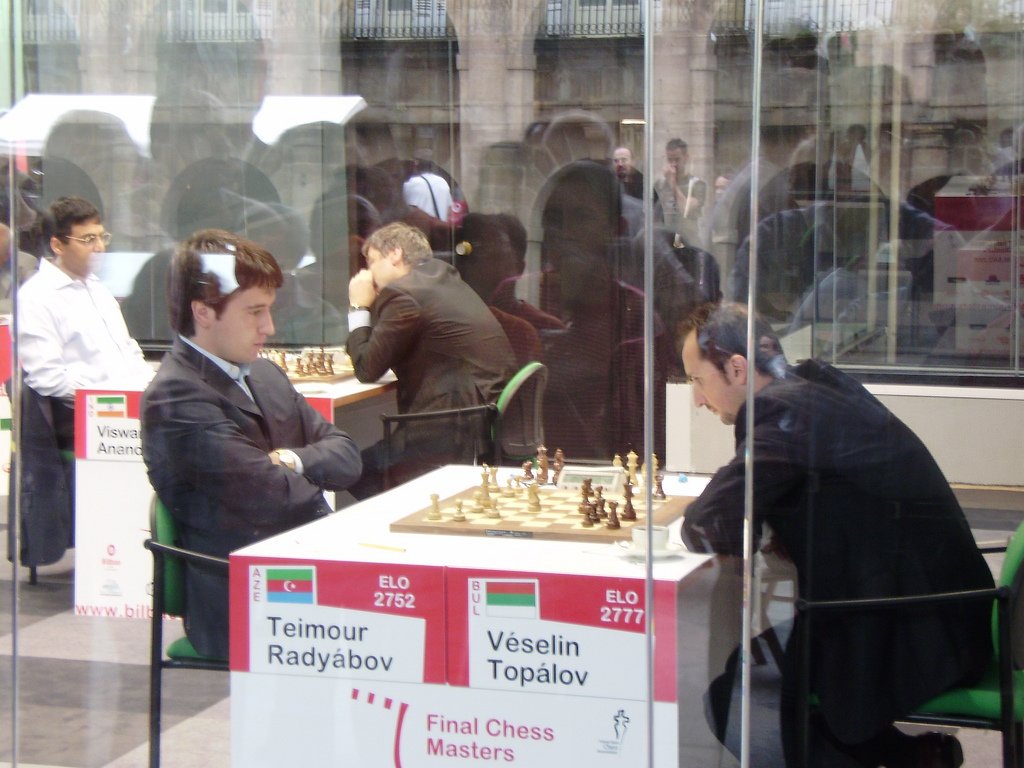
Teimour Radjabov and Veselin Topalov in Bilbao, 2 September 2008. By Mikel Larreategi from Eibar, Basque Country - Radjabov vs. Topalov, CC BY 2.0
Style and Reputation
The sources support an image of stylistic development rather than stylistic contradiction. In the late 1990s, observers described Radjabov as overtly attacking and unusually combative for his age, and he himself emphasized concentration, endurance, and refusal to give up. By 2007, Nauka i Zhizn described him as combining an initially romantic, tactical style with pronounced strategic and positional growth. This is persuasive as a long-term description of his best chess. Radjabov’s strongest years were built not on one-dimensional aggression but on the fusion of stubborn defense, practical calculation, opening ambition, and a willingness to choose strategically double-edged positions as Black against the very best players.
His reputation among contemporaries and commentators was shaped early by the Kasparov game at Linares. ChessBase’s retrospective on the beauty-prize controversy is useful because it captures both sides of the reaction. On one side, grandmasters praised Radjabov’s resilience and nerve in a bad position. On the other, they resisted romanticizing the game as a purely objective masterpiece, since Kasparov’s errors were part of the story. That dual judgment is historically revealing. Radjabov’s best chess often lived in the zone where objective evaluation and practical difficulty are not the same thing. He was dangerous because he could keep a complicated position alive until the opponent’s control loosened.
In opening culture, Radjabov’s contribution is more concrete and easier to document. ChessBase repeatedly identified him as a major modern expert on the King’s Indian Defence, even speaking of him in 2021 as the “king” of the opening and crediting his practice with reshaping how it was handled at the top level. Separate ChessBase coverage also credits him with helping make the Schliemann, or Jaenisch Gambit, fashionable again in elite play. These claims are not mere opening-branding. They indicate genuine theoretician’s influence. Radjabov was one of the relatively few super-grandmasters of his generation prepared to defend the dynamic black side of historically risky systems against the strongest possible opposition.
There were also weaknesses. His tournament record shows long stretches where solidity and caution could drift into limited winning volume, especially when compared with the conversion rate of world champions and perennial Candidates winners. FIDE and specialist reports from the Geneva Grand Prix in 2017, however, also show the positive side of that solidity: stronger opening control, professional risk management, and the ability to “milk” small advantages. The historical verdict, then, is that Radjabov became one of the great counterpunchers of modern elite chess, even if that profile also imposed ceilings at certain moments of the classical world-championship cycle.
Contributions Beyond Tournament Play
Radjabov has not become a major chess author in the classical printed sense, nor is he chiefly remembered as a federation official or tournament organizer. His most visible contribution beyond tournament play has instead been educational. In 2020 he launched Chess Stars Academy, explaining that it had long been his dream to create an academy in Baku with global reach. That is historically interesting for two reasons. First, it shows him deliberately locating part of his chess legacy in Azerbaijan rather than abroad. Second, it places him within the recent trend of elite players turning from pure competition toward instructional ecosystems, digital content, and branded training platforms.
The academy also sheds light on Radjabov’s important professional relationships. Official academy material, as quoted by ChessBase and previewed in search results from the academy site, links him closely with two major trainers. Igor-Alexandre Nataf is described as having begun working with Radjabov in 2002 and as standing behind much of the theoretical work in his opening preparation. Vladimir Chuchelov, meanwhile, is presented as a later formative influence. In a 2021 ChessBase interview around Chuchelov’s “strategic balance” method, Radjabov himself said that working with Chuchelov changed his attitude toward the game. Those remarks help explain how the teenage attacker matured into the more structurally grounded elite player of his peak years.
His media presence in the 2020s has reinforced this educational turn. Public platforms associated with his academy and YouTube channel feature lessons, interviews, commentary, and discussions with other high-level figures. This is not an incidental appendix to his playing career. For a player whose generation came of age before the streaming era, it represents a real adaptation. In legacy terms, Radjabov has moved from being simply a subject of chess history to helping shape how chess is taught and discussed for a newer audience.
Historical Legacy
Radjabov’s legacy within Azerbaijani and post-Soviet chess is best understood through continuity and transformation. He was formed by a family and city deeply rooted in Soviet chess institutions, yet his public career matured after the Soviet Union’s collapse and became inseparable from the international projection of Azerbaijani chess. The 2002 Olympiad teenage lineup, the later European team titles, and Radjabov’s own long service on top boards show that he was one of the principal faces of that national ascent. He was not merely a strong individual from Azerbaijan. He was one of the players who helped define what Azerbaijani chess looked like to the wider world.
There are also overlooked elements in his story. One is simple longevity. Because Radjabov became famous so young, observers sometimes narrate his career as if the essential plot ended with Kasparov in 2003 and the cavalry arrived later in the form of Carlsen’s generation. That is misleading. Radjabov reached world number four in 2012, won the World Cup in 2019, captured a major online title in 2021, and finished third in the 2022 Candidates. Another overlooked feature is the seriousness of his practical and ethical judgment during the pandemic dispute. His 2020 stand was not a side controversy. It entered chess institutional history because events validated his concerns and FIDE eventually recognized that by reserving him a place in the next Candidates.
As of July 2026, FIDE still listed him as Azerbaijan’s number two active player and among the world’s top forty. That current rating does not define his historical standing, but it underscores a final point: Radjabov’s career has not been a brief comet. It has been a long elite life in chess, marked by reinvention, national leadership, and technical influence on the game’s modern opening culture.
A concise historical assessment would place Teimour Radjabov among the most important non-world-champions of his generation. He deserves attention today because he was simultaneously a prodigy of the old Baku school, a builder of modern Azerbaijani chess prestige, a creative and influential theoretician, and a player whose best years stretched across more than two decades. His story enlarges the history of modern chess because it shows how early genius can harden into durable significance without ever needing a world title to justify itself.
Notes and Sources
This profile draws on a mix of primary or near-contemporary material, official federation records, specialist chess reporting, and a small number of reference sources used only to confirm dates, titles, and event results. Name forms vary across languages and eras. English-language chess media usually use Teimour Radjabov, while Azerbaijani sources often use Teymur Rəcəbov; Russian-language material uses Теймур Раджабов.
Especially useful primary and specialist sources included Farida Sadikhova’s 1999 profile in Azerbaijan International for childhood development and early training; Evgeny Gik’s later Nauka i Zhizn profile for family background, education, and stylistic assessment; Leonard Barden’s contemporary Guardian column on the Linares upset; official FIDE pages for Radjabov’s title history, ratings, World Cup victory, Candidates withdrawal and later reinstatement path, plus team and career summaries; Tata Steel’s historical list of champions; European Chess Union and Chess-Results records for Azerbaijan’s team titles; OlimpBase for the 2002 Olympiad generation and Radjabov’s team record; ChessBase reporting on the Linares controversy, his opening influence, academy project, and work with Chuchelov; and selected Chess.com reports for the 2017 Geneva Grand Prix, the 2021 Airthings Masters, and Radjabov’s own post-Candidates interview.
