Mikhail Gurevich
Introduction
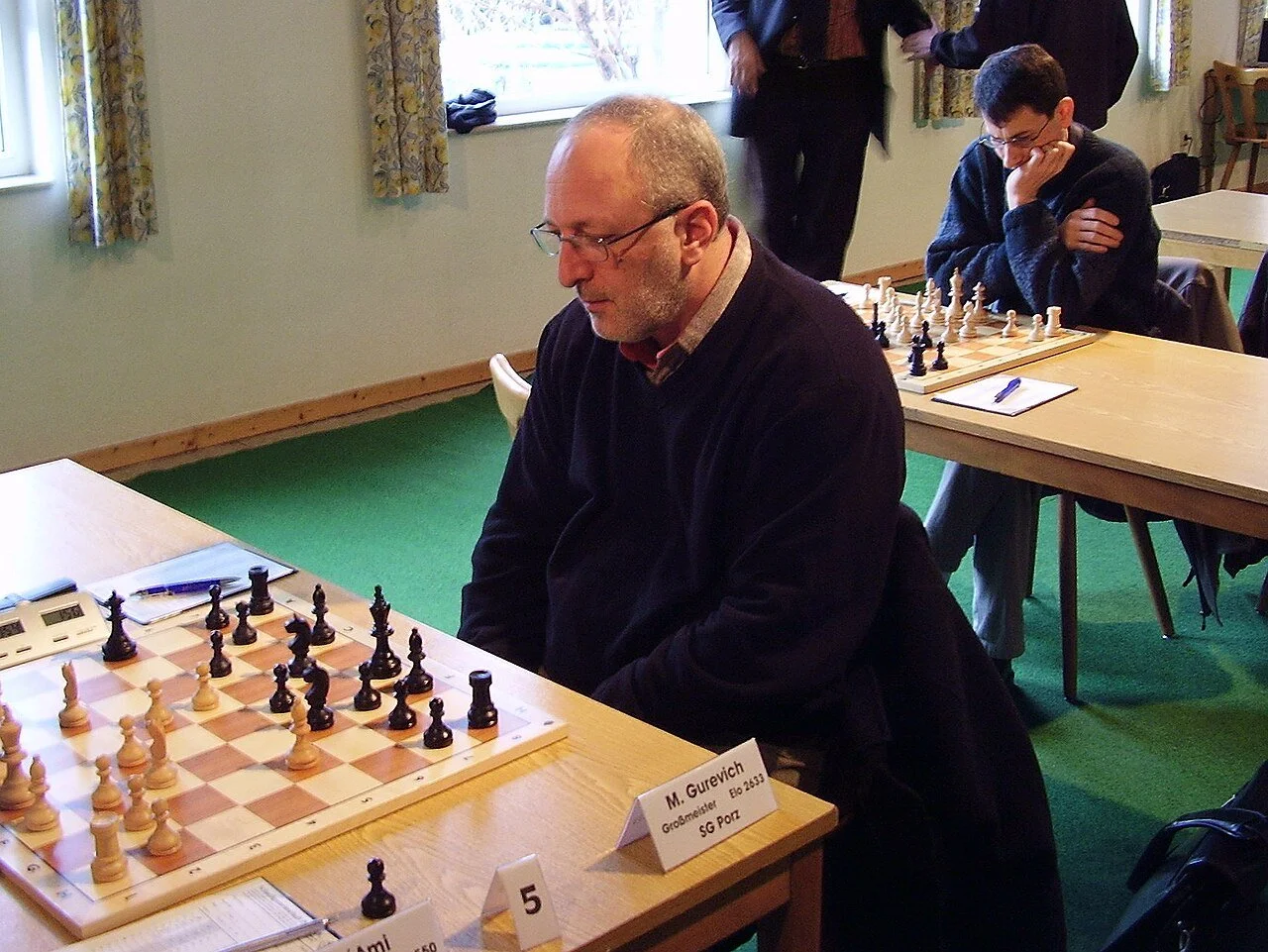
Mikhail Naumovich Gurevich, Russian: Михаил Наумович Гуревич, was born on February 22, 1959 in Kharkiv, then in the Ukrainian SSR. He emerged from the Soviet system in the 1980s, won the USSR Championship in 1985, entered the world top ten by the turn of the next decade, later represented Belgium and then Turkey, and remained significant as an analyst, trainer, and opening specialist long after his peak years as a tournament player. His current FIDE profile lists him under Belgium, with a lifelong FIDE Senior Trainer license and a continuing active playing record.
Gurevich deserves attention because his career cuts across several chess worlds at once. He was a product of late Soviet competitive culture, a near-Candidates strength grandmaster whose best years were partly obscured by institutional obstacles, and later a major figure in the chess life of smaller federations that benefited from Soviet training depth. His legacy is therefore larger than a list of first prizes. It lies in the quality of his chess, the seriousness of his analytical work, and the way his career illuminates what strong Soviet grandmasters carried with them after the Soviet center loosened and later disappeared.
Early Life and Chess Formation
The public biographical record on Gurevich’s family background and formal education is surprisingly thin. The standard biographical notices used for this profile, FIDE’s player record, the Russian Chess Federation’s brief profile, and Douglas Griffin’s historical note, state clearly that he was born in Kharkiv and focus almost entirely on chess milestones rather than parents, siblings, or higher education. One indexed interview summary adds that he was born in Kharkiv, lived in Mariupol, then still called Zhdanov, until age seven, and later returned to Kharkiv. That is useful biographical texture, although it comes to us in summarized form rather than as a full archival transcript.
What can be documented with more certainty is the speed of his chess maturation. Griffin notes that Gurevich had already earned the Soviet Master of Sport title in 1978, an important marker in the Soviet hierarchy, especially for a player who was still little known in the West for several years afterward. That combination, early domestic recognition and late international visibility, is characteristic of many strong Soviet players whose reputations were formed inside a very dense internal competitive system before broader international circulation became possible.
Rise in Competitive Chess
Gurevich’s breakthrough arrived in 1984 and 1985. The Russian Chess Federation’s profile records that he won the Ukrainian championship in 1984, placed fourth in a USSR semifinal, advanced through the First League, and then shared first through third in the 1985 Soviet Championship. A subsequent playoff with Alexander Chernin and Viktor Gavrikov gave him the title. That ascent was swift, and it placed him immediately among the strongest grandmaster prospects of his generation.
The central complication of his Soviet career followed immediately. Griffin notes that the 1985 USSR Championship also functioned as a FIDE zonal, yet Gurevich did not go on to the Interzonal stage, whereas other leading finishers did. In a later retrospective quoted by the Russian Chess Federation, Gurevich said that he was not allowed to travel abroad, described himself as effectively non-traveling in that period, and tied the decision to Soviet political authorities. The underlying historical fact, namely that the Soviet champion did not advance to the next stage, is firm. The political explanation should be treated as retrospective testimony from Gurevich himself, not as a fully documented bureaucratic file, but it is an important part of how he understood the turning point in his own career.
Major Career Achievements
After the Soviet title, Gurevich consolidated at a very high level. The Russian Chess Federation profile summarizes tournament victories in Baku, Havana, and Vršac in 1986, Tallinn and Moscow in 1987, Reggio Emilia in 1988 and 1989, and Belgrade and Tel Aviv in 1989. Griffin independently notes that his first place at Reggio Emilia, at the turn of 1988 and 1989, came by a full point over the field, which is a strong sign of how quickly he had moved from breakthrough player to recognized elite grandmaster.
Team events confirmed the same rise. At the 1989 European Team Championship in Haifa, the USSR won gold, and OlimpBase’s tournament review remarks that Gurevich and Vladimir Tukmakov had the best results among the Soviet players. At the 1989 World Team Championship in Lucerne, the USSR again took first place, and Gurevich scored 5 out of 6 on second reserve board, enough for second place individually on that board. These results locate him not on the fringes of the Soviet team machine, but inside it.
His standing on the rating list confirms the picture. OlimpBase’s historical FIDE rating archive shows him tied for fifth in the world on the January 1990 list at 2645 and tied for fifth again on the January 1991 list at 2650. For a player who never became a household name outside specialist circles, that is a striking peak. It places him among the strongest active players in the world during the transition from the Karpov and Kasparov era into the wider generation of Ivanchuk, Anand, Gelfand, and others.
The great missed opportunity of his competitive career came at the 1990 Manila Interzonal. Later summaries agree that after eleven rounds Gurevich was sharing the lead or very near it, but losses in the last two rounds, to Anand and then Short, dropped him out of qualification. The Russian Chess Federation note compresses the point well: he was leading in Manila, then failed to reach the Candidates after late defeats. This is one of the few cases where a very strong Soviet grandmaster’s historical reputation is shaped not by a bad tournament, but by two late losses in a tournament he had largely mastered.
His post-Soviet career was long and serious. By July 1992 he appeared on the FIDE list under Belgium, and in the same year he played for Belgium at the Manila Olympiad, where one of his wins received a special game award. His late-career revival was also real, not merely cosmetic. OlimpBase’s rating archive shows him reaching 2694 on the January 2000 and January 2001 lists, ranking twelfth and then fourteenth in the world. In July 2001 he won the Belgian Championship in Charleroi with a perfect 9 out of 9, a rare feat even in a modestly sized national championship.
Gurevich later transferred from Belgium to Turkey on November 1, 2005, according to FIDE’s transfer records, and back from Turkey to Belgium on October 1, 2015. The Russian Chess Federation profile credits a strong run in the 2005 World Cup with qualifying him for the 2007 Candidates matches, where he lost to Peter Leko. Even in that later phase, he was functioning at a level high enough to remain relevant to the world championship cycle, which is itself an index of durability.
Style and Reputation
Douglas Griffin’s historical portrait is especially helpful on playing style. He describes Gurevich as a player of “clear positional style” and a “rigorous approach,” and singles out his endgame technique as superb. That is valuable because it is not generic praise. It places Gurevich in a recognizable Soviet lineage of exact, well-structured chess, with emphasis on transition play and technical conversion rather than flamboyant public image. As a reasonable interpretation from the record, Gurevich seems best understood as a grandmaster whose strength began in structure, method, and precision, then expanded into much broader forms of mastery.
That said, he was never merely dry or technical. Griffin uses Gurevich’s celebrated win over Julian Hodgson at Haifa in 1989 to show “a different side” to his talent, one that involved initiative, material sacrifice, and complex opposite-side castling play. The same essay notes that Gurevich said he was “in fighting mood” for the game, and that the sharp system he chose in the Leningrad Dutch was connected to work he had done with Vladimir Malaniuk in popularizing the plan with ...Qe8. In other words, the usual picture of Gurevich as a positional player is accurate, but incomplete. He could play dynamically at full strength when the position and tournament situation asked for it.
A second, equally important part of his reputation concerns depth of analysis. In a later Anand interview, retold by ChessBase, Viswanathan Anand recalled training with Gurevich and receiving the image that a chess position is “like an onion,” with layers to be peeled away, along with advice not to play too fast. That recollection fits Griffin’s stylistic description very well. It suggests that contemporaries valued Gurevich not only for results, but for a particular manner of thinking about chess, patient, layered, and skeptical of superficial impressions.
Contributions Beyond Tournament Play
Gurevich’s importance beyond over the board competition rests chiefly on analysis, annotation, authorship, and training. Griffin notes that he was a regular annotator for Chess Informant, which made his games and ideas unusually accessible to serious readers. That was significant in the pre-database and early database era, when annotations were still a major medium for transmitting a player’s intellectual character. The same essay points readers to Gurevich’s own annotations in the Soviet weekly 64, which reinforces the impression of him as a working analyst, not only a practical competitor.
His work as a second is equally important. The Russian Chess Federation quotes Gurevich saying that he worked with Garry Kasparov for about five years and stresses how educational that period was because Kasparov was then the best prepared player in the world in the opening. Anand’s retrospective evidence points in the same direction from another angle, not as Kasparov’s helper, but as Anand’s trainer and conceptual guide. Together, those sources place Gurevich in the inner analytical circles of two world champions. Very few grandmasters with no title match of their own can claim that kind of intellectual proximity to the summit.
He also left a more conventional theoretical record. Library catalog data confirm his 1991 English monograph Queen’s Indian Defence: Kasparov System, published by B. T. Batsford. Griffin’s Haifa essay further suggests that his analytical work extended beyond the Queen’s Indian, since it credits him and Vladimir Malaniuk with helping popularize a particular Leningrad Dutch setup. The broad picture is that Gurevich was not a mass-market author, but he was a respected working theoretician whose ideas circulated through books, annotations, and elite preparation teams.
Institutionally, his later profile is centered on training. FIDE’s current player page lists him as a FIDE Senior Trainer, licensed from 2006 on a lifelong basis. A ChessBase report on the ACP World Rapid Cup in Odesa in 2010 describes him at that time as the Turkish national trainer. That role is historically fitting. By then Gurevich was no longer primarily a contender for the world elite, but he remained an important transmitter of Soviet analytical culture into other national settings.
Historical Legacy
Gurevich’s legacy begins with a plain historical fact. He was good enough to win the Soviet championship, to reach the world top five on the FIDE list, and to come within sight of the Candidates. Those achievements alone would justify sustained historical attention. Yet his career also contains the kind of distortion that can make a strong player seem smaller in retrospect than he really was. The 1985 Interzonal anomaly and the 1990 Manila collapse mean that his record never quite turned into a canonical world championship narrative, even though his strength plainly reached that level for substantial stretches.
His second legacy is diasporic. Gurevich’s competitive and training career linked the Soviet Union, Belgium, and Turkey through federation transfer, national representation, and coaching work. In 1992 he was already playing for Belgium at the Olympiad; in 2005 he officially transferred to Turkey; in 2015 he transferred back to Belgium; and his training credentials remained recognized by FIDE. This is historically important because it shows how Soviet chess knowledge did not simply vanish after 1991. It was redistributed through people like Gurevich, whose expertise traveled with them.
A concise historical assessment is therefore possible. Mikhail Gurevich deserves attention today because he was a genuine elite player whose public reputation never fully matched his strength, and because his career reveals how much chess history is carried not only by champions, but by analysts, seconds, trainers, and bridge figures between systems. He stands as a Soviet champion, a near-Candidates player, a top-level theoretician in practice, and a durable transmitter of chess culture across borders.
Notes and Sources
This profile uses the following name forms and transliterations interchangeably where the sources do: Mikhail Gurevich, Michail Gurevich, and Михаил Наумович Гуревич. For core biographical facts and present status, the most authoritative source used here is FIDE’s player page. For historical ratings and team results, OlimpBase is indispensable and should be treated as a reference work rather than a narrative authority. For Soviet period context and one important translated primary source, Douglas Griffin’s Soviet Chess History is especially valuable, since it preserves Gurevich’s annotations from 64.
Two methodological cautions are worth stating. First, publicly accessible sources are noticeably sparse on Gurevich’s family background and formal education, so this profile does not speculate beyond what the available chess references actually show. Second, there is a small bibliographical discrepancy regarding his grandmaster title year. FIDE’s current profile lists the title as 1985, whereas the Russian Chess Federation’s brief profile phrases the international grandmaster milestone as 1986. Because that single-year difference does not affect the larger historical argument, the article does not build any interpretive weight on it.
For tournament milestones, I have relied mainly on the Russian Chess Federation note, historical FIDE rating data at OlimpBase, team-event documentation at OlimpBase, and contemporary reporting in The Week in Chess. For Gurevich’s work with Kasparov and Anand, the strongest usable evidence located in open sources is retrospective testimony, Gurevich’s own recollection in the Russian Chess Federation profile and Anand’s later recollection reported by ChessBase. Those are appropriate sources for reputation and influence, but they remain retrospective, which is why the article distinguishes documented results from interpretation whenever the record becomes less direct.
