Smbat Garegini Lputian
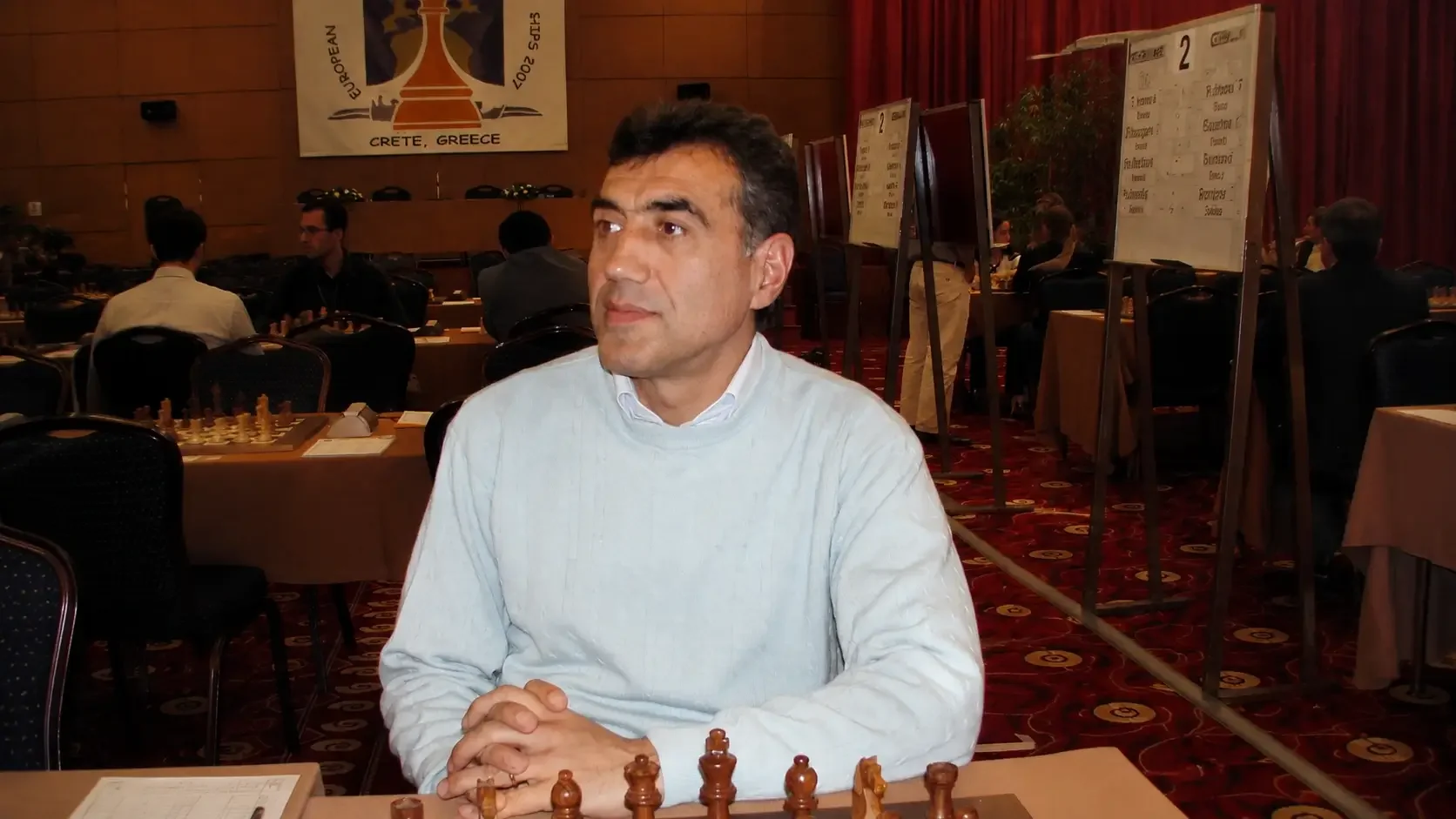
karpidis from Piraeus, Greece, CC BY 2.0
Introduction
Smbat Garegini Lputian, also rendered in some Armenian institutional sources as Smbat Lputyan, belongs to the important class of players whose historical significance cannot be measured only by peak rating or headline tournament wins. Born in Yerevan on February 14, 1958, he became an International Master in 1982 and a Grandmaster in 1984, reached a peak published rating of 2640, and rose to world number 17 on the January 1989 rating list. He was also a four time Armenian champion, a member of Armenia’s gold medal team at the 2006 Turin Olympiad, the founder-president of the Chess Academy of Armenia, a FIDE Senior Trainer, and, in official FIDE and Armenian institutional records, one of the central architects of Armenian chess education in the post Soviet era.
Historically, Lputian is best understood as a bridge figure. He emerged from the demanding Soviet system, remained internationally competitive through the first post Soviet decades, helped anchor Armenia’s major team results after independence, and then redirected much of his authority toward institution building, teacher training, and the integration of chess into Armenian public education. That dual identity, player and builder, is the real key to his place in chess history.
Early Life and Chess Formation
Accessible official and semi official biographies are strikingly sparse about Lputian’s family background and private early home life. What can be documented securely is that he was born in Yerevan, studied at the Yerevan State Institute of Physical Culture from 1978 to 1982 as a chess instructor, and came of age in an Armenian chess culture deeply shaped by Tigran Petrosian’s success. The Armenian Chess Federation describes Petrosian’s rise as the start of a distinct “Tigran period” in Armenian chess, and Lputian himself later recalled that Petrosian’s victories changed Armenian society’s whole way of thinking about chess. For a careful historical profile, that combination of hard fact and contextual testimony is more useful than anecdote.
His rise was early and unmistakable. Russian Chess Federation material notes that, at age twenty, after a strong performance in the all Union qualifying system, he earned the title of Master of Sport. The same broad period already saw him win the Armenian championship in 1978, which placed him among the most serious young players in the republic before he had fully entered the grandmaster class.
The decisive formative breakthrough came in the early 1980s. In 1982 Lputian won the USSR juniors’ tournament for masters ahead future stars including Zurab Azmaiparashvili, Valery Chekhov? Wait no, this source names Vyzhmanavin, Yudasin, and Malaniuk among those left behind. In 1983 he also played for the Soviet Union in the World Youth U26 Team Championship in Chicago, scoring 6.5 out of 7 on reserve board and finishing first individually while the Soviet team took gold. These are exactly the sort of results that show a player moving from national promise to all Soviet seriousness.
Rise in Competitive Chess
Lputian’s mature ascent followed the classic late Soviet path, but to follow that path at all was itself a distinction. He appeared six times in the premier league of the Soviet Championship, won the First League in 1984 and 1985, and, according to Russian Chess Federation biographical material, fulfilled grandmaster norms at his first attempts in major foreign events at Berlin and Athens. Official FIDE records confirm the formal progression, IM in 1982 and GM in 1984.
His international tournament record in the 1980s shows that he was more than a solid product of the Soviet school. Reference databases and biographical summaries consistently credit him with major or shared first places at Berlin in 1982, Athens and Irkutsk in 1983, Sarajevo in 1985, Irkutsk again in 1986, Hastings 1986 to 1987, and Dortmund in 1988. By January 1989, the official FIDE list and modern rating history compilations place him on 2610 and at world number 17, his clearest moment of entry into the near elite.
Lputian also entered the world championship cycle in a serious way. In 1990 he shared first at the Soviet zonal and advanced to the interzonal. Three years later he won another zonal and returned to FIDE qualifying competition. In the knockout world championship cycle, he defeated Sergei Rublevsky in New Delhi in 2000 before losing to the eventual champion Viswanathan Anand, eliminated Michał Krasenkow in Moscow in 2001 before losing to Loek van Wely, and in Libya in 2004 was stopped by Shakhriyar Mamedyarov only in Armageddon. These are not the results of a fleeting player. They show durable world class competence over more than two decades.
Major Career Achievements
Lputian’s record as a national and team competitor is especially strong. He won the Armenian championship four times, in 1978, 1980, 1998, and 2001, a spread that says something important about his longevity. He was also a four time winner of the European Champions Cup in club play, with CSKA in 1986 and 1988, Bosna in 1994, and Yerevan in 1995. Those titles place him in the core of strong professional team culture from the late Soviet period into the plural club world of the 1990s.
For Armenian national chess, his team record is even more revealing. Official federation history credits him as a member of the Armenia side that won the European Team Championship in 1999. In Olympiad play, OlimpBase records eight appearances from 1992 through 2006, with Armenia taking team bronze in 1992, 2002, and 2004, then team gold in Turin in 2006. The same OlimpBase summary shows that across those Olympiads he also collected individual board medals, two silvers and one bronze. In a country where team identity became central to chess self understanding after independence, Lputian was not merely present. He was one of the repeat carriers of that continuity.
One interview detail helps explain why his peers and institutions continued trusting him in team environments. Speaking in 2013, Lputian said he had played on Armenia’s national team for thirty two years and stressed that Armenia’s successes came when players supported one another and remained honest and loyal within the team. That is, of course, testimony rather than neutral archival description, yet it fits the record of his repeated selection and his presence in several of Armenia’s defining team results.
Style and Reputation
A precise stylistic label for Lputian is less useful than a careful description. His game corpus, as preserved by large databases, contains more than 1,500 recorded games, with a high draw rate of 43.44 percent and a relatively low loss rate of 18.81 percent. His most played defenses with Black include the French Winawer, the French against the Tarrasch, and Queen’s Gambit Declined structures including the Tartakower system. With White, his most common choices include Queen’s Indian and Bogo Indian related structures, along with strategically dense queen’s pawn systems.
A reasonable inference from that material is that Lputian was a universal player with a classical backbone. He was willing to enter sharp French positions, which gave him counterattacking bite, yet much of his repertoire also rested on structure, maneuver, and strategic control. That blend helps explain why he was useful on so many different boards in club and national competition. He was not remembered as a purely tactical showman, nor as a sterile safety first specialist, but as a dependable high level professional whose opening choices could be both principled and ambitious. This is an inference from the record rather than a direct quotation from contemporaries, but it is a grounded one.
If one wants a career emblem rather than a game study, the most telling choices are match results, not brilliant prizes. His knockout win over Rublevsky in 2000 showed that even in the age of Anand, Kramnik, and Ivanchuk, Lputian remained dangerous in elite company. His loss to Anand in that same event, and the fact that Mamedyarov needed Armageddon to stop him in 2004, suggest a player who was difficult to remove cleanly from world level competition.
Contributions Beyond Tournament Play
Lputian’s post playing career is the strongest reason he deserves renewed historical attention. According to the Chess Academy of Armenia’s own institutional history, he proposed the idea of a national chess academy in 1996, at a moment when many leading players had left the country and Armenia urgently needed a system for developing successors. With the support of Prime Minister Andranik Margaryan, that idea became reality in 2002 with the founding of the Chess Academy of Armenia in Yerevan. The academy’s stated mission was not only to train strong players but also to publicize chess across the country.
That project expanded far beyond a private school. Official Armenian federation and academy sources present the academy as a national institutional center, one that organizes school olympiads, training seminars, camps, and major tournaments. They also tie it directly to Armenia’s decision to include chess as a compulsory subject in all public schools beginning in 2011. In that framework, Lputian was not simply an administrator attached to an existing success. He was one of the people who helped build the mechanism through which Armenian chess reproduced itself.
His formal titles reinforce that conclusion. Institutional biographies identify him as Founder-President of the Chess Academy, First Vice-President of the Armenian Chess Federation, Director of the “Chess” Scientific Research Institute, and chairman of the Chess and Sports Department at the Armenian State Pedagogical University. In 2018, the Academy announced that he had been appointed chairman of the FIDE Chess in Education Commission, explicitly connecting the appointment to Armenia’s successful school chess program and the desire to spread that model abroad. In 2026, FIDE itself described him as a pioneer of the Chess in Schools program and highlighted his role in the training of Armenian chess teachers.
There is also an overlooked analytical side to his work. A 2026 FIDE article on Lev Legky noted that Legky worked with Lputian from 1981 to 1984, and that Legky, Lputian, and later Vladimir Malaniuk annotated and published numerous games in Chess Informant and Soviet chess periodicals. This does not make Lputian a major author on the scale of a Botvinnik or a Dvoretsky, but it does remind us that he functioned inside the Soviet analytical publishing world, not only at the board and not only later as an organizer.
Historical Legacy
Lputian’s legacy is strongest where several histories meet. He was a genuine late Soviet grandmaster, strong enough to rise into the world top twenty and remain a credible world championship cycle participant. He was a foundational figure in Armenian national team chess after 1992, present in major team medal runs and in the 1999 European and 2006 Olympiad triumphs. He then became an institutional strategist of unusual consequence, shaping academy structures, chess teacher training, research, and the school curriculum itself.
That combination gives him a different historical profile from Armenian stars who reached higher absolute playing peaks. Levon Aronian was the greater world contender. Vladimir Akopian reached a world junior title and a Candidates level stature. Yet Lputian’s contribution is broader in another sense. He helped carry the Armenian chess tradition from the Soviet championship pipeline into the institutional life of an independent republic, and he did so with unusual continuity. Even his honors listed by Armenian official sources, including the Movses Khorenatsi medal, the Medal of Services to the Motherland, and earlier state distinctions, reflect recognition not only for results but for service.
Smbat Garegini Lputian deserves attention today because he exemplifies a type of historical chess figure who is easy to underrate. He was not a world champion, and he was not the single strongest Armenian player of his generation. What he was, documentedly and over a very long span, was a high class Soviet trained grandmaster who became one of the principal custodians and organizers of Armenian chess culture. For a serious history of chess, that is more than enough to justify close study.
Notes and Sources
This profile prioritizes official and near primary material where possible: FIDE’s player and news records, the Armenian Chess Federation’s historical pages, the Chess Academy of Armenia’s institutional history and biographies, and OlimpBase for team event records. Russian Chess Federation biographical material is especially useful for Lputian’s Soviet era development, including his Soviet championship participation, First League victories, zonal qualifications, and his transition away from full time professional play.
For tournament chronology, ratings, and repertoire confirmation, this article also uses specialist reference databases such as 2700chess, 365Chess, and other standard chess record sites, but mainly in a confirmatory role rather than as sole authorities. Where official sources are thin, especially on family background and private life, the article deliberately marks the evidentiary limit instead of filling gaps with anecdote. Transliterations vary across sources, with FIDE using “Lputian” and Armenian institutional material also using “Lputyan.”
