Zurab Azmaiparashvili
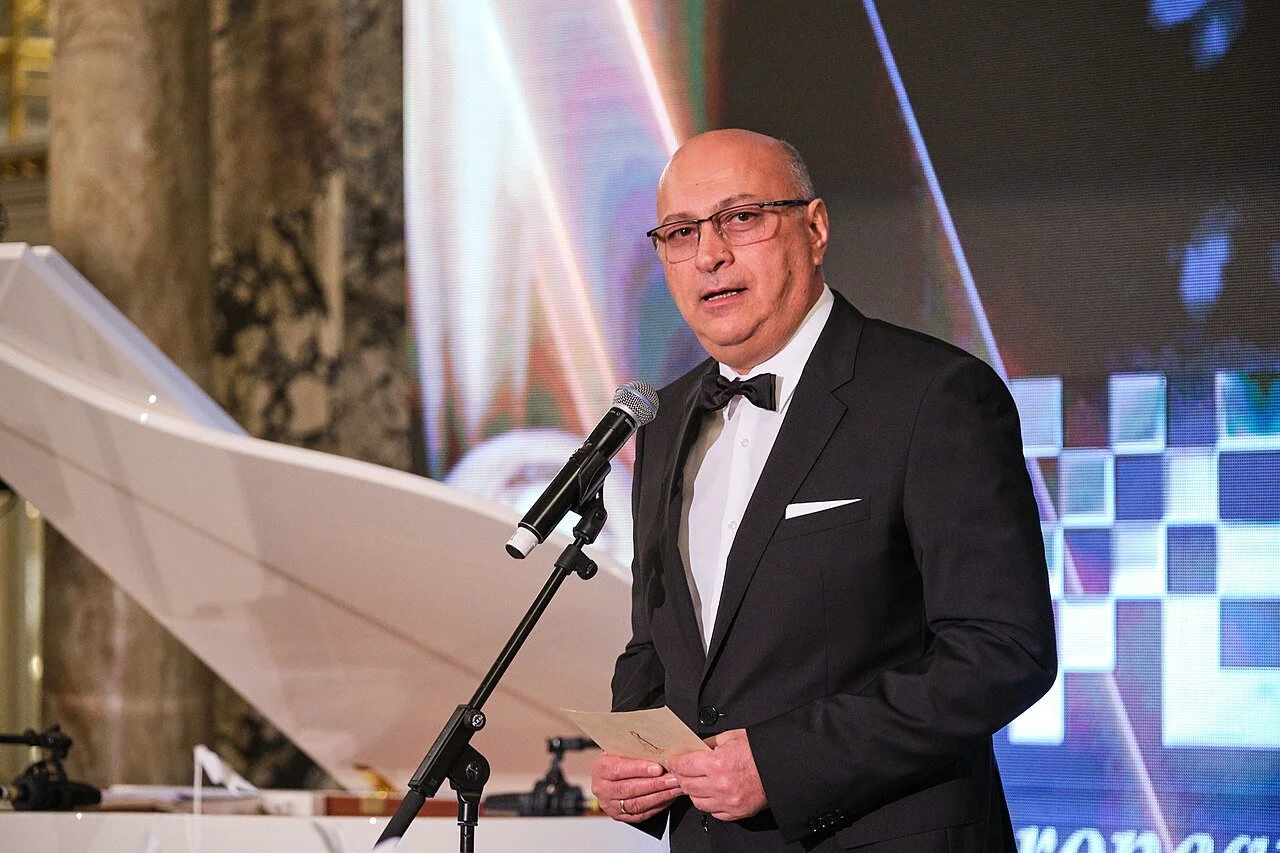
By Te100aK - Own work, CC BY-SA 4.0, https://commons.wikimedia.org/w/index.php?curid=145349221
A career formed in Soviet Georgia, tested at the highest international level, and extended through coaching, organization, and the governance of European chess.
Introduction
Zurab Azmaiparashvili occupies an unusual place in modern chess history. He was a Soviet junior champion, a world top-20 grandmaster, the long-serving first-board player of independent Georgia, the 2003 European champion, a trusted analyst for Garry Kasparov, and later one of the most durable elected officials in international chess. Each stage grew from the previous one. The competitor who learned to navigate the Soviet tournament system became a team leader after the breakup of the USSR, then transferred the authority of elite play into training and institutional work.
Born in Tbilisi on 16 March 1960, Azmaiparashvili earned the international master title in 1984 and the grandmaster title in 1988. He reached world number 11 on the January 1993 FIDE list and a career-high rating of 2702 in July 2003. In July 2026, delegates reelected him president of the European Chess Union for a fourth term, covering 2026 to 2030. This breadth makes him valuable to chess historians. His life links the institutions of Soviet sporting culture, the formation of Georgian national chess, the private analytical world of championship preparation, and the international administration of the game.
Early Life and Chess Formation
Azmaiparashvili was born in Tbilisi, then the capital of the Georgian Soviet Socialist Republic. His name appears in Georgian as ზურაბ აზმაიფარაშვილი and in Russian records as Зураб Алексеевич Азмайпарашвили. FIDE and the European Chess Union use the English spelling Zurab Azmaiparashvili; older English-language material sometimes renders the surname as Azmayparashvili. Reliable public sources give little information about his parents, their occupations, or the domestic circumstances in which he first learned chess. Claims that add detail to this part of his childhood should therefore be treated cautiously. The firm educational fact is that he graduated from the Georgian Institute of Physical Culture in 1981 with a specialization in chess.
His own recollections provide a clearer picture of the chess environment that formed him. In the Tbilisi of the late 1960s and early 1970s, established players gathered at the old chess club on Rustaveli Avenue, while children studied in chess circles distributed among district Houses of Pioneers. Major events could fill local theatres. The Tbilisi Chess Palace, opened in 1974, gave this culture a permanent and conspicuous home. The achievements of Nona Gaprindashvili, Maia Chiburdanidze, and other Georgian women had already made serious chess unusually visible within the republic. For an ambitious boy, chess was both a local cultural practice and a route into the Soviet competitive system.
Azmaiparashvili dated his first important all-Union experience to the 1969 White Rook school competition. Although younger than many of the participants, he placed second on his board and received a special prize from the children's magazine Murzilka. He later identified Shota Intskirveli, Temur Lomaya, and Yuri Chikovani as the coaches who most influenced his development. His answer also included two literary works, Shota Rustaveli's The Knight in the Panther's Skin and Alexandre Dumas's The Count of Monte Cristo. The remark was playful, yet revealing: he presented imagination, character, and narrative appetite as part of his chess education.
The competitive evidence soon became substantial. He won the Georgian schoolboys' championship in 1973, represented the Georgian team that won the USSR Youth Games in 1976, and became USSR junior champion in 1978. That title did not automatically secure international selection. Soviet youth coach Anatoly Bykhovsky made what Azmaiparashvili later called an exception and sent him to the European Junior Championship at Groningen, held at the end of 1979 and the beginning of 1980. Alexander Chernin won; Azmaiparashvili took silver. In 1980, he also won the Georgian championship.
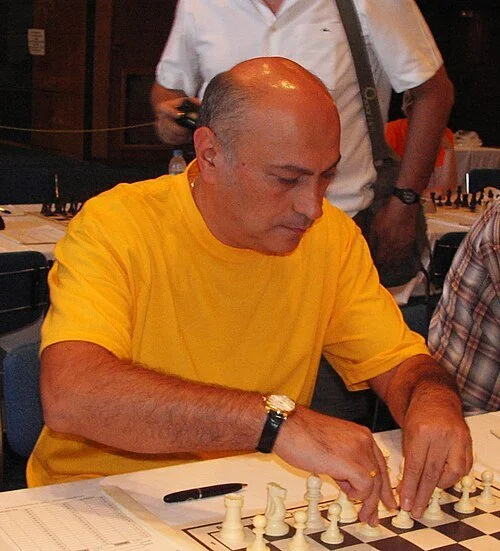
By karpidis from Piraeus, Greece - KIF_6733, CC BY 2.0, https://commons.wikimedia.org/w/index.php?curid=4522207
Rise Through Soviet Chess
His advance followed recognizable Soviet channels while retaining a Georgian identity. He represented the Dinamo sports society, won the 1982 semifinal of the USSR Championship, and contributed to Georgian medals in the USSR team championship: bronze in 1981, followed by silver in 1983 and 1985. Georgia also took silver at the 1983 Spartakiad. These results placed him within a strong republican team culture, where preparation and collective responsibility carried nearly as much prestige as individual success.
The decisive public breakthrough came at the 50th USSR Championship in Moscow in 1983. Azmaiparashvili was making his first appearance in the top league and entered as a 2455-rated Soviet master. On 8 April, he defeated world champion Anatoly Karpov with Black in the Pirc Defense. The game's importance lies in what it established about the younger player's reputation. He was willing to employ a system that many elite Soviet players regarded with suspicion, and he could turn deep familiarity with an unfashionable opening into a practical weapon against the most formidable positional player of the period. Azmaiparashvili later recalled that Karpov had underestimated both him and the surprise value of the opening. The result remained the signature victory of his Soviet career.
The same year, he helped the USSR win the World Youth Under-26 Team Championship in Chicago. Playing fourth board, he scored 6.5 points from eight games without a defeat and took first place on his board. He was again a member of the gold-medal Soviet team at Mendoza in 1985. The international master title arrived in 1984, and he made a second appearance in the USSR Championship top league in 1986. By the time FIDE awarded him the grandmaster title in 1988, his standing rested on success in several demanding settings: the Soviet qualification structure, international team competition, and strong open and round-robin tournaments.
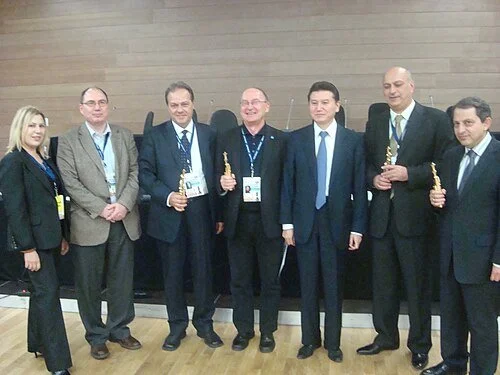
Boleslavsky Medal Award 2010. By MarachrisSOK - Own work, CC BY-SA 4.0, https://commons.wikimedia.org/w/index.php?curid=129902171
International Grandmaster
Azmaiparashvili's late Soviet and early post-Soviet results show both range and consistency. He won the 1988 Capablanca Memorial in Cuba and the 1989 Lloyds Bank Masters in London, where he scored 8.5 from ten games. In 1990 he shared first place in the 42-player final qualifier organized by the Grandmasters Association. The field included many of the strongest players outside the immediate world-title match, and the leading finish should have admitted him to a planned series of World Cup tournaments. The series was never held after the association's internal rupture. In a later interview, Azmaiparashvili described this as a major lost opportunity because sustained play against the elite would have accelerated his development.
His ranking nevertheless rose sharply. On the January 1993 FIDE list he was rated 2655 and placed eleventh in the world, level on rating with Gata Kamsky and Nigel Short. This was his highest official world ranking and places his best years securely within the international elite. With Bosna Sarajevo he shared the 1994 European Club Cup title, and in 1995 he won a zonal tournament in the world championship qualification system. He later appeared repeatedly in FIDE's knockout world championship events. These achievements did not coalesce into a single Candidates campaign, partly because his peak coincided with a fragmented and rapidly changing qualification landscape. His record is concentrated in elite tournaments, team competition, and later training work, arenas in which his practical judgment had its widest reach.
Board One for Independent Georgia
The dissolution of the Soviet Union changed the meaning of team chess for Azmaiparashvili. Beginning at Manila in 1992, he played first board for Georgia in seven consecutive Olympiads, continuing through Calvia in 2004. The assignment was demanding. First board exposed him round after round to the leading player of each opposing federation, while the new Georgian team was establishing its own identity and competitive expectations. Azmaiparashvili embraced the role. In his own account, he loved team chess and wanted to be its "leader, motor, and soul."
His finest Olympiad came at Elista in 1998. He scored eight points from ten games on first board, with seven wins, two draws, and one loss. OlimpBase calculates a 2804 performance, the highest rating performance of the event, and records a bronze medal on first board. Georgia finished seventh in the open competition and third in the inaugural combined Nona Gaprindashvili Trophy standings. The result gave exceptional competitive substance to his leadership.
In 2001 he took bronze at the European Individual Championship in Ohrid, defeating his former pupil Judit Polgar in the medal playoff. Two years later, at Silivri in greater Istanbul, he achieved the defining title of his individual career. The 2003 European Championship drew 207 players. Azmaiparashvili scored 9.5 from 13 games and finished alone in first place, half a point ahead of Vladimir Malakhov and Alexander Graf. At forty-three, he combined experience, opening preparation, and steady control of a long Swiss-system event. His rating reached 2702 on the July 2003 list, the first published 2700 rating achieved by a Georgian player. Later that year he led Georgia to bronze at the European Team Championship in Plovdiv.
The European title gave his playing career a fitting summit. He continued to compete, and in 2010 he shared first in the inaugural ASEAN Championship in Singapore and won on tie-break. Yet his priorities were already shifting. He later explained that after 2003 he assessed his prospects pragmatically and found new forms of work within chess. That transition was gradual, allowing him to preserve the authority of an active grandmaster while taking on broader responsibilities.
Style and Reputation
Azmaiparashvili's style was practical, prepared, and comfortable with asymmetry. The Pirc and Modern Defenses became his most recognizable systems with Black. Their strategic appeal was clear: he could concede space, invite an opponent to overextend, and reach middlegames in which his knowledge of typical breaks and tactical resources outweighed the opponent's more conventional development. His victory over Karpov gave the Pirc a lasting association with his name, while database records confirm that Pirc and Modern structures formed a large share of his black repertoire.
He linked this preference to a Georgian taste for slightly off-center play with tactical complications, citing Bukhuti Gurgenidze as an exemplar of the tradition. The description fits Azmaiparashvili's best games, while his complete repertoire was broader. With White, he frequently used the English Opening and other flexible closed systems, and his later coaching assignments required exact, long-range analysis. His hallmark was the ability to guide a game toward a type of uncertainty he understood better than his opponent.
His own comments also supply the fairest qualification. The Pirc succeeded when it drew opponents onto familiar tracks, but he acknowledged that "one cannot live on one opening." Positions with restricted space could become difficult once surprise and preparation had been neutralized. His career response was a broader repertoire and an increasingly exact approach, strengthened by his work with Kasparov. The longevity of his results offers the clearest evidence of adaptation: world number 11 in 1993, the best performance at the 1998 Olympiad, and European champion in 2003.
Contemporary reputation can be difficult to reconstruct from praise alone. In Azmaiparashvili's case, the responsibilities entrusted to him are more persuasive. Kasparov brought him into world championship preparation. Independent Georgia placed him on first board for more than a decade. Judit Polgar, Etienne Bacrot, and Teimour Radjabov worked with him during crucial phases of their development. These relationships identify the qualities other elite players valued: opening preparation, competitive experience, direct judgment, and an aptitude for helping ambitious attacking players organize their ideas.
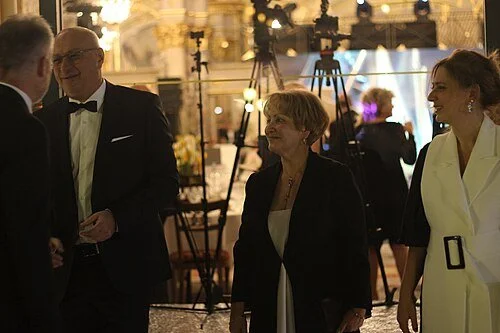
Zurab Azmaiparashvili, Marina Milorava, Tea Kipshidze. By Te100aK - Own work, CC BY-SA 4.0, https://commons.wikimedia.org/w/index.php?curid=145349192
Trainer, Second, and Teacher
Azmaiparashvili joined Garry Kasparov's team before the 1987 world championship match against Karpov in Seville. Russian Chess Federation accounts credit him with important work on the English Opening, one of the central fields of the match. He remained associated with Kasparov's analytical team into the 1990s; his official biography dates the collaboration from 1987 to 1994. Azmaiparashvili later said the experience gave him a more exact understanding of chess and changed how others viewed him. The relationship was therefore both analytical and formative. It brought a rising Georgian master into the most advanced private research environment in contemporary chess.
His subsequent training record has an instructive sequence. He worked with Judit Polgar from 1995 to 1997, with Etienne Bacrot from 1998 to 1999, and with Teimour Radjabov from 2000 to 2002. All three were exceptional young talents moving toward the highest level, and each favored active, concrete chess. Azmaiparashvili's role appears to have combined repertoire work, practical preparation, and the transmission of elite competitive habits. The private nature of this work limits precise attribution, so it is unwise to assign any player's later success to a single trainer. The repeated appointments nevertheless show that his analytical reputation traveled well beyond Georgia.
His influence also reached national teams. As captain of Azerbaijan, he helped guide the team to its first European Team Championship in Novi Sad in 2009. The achievement is easy to overlook in a player-centered account, yet it drew on the leadership habits visible in his own Olympiad career. FIDE recognized him as a Senior Trainer, and he received the Trainers Commission's Botvinnik award in 2010. From 2007 to 2010 he managed training programs at the Singapore Chess Academy, and from 2010 to 2019 he established and led the FIDE-recognized Tbilisi International Chess Academy.
Azmaiparashvili's published bibliography is modest. His analytical contribution circulated through confidential match preparation, individual coaching, team work, and academy programs. This helps explain why part of his chess legacy is less visible than his tournament record. Much of the labor of a high-level second disappears into another player's games, while effective organizational teaching is dispersed among students and institutions.
Organizer and Chess Administrator
Azmaiparashvili entered chess administration while he was still an elite player. He served as president of the Georgian Chess Federation from 1998 to 2000 and as co-president from 2000 to 2004. He also led the Black Sea Chess Association from 1999 to 2004 and served as a FIDE vice president from 2004 to 2010. These roles placed him near the central institutional problems of post-Soviet chess: sustaining national teams, obtaining events and sponsorship, and representing smaller federations within FIDE.
His public-service career extended beyond federation office. He became First Deputy Minister of Sport and Youth Affairs of Georgia in 2012 and resigned voluntarily in March 2015, after his election to the European Chess Union presidency made the combination of duties impractical. Contemporary Georgian reporting fixes the end date more precisely than later institutional biographies, which give inconsistent year ranges. His state honors include Georgia's Medal of Honor in 1996 and the Order of Vakhtang Gorgasali, third class, in 2002.
Major-event organization became another central part of his work. He was director of the organizing committee for the 2018 Batumi Chess Olympiad and took a leading role in preparations for the 2017 FIDE World Cup in Tbilisi. Together, those events demonstrated Georgia's ability to host the most complex competitions on the international calendar. They also extended a pattern present throughout his career: using Georgian chess culture as a platform for international engagement.
Azmaiparashvili was elected president of the European Chess Union in 2014, defeating the incumbent Silvio Danailov by 33 votes to 18. He was reelected in 2018 and 2022, then won a fourth term in July 2026 with 35 of 53 votes cast. His tenure has emphasized a dense continental competition program, educational chess, federation cooperation, and the professional administration of events. In 2025 FIDE awarded him its Medal of Merit during the European Chess Union's fortieth-anniversary celebrations.
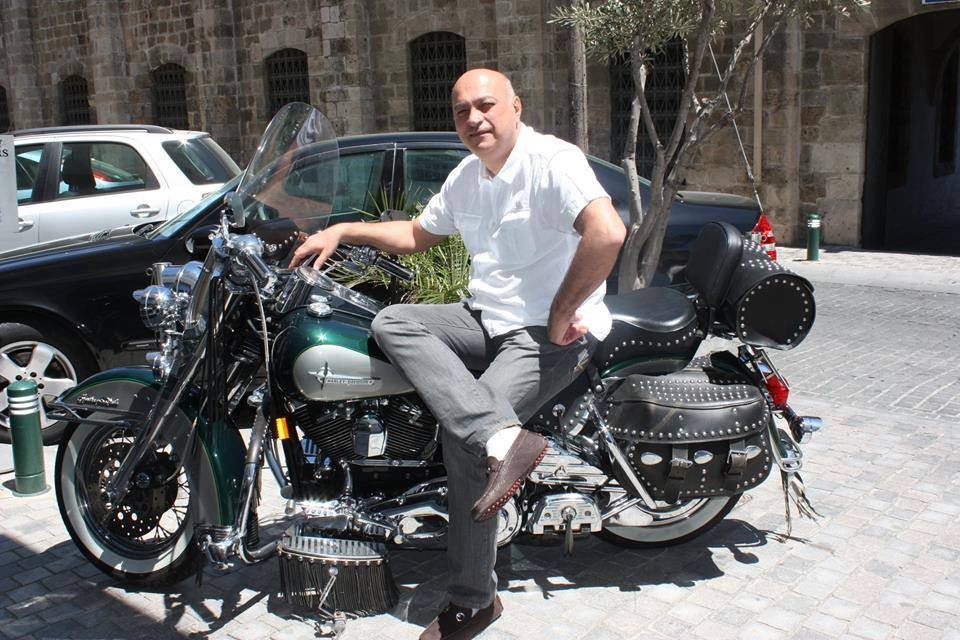
His long tenure in elected office documents a sustained transfer of authority from the chessboard to institutions. He has understood elite players as competitors, trainers as specialists, national federations as political constituencies, and organizers as the people responsible for converting plans into playable events. This unusual combination of direct experience is central to assessing his administrative career.
Historical Legacy
Azmaiparashvili's legacy begins with his playing record. He was among the strongest Georgian male players produced by the Soviet system, reached eleventh in the world, defeated Karpov in the USSR Championship, produced the best rating performance of the 1998 Olympiad, and won the European title at forty-three. His seven consecutive Olympiads on first board gave continuity to Georgia during the formative years of its independent national team.
His less visible contributions broaden that record. He assisted Kasparov in championship preparation, coached several of the most important young players of the 1990s and early 2000s, captained Azerbaijan to a landmark team title, developed academy programs in Singapore and Tbilisi, and helped establish Georgia as a host of global events. His administrative career has now lasted longer than his years at the absolute peak of tournament play, yet it remains grounded in the habits of the player: preparation, coalition-building, practical risk assessment, and sustained attention to competitive conditions.
He also represents a distinctive historical transition. Soviet chess offered him structured training, titles, sports-society competition, and access to a powerful national team. Independent Georgia asked him to become a visible first-board leader. International chess then drew on his knowledge as a second, captain, organizer, and elected official. The coherence of his career lies in that repeated willingness to turn experience into responsibility.
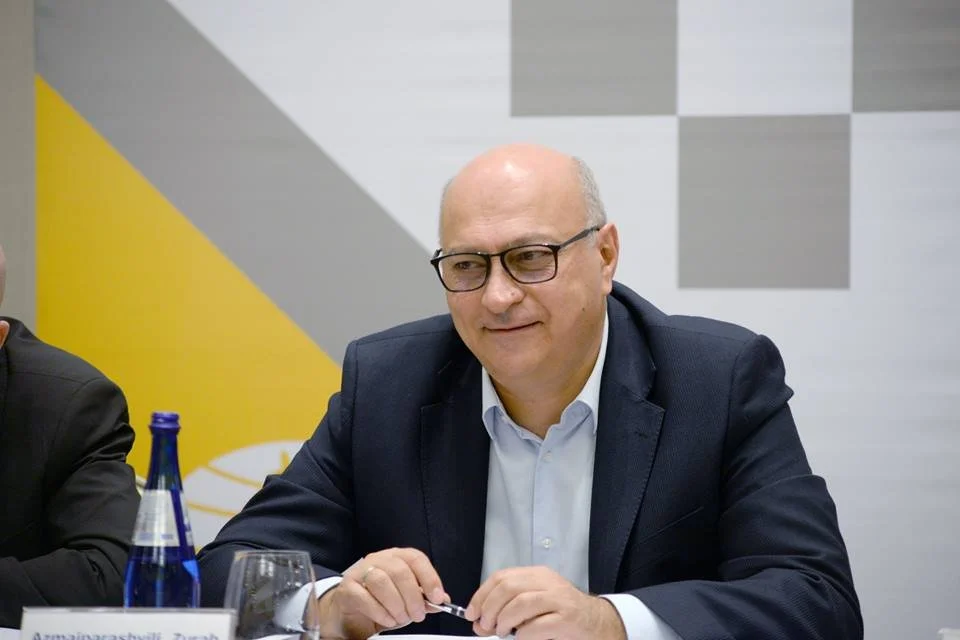
Photo by: Seyran Baroyan
Historical Assessment
Zurab Azmaiparashvili deserves attention today because his career illuminates how chess expertise can survive a political and institutional rupture, then acquire new forms. His best results establish him as a major grandmaster in his own right. His work with players, teams, academies, federations, and international events shows how the practical culture of Soviet chess was carried into the post-Soviet era and adapted to new national and European structures.
His full historical identity joins several roles: a product of Tbilisi's exceptional chess culture, a top-level competitor, Georgia's first-board standard-bearer, an elite analytical collaborator, and an institution builder whose influence has continued long after regular tournament play. His famous victory and high office belong to a coherent record of competitive preparation and public responsibility. That combination gives his career enduring value for the study of Soviet, Georgian, and European chess.
Notes and Sources
Sources were checked through 30 July 2026. Russian and Georgian names are transliterated in the forms most familiar to English-language chess readers. Short translations from Russian are the author's. Institutional biographies are useful for career chronology, but contemporary reports and event records take precedence where dates differ.
The European Chess Union biography gives Azmaiparashvili's birth date and title chronology. The January 1993 rating list records him at world number 11: OlimpBase, FIDE Rating List, January 1993. For the 2702 peak, see 2700chess, FIDE Top 100 History, July 2003. On the 2026 election, see FIDE, 18 July 2026.
The Georgian spelling and education are recorded in the Biographical Dictionary of the National Parliamentary Library of Georgia, which states that he completed the Georgian Institute of Physical Culture's chess specialization in 1981. Current official English usage appears in the European Chess Union President's Office. The absence of further family detail reflects the limits of the reliable public record reviewed for this article. ↩
Sergey Kim, "Zurab Azmaiparashvili: Chess Needs Me More!", ChessPro, 11 July 2015. The interview is the principal first-person source for Azmaiparashvili's recollections of Tbilisi chess, his junior selection, style, coaching, and career transition. For the position of Georgian women's chess in the local culture and Azmaiparashvili's emergence as a leading male player, see the Russian Chess Federation profile.
Kim, ChessPro interview, especially the discussion of the 1969 White Rook event, the old Rustaveli Avenue club, and the influence of Shota Intskirveli, Temur Lomaya, and Yuri Chikovani. Chikovani is also identified as a trainer of Azmaiparashvili in a later Georgian profile: Tbiliselebi, profile of Yuri Chikovani.
Youth and national titles are listed in the ECU biography. Azmaiparashvili's own account clarifies that the European junior event began in late 1979; the competition is conventionally catalogued as 1979/80. See Kim, ChessPro interview, and OlimpBase, European Junior Championship records.
European Chess Union biography, sections on Dinamo, the USSR Championship semifinal, USSR team championships, and the 1983 Spartakiad. For the wider institutional setting, see Andrew Soltis, Soviet Chess 1917-1991 (Jefferson, NC: McFarland, 2000), especially its treatment of republican teams, title pathways, and all-Union competition; publisher's record.
The game was Karpov-Azmaiparashvili, Moscow, 8 April 1983, Pirc Defence, 0-1. See the contemporary-career discussion in Kim's ChessPro interview, the Russian Chess Federation profile, and the score metadata at 365Chess. The article cites the game only because it shaped his reputation and the public association between his name and the Pirc.
OlimpBase, Chicago 1983 individual statistics, records 6.5/8, no losses, and first place on board four. The World Youth Under-26 team summary records Soviet gold in 1983 and 1985. Title dates and USSR Championship appearances are confirmed by the ECU biography.
For the Capablanca Memorial, see OlimpBase, Capablanca Memorial records. For London, see John Saunders, Lloyds Bank Masters 1989. The GMA qualifier result is recorded at 365Chess; its personal significance and the cancellation of the projected World Cup series are discussed in Kim's ChessPro interview.
OlimpBase, FIDE Rating List, January 1993. The 1994 European Club Cup result is catalogued by OlimpBase, which records Bosna Sarajevo and Lyon-Oyonnax as joint winners. The zonal and knockout-championship record appears in the ECU biography. That biography contains a typographical error in its Las Vegas year, so this article does not repeat its year-by-year knockout list.
Seven consecutive first-board Olympiad appearances from 1992 through 2004 are listed in the ECU biography and summarized in the ChessBase career profile published in July 2026. The quotation on team leadership is from Kim's ChessPro interview.
OlimpBase, 33rd Chess Olympiad, Elista 1998, individual medals and Nona Gaprindashvili Trophy standings. OlimpBase gives a 2804 performance; some later biographies give 2810. This article uses the event archive's calculation.
For Ohrid 2001, see the contemporary results report at Chessib.com. Mark Crowther, The Week in Chess 449, 16 June 2003, gives the 2003 field size, score, and official standings. The rating peak appears in the July 2003 FIDE Top 100 history. Georgia's team bronze is recorded at OlimpBase, European Team Championship 2003.
The FIDE tournament report for the 2010 ASEAN Championship records Azmaiparashvili and Oliver Barbosa on 6.5/9; the ECU biography records Azmaiparashvili as champion on tie-break. His explanation of the post-2003 transition appears in Kim's ChessPro interview.
Kim, ChessPro interview, for Azmaiparashvili's explanations of the Pirc and Georgian style. The opening frequencies can be checked in the 365Chess player record. The stylistic interpretation in the text is the author's, grounded in those first-person comments and repertoire data.
The Russian Chess Federation profile identifies Azmaiparashvili's English Opening work before Seville 1987. The broader 1987-1994 period is given in the ECU biography. His assessment of the collaboration appears in Kim's ChessPro interview. See also Garry Kasparov, Garry Kasparov on Modern Chess, Part Three: Kasparov v Karpov 1986-1987 (London: Everyman Chess, 2009), for Kasparov's account of the match context.
Training periods for Polgar, Bacrot, and Radjabov are listed in the ECU biography. The Russian Chess Federation profile of Etienne Bacrot independently notes Azmaiparashvili's role in Bacrot's training sessions.
For Azerbaijan's 2009 title, see the contemporary Week in Chess report and the official Chess-Results standings. Azmaiparashvili discussed his captaincy during the event in Azerisport, 28 October 2009. Trainer titles, the Botvinnik award, and academy work are recorded in the ECU biography.
Georgian federation, Black Sea Chess Association, and FIDE offices are listed in the European Chess Union biography.
Radio Tavisupleba, 10 March 2015, reports that First Deputy Minister Azmaiparashvili resigned voluntarily after becoming ECU president. The official ECU biography gives 2012-2015 in one section and 2012-2014 in another; the dated Georgian report supports March 2015 as the endpoint. State honors are listed by the ECU.
Official FIDE World Cup 2017 site, joint press conference, identifying Azmaiparashvili as director of the Batumi 2018 organizing committee and describing preparations for the Tbilisi World Cup. The role is also listed in the ECU biography.
Official election reports: ECU, 2014; ECU, 2018; FIDE, 2022; and FIDE, 2026. For the Medal of Merit, see FIDE, "Celebrating 40 Years of the European Chess Union," 11 October 2025. Educational priorities are discussed by Azmaiparashvili in the 2015 ChessPro interview.
