Anatoly Lein
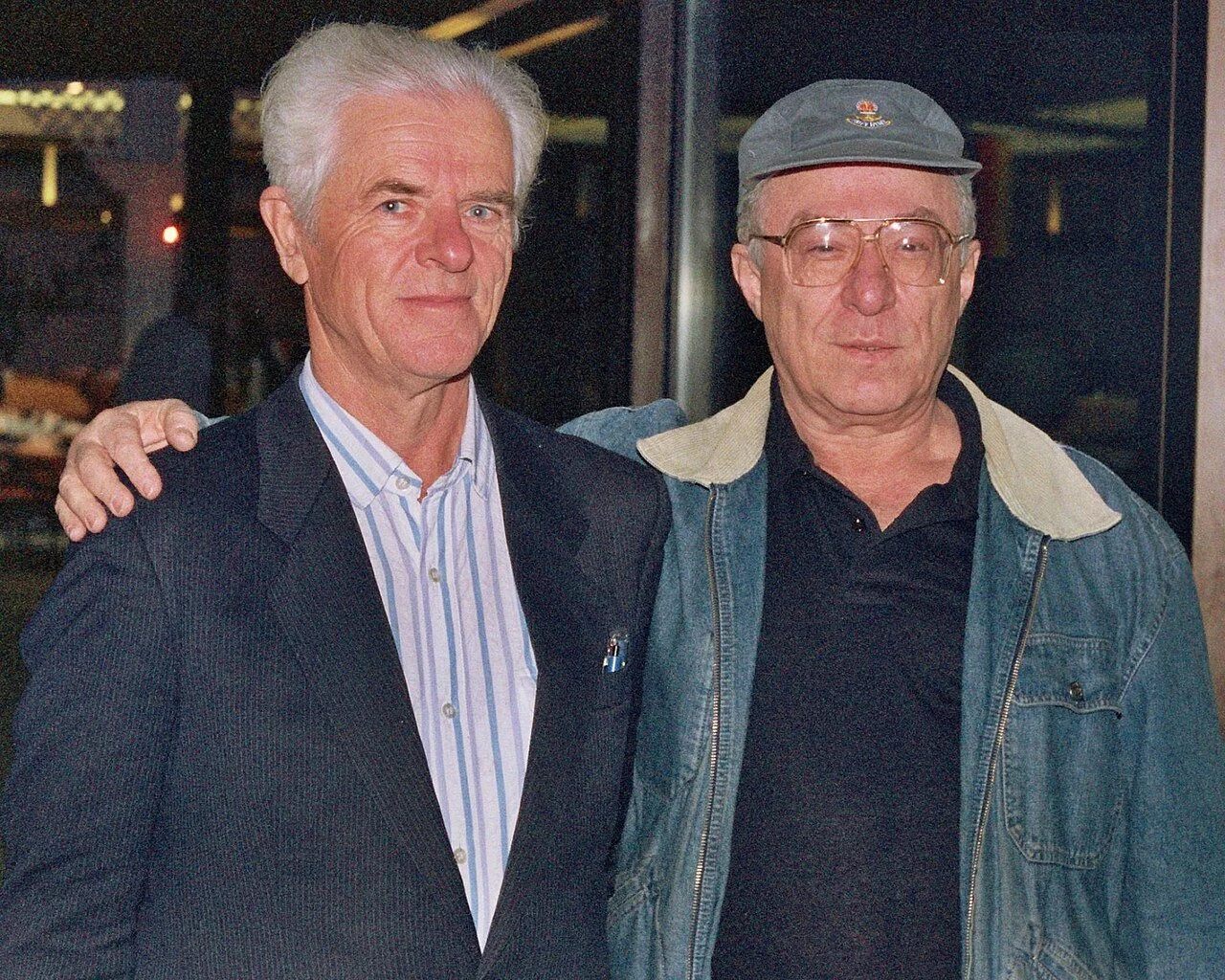
Boris Katalymov and Anatoly Lein. By GFHund - Own work, CC BY 3.0, https://commons.wikimedia.org/w/index.php?curid=10014275
Introduction
Anatoly Yakovlevich Lein (Анатолий Яковлевич Лейн), whose first name also appears in English as Anatoli, belonged to a formidable generation of Soviet grandmasters whose strength outweighed their visibility in world championship history. Born in Leningrad on 28 March 1931, he became an International Master in 1964 and a grandmaster in 1968. He won major events in the Soviet Union, Cuba, Yugoslavia, and the United States, represented two countries in elite team competition, and remained an active tournament player into his eighties. He died in the Cleveland area on 1 March 2018.1
Lein's historical importance rests on more than longevity. In the 1960s and early 1970s he established himself within the unusually deep Soviet championship system, winning the championship of the Russian republic, finishing high in USSR Championship finals, and earning the best percentage on the victorious Soviet team at the 1965 European Team Championship. After emigrating in 1976, he immediately became a leading figure in American open tournaments and later helped the United States win an Olympiad bronze medal. Younger American masters remembered him as a demanding technical player whose games and postmortem analysis offered an education in grandmaster practice.2
This double career makes Lein especially revealing. He was formed by Soviet chess institutions, but a substantial part of his influence was exercised in the more open, mobile, and commercially organized tournament culture of the United States. His record connects those settings without reducing his life to a political symbol. The central subject is the chess player himself: his development, competitive achievements, working methods, teaching, and place in historical memory.
Early Life and Chess Formation
The dependable public record says much less about Lein's parents and childhood household than it does about his tournament career. No well-sourced published biography located for this profile gives a reliable account of his parents' occupations or identifies a family chess tradition. That silence is worth preserving. It is preferable to acknowledge a gap in the record than to turn an undocumented story into biography.
The available evidence indicates that Lein learned chess when young and developed largely through his own effort. In a later interview, he recalled repeatedly losing to an older local boy and becoming determined to improve; he described himself as essentially self-taught. His formal education was scientific. A contemporary obituary reports that he studied mathematics and physics and worked as an engineer, while the Russian Jewish Encyclopedia identifies him as a mathematician. The combination is consistent with the analytical habits that later colleagues associated with his chess, although any direct causal link remains interpretation rather than documented testimony.3
Lein's emergence as a strong player came from Leningrad rather than the more celebrated Moscow chess circles. By the middle of the 1950s he had reached the national qualifying structure. In his first USSR Championship semifinal he defeated Alexander Tolush and drew with Mark Taimanov and Ratmir Kholmov, all established masters. He received the Soviet title of Master of Sport in 1956 and represented the Trud sports society in Leningrad.4
Those results show a player whose route differed from early institutional selection. Lein entered the upper level of Soviet chess as a mature competitor, after education and professional training, and then consolidated his place through repeated success against experienced opposition. His formation appears to have depended on self-instruction, strong local competition, and the demanding Soviet qualification system more than on a single celebrated coach.
Rise in Competitive Chess
Lein played in seven USSR Championship finals between 1961 and 1972. The number alone requires context. A Soviet final of this period was an exceptionally strong national championship: it regularly included world champions, Candidates, and grandmasters who would have led most other national teams. Lein's repeated qualification therefore marked sustained membership in the Soviet elite. His career developed through championships and international tournaments outside the Candidates cycle.
Lein won the USSR Armed Forces Championship in 1962, followed by his broader breakthrough in 1963. That year he won the championship of the Russian Soviet Federative Socialist Republic and, in the USSR team championship, scored 7 points from 9 games on board five for the Russian republic. He was undefeated and produced the best result on that board.5 In the 1964/65 USSR Championship final, he scored 11 from 19, defeating Leonid Stein, Evgeny Vasiukov, and Alexey Suetin. Two years later he finished sixth in the 1966/67 final, another result of high standing in an event headed by Stein, with a notable victory over former world champion Vasily Smyslov.6
Team competition supplied equally strong evidence of his level. At the 1965 European Team Championship in Hamburg, Lein served as the Soviet Union's first reserve. He scored 6 from 7, with five wins and two draws. His 85.7 percent was the highest percentage on the Soviet team, which won the championship by a wide margin.7 Reserve status on that roster conveyed elite standing. The team included Tigran Petrosian, Mikhail Botvinnik, Smyslov, Paul Keres, Stein, Viktor Korchnoi, Efim Geller, and other leading grandmasters. Lein's selection and score placed him securely within that company.
His international results soon converted standing into title. At Sarajevo in 1968, Lein went through the fifteen-round tournament without a loss and scored 10 points, level with Dragoljub Ćirić at the head of the table. Some later summaries list Ćirić first and Lein second, apparently reflecting the published order or tie-breaking convention; on score, they shared first place. FIDE awarded Lein the grandmaster title that year.8
Major Career Achievements
Lein's strongest sequence of individual tournament results came from the late 1960s through the early 1970s. He shared first in a Moscow event in 1970 and won the Moscow city championship in 1971 after a playoff. These successes were significant because Moscow's championship field drew from one of the densest concentrations of grandmaster strength in the world.9
The clearest international triumph was the 1972 Capablanca Memorial in Cienfuegos, Cuba. Lein scored 14 from 19, one point ahead of Igor Platonov, and remained undefeated. The result combined the two qualities most associated with his mature play: the ability to accumulate wins and the practical discipline to avoid losses across a long event.10 The year is sometimes given incorrectly as 1973 in later biographical pages. Contemporary tournament records and the event's historical roll show that Lein won in 1972; Smyslov won the 1973 edition.11
Lein also won at Novi Sad in consecutive years. In both 1972 and 1973 he scored 12 from 15, finishing ahead of Pal Benko in the first event and Milan Matulović in the second. Repeating a commanding result in the same strong Yugoslav tournament reinforced his reputation as a reliable international professional rather than a player dependent on a single exceptional performance.12
FIDE's July 1973 rating list placed Lein at 2545 and joint 38th in the world. Historical ratings should be handled cautiously because list frequency, player pools, and inflation differ across periods. Even so, a documented top-forty position provides a useful scale for his early-1970s standing. It also helps explain why his name recurs in the results of world champions and Candidates despite his absence from the championship cycle itself.13
His individual record included victories over Mikhail Tal, Smyslov, David Bronstein, Polugaevsky, Stein, and Taimanov. The list supports a career assessment when read alongside his tournament scores. Its breadth is informative. Lein could compete successfully with tactical improvisers, strategic technicians, and players of different generations. The Smyslov victory in the 1966 USSR final and the undefeated first-place scores at Sarajevo and Cienfuegos are especially representative because they connect a celebrated result with the sustained qualities of his play.14
Emigration and the American Chess World
Lein left the Soviet Union for the United States in 1976, during the early movement of Soviet Jewish chess professionals to the West. He arrived in the same period as Leonid Shamkovich. His second career began at full pace. In 1976 he shared first place in the U.S. Open with Shamkovich and shared first in the World Open with Bernard Zuckerman, two of the central events on the American tournament calendar.15
The American open circuit rewarded stamina, rapid adjustment to varied opposition, and the ability to play several serious events in succession. Lein's Soviet experience transferred naturally. His presence also changed the educational environment around young American masters. Joel Benjamin later recalled that players including John Fedorowicz, Michael Rohde, John Wilder, and Benjamin himself benefited from facing Lein and listening to his analysis. Norwegian grandmaster Jonathan Tisdall likewise credited Lein with shaping his chess philosophy. These recollections are evidence of influence through direct contact rather than proof of a formal coaching position.16
Lein's most important national-team appearance for his adopted country came at the 1978 Chess Olympiad in Buenos Aires. Playing board three, he scored 6 from 10. The United States finished third, behind Hungary and the Soviet Union, and won the bronze medal.17 Thirteen years after contributing the top percentage to a Soviet European championship team, he had helped an American team reach the Olympiad podium. Few elements of his career illustrate its unusual geographical range more clearly.
Style and Reputation
Lein's style is best reconstructed from results and from the testimony of players who faced him. Benjamin remembered exceptional endgame technique, persistent pressure from small advantages, and resourceful defense in inferior positions. Among a group of young American players, the difficulty of escaping his long technical games produced the affectionate expression "Anatoly Lein Chamber of Horrors." The phrase captured a practical experience: an apparently modest edge could become an extended examination in calculation, patience, and precision.18
That description is broader than the narrow label of a purely positional player. Lein defeated some of the most dynamic players of his era, and two of his books were devoted explicitly to tactical training. His strength lay in integrating tactics into a coherent technical game. He could calculate sharply, while his reputation rested especially on what happened after the immediate complications had passed: preserving pressure, finding defensive resources, and making the opponent solve problems for many hours.
Lev Alburt, another Soviet-trained grandmaster who built a major career in the United States, called Lein "a true grandmaster" and emphasized the originality of his approach. The short judgment is valuable because it came from a peer familiar with both chess cultures in which Lein worked.19 It also points to a feature that bare tournament tables miss. Lein's contemporaries remembered a solid scorer with a recognizable way of thinking about positions.
A fair account should place his competitive profile in context. Lein's greatest results were distributed among national finals, team events, and strong international tournaments, with his reputation built outside a world championship campaign. His technical victories also generated fewer famous set pieces than the short tactical games that circulate most easily in anthologies. This helps explain his comparatively modest public profile and describes the way his record entered historical memory.
Contributions Beyond Tournament Play
The strongest documented evidence for Lein's work beyond competition concerns authorship and instruction. One easily overlooked credit is Kasparov vs. Karpov 1990, published in English in 1991 under the names of Garry Kasparov, Efim Geller, Lein, and Viktor Chepizhny. Chess historian Edward Winter cites the volume under those joint authors. The bibliographic credit establishes Lein's contribution to contemporary match literature, although the accessible record does not specify the division of work among the four authors or establish that Lein served as a match second.20
Lein later coauthored The Latvian Gambit: A Grandmaster View with Sid Pickard in 1995 and Sharpen Your Tactics! 1125 Brilliant Sacrifices, Combinations, and Studies with Boris Archangelsky in 1996. In the World of Tactics, Volume 1: 1997 followed in 1998. The titles show two sides of his intellectual interests: close examination of a provocative opening and the systematic cultivation of tactical vision.20
The most reliable accessible sources used here do not establish a sustained formal role for Lein as a state trainer, organizer, or commentator. His contribution as a teacher is well documented in a less bureaucratic form. Benjamin's recollection presents Lein as an exacting opponent and postmortem analyst whose influence spread through repeated contact. In Cleveland, he mentored International Master Calvin Blocker, who visited Lein's Shaker Heights apartment to analyze games and receive advice. Lein's stepson, William Jacobson, also remembered receiving chess lessons from him and described Lein as genuinely invested in his tournament progress. Jacobson recalled his devotion to chess, books, and literature.21
This mode of transmission was well suited to the American chess scene of the late 1970s and 1980s. His methods became influential through long games, shared analysis sessions, lectures, and published collections. Each gave ambitious players access to habits formed in Soviet master competition. It is reasonable to interpret this as one of his most enduring contributions, while keeping informal mentorship distinct from an institutional post.
Later Life
Lein continued to compete at a high level long after the peak of his international ranking. He won the New Jersey state championship four consecutive times from 1992 through 1995. In the 1996 World Senior Championship, he finished level on points with Alexey Suetin, who received first place on tie-break. At seventy-one, Lein scored 4.5 from 9 in the 2003 U.S. Championship, an even result in a national field containing several generations of professionals.22
FIDE's record includes rated games by Lein as late as October 2013. His continued activity is more historically meaningful than a simple longevity statistic. It allowed players whose chess education belonged to the internet era to meet, in direct competition, a grandmaster whose Soviet career had placed him across the board from Botvinnik, Smyslov, Tal, Petrosian, and their contemporaries.23
Lein married Barbara Gottlieb and moved to the Cleveland area in 1998. She died in February 2018, thirteen days before him. Lein died on 1 March 2018 at the age of eighty-six. The U.S. Chess Hall of Fame inducted him in 2004, recognizing both his international accomplishments and his place in American chess.24
Historical Legacy
Lein's career resists a single national frame. He was a product of Leningrad, Karelia, Soviet sports organizations, republican championships, and USSR finals. He was also a U.S. Open and World Open winner, an American Olympiad medalist, a state champion, an author in English, and a formative opponent for a rising generation of American professionals. Neither half of the record is supplementary to the other.
His legacy is clearest in three areas. First, his results document the depth of elite Soviet chess below the small circle of world championship candidates. A player ranked among the world's top forty could finish sixth in a national final and serve as a reserve on a national team. Second, his American career shows how émigré grandmasters altered competitive and educational standards through tournament play and face-to-face analysis. Third, his unusually long activity made him a living link between mid-century Soviet master culture and twenty-first-century international chess.
Anatoly Lein deserves attention today because his life enlarges the usual definition of historical significance. His durable record rests on Soviet results, international tournament victories, service to two national teams, books, and influence on younger players. Together they form a coherent portrait of grandmaster professionalism. He carried a rigorous chess culture across borders and transmitted it through competition, analysis, and teaching for more than half a century.
Notes and Sources
1. FIDE records Lein's birth date as 28 March 1931 and lists the IM title in 1964 and GM title in 1968: FIDE, "Lein, Anatoly". Dylan Loeb McClain's obituary, republished by WRAL, gives 31 March, a discrepancy with FIDE and Russian reference records: "Anatoly Lein, Soviet-Born Chess Grandmaster, Dies at 86". The 28 March date is used here because it is supported by the official rating record and Russian biographical sources.
2. World Chess Hall of Fame, "Anatoly Lein"; Joel Benjamin, "GM Joel's Tribute to Anatoly Lein".
3. McClain, "Anatoly Lein, Soviet-Born Chess Grandmaster, Dies at 86". See also the entry in the Russian Jewish Encyclopedia, "ЛЕЙН Анатолий Яковлевич", which identifies his profession as mathematics.
4. Russian Chess Federation, "Анатолий Лейн"; Sport-Strana, "Лейн Анатолий Яковлевич".
5. A USSR Championship player index records Lein's seven finals. The Russian republican title is recorded by the World Chess Hall of Fame and the Russian Chess Federation. For the board-by-board USSR team championship record, see OlimpBase, "9th Soviet Team Chess Championship: Individual Results, Board 5".
6. Russian Chess Federation, "Анатолий Лейн". The source supplies Lein's scores and identifies the victories over Stein, Vasiukov, Suetin, and Smyslov.
7. OlimpBase, "3rd European Team Chess Championship, Hamburg 1965: Individual Results".
8. The tournament score is given by 365Chess, "Sarajevo 1968". For the title year, see FIDE, "Lein, Anatoly". The Russian Chess Federation biography places Lein second at Sarajevo, while the tournament table gives Lein and Ćirić equal scores; the text therefore uses "shared first on points."
9. World Chess Hall of Fame, "Anatoly Lein"; Russian Chess Federation, "Анатолий Лейн"; Chessgames, "The Chess Games of Anatoly Lein". The sources differ slightly in how they label the 1970 Moscow success, so it is distinguished here from the documented 1971 city championship.
10. 365Chess, "Capablanca Memorial 1972".
11. The event-by-event series record lists Lein as the 1972 winner and Smyslov as the 1973 winner: OlimpBase, "Capablanca Memorial". A separate historical survey published by ChessBase gives the same sequence: "Ivanchuk Wins Capablanca Memorial with 2839 Performance". This corrects the stray 1973 attribution on some later summaries, including the otherwise useful World Chess Hall of Fame page.
12. For the Novi Sad series and final scores, see Uno Scacchista, "I luoghi degli scacchi: Novi Sad".
13. OlimpBase, "FIDE Rating List, July 1973". The list places Lein in a group tied at rank 38 with a rating of 2545.
14. McClain, "Anatoly Lein, Soviet-Born Chess Grandmaster, Dies at 86"; Russian Chess Federation, "Анатолий Лейн".
15. Russian Chess Federation, "Анатолий Лейн"; US Chess, "Hall of Famer Anatoly Lein Dies at 86"; World Chess Hall of Fame, "Anatoly Lein"; McClain, "Anatoly Lein, Soviet-Born Chess Grandmaster, Dies at 86".
16. Benjamin, "GM Joel's Tribute to Anatoly Lein". This is a participant's retrospective testimony and is treated as evidence of personal influence rather than as an institutional record.
17. OlimpBase, "23rd Chess Olympiad, Buenos Aires 1978: Individual Results" and "Final Group A: Final Standings".
18. Benjamin, "GM Joel's Tribute to Anatoly Lein".
19. Alburt's assessment is quoted in McClain, "Anatoly Lein, Soviet-Born Chess Grandmaster, Dies at 86".
20. Edward Winter, "Kasparov, Karpov and the Scotch", identifies the 1990 match book as the work of Kasparov, Geller, Lein, and Chepizhny. A bibliographic record for Kasparov vs. Karpov 1990 gives the English edition as Pergamon Press, 1991, ISBN 9780080411101. The World Chess Hall of Fame profile also identifies Lein as a chess writer. Further catalog records: Anatoly Lein and Sid Pickard, The Latvian Gambit: A Grandmaster View (1995), ISBN 9781880673973; Anatoly Lein and Boris Archangelsky, Sharpen Your Tactics! (1996), ISBN 9781880673133; Anatoly Lein, In the World of Tactics (1998), ISBN 9781886846111. These commercial links are used only as catalog records. No claim in the article relies on a book-preview snippet.
21. Jason Bracelin, "Blocker's Gambit", Cleveland Scene, 5 October 2005; US Chess, "Hall of Famer Anatoly Lein Dies at 86".
22. The New Jersey titles are recorded by the World Chess Hall of Fame. For the 1996 senior result, see Mark Crowther, The Week in Chess 107. For the 2003 national championship score, see ChessFocus, "2003 U.S. Championship".
23. FIDE, "Lein, Anatoly", rating progress and game record.
24. US Chess, "Hall of Famer Anatoly Lein Dies at 86"; World Chess Hall of Fame, "Anatoly Lein". The current Hall of Fame record gives induction in 2004.
