Andrei Kovalev
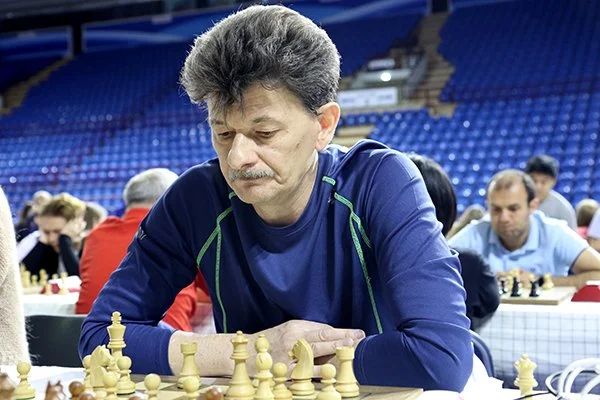
Photo by Eteri Kublashvili. Viktor Kupreichik Memorial 2018. Via Ruchess
Introduction
Andrei Vasilyevich Kovalev was born on 7 November 1961 in Vitebsk, then part of the Byelorussian Soviet Socialist Republic. His name appears in Russian as Андрей Васильевич Ковалёв or Ковалев, in Belarusian as Андрэй Васільевіч Кавалёў, and in Western publications as Andrei or Andrey Kovalev. German sources often use Andrej Kowaljow. FIDE awarded him the International Master title in 1989 and the Grandmaster title in 1992.¹
Kovalev belongs to a generation whose careers crossed several institutional worlds. He developed in the Vitebsk chess school, advanced through Soviet qualification tournaments, played for the Soviet military and German clubs, and then represented independent Belarus. His competitive record includes a peak rating of 2580, the Belarusian championship, four Chess Olympiads, four European Team Championships, and an exceptional run through the 1992 Tilburg knockout tournament. His later work as a national-team coach, analytical writer, and contributor to Belarusian chess archives adds an important second dimension to that record.
The available sources are considerably fuller on Kovalev’s chess than on his private life. Tournament records, interviews, federation publications, and recollections by fellow players document his development and professional relationships. Reliable published information about his parents and family background remains unavailable. Any more detailed account of his household or social origins would therefore be speculative.
Early Life and Chess Formation
A professional profile published under Kovalev’s name lists his education at the Belarusian Institute of Physical Culture. No accessible institutional record provides the degree, department, or dates, so the educational detail should be regarded as self-reported.² His formative chess education is much better documented.
Kovalev’s first coach was Lev Ruvimovich Pak, one of the central figures in postwar Vitebsk chess. Pak’s pupils included four future grandmasters: Kovalev, Ilya Smirin, Evgeny Agrest, and Raisa Eidelson. Smirin later observed that producing four grandmasters in a city the size of Vitebsk was a remarkable achievement. Kovalev’s own memorial tribute presents Pak as a teacher who encouraged imagination, humor, and flexible thought. He recalled that Pak’s pupils were associated with “вкусные шахматы,” literally “chess with flavor.” The phrase described a shared aspiration toward lively and interesting play, rather than a formal technical school.³
Kovalev also remembered a practical lesson concerning unusual openings. Pak did not teach eccentric systems as ends in themselves. He used them to make young players think independently and to remove the comfort of memorized patterns. This helps explain a recurrent feature of Kovalev’s mature chess: readiness to enter unfamiliar or unbalanced positions without depending on a narrow repertoire.
His first major documented team success came at the Fifteenth All-Union Spartakiad of Schoolchildren in Tashkent in 1978. The Byelorussian team finished first. Kovalev played alongside Petr Korzubov, Igor Lyutsko, Evgeny Voikhansky, Eduard Raisky, Alexander Ryskin, Elmira Khorovets, and Elena Shukhman. Albert Kapengut, who prepared the team, later recalled that Korzubov and Kovalev stood out during the training period. Kapengut’s account is a retrospective personal recollection, while the team victory and roster are independently preserved by the Belarusian Chess Federation.⁴
The Tashkent result placed Kovalev within an unusually productive Belarusian generation. It also introduced him to the Soviet model of collective preparation, in which regional coaching, training camps, and team competitions could accelerate the development of promising players well before they entered the adult championship system.
Rise in Competitive Chess
Kovalev became a Soviet Master of Sport in 1982, reportedly after his performance in the Sokolsky Memorial. He subsequently served in the Group of Soviet Forces in Germany and joined its chess team at Wünsdorf, south of East Berlin. The unit was a serious competitive environment. Grandmaster Rustem Dautov recalled a group that included Valery Chekhov, Konstantin Aseev, Sergei Kalinichev, Vladimir Chuchelov, Kovalev, and Dautov himself. According to Dautov, the players trained daily, contested military championships, and entered individual tournaments in East Germany.⁵
Military chess was therefore a substantial phase of Kovalev’s professional formation. It gave him regular practice against master-level opposition and access to the dense club and tournament culture of the German Democratic Republic. His International Master title was formally awarded in 1989.
A decisive advance had come in 1988 at an All-Union qualifying tournament in Blagoveshchensk. The contemporary Soviet magazine 64: Shakhmatnoe obozrenie recorded Kovalev in second place behind Smbat Lputian, half a point from first. Lputian advanced to the Higher League of the USSR Championship, while Kovalev qualified for the First League.⁶ Reaching the First League placed him close to the upper boundary of Soviet tournament chess. The field below the national championship proper contained experienced grandmasters, strong regional masters, and younger players moving toward international recognition.
Kovalev also represented the Byelorussian SSR in Soviet team competitions in 1983, 1986, and 1991. OlimpBase’s surviving records give him 12 points from 19 games and an individual silver medal, though the database warns that Soviet team records are incomplete.⁷ The 1991 republican team included Kovalev on first board and finished sixth at the final Soviet-era Summer Spartakiad. His place at the head of that team reflected the status he had attained within Belarusian chess by the end of the USSR.
His German connections continued beyond military service. Playing for SV Empor Berlin in the 1991 eastern German team championship, Kovalev scored six points from eight games. The reconstructed competition record assigns him a performance rating of 2557, one of the strongest individual results in the event.⁸ Club chess in Germany would remain an important part of his career.
Major Career Achievements
FIDE awarded Kovalev the grandmaster title in 1992, the year in which his rating reached 2580.⁹ That season also produced the most internationally visible tournament run of his career.
The 1992 Interpolis tournament in Tilburg used a large knockout format. Kovalev eliminated Alexander Chernin in the first round, the thirteen-year-old Peter Leko in the second, and Rafael Vaganian in the third. He reached the last sixteen before losing to Michael Adams, who went on to win the tournament.¹⁰ Chernin and Vaganian were established members of the Soviet grandmaster elite, while Leko was already recognized as an exceptional prodigy. Kovalev’s progress through three very different opponents offered a concise demonstration of his practical range. It remains more informative about his international standing than a survey of minor tournament victories would be.
The same year, Kovalev played first board for Belarus at the European Team Championship in Debrecen. This was the country’s first appearance in the event as an independent state. The team comprised Kovalev, Viktor Kupreichik, Viacheslav Dydyshko, Alexei Alexandrov, and Yuri Mochalov. Kovalev was still listed as an international master in the competition records and scored four points from eight games against first-board opposition.¹¹ His assignment illustrates the transitional nature of his career: a player formed entirely within Soviet institutions became the leading board of a new national team.
Kovalev’s record in the Belarusian championship stretched across nearly two decades. He won bronze in 1984 with 9 points from 13 games, silver in 1997 with 7 from 11, the championship in 2000 with 8 from 11, and another bronze in 2003 with 8 from 12. In 2000 he finished a full point ahead of Viktor Kupreichik.¹² The interval between his first and last medals demonstrates sustained domestic relevance across the Soviet and post-Soviet periods.
Soon after winning the national title, Kovalev contested the Minsk zonal tournament of May and June 2000. Viktor Bologan won with 11 points from 13 games, followed by Viorel Iordachescu with 9½. Kovalev finished third with 8 points. Only Bologan and Iordachescu qualified for the next stage of the world championship cycle.¹³ Some later biographical summaries have understated the distance between Kovalev and the second qualifying place. The contemporary standings establish a margin of one and a half points.
Kovalev represented Belarus at four Chess Olympiads: Moscow 1994, Istanbul 2000, Bled 2002, and Calvià 2004. His cumulative Olympiad score was 15 points from 32 games.¹⁴ The 1994 team, which also included Boris Gelfand, Kupreichik, Yuri Shulman, Dydyshko, and Alexei Fedorov, placed twelfth. It was one of the strongest Belarusian lineups assembled after independence.
His European Team Championship record is occasionally reported incorrectly. The event records show four appearances, in 1992, 1999, 2001, and 2003. In León in 2001 he scored 4½ from 7, with an OlimpBase performance calculation of 2635. At Plovdiv in 2003 he was unbeaten, scoring 6 from 9 with a calculated performance of 2625. Belarus finished eighth, its best placing during Kovalev’s appearances.¹⁵ These results reinforce his value in national-team competition, particularly after his individual rating peak had passed.
Style and Reputation
Contemporary sources do not supply a universally accepted label for Kovalev’s playing style. Precise claims about a habitual endgame weakness, excessive risk-taking, or dependence on tactics would go beyond the evidence. The most defensible description is that of a resourceful and tactically alert all-rounder who was comfortable in unbalanced positions.
The creative atmosphere of Pak’s Vitebsk school is one part of that assessment. Tournament evidence supplies another. Kovalev could defeat highly experienced positional players, cope with a rapidly calculating young opponent such as Leko, and produce solid results in team events where reliability carried special weight. His Tilburg run shows practical ambition. His unbeaten 2003 European Team Championship performance shows restraint and adaptability.
His games also reveal a broad opening range. This breadth should not be confused with the construction of a major theoretical system. No single variation became permanently associated with his name. His contribution was primarily practical: testing positions in competition, choosing structures suited to the opponent, and using less familiar openings to create independent play. That approach closely resembles the method he attributed to Pak.
The principal limitation visible in his career record is continuity at the highest international level. Kovalev’s elite results arrived in concentrated episodes. His 2580 rating, Tilburg performance, and best national-team events demonstrate considerable peak strength. The larger portion of his career developed through national championships, club leagues, team competitions, and coaching. Consequently, his reputation is firmly established within Belarusian chess and the German club circuit, while general international histories give him less space than his strongest results warrant.
Professional trust forms another part of his contemporary reputation. Federations repeatedly appointed him as a team captain or coach, and fellow players recruited him for club teams. Those responsibilities required preparation, discretion, and an ability to work with players of different styles. They offer evidence of standing among colleagues that rating lists alone cannot provide.
Contributions Beyond Tournament Play
Kovalev gradually made training his principal occupation. FIDE awarded him the Senior Trainer title in 2010.¹⁶ His work has included national teams, club players, established professionals, and juniors.
He served as a mentor to the Belarusian women’s team by the 2008 Dresden Olympiad. That team finished tenth overall and won its rating group. The Belarusian Chess Federation later identified him as captain at the 2013 European Team Championship and as senior coach of the women’s national team in 2020.¹⁷ In 2016 the German Chess Federation listed “GM Andrej Kowaljow” of Belarus as captain of the Iranian women’s team at the Baku Olympiad, evidence that his coaching reputation extended beyond Belarus.¹⁸
Several players have acknowledged his assistance. Anastasia Sorokina stated in an interview that Kovalev “helped me a lot.” More recently, Vitebsk reports have identified him as part of the coaching group behind junior Egor Silich, a European youth medalist.¹⁹ The latter relationship is historically apt. Kovalev became a transmitter of the Vitebsk tradition in which he had been trained by Pak.
His connection with Ilya Smirin also continued well beyond their common origins. Smirin recalled bringing Kovalev to the Ashdod club in Israel in 2001, after which Kovalev played several seasons there.²⁰ Their association linked personal friendship, club recruitment, and professional chess work. It also illustrates the international networks through which post-Soviet grandmasters sustained competitive and coaching careers.
Kovalev has published analytical writing, though the evidence does not support describing him as a prolific chess author. His most notable historical essay is “Kupreichik and Houdini,” published by ChessPro in 2015. The article revisited four games by Viktor Kupreichik with the assistance of the Houdini engine. Kovalev used the computer to test combinations while preserving attention to Kupreichik’s imagination and the practical difficulty of his decisions.²¹ The result is valuable as testimony from one Belarusian grandmaster about another. It also shows Kovalev negotiating a central problem in modern chess historiography: how to use engines without reducing creative play to a sequence of numerical verdicts.
A quieter contribution concerns the preservation of Belarusian tournament history. Chess historian Andrei Malyush publicly thanked Kovalev for supplying missing information and supporting the reconstruction of Belarusian championship records.²² Such assistance rarely appears in player biographies, yet it can determine whether regional chess history remains verifiable. Kovalev’s participation gave the project access to a competitor’s memory and records from events whose documentation was scattered across Soviet publications and private collections.
Later Life and Historical Legacy
Vitebsk marked Kovalev’s sixtieth birthday in 2021 with a simultaneous exhibition. The accompanying local report described coaching as his main activity and identified him as a senior coach of the Belarusian national team.²³ He has also remained active as a player, continuing to appear in rated competition and current game records into 2026.²⁴
His legacy rests on continuity across generations and institutions. Pak’s training shaped his early conception of chess. Soviet schools and military competition supplied the structure within which he became a master. German club chess broadened his professional experience. Independent Belarus entrusted him with first-board and later coaching responsibilities. His subsequent work with women’s teams, junior players, Smirin, and foreign federations carried that accumulated experience into new settings.
Kovalev also occupies a distinctive place in Belarusian chess chronology. His 1978 school-team victory belongs to the mature Soviet system. His 1992 European Team Championship appearance belongs to the first year of Belarusian international representation. His national title and zonal performance came during the consolidation of post-Soviet chess. His later coaching and archival assistance helped preserve connections among these periods.
Historical Assessment
Andrei Kovalev deserves attention today because his career joins high-level achievement with the transmission of chess culture. He reached the Soviet First League, became Belarusian champion, defeated leading grandmasters at Tilburg, and represented Belarus during the country’s first decade of independent competition. He subsequently invested his experience in national teams, younger players, analytical writing, and the preservation of Belarusian championship history. His record provides a focused view of how a gifted Vitebsk pupil became an international grandmaster and then helped carry the tradition that formed him into another generation.
Notes and Sources
The source base for Kovalev is heterogeneous. Official federation records and contemporary tournament reports have been preferred for dates, standings, and team selections. First-person recollections are used for coaching relationships and institutional experience. Retrospective profiles were checked against event records where possible.
International Chess Federation, “Kovalev, Andrei, FIDE Profile”; Russian Chess Federation, “Андрей Ковалев”. The FIDE profile confirms the title years, federation, birth year, identification number, and Senior Trainer title.
Andrei Kovalev, professional profile, listing the Belarussian Institute of Physical Culture. As a self-authored professional source, it is useful but less authoritative than an institutional register.
Andrei Kovalev’s first-person tribute in a memorial collection devoted to Lev Pak; Ilya Smirin, interview with ChessPro. The memorial collection also contains recollections by other Pak pupils.
Belarusian Chess Federation, “История белорусских шахмат”; Albert Kapengut, recollections of the 1978 school Spartakiad team.
Rustem Dautov, recollections of chess in the Group of Soviet Forces in Germany; FIDE, Kovalev profile.
64: Shakhmatnoe obozrenie, 1988, no. 20, available through the Soviet chess-periodical archive; Russian Chess Federation, Kovalev biographical profile.
OlimpBase, Andrei Kovalev in Soviet team competitions; Belarusian Chess Federation, historical competition records. OlimpBase expressly notes gaps in the surviving Soviet results.
1991 eastern German team-championship results, tabulated from Schach, 1991, no. 6; SV Empor Berlin, club retrospective naming Andrej Kowaljow among its former players.
FIDE, Kovalev profile; ChessBase, Andrei Kovalev player record.
Belgian Chess History, “16th Interpolis Tournament, Tilburg 1992”; 365Chess, Tilburg 1992 game and result index.
OlimpBase, Belarus at the 1992 European Team Championship.
Belarusian Chess Federation, official list and scores of Belarusian championship medalists.
Mark Crowther, The Week in Chess, no. 293, contemporary report and final standings of the Minsk zonal, 2000.
OlimpBase, Andrei Kovalev’s Belarus Olympiad record; Belarus at the 1994 Moscow Olympiad.
OlimpBase, Belarus at the European Team Championships of 1999, 2001, and 2003. Performance ratings cited here are OlimpBase calculations.
FIDE, Kovalev profile.
Sovetskaya Belorussiya, report on Kovalev and the Belarusian women’s team before the 2008 Olympiad; Belarusian Chess Federation, 2013 European Team Championship announcement, and 2020 report identifying Kovalev as senior coach; Belarusian Chess Federation, historical national-team results.
German Chess Federation, Olympiad report identifying GM Andrej Kowaljow as captain of the Iranian women’s team, 2016.
Anastasia Sorokina, interview with ChessPro; Vitbichi, report on Egor Silich and his Vitebsk coaching team.
Ilya Smirin, interview discussing Kovalev’s recruitment to the Ashdod club.
Andrei Kovalev, “Купрейчик и Гудини”, ChessPro, 2 July 2015.
Andrei Malyush, “Статистика чемпионатов Беларуси”, acknowledging Kovalev’s assistance with missing historical data.
Vitbichi, report on Kovalev’s sixtieth-birthday simultaneous exhibition, 2021.
FIDE, current rating profile; 365Chess, Andrei Kovalev game record.
