Vlastimil Hort
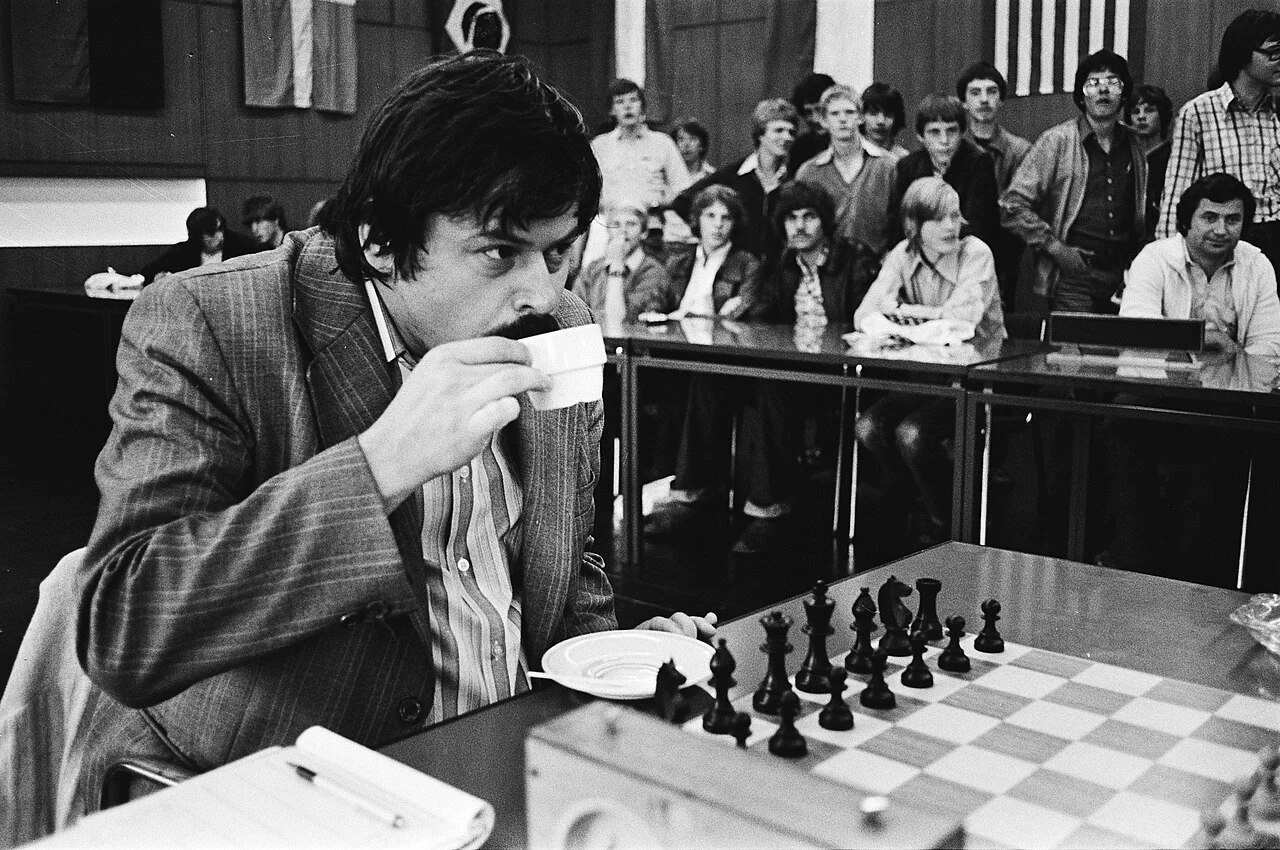
Rob Bogaerts / Anefo
Introduction
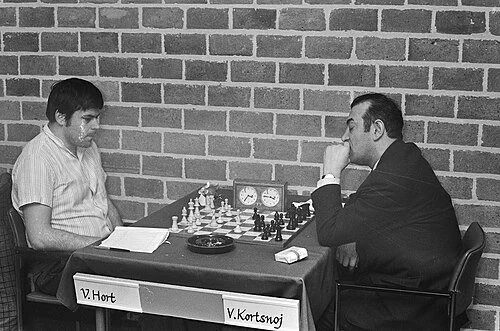
Vlastimil Hort, born on 12 January 1944 in Kladno and deceased on 12 May 2025, was one of the strongest non-Soviet grandmasters of the late 1960s through the early 1980s. FIDE’s obituary described him as a former world number six, and historical rating records place him at a peak of 2620 and tied for sixth in January 1977. He reached the 1977 to 1978 Candidates cycle, represented Czechoslovakia and later Germany in fourteen Olympiads, and remained a conspicuous public face of chess long after his peak as a competitor.
For readers interested in Soviet chess history, Hort deserves attention because he stood near the top of world chess without belonging to the Soviet chess establishment. He emerged from Czechoslovakia, a state inside the Soviet sphere yet outside Soviet institutional control, and repeatedly crossed swords with Soviet elite players in zonals, interzonals, Olympiads, and the 1970 USSR versus Rest of the World match. His career therefore offers a useful corrective to narratives that reduce elite Cold War chess to a simple Soviet versus Western binary. That is an interpretation based on his competitive record, his repeated presence in events structured around Soviet dominance, and his later reflections on life under the communist system.
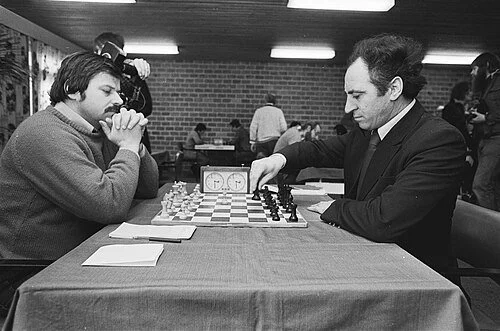
Rob Croes for Anefo
Early Life and Chess Formation
Memory of Nations records that Hort was born into the family of the social democrat Antonín Hort and Vlasta Hortová. Childhood illness shaped the origin story of his chess life. He later recalled that, while spending weeks in hospital at about age five, a friendly doctor named Novak taught him the moves. Afterward, his mother took him to a chess club, and by age seven he was already playing competitively in local events. These details appear both in his own retrospective interview and in Czech remembrance sources, which makes them unusually secure for an early-biographical anecdote.
Hort’s chess upbringing was formed inside a specifically Czech tradition. In his later historical essays, he described Salo Flohr as the spiritual father of the Czech school, rooted in safety, technique, and a Capablanca-like sense of proportion. He also knew Karel Opočenský personally and wrote about him with the familiarity of someone who felt himself to be part of an inherited national chess lineage rather than an isolated prodigy. These self-descriptions do not prove a formal line of instruction, but they strongly suggest how Hort understood his own formation.
He also studied economics at Prague’s Vysoká škola ekonomická, or VSE. In a later autobiographical piece, Hort recalled the ideological pressure of mandatory Marxism-Leninism examinations and wrote that, by the mid 1960s, he had already begun “putting feelers out to the West.” Russian Chess Federation profiles and later biographical notices describe him as an engineer-economist by education. Taken together, those sources suggest a young player who was academically capable, politically skeptical, and increasingly drawn toward a professional chess career that could not be cleanly separated from the regime under which he lived.
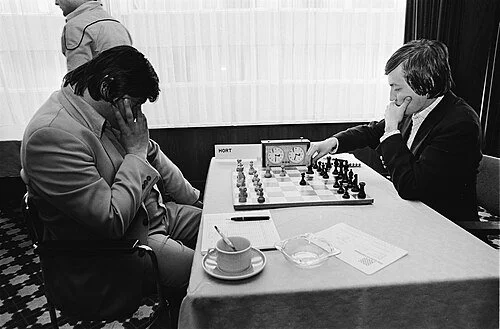
Marcel Antonisse / Anefo
Rise in Competitive Chess
Hort’s rise was early and unmistakable. Russian Chess Federation biographical material notes that as a teenager he was already making a deep impression in the national championship finals, and at sixteen he debuted for Czechoslovakia at the 1960 Olympiad in Leipzig. FIDE, Czech federation sources, and later specialist accounts agree on the broad outline: he became a regular national representative while still very young, gained the grandmaster title in 1965, and by the second half of the 1960s belonged to the first rank of Eastern European players outside the USSR.
The early international phase of his career produced a pattern that would define him for years. He did not merely win lesser events and disappear when the field hardened. Eduard Frey’s well-sourced anniversary essay, supported in part by historic tournament books and rating lists, places Hort among the world top twenty for the whole 1970s, with major results at Mariánské Lázně in 1965, Hastings in 1967 to 1968, Skopje and Venice in 1969, Havana and Göteborg in 1971, Reykjavík in 1972, Banja Luka in 1976, and Sarajevo in 1980. Such a list is selective, though already enough to show why he was viewed not as a regional star but as a durable member of the international elite.
The Soviet invasion of Czechoslovakia in 1968 sharpened the political context of his career. In a 2024 interview, Hort said that after the invasion he briefly refused to speak to Russian players and officials and wanted to leave, though circumstances and obligations kept him inside the Czechoslovak chess structure for years longer. That recollection is evidently retrospective, and therefore colored by memory, but it fits well with other biographical evidence that he was never comfortable with ideological conformity. His later standing as a major Soviet rival should therefore be understood not as a Cold War slogan, but as the lived position of a top player from an occupied Warsaw Pact state.
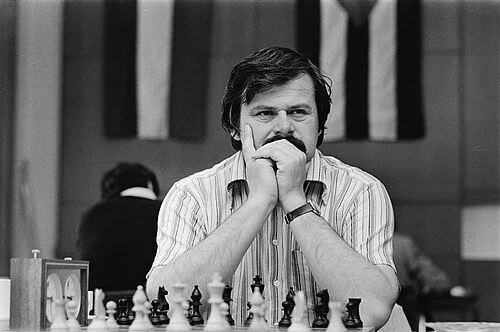
Rob Croes / Anefo
Major Career Achievements
Hort’s competitive record is rich enough that selectivity is essential. Most specialist and Czech federation sources credit him with six Czechoslovak championships, generally counted as 1969 to 1972, 1975, and 1977, while FIDE’s 2025 obituary listed five and omitted 1969. Whatever count one follows, the larger point is clear: for more than a decade he was the central over the board figure in Czechoslovak men’s chess. After settling in West Germany, he added German titles in 1987, 1989, and 1991.
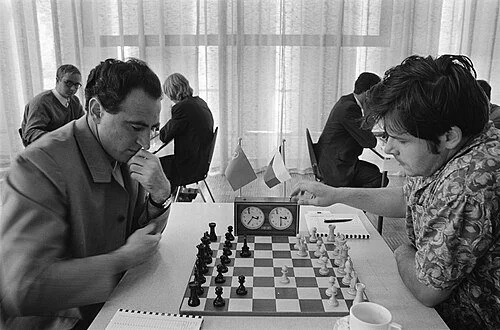
His international breakthrough into the very highest echelon was visible by 1970. In the celebrated USSR versus Rest of the World match in Belgrade, Hort played board four for the World team and defeated Lev Polugaevsky by 2.5 to 1.5. FIDE’s obituary called that score one of the highlights of his career, and Czech specialist Richard Biolek emphasized the significance of his selection behind only Larsen, Fischer, and Portisch in the World team order. For a non-Soviet player from Czechoslovakia, that was a public declaration of elite status.
His Olympiad record further confirms the scale of his career. He played fourteen Olympiads in all, for Czechoslovakia from 1960 through 1984 and for Germany from 1988 through 1992. At Skopje in 1972 he won silver on board one and also took the best-game prize for his victory over Werner Hug. At Lucerne in 1982 he led Czechoslovakia on first board to the team silver medal. These were not ceremonial appearances by a famous veteran. They were central contributions to national teams that depended on him.
The high point of his world championship ambitions came at the 1976 Manila Interzonal, where he qualified for the Candidates. FIDE states that he earned his spot there, and the World Chess Hall of Fame notes that he tied for second in Manila before reaching the Candidates quarterfinal. He then met Boris Spassky in Reykjavík in 1977. The match is inseparable from one of chess history’s most famous episodes of sportsmanship: after Spassky fell ill and exhausted his time-outs, Hort used one of his own to let the former world champion recover. Spassky eventually won by the narrowest of margins, after Hort missed a winning chance on time in the penultimate game. That decision, generous and costly at once, has become the defining episode of Hort’s public memory.
Rob Croes for Anefo
Style and Reputation
The most reliable descriptions of Hort’s style converge on the same point: he was universal, psychologically alert, and stronger in the middlegame and endgame than in opening dogma. David Navara described him as “a clever universal player,” strong in the middlegame and endgame and notably adept at choosing openings that made specific opponents uncomfortable. Hort himself said that he preferred to decide games in the middlegame and did not consider himself an opening theoretician. Richard Biolek’s profile is strikingly similar, calling his style universal and emphasizing his ability to attack, defend, maneuver, and handle endgames with virtuosity.
That combination explains why certain games loom larger than others in his reputation. His win over Dragoljub Minić at Halle in 1967 helped confirm him as a player who could convert a positional initiative into a decisive attack. His victory over Werner Hug at Skopje in 1972 won the Olympiad’s best-game prize. His match score against Polugaevsky in Belgrade in 1970 announced that Soviet stars could not assume supremacy against him. None of these games alone defines Hort, but together they show a competitor whose strength lay in transition, pressure, and practical conversion rather than in doctrinal allegiance to one school or one system.
His public reputation among contemporaries rested on more than his moves. Hort was widely regarded as warm, witty, and deeply human. Even late obituaries written for different audiences, FIDE, Chess.com, Czech federation notices, and specialist memorials, return to the same cluster of traits: humor, self-irony, generosity, and extraordinary powers of narration. Since independent sources repeat those qualities so consistently, they can be treated as a real historical feature of his standing rather than mere obituary convention.

Joost Evers / Anefo
Contributions Beyond Tournament Play
Hort’s post-peak importance to chess culture was substantial. FIDE and later German and international sources remember him as a beloved commentator, especially for his long partnership with Helmut Pfleger on German television’s Schach der Großmeister. ChessBase states that the partnership lasted twenty-two years, and contemporary recollections stress that the program drew in audiences beyond strict tournament followers. In this role Hort became not just a former grandmaster who talked about chess, but one of the sport’s major interpreters for the broader public.
As an author, he had influence in at least two distinct registers. First, with Vlastimil Jansa he co-authored The Best Move, originally published in Czech and later in Russian and English. Chess.com grandmaster Gregory Serper wrote that the Russian edition, Vmeste s grossmeysterami, was formative for generations of Soviet players, including the young Garry Kasparov. Publication metadata confirms the English edition’s circulation from 1980 onward. Second, Hort became a late-life memoirist and storyteller, publishing My Chess Stories after years of successful historical and anecdotal essays for ChessBase.
There were also smaller, easy-to-overlook contributions. A later tournament-prize allocation method, the “Hort system,” is explicitly credited to him in obituary literature, and the term now appears in European Chess Union regulations and standard pairing software documentation. His authorship also extended into remembrance work: in 2025 the Czech federation announced a book on Lubomír Kavalek, written with Michal Konopka, and noted that the project grew from Hort’s own initiative. These are not side notes. They show a figure who kept shaping chess culture through explanation, memory, and practical tournament life after his peak rating years had passed.
Bert Verhoeff / Anefo
Historical Legacy
Hort’s legacy operates on several levels at once. In purely competitive terms, he remains one of the finest players ever produced by Czechoslovakia or the Czech lands. The Czech federation noted in 2024 that his world number six ranking from 1977 remained the best placement ever achieved by a Czechoslovak or Czech player. FIDE, the World Chess Hall of Fame, and later memorial essays all place him securely in the first rank of non-Soviet players of his generation.
In cultural terms, he became a bridge figure. He linked the older Czech chess world of Flohr, Opočenský, Pachman, and Filip to the media-savvy international chess culture of the late twentieth and early twenty-first centuries. He also linked Czech and German chess communities, a bond symbolized in December 2025 when his remains were interred at Prague’s Vyšehrad Cemetery in a ceremony attended by representatives of both federations. The Czech federation emphasized that this fulfilled his personal wish to be buried in the Czech Republic.
A concise historical assessment would run as follows. Vlastimil Hort deserves attention today because he joined elite strength, ethical distinctiveness, and cultural afterlife in a way few grandmasters have managed. He was strong enough to become a serious Soviet rival, humane enough to lose his best world title chance through an act of generosity still remembered decades later, and gifted enough as a speaker and writer to remain central to chess memory long after his tournament peak. If one seeks a figure who shows how chess excellence in Eastern Europe extended far beyond the Soviet center, Hort is indispensable.
Notes and Sources
This profile gives priority to primary and near-primary material, especially Hort’s own late interviews and autobiographical essays, official notices from FIDE and the Czech Chess Federation, Olympiad and rating data from OlimpBase, and specialist historical writing by Richard Biolek and Russian Chess Federation compilers. For bibliographical and reception history, it also draws on publication metadata for The Best Move and on later specialist commentary about the book’s influence. Relevant alternate forms used in research included the Czech name Vlastimil Hort and the Russian form Властимил Горт.
Two source discrepancies should be stated plainly. First, most Czech and specialist sources credit Hort with six Czechoslovak titles, while FIDE’s 2025 obituary listed five, apparently omitting 1969. Second, Hort’s own 2024 recollection places his flight west after a Tunisian tournament in 1982, whereas federation biographies more often date his emigration or West German transfer to 1985. The safest interpretation is that the public record distinguishes imperfectly between departure, residence, legal emigration, and federation change. In the body of this article, I have therefore emphasized the consensus facts and signaled disagreement where necessary.
Selected high-value sources used here include Memory of Nations for family background and childhood; Hort’s ChessBase interviews and historical essays for self-description, political context, and intellectual lineage; FIDE and World Chess Hall of Fame biographies for career summary; OlimpBase for Olympiad and rating confirmation; the Czech Chess Federation for national legacy, memorialization, and later publications; and Chess.com’s 2025 obituary for documented quotations from Hort and Navara, as well as for the later reception of his sportsmanship and literary output
