Pal Benko

Eric Koch for Anefo
Introduction
Pál Benkő, known internationally as Pal Benko, was born on 15 July 1928 in Amiens, France, and died on 25 August 2019 in Budapest. He became Hungarian champion, a grandmaster, a twice-qualified world championship Candidate, the record eight-time winner or co-winner of the U.S. Open, a leading endgame writer, and an International Master of Chess Composition.
Benko was never a Soviet player. His relevance to Soviet chess history arises from his position beside and eventually outside the Soviet sphere. He first confronted Soviet chess as a leading Hungarian master, suffered imprisonment under Hungary’s Stalinist government, sought asylum in 1957, and subsequently represented the United States against Soviet teams and Candidates. He later resumed an active role in Hungarian chess. His career therefore connects postwar Hungary, Soviet-dominated international competition, American tournament professionalism, and the revival of Hungarian chess after communism.

By Eric Koch for Anefo
Early Life and Chess Formation
Benko’s father, Pál Ágoston Benkő, was a Hungarian engineer working in France when his son was born. His mother was Erzsébet Vilhelm. The family returned to Hungary in 1932 and settled in Budapest. Benko learned chess from his father at about ten. Sources give several ages, but his own recollection supports that approximate date. He joined the Zugló Chess Circle in 1942 and had a chess problem published that same year. Composition was thus part of his chess identity before he entered serious tournament play.
A formative book was Ferenc Chalupetzky and László Tóth’s Hungarian collection of Capablanca’s games. Benko later credited Capablanca with teaching him economy, technique, and the coordination of pieces. He was largely self-directed, with books, club play, and analysis taking the place of a formal coaching system.
The Second World War disrupted his schooling and family life. According to Benko’s later autobiographical account, he was attached at sixteen to a Hungarian Levente labor formation digging defensive works near the Austrian frontier. He escaped, was subsequently caught and put to labor by Soviet forces, and escaped again. His father and elder brother were deported to forced labor in the Soviet Union, while his mother died in 1945. Benko was left with responsibilities toward a younger sister. Chess contacts sometimes provided food and shelter during the immediate postwar scarcity. These details come principally from his memoir and should be understood as personal testimony rather than a fully documented archival reconstruction.
Benko completed secondary school in 1947 and studied economics at the Budapest University of Economics while working, at different times, in bookkeeping and the textile sector. The available evidence establishes university study but does not confirm that he completed a degree.
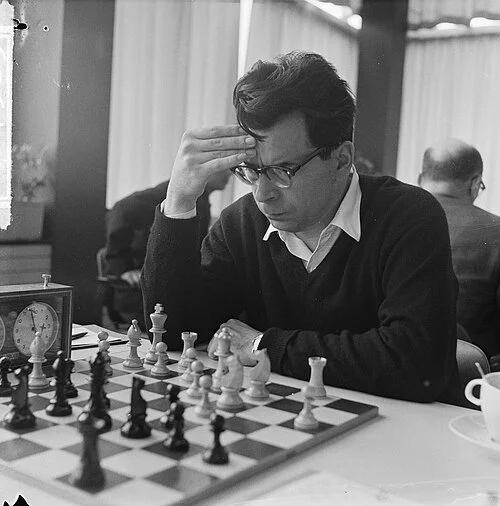
F.N. Broers / Anefo
Rise in Hungarian Chess
Benko won a strong master tournament in 1945 and received the Hungarian master title. He became national champion in 1948 and was awarded the International Master title in 1950. His progress was unusually rapid because wartime conditions had prevented a conventional junior career.
The 1949 Budapest-Moscow match-tournament provided his first sustained encounter with the Soviet elite. Budapest’s team faced Smyslov, Bronstein, Kotov, Lilienthal, Flohr, Ragozin, Averbakh, and Simagin in a double Scheveningen competition. The Moscow team won overwhelmingly, but Benko was the leading Hungarian scorer with 7½ points from sixteen games. Aleksandr Kotov’s contemporary report in Shakhmaty v SSSR identified Benko’s national championship as evidence of Hungary’s emerging chess strength. The event placed the young Hungarian directly inside the competitive and analytical culture that Soviet institutions were exporting throughout Eastern Europe.
Benko stood next in line for a place in the 1952 Interzonal after the death of Jan Foltys. He never reached the tournament. Following a chess event in Görlitz, East Germany, Benko and Hungarian master Géza Füster attempted to reach West Berlin. Füster escaped, but Benko was captured and transferred to Hungarian state security. He was interrogated and interned without trial at Kistarcsa for approximately sixteen months. Benko later described severe hunger, darkness, deaths among prisoners, and interrogators who initially suspected that his correspondence-chess notation was coded espionage material.
Kistarcsa is sometimes inaccurately described as a Soviet camp. It was a Hungarian ÁVH internment camp operating under the Stalinist Rákosi government. Benko was released during the amnesty associated with Imre Nagy’s first premiership after Stalin’s death in 1953. His travel and tournament opportunities remained restricted for a time.
He returned strongly. Benko tied Lajos Portisch for first in the 1956 Alekhine Memorial in Budapest and scored 10 points from fifteen games on board three at the Moscow Olympiad, helping Hungary win the bronze medal. Hungary’s victory over the Soviet team in that Olympiad was among the most important collective results of his Hungarian career.
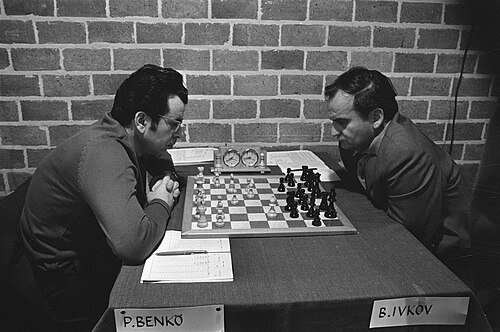
By Bert Verhoeff / Anefo
Escape and Entry into World Championship Chess
At the 1957 Dublin Zonal, Benko tied Svetozar Gligorić for second behind Luděk Pachman, qualifying for the following year’s Interzonal. He then represented Hungary at the World Student Team Championship in Reykjavík. After the event he sought political asylum in Iceland. Contemporary Icelandic newspapers reported the asylum request and assistance from Icelandic authorities and the Red Cross; Benko recalled initiating the process at the American embassy. He reached New York on 17 October 1957 and became an American citizen in 1962 while retaining his Hungarian citizenship.
His early American circumstances were modest. Benko stayed at a YMCA, spoke limited English, and discovered that the United States Chess Federation could offer little financial assistance. He found employment at a brokerage firm and negotiated paid leave for tournaments. His economics training and bookkeeping experience proved useful while he established himself in New York.
The decisive competitive breakthrough came at the 1958 Portorož Interzonal. Benko scored 12½ from twenty and shared third and fourth with Tigran Petrosian, half a point behind Gligorić and one point behind Tal. He also defeated fifteen-year-old Bobby Fischer. The game is historically relevant because both players qualified for their first Candidates tournament and because it began a long, sometimes complicated association between them. FIDE awarded Benko the grandmaster title that year.
The 1959 Candidates tournament was a demanding four-cycle contest spread across Bled, Zagreb, and Belgrade. Benko finished eighth with 8 points from twenty-eight games. He nevertheless defeated former world champion Vasily Smyslov and twice defeated Friðrik Ólafsson. Qualification itself placed him among the eight players contesting the right to challenge the world champion.
Benko reached the Candidates again in 1962. At the Stockholm Interzonal he tied Leonid Stein and Gligorić for sixth through eighth on 13½ points. Stein won the subsequent playoff, but FIDE rules limited the number of qualifiers from a single federation. Since three Soviet players had already qualified through Stockholm, Stein could not take the final place. Benko advanced as the next eligible player. Accounts saying that he won the playoff are incorrect.
At Curaçao, Benko finished sixth with 12 points from twenty-seven games. He defeated Fischer and Tal with flexible 1.g3 systems and scored well against Korchnoi and Miroslav Filip. His most consequential result came late in the tournament against Paul Keres. Keres entered the round level with Petrosian, but Benko’s victory allowed Petrosian to establish the half-point lead that became his final winning margin. Benko later recalled that Petrosian and Geller had offered analytical assistance during the adjournment and that he declined. That episode remains Benko’s retrospective testimony and lacks independent contemporary confirmation.
His 1964 Amsterdam Interzonal produced a more modest result, 9 points from twenty-three games. By then his most productive competitive setting was becoming the expanding North American open-tournament circuit.
Major Career Achievements in the United States
Benko finished first or shared first in the U.S. Open eight times between 1961 and 1975, a record. Three victories were outright and five were shared. He also won the 1964 Canadian Open. The Hungarian federation credited him with approximately sixty open-tournament victories over his career, the basis for his contemporary nickname, the “King of Opens.” His best result in the closed U.S. Championship was joint second in 1974, when he completed the event undefeated.
His open success reflected more than longevity. American Swiss tournaments frequently required leading players to seek wins with Black against varied opposition, often with limited preparation time. Benko developed opening systems that created imbalance while preserving positional soundness. This practical environment helped shape both his playing style and his theoretical work.
Benko played in seven Olympiads. He represented Hungary in 1956, then appeared in six consecutive Olympiads for the United States from 1962 through 1972. At Varna in 1962 he won an individual silver medal on board two. At Havana in 1966 he was unbeaten and helped the United States win team silver. His two team medals, Hungary’s bronze in 1956 and the American silver a decade later, neatly mark the transnational course of his career.
His most famous administrative decision came before the 1970 Palma de Mallorca Interzonal. The 1969 U.S. Championship had served as the American zonal, and Benko, Samuel Reshevsky, and William Addison earned the available places. Fischer had declined to enter the championship. FIDE later permitted Fischer to play in Palma if a qualified American withdrew. Benko voluntarily surrendered his place and required Fischer to promise that he would complete the Interzonal and any subsequent Candidates matches. Fischer accepted and kept the promise.
A persistent story claims that Benko sold the place for $2,000. Benko corrected this in a 1975 Chess Life & Review account. The money compensated him for serving as second to Reshevsky and Addison at Palma and equaled the appearance payment he would have received as a player. He did not describe it as payment for the berth. Fischer won Palma, swept through the Candidates matches, and defeated Boris Spassky in 1972. Benko’s decision therefore had a direct and documented effect on world championship history.
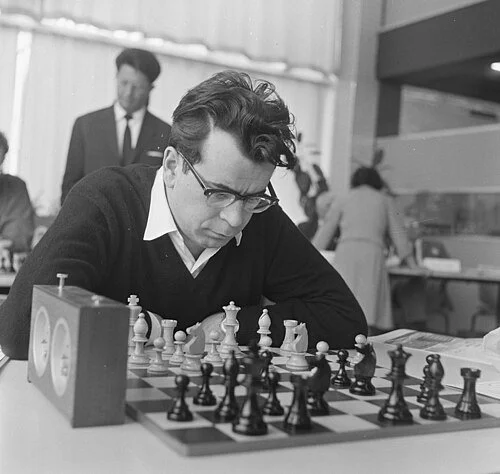
F.N. Broers / Anefo
Style and Reputation
Benko was fundamentally a positional player with strong tactical awareness and exceptional endgame understanding. Arthur Bisguier and Anthony Saidy both emphasized his positional subtlety, endgame technique, and recurring difficulty with the clock. Benko himself acknowledged chronic time pressure as a central practical constraint. ChessBase’s retrospective accounts also record his considerable strength at blitz.
His best play was distinguished by flexible piece placement, a readiness to transpose between structures, and an ability to convert small or unconventional forms of compensation into lasting pressure. He did not seek complications indiscriminately. Even his characteristic pawn sacrifices were usually intended to secure open files, active squares, or a favorable ending.
The Candidates tournaments exposed the difficulty of sustaining this approach through exceptionally long, four-cycle events. Benko’s practical decision-making proved especially effective in Swiss opens, where he repeatedly had to create winning chances against opponents with very different styles. His eight U.S. Open first places provide the clearest statistical evidence of that strength.
Contributions Beyond Tournament Play
Opening theory
The opening carrying Benko’s name was not his invention in a literal sense. Benko acknowledged in his 1973 book The Benko Gambit that related ideas had appeared in Sweden during the 1920s and credited Erik Lundin with introducing the concept into international tournament practice. Russian masters had also analyzed related pawn sacrifices in print, and David Bronstein employed an important version against Mark Taimanov at Zürich in 1953.
Benko’s contribution was sustained advocacy and systematization. He played the gambit repeatedly, refined its strategic logic, published articles, and produced the first major English-language book devoted to it. He showed that Black’s sacrificed queenside pawn could yield persistent positional compensation rather than a short tactical attack. In Russian and Soviet literature the opening remained widely known as the Volga Gambit, or Volzhskii gambit. The difference in names reflects two theoretical traditions attached to the same family of positions.
Benko’s name also became associated with 1.g3. He used it in eleven of his fourteen games with White at Curaçao in 1962, including his victories over Fischer and Tal. Réti and other masters had played the move earlier, so “Benko Opening” describes his systematic high-level advocacy rather than original invention.
Endgame writing and composition
Benko’s work in composition was unusually substantial for an elite tournament grandmaster. His first problem appeared in 1942, and the Hungarian federation estimated his total output at more than 360 problems and studies. He received the FIDE Master title for chess composition in 1990 and the International Master title in 1995.
His practical and artistic work often overlapped. Benko explained that his first serious endgame study developed from analysis of an adjourned 1964 game against Aleksandar Matanović; the resulting study won first prize in Magyar Sakkvilág. He composed direct mates, helpmates, endgame studies, retrospectives, and other problem forms. The quality of this work earned recognition within the specialist composition community, independently of his reputation as a tournament player.
Beginning in 1967, Benko maintained an association with Chess Life that lasted approximately forty-six years. His features included “Benko’s Bafflers,” “In the Arena,” and, from January 1981, “Endgame Laboratory.” The columns combined exact analysis with positions drawn from practical play and composition. His explanations helped bring serious endgame study to readers who might otherwise have encountered it only in specialist manuals.
His major books included The Benko Gambit, Winning with Chess Psychology with Burt Hochberg, Chess Endgame Lessons, a substantial revision of Reuben Fine’s Basic Chess Endings, and Pal Benko’s Endgame Laboratory. His 668-page autobiography, Pal Benko: My Life, Games and Compositions, written with Jeremy Silman and supplemented by John Watson’s opening survey, appeared in 2003. It included 138 annotated games and approximately 300 compositions and received book-of-the-year awards from the British Chess Federation, ChessCafe, and the Cramer committee.
Trainer, analyst, and team figure
Benko trained all three Polgár sisters for several years and recalled accompanying them as coach at the Moscow and Novi Sad Olympiads. The Hungarian federation also records that he taught Fabiano Caruana when Caruana was twelve, while the US Chess memorial credits him as a mentor to Peter Leko. These roles are easily obscured by his playing record but illustrate the transmission of his analytical methods to later generations.
His ability to analyze adjournments made him valuable in team events. He served repeatedly as an American Olympiad captain or analyst and was part of the analytical staff when the United States won gold at Haifa in 1976. Between 1990 and 1996 he also assisted Hungarian Olympiad teams on three occasions. At Palma in 1970 he worked as second to Reshevsky and Addison.
Later Life and Historical Legacy
Benko began visiting Hungary again in 1964. In 1968 he married Gizella Nagy, a mathematics lecturer and competitive chess player. Their children, Dávid and Pálma, became mathematicians. Benko retained close connections with both American and Hungarian chess, increasingly spending time in Budapest while continuing to write for American readers.
He remained active in Hungarian club chess and was a member of the Budapest Spartacus team that won the European Club Cup in 1982. His later honors included induction into the U.S. Chess Hall of Fame in 1993, Hungary’s Maróczy Prize, and the Knight’s Cross of the Hungarian Order of Merit. Even after retiring from serious tournament play, he continued composing and submitting material. The Hungarian federation noted that he sent manuscripts to Magyar Sakkvilág in 2019, seventy-seven years after his first published problem.
Benko deserves attention today because he united several demanding forms of chess achievement. He was a twice-qualified Candidate, the outstanding American open-tournament player of his generation, an influential practical theoretician, a long-serving endgame teacher, a titled composer, and an analyst trusted by national teams. His departure from Stalinist Hungary and later reconnection with Hungarian chess also make his career a valuable record of how individual chess culture crossed political boundaries. The Fischer decision altered one championship cycle. Benko’s larger historical legacy rests on the chess he played, developed, explained, composed, and passed to later generations.
Notes and Sources
Iván Bottlik, “In Memoriam Benkő Pál”, Hungarian Chess Federation, 27 August 2019. The federation gives 25 August as the date of death; some initial English-language notices reported 26 August. On the sometimes misreported birth date, see Frank Zeller, “Pal Benko Celebrates His 90th Birthday”, ChessBase, 15 July 2018. Hungarian usage is Benkő Pál; older Western sources sometimes print Benkö, and Russian sources use Пал Бенко.
György Négyesi, Sakkedzők, -oktatók, p. 51; Bottlik, Hungarian Chess Federation obituary. On his economics studies, see Diana Mihajlova, “The Life Gambit à la Benko, Part Two”, ChessBase, 18 July 2013.
Pal Benko and Jeremy Silman, with an opening survey by John Watson, Pal Benko: My Life, Games and Compositions, Siles Press, 2003; Jeremy Silman, “The Early Life of Pal Benko”, an authorized adaptation of Benko’s recollections; Edward Winter, “Pal Benko, 1928–2019”, especially Winter’s bibliographical identification of Benko’s Capablanca book.
Bottlik, Hungarian Chess Federation obituary. For the championship field and result, see the federation’s history of the 1948 Hungarian Championship.
Douglas Griffin, “The Budapest-Moscow Match-Tournament, 1949”, based on Shakhmaty za 1947–49 gg. and Aleksandr Kotov’s report in Shakhmaty v SSSR, no. 5, 1949. Griffin’s reconstructed crosstable gives Benko 7½ points.
Benko and Silman, My Life, Games and Compositions; Silman, “The Early Life of Pal Benko”; Skakbladet, 2020, no. 1, pp. 62–65, which identifies Kistarcsa. For the 1951 Zonal result and his contingent Interzonal status, see the Mariánské Lázně event record.
Hungarian Chess Federation, “1956 Alekhine Memorial”; OlimpBase, Hungary at the 1956 Moscow Olympiad.
Dublin Zonal 1957 reconstruction, Irish Chess History; contemporary report in Tíminn, 30 July 1957; Jeremy Silman, “Pal Benko: At Last, Freedom!”; Bottlik, Hungarian Chess Federation obituary.
Portorož Interzonal event record; World Chess Hall of Fame, “Pal Benko”.
Douglas Griffin, “The Candidates Tournament of 1959”; 1959 Candidates crosstable; Stockholm Interzonal and Stockholm playoff; FIDE, “History of the Candidates”.
Curaçao Candidates crosstable; André Schulz, “The Candidates Tournaments 1959 and 1962”, ChessBase, 2016; Benko and Silman, My Life, Games and Compositions, pp. 127–128.
US Chess, historical U.S. Open winners list; US Chess, “GM Pal Benko”; 1974 U.S. Championship record.
OlimpBase records for Hungary in 1956, the United States in 1962, and the United States in 1966; Bottlik, Hungarian Chess Federation obituary.
US Chess, “Under One Condition, Fischer Begins Path to World Championship”, reproducing Benko’s account; Benko, “The Road to Palma,” Chess Life & Review, July 1975, p. 439; Winter, “Pal Benko”.
Silman-James Press biography and contemporary assessments, including comments by Arthur Bisguier and Anthony Saidy; Zeller, “Pal Benko Celebrates His 90th Birthday”.
Edward Winter, “Unsolved Chess Mysteries (25)”, quoting Benko’s 1973 account of the opening’s earlier history; John Hartmann, “The Evolution of the Benko Gambit”, US Chess. On the Russian designation, see the Russian Chess Federation’s Benko profile.
Frederic Friedel, “Pál Benkő Dies at 91”, ChessBase, including Benko’s 1.g3 usage at Curaçao.
World Federation for Chess Composition, Handbook of Chess Composition, no. 51; ARVES, “Benko, Pal, 1928–2019”; Pal Benko, “Secrets of Study Composition, Part One”, ChessBase.
Silman-James Press book record; World Chess Hall of Fame, “Pal Benko”; Bottlik, Hungarian Chess Federation obituary.
Mihajlova, “The Life Gambit à la Benko, Part Two”; Bottlik, Hungarian Chess Federation obituary; World Chess Hall of Fame, “Global Moves: Americans in Chess Olympiads”.
Bottlik, Hungarian Chess Federation obituary; World Chess Hall of Fame, “Pal Benko”.
