Sergei Yuryevich Makarichev
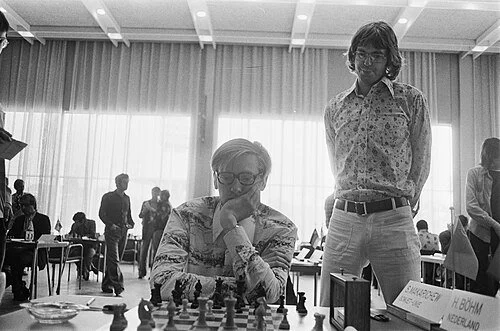
By Fotograaf Onbekend / Anefo
Introduction
Sergei Yuryevich Makarichev was born in Moscow on 17 November 1953. His surname appears in English as Makarichev and Makarychev. The Russian form is Сергей Юрьевич Макарычев. A grandmaster from 1976, he belonged to the strong generation that came of age in the last decades of the Soviet chess system. His historical importance extends beyond his tournament record. He became an opening analyst, a coach of Soviet and Russian teams, a second to both Anatoly Karpov and Garry Kasparov, an author, and one of post-Soviet television's most persistent interpreters of chess for a general audience.1
Makarichev's career is best understood as a sustained transfer of chess knowledge between competition, collective preparation, and public explanation. His authority in the later roles rested on genuine grandmaster achievement: a European junior title, four appearances in the USSR Championship final, victories in strong international events, a peak published rating of 2550, and success in major club competitions. His later analytical and broadcasting work gave that competitive experience an unusually broad reach.
Early Life and Chess Formation
Reliable public sources say little about Makarichev's parents, their occupations, or the household in which he grew up. Filling that gap with a conventional story about a Soviet intellectual family would be speculation. Makarichev's own recollection supplies a narrower family picture. His father explained the rules when he was four and later played with him, as did several cousins. A loss to a slightly older friend at six awakened a serious interest. His grandmother eventually took him from a neighborhood chess circle to the Moscow Palace of Young Pioneers. The Russian Chess Federation compresses this story into the customary statement that he learned at five.2
His formal development took place at the Palace under Alexander Roshal, a respected trainer who later became a prominent chess journalist and editor. Makarichev had already shown an unusual appetite for self-study, reading Vladimir Nenarokov's old opening manual and the bulletins of the 1962 Curaçao Candidates Tournament during childhood. Mark Dvoretsky, another member of Roshal's group, recalled an education that emphasized the middlegame, endgame, competitive character, and individual attention. Makarichev briefly stepped away from tournament chess after a painful setback at fourteen and entered a mathematics school. Roshal later persuaded him to return for the junior qualification cycle. The episode shows the coach's practical importance at a genuine turning point.3
Makarichev became a Soviet Master of Sport at sixteen.1 In the 1973/74 European Junior Championship at Groningen, held from December 1973 into January 1974, he and the Hungarian József Pintér each scored seven points in the final group. The competition's tie-break, which incorporated their preliminary-stage results, awarded Makarichev the title. This was a substantial success in an event that served as one of Europe's clearest tests of emerging international talent.4
The victory coincided with an important educational choice. Moscow State University's own history records that Makarichev was then a first-year student in the Faculty of Computational Mathematics and Cybernetics. After winning at Groningen, he decided to devote more time to chess and continued his studies in the university's Faculty of Journalism. That journalism education acquired direct relevance when broadcasting became a major part of his professional life.5
His international titles followed rapidly: International Master in 1974 and Grandmaster in 1976. In a 2013 interview, he also recalled receiving Soviet grandmaster certificate number 44 in 1977. The distinction is worth preserving because the Soviet sports classification and FIDE title system were separate forms of recognition.6
Rise in Competitive Chess
Makarichev's early senior results established him as a strong Moscow and international grandmaster. In the main IBM tournament at Amsterdam in 1975, he shared second through fifth place, half a point behind Ljubomir Ljubojević. He shared first place in the Moscow Championship in 1976 with Mikhail Tseitlin and again in 1983 with Evgeny Sveshnikov. At the 1977 World Student Team Championship in Mexico City, he served as the Soviet second reserve, scored 5.5 points from six games, and helped the USSR win the team title. Some short biographies call this a youth world championship; the surviving tournament record identifies it more precisely as the World Student Team Championship.7
He reached four USSR Championship finals: 1978, 1979, 1980/81, and the final Soviet championship in 1991. His best finish came at Minsk in 1979, one of the central competitive tests in Soviet chess. The complete crosstable gives him 9.5 points from 17 games and a share of fifth through seventh place with Tamaz Georgadze and Viktor Kupreichik. Several later profiles describe this result as a share of second through seventh or as a silver medal. Those claims are inconsistent with the score table, which places Efim Geller first, Artur Yusupov second, and Garry Kasparov and Yuri Balashov jointly third and fourth.8
His standing can also be measured through the historical FIDE lists. In January 1981, a rating of 2535 placed him in a tie for forty-fourth in the world. His published rating reached 2550 in January 1991. These figures locate him securely among the period's high-level grandmasters and provide a precise historical scale for his competitive standing.9
Makarichev continued to collect significant international results during the 1980s. He shared first at Novi Sad in 1983 and won outright at Frunze in 1985. His joint first place in the 1992 Moscow tournament held in Mikhail Tal's memory, alongside Nukhim Rashkovsky and Mikhail Krasenkow, demonstrated that his competitive strength survived the professional changes of the preceding decade. These results are more historically informative than an exhaustive tournament list: they show repeated success across junior, national, international, and open competition.7
Major Career Achievements
One of Makarichev's least noted achievements came in European club play. Surviving match records place him on four European Club Cup winning or co-winning squads: Burevestnik in 1976, then CSKA Moscow in 1986, 1988, and 1990. He scored 1.5/2 for Burevestnik, 3/4 for CSKA in 1986, 4/7 in 1988, and 3/6 in 1990. The 1976 and 1990 trophies were shared under the competition rules. This record corrects retrospective accounts that credit him with only two European club titles and shows the practical value assigned to him by two major Soviet sporting institutions.10
The club record also illuminates the collective dimension of his career. Soviet elite chess involved far more than individual tournaments. A player could contribute through league matches, club competitions, training camps, opening files, and preparation for teammates. Makarichev's reliability in this environment helps explain his later selection for national-team and world-championship support work.
By the early 1980s, he was devoting increasing energy to coaching and analysis. The birth of twin sons, Yury and Konstantin, in 1979 had interrupted the sustained tournament routine of Sergei and Marina. Makarichev later described the turn to coaching as a natural response to family life and growing demand for his analytical work. Serious competition continued, as his 1991 rating peak and 1992 Moscow result demonstrate. His professional role widened, allowing a strong grandmaster's preparation skills to influence matches and team events beyond his own board.2
Style and Reputation
The Russian chess encyclopedia describes Makarichev as a player of original positional style. That concise judgment accords with the surviving record. He was comfortable in strategically complex positions, prepared openings deeply, and regularly built forceful play from positional preparation. His strongest competitive asset was analytical organization: he could connect an opening idea with the type of middlegame it was designed to produce.11
FIDE credits Makarichev with research in the Sicilian Defence and the Petroff, or Russian Game, and singles out his early treatment of quiet Italian Game positions with White, an approach that became conspicuous in elite play decades later. The Russian Chess Federation describes him more generally as an original opening researcher and analyst. Such claims should not be converted into sole-inventor narratives, since opening development is cumulative. They do establish that contemporaries and later authorities regarded Makarichev as an original theoretician whose ideas travelled beyond his own games.12
His practical record suggests a clearly defined competitive scope. He won strong events and reached the upper fifty of the world ranking. He never became a regular participant in the world championship qualifying cycle. His Soviet-final record was resilient and frequently draw-heavy, including fourteen draws in seventeen games in 1978 and eleven in each of the next two finals. Contemporary sources do not identify a single recurring technical weakness, and assigning one retrospectively would exceed the evidence. The documented pattern is a career whose greatest distinguishing strengths, preparation, synthesis, and explanation, became increasingly valuable in collaborative work.8
Contributions Beyond Tournament Play
National teams and world-championship preparation
The Russian Chess Federation credits Makarichev's coaching work with Soviet Olympiad victories in 1982, 1984, 1986, and 1988, Russia's victory in 1992, and European team titles in 1989 and 1992. The exact job description could vary from one event to another, as it often did in Soviet delegations, so these results are best understood as team achievements to which he contributed through preparation and coaching.13
His individual seconding work carried particular historical weight. Federation records place him in Anatoly Karpov's team from 1984 to 1986, including the 1985 world championship match, and in Garry Kasparov's team from 1991 to 1994, including the 1993 match with Nigel Short. Working successfully with both champions required analytical discretion and an ability to adapt to markedly different competitive personalities. Kasparov later wrote, “With the help of Sergey Makarychev I renovated my opening repertoire,” linking that work to his preparations in the early 1990s.14
Makarichev's role was therefore more substantial than the generic label “second” can imply. At this level, the work included examining opening directions, testing opponents' likely choices, organizing large bodies of analysis, and helping a champion decide which material was ready for competition. The sources do not permit a precise allocation of individual novelties, much of which remained deliberately confidential. Kasparov's acknowledgement provides unusually direct evidence of the scope of Makarichev's contribution.
Television, journalism, and chess education
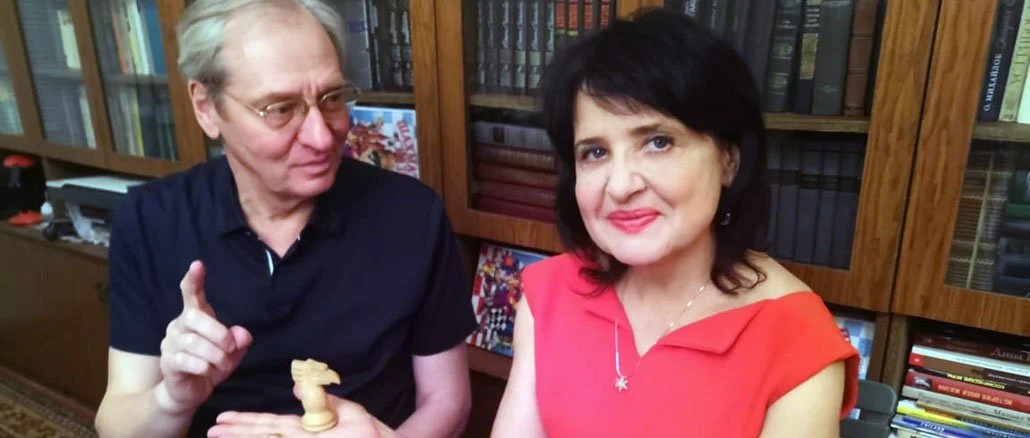
Makarichev's longest public partnership was with his wife, Marina Makaricheva, née Ostrovskaya, a Soviet Master of Sport and longtime chess journalist and broadcaster. They began chess broadcasting on NTV in the mid-1990s. From November 1996 through October 2015, their weekly program Shakhmatnoe obozrenie (Chess Review) appeared on NTV-Plus. Marina generally travelled to events, conducted interviews, and assembled reports; Sergei presented and analyzed from the Moscow studio. During major competitions, they also produced frequent live or near-live coverage.15
The scale was exceptional for specialized television: the Russian Chess Federation credits the pair with nearly 3,500 programs, more than 100 instructional broadcasts, and several documentary films. Numbers alone do not explain the achievement. In interviews, Makarichev described the task as a form of popular-science communication. Chess had to stay intellectually honest, visually legible, and well-paced for viewers who could not follow a long analytical variation. His journalism training, grandmaster authority, and economy of explanation met in this format.16
The programs preserved continuity during a period when Soviet state-supported chess media fragmented and new commercial outlets emerged. Makarichev used television to keep elite events, historical subjects, player interviews, and instruction in the same serious public conversation. FIDE recognized Sergei and Marina for chess journalism in 2015. His other formal distinctions included the Soviet Medal “For Labour Distinction” in 1985, the title Honored Coach of Russia, and the Russian title Honored Worker of Culture in 2011.17
Their educational books extended the same project. Ot A do...: Dlya tekh, kto uchit igrat v shakhmaty (From A to...: For Those Who Teach Chess, 1995) was aimed at instructors. Shakhmatnaya skazka (A Chess Fairy Tale, 2010) used a more literary framework for teaching children. Makarichev continued writing a joint chess column in Nezavisimaya Gazeta and carried his explanatory work onto the Makarychev Chess YouTube channel in 2018. These activities form a coherent pedagogical practice.18
One lesser-known family contribution also belongs to the history of the broadcasts. In Sergei and Marina's later recollection, their sons created an interactive chessboard program at thirteen. The software was used throughout the television years and later updated for their YouTube work. The family memory offers a concrete glimpse of how the program's technical and domestic worlds overlapped.15
Historical Legacy
Makarichev's career joins three phases of modern Russian chess culture. He was formed by the Moscow youth-training system and tested in the densely competitive Soviet tournament structure. He then worked inside the analytical teams that supported national squads and world champions. Finally, with Marina, he adapted serious chess journalism to commercial television and internet video. That continuity across institutions and media is historically distinctive.
His later activity has remained public through instruction and occasional competition. A current academy biography lists him as teaching online and in the Chicago area. In March 2026, at age seventy-two, he played in Moscow at the Aeroflot Open Legends round robin, scored 2.5/4, and finished third on tie-break in a three-way tie on points with Rafael Vaganian and Eugenio Torre. The result is an illuminating late-career coda and evidence that his connection to practical play endured.19
Sergei Makarichev deserves attention today because his career reveals how grandmaster expertise can acquire historical force outside a bid for the world title. His tournament results established the authority; his theoretical work, team preparation, books, and thousands of broadcasts multiplied its reach. He belongs in chess history as a strong Soviet grandmaster and as a consequential transmitter of chess knowledge across the Soviet and post-Soviet eras.
Notes and Sources
Russian Chess Federation, “Sergei Makarychev”, biographical profile in Russian; FIDE, “A Tribute to Our Veterans”. FIDE's English tribute alternates Makarychev and Makarichev. The present article uses Makarichev and the feminine Makaricheva to match the website's requested house spelling. Bibliographic citations preserve the spellings used by their sources.
Sergei and Marina Makarychev, “Na odnom dykhanii. Kniga tak kniga, reportazh tak reportazh” [“In One Breath: A Book Is a Book, a Report Is a Report”], 64 - Shakhmatnoe obozrenie, no. 11 (2003); Sergei Makarichev, “V 90-e reiting shakhmat byl vyshe, chem u sportivnykh programm v praim-taim” [“In the 1990s Chess Ratings Were Higher Than Prime-Time Sports Programs”], interview by Kirill Blagov, Sports.ru, 2 March 2015; Marina and Sergei Makarychev, “Shakhmaty eto nasha zhizn” [“Chess Is Our Life”], joint interview in Russian. These accounts supply the childhood, family, and career-transition details. The Russian Chess Federation profile in note 1 gives age five. Public biographical sources consulted for this article do not document his parents' identities or occupations.
Russian Chess Federation, biographical profile, on study at the Moscow Palace of Young Pioneers under Alexander Roshal; Mark Dvoretsky, For Friends and Colleagues, Volume 1: Profession: Chess Coach (Milford, CT: Russell Enterprises, 2014), “School Years,” with an authorized publisher listing, for a fellow pupil's account of Roshal's group. The details of Makarichev's self-study, break from competition, and return come from the 2003 interview cited in note 2.
Belgian Chess History, “12th Niemeyer Tournament for the European Junior Championship, Groningen”, including dates, final-group scores, and tie-break procedure; OlimpBase, European Junior Championship summary.
Moscow State University, Faculty of Computational Mathematics and Cybernetics, “1974 god” [“The Year 1974”]. This institutional history records his initial faculty and subsequent continuation in journalism.
FIDE, “A Tribute to Our Veterans”, and the 1990 Soviet chess encyclopedia cited in note 11 give the IM and GM dates used here; Sergei Makarichev, 2013 interview, originally published by Moscow News, for his recollection of Soviet grandmaster certificate number 44. FIDE's current player profile lists the GM title in 1977, an apparent database discrepancy. The contemporary Soviet reference and FIDE's own retrospective support 1976.
IBM Amsterdam 1975 crosstable, 365Chess; OlimpBase, 22nd World Student Team Chess Championship, Mexico City 1977, team and individual score records; 365Chess event records for Novi Sad 1983 and the Moscow Tal Memorial 1992. The Soviet encyclopedia cited in note 11 records his two shared Moscow championships and first place at Frunze in 1985.
OlimpBase crosstables for the USSR Championship finals of 1978, 1979, 1980/81, and 1991. The 1979 totals resolve the inaccurate second-through-seventh and silver-medal formulations found in some later biographical summaries.
OlimpBase historical FIDE lists, January 1981 and January 1991. Rankings on old lists can include ties; “forty-fourth” here means a shared ranking.
OlimpBase, European Club Cup team records for Burevestnik 1976, CSKA Moscow 1986, CSKA Moscow 1988, and CSKA Moscow 1990; see also the competition results summary. FIDE's retrospective profile says two European club wins. The match records document his participation in all four winning or co-winning campaigns.
A. E. Karpov, ed., Shakhmaty: Entsiklopedicheskii slovar [Chess: Encyclopedic Dictionary] (Moscow: Sovetskaya Entsiklopediya, 1990), Makarichev entry; see the Russian National Public Library for Science and Technology's bibliographic listing. The entry describes his style as original and positional and records the 1985 Medal “For Labour Distinction.”
FIDE, “A Tribute to Our Veterans”, on his Sicilian, Petroff, and Italian Game research; Russian Chess Federation, biographical profile, on his reputation as an opening researcher and analyst.
Russian Chess Federation, biographical profile, for the Olympiad and European team championship coaching credits. These are collective results and should not be read as the work of one coach in isolation.
Russian Chess Federation, biographical profile, for the Karpov and Kasparov dates; Garry Kasparov, Garry Kasparov on Garry Kasparov: Part Two, 1985-1993 (London: Gloucester Publishers/Everyman Chess, 2013), 6, available in a retailer's sample PDF, for Kasparov's acknowledgement. FIDE's profile specifically confirms work in the 1985 and 1993 matches.
Marina and Sergei Makarychev, “Shakhmaty eto nasha zhizn”, for their division of work, broadcasting history, and their sons' interactive-board software; Russian Chess Federation, Sergei's biographical profile, for the program's November 1996 to October 2015 run; Russian Chess Federation, Marina Makaricheva profile, for her playing title, maiden name, and journalistic career.
Sergei Makarichev, 2013 interview, on television as popular-science communication and the practical limits of on-screen analysis; Russian Chess Federation, biographical profile, for production totals. Contemporary trade reporting also described the program's reach: ChessBase, “Chess on TV: Golden Blitz in Jazz Town” (2005).
Russian Chess Federation, “Sergei and Marina Makarychev Receive Awards from FIDE” (21 January 2015); FIDE, “A Tribute to Our Veterans”, for other professional distinctions and inclusion in FIDE's Golden Book; Russian Chess Federation, biographical profile, for the title Honored Coach of Russia; President of Russia, Decree No. 1019, 28 July 2011, awarding Makarichev the title Honored Worker of Culture of the Russian Federation. The Soviet medal is documented in the reference cited in note 11.
Sergei Makarychev and Marina Makarycheva, Ot A do...: Dlya tekh, kto uchit igrat v shakhmaty (Moscow: 64, 1995), described in the Russian National Public Library for Science and Technology's collection guide; Marina Makarycheva and Sergei Makarychev, Shakhmatnaya skazka (Elista: Dzhangar, 2010), catalogued by the same library. See also the Nezavisimaya Gazeta chess page and the Makarychev Chess YouTube channel.
Chess Max Academy, Sergey Makarychev instructor profile, for current teaching; Russian Chess Federation, Aeroflot Open 2026 report, and Chess-Results, Aeroflot Open Legends final standings, for the March 2026 result. Current-web claims in this note were checked on 1 August 2026.
