Jānis Klovāns
Introduction
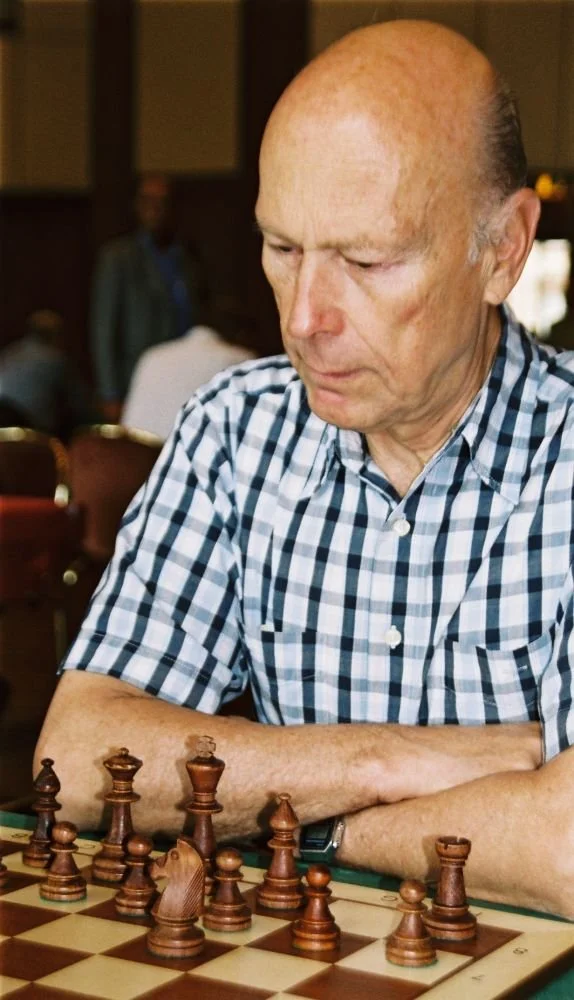
Jānis Klovāns, commonly rendered without diacritics as Janis Klovans, was born on 9 April 1935 in Ruba, in Latvia’s Saldus district, and died in Riga on 5 October 2010. His career encompassed nine Latvian championships, four appearances in the final of the USSR Championship, three World Senior Championship titles, grandmaster titles in both over-the-board and correspondence chess, and almost five decades of coaching.
The chronology is striking. Klovāns won his first Latvian championship in 1954 and his last in 1986. His highest published FIDE rating, 2530, came in July 1996, when he was sixty-one. The following year he won the World Senior Championship and became a FIDE grandmaster. He subsequently regained the senior world title in 1999 and 2001. This combination of early national success, sustained Soviet master-level competition, and late international recognition gives his career unusual historical coherence.
This article uses the Latvian spelling Jānis Klovāns. Soviet sources generally called him Янис Янович Клован, while English databases usually list Janis Klovans. He should not be confused with the Latvian master Jānis Kļaviņš, whose name was occasionally conflated with his in accounts of Mikhail Tal’s early career. Edward Winter has documented this identification problem in Chess Notes.
Early Life and Chess Formation
Klovāns was born in the village of Ruba, but his family moved first to Jelgava and subsequently to Riga. The publicly accessible biographical record contains little reliable information about his parents, their occupations, or the family’s experience of the wartime and immediate postwar years. A fuller account of his household background would therefore require archival research beyond the published evidence.
Chess was not his first sporting interest. According to the Riga Chess School’s biographical survey, he played basketball and swam before beginning serious chess at fourteen. That was a relatively late start for a future grandmaster, even by the standards of his generation.
His decisive formative institution was the Riga Palace of Pioneers. There he joined a group taught by Jānis Krūzkops, an important figure in postwar Latvian junior chess. Krūzkops’s pupils included Mikhail Tal, Aivars Gipslis and Valentin Kirillov. His teaching reportedly emphasized active play and the confident handling of complicated positions. A surviving 1951 photograph of Klovāns and Tal playing blitz illustrates their shared place in Riga’s young chess community, although later descriptions of Klovāns as Tal’s formal trainer or second are insufficiently documented. “Boyhood colleague,” “contemporary,” and, in later years, “sparring partner” are more defensible descriptions.
Klovāns also completed an economics degree at Latvian State University. Latvian biographical records identify him as an economist, although at least one later Russian profile calls him an engineer. The Latvian institutional evidence is preferable on this point. His subsequent decision to make chess his profession placed him within the Soviet system of sports clubs, military teams and state-supported coaching appointments.
Rise in Competitive Chess
Klovāns became a Soviet candidate master in 1954. In the same year, when he turned nineteen, he won the Latvian championship for the first time. It was the beginning of a national record that remains central to his reputation.
His nine Latvian titles came in 1954, 1962, 1967, 1968, 1970, 1971, 1975, 1979 and 1986. The 1975 championship was shared. The Riga Chess School credits him with thirty-five appearances in the event, together with six silver and three bronze medals. The thirty-two-year interval between his first and last victories demonstrates an exceptional capacity to remain competitive across generations.
The national championship had particular weight in Soviet Latvia. Leading participants included Tal, Gipslis, Vladas Mikėnas, Zigurds Lanka, Alvis Vītoliņš and Edvīns Ķeņģis at different stages of Klovāns’s career. His record therefore reflects sustained success in a substantial chess culture, even though a national title alone could not provide the international norms required for advancement in the FIDE title system.
Klovāns received the USSR Master of Sport title in 1959. This was a significant credential in Soviet chess, awarded through domestic competitive performance rather than through the FIDE rating system. He went on to reach four USSR Championship finals: 1963, 1967, 1968/69 and 1975.
His strongest result came in the 1968/69 championship, where he scored 10½ points from nineteen games and shared seventh through eleventh place. In a field drawn from the deepest national chess establishment of the period, that result placed him securely among the Soviet Union’s stronger masters. It also supplies important context for his later grandmaster title. His international recognition arrived late, but strong domestic results had been present decades earlier.
Soviet Career and Major Achievements
Klovāns spent an important part of his career within the Soviet armed forces’ sporting structure. He represented the Central Army sports organization and worked with the Baltic Military District’s chess team. Latvian records list him as USSR Armed Forces champion in 1969, 1971 and 1973. In 1974 he won the chess event associated with the Sports Committee of Friendly Armies in Leningrad, according to the Russian Chess Federation’s biographical notice.
In 1976 he shared first place in an international tournament at Primorsko, Bulgaria, and received the FIDE international master title. He was then forty-one. Several later accounts connect the slow progress of his international title career with his military employment and with Soviet control over foreign tournament assignments. These explanations are plausible and recur in Latvian and German-language accounts, but the surviving public record does not establish a single administrative decision that blocked his advancement. The safest conclusion is that he had far fewer regular opportunities to collect international norms than his playing strength might suggest.
This distinction is important when assessing Soviet masters. Domestic achievement and international title status were governed by partly separate structures. Selection for foreign events depended on institutional position, official confidence and the availability of invitations. Klovāns’s four USSR finals, army championships and long dominance in Latvia reveal a player whose historical standing cannot be read from the date of his FIDE title alone.
International Recognition After 1991
Latvia’s restored independence opened a substantially wider international calendar. Klovāns represented Latvia at the 1992 Chess Olympiad in Manila and again at Istanbul in 2000. In Istanbul, at sixty-five, he played thirteen games on third board and scored five wins, four losses and four draws. His selection at that age reflects both his continuing strength and his standing within Latvian chess.
His rating reached 2530 in July 1996. In November 1997, at Bad Wildbad in Germany, he scored 9 points from eleven games and won the World Senior Championship. The victory brought him the FIDE grandmaster title, conventionally dated 1997 in FIDE records and in Edward Winter’s survey of grandmaster title history. Some later reports give 1998, apparently reflecting the date on which the award was formally reported or processed.
Klovāns’s title followed a current competitive achievement. At sixty-two, he became one of the oldest players to receive the grandmaster title on the basis of tournament performance. His rating before the championship already provided numerical evidence that the result was consistent with his established level.
He won the World Senior Championship again at Gladenbach in 1999. Three consecutive victories at the end of the tournament, including a final-round win over Boris Katalymov, gave him another score of 9 from eleven. The Russian Chess Federation’s history of the senior championship records the dramatic finish. In 2001, at Arco in Italy, Klovāns scored 9 from eleven for a third title, as reported contemporaneously by The Week in Chess.
The identical winning scores in 1997, 1999 and 2001 illustrate the consistency of his senior results. According to the Riga Chess School, he ultimately collected eight World Senior Championship medals: three gold, three silver and two bronze. His final silver came in 2009, when he was seventy-four. He also earned medals in the European Senior Championship.
In a 1998 interview, Klovāns observed that “big results tend to come late.” In his case, the comment expressed experience rather than resignation. The senior circuit gave international visibility to abilities already demonstrated in Latvian, Soviet military and USSR championship competition.
Style and Reputation
There is no widely available contemporary study that systematically defines Klovāns’s playing style. Most biographical notices concentrate on his longevity and results, while published game collections devote far greater attention to Tal, Gipslis or Vītoliņš. A stylistic assessment must consequently remain interpretive.
Klovāns’s games suggest practical universality. He was comfortable in strategically complex positions, possessed the patience required for extended technical struggles, and retained enough tactical alertness to compete successfully into his seventies. His repertoire was broad and durable. It was designed for repeated tournament use across many decades, rather than around a single signature system.
The influence of Krūzkops’s school is visible in Klovāns’s willingness to accept complications. His handling of them was usually controlled and methodical. His profile resists the dramatic labels often attached to players from the Riga school. Precision, competitive stamina and an ability to keep difficult positions playable are more useful descriptions.
His correspondence record strengthens this interpretation. Success in correspondence chess demanded structured analysis, opening preparation and a willingness to work through positions over long periods. Those qualities also appear in the teaching methods remembered by his students.
Klovāns was sometimes nicknamed “Iron John,” an English rendering of a sobriquet associated with his stamina and remarkably active later life. He remained physically active through walking, tourism and mountaineering, and he spoke of physical and intellectual activity as complementary parts of his routine. The nickname should not be mistaken for a precise technical description of his chess.
No reliable contemporary source located for this profile offers a serious catalogue of his competitive weaknesses. Deriving one from isolated database games would be speculative. The clearest limitation visible in his career was institutional: much of his strongest period unfolded without a regular international schedule capable of converting Soviet master-level results into FIDE norms.
Correspondence Chess and Analytical Work
Correspondence chess was a substantial parallel career for Klovāns. Soviet reference works date his correspondence international master title to 1968, although a later Riga Chess School biography gives 1973. The earlier date appears in sources closer to the period.
Representing the Soviet Union, Klovāns contributed to victories in the second and third European correspondence team championships. The ICCF’s Latvian federation history records his first-board success in the second championship. His correspondence rating reached approximately 2580 in the early 1990s, and the ICCF awarded him the correspondence grandmaster title in 2001. His official title is confirmed in the ICCF grandmaster register and player record.
This side of his career is easily overlooked because his World Senior victories dominate later accounts. Correspondence chess helps explain his analytical discipline and the breadth of his chess identity. He belonged to both the tournament and long-form analytical traditions of Soviet chess.
Contributions Beyond Tournament Play
Klovāns began coaching in 1961 and continued for almost fifty years. He first taught at the Riga Palace of Pioneers, later worked at the Republican Chess and Draughts Club and the Army sports club, and joined the Riga Chess School in 1991. He remained on its staff until his death.
The Riga Chess School and former pupil Arturs Neiksans identify numerous prominent Latvian players among those he taught, including grandmasters Māris Krakops, Laura Rogule, Arturs Neiksans, Nikita Meshkov and Toms Kantans, as well as international master Ingūna Erneste and leading women players Katrina Amerika and Viktorija Ni. Such lists should not be understood as claims of exclusive coaching responsibility. Strong players usually developed through several teachers and institutions. They nevertheless demonstrate Klovāns’s direct presence in the formation of several generations.
Neiksans’s personal memorial for ChessBase emphasizes Klovāns’s seriousness as a teacher and the duration of his coaching work. The Riga Chess School also credits him as one of Latvia’s early adopters of computer-assisted chess instruction. That detail is historically significant. A player formed in the era of adjournments and handwritten analysis incorporated digital databases into his teaching late in life.
Klovāns contributed articles and analysis to the Latvian periodicals Šahs and Šahs Baltijā. His most substantial known book project was a collaborative study of Alvis Vītoliņš, written with Zigurds Lanka, Edvīns Ķeņģis and Jānis Vitomskis. First published in Latvian in 2008, it later appeared in English as The Livonian Knight: Selected Games of Alvis Vitolins. The publisher’s edition and preview show that the authors aimed to preserve Vītoliņš’s games, ideas and distinctive place in Latvian chess. Klovāns contributed annotations drawn from personal competitive experience.
This project casts him as a custodian of Latvian chess memory. He helped document a colleague whose creative importance exceeded his international title record, a problem Klovāns himself understood well.
The available evidence does not indicate an extensive public career as an organizer, broadcaster or professional commentator. His main contributions outside competition were coaching, analytical writing, correspondence play and the preservation of Latvian chess heritage.
Family, Later Life, and Public Recognition
Klovāns married Astra Ērgle, later Astra Klovāne, in late 1967. She was herself a multiple Latvian women’s champion and an active figure in Latvian chess administration. They had two daughters. Their marriage joined two substantial Latvian chess careers, although published accounts provide relatively little detail about their private family life
Klovāns remained competitively active through 2010. His later career included senior championships, open tournaments and European club competition. This was sustained participation, with his 2009 World Senior silver medal providing a final elite result.
In 2009 the Latvian state awarded him the Cross of Recognition, Fourth Class. The official decision of the Latvian Chapter of Orders identifies him specifically as a Riga Chess School coach and international grandmaster. Some secondary biographies mistakenly call the decoration the Order of the Three Stars. The official gazette establishes the correct award.
Klovāns died suddenly in Riga on 5 October 2010, aged seventy-five, and was buried in Riga’s Forest Cemetery. Memorial tournaments were organized soon afterward, with support from figures including Alexei Shirov. The Jānis Klovāns Memorial Cup has continued under the auspices of the Riga Chess School.
Historical Legacy
Klovāns’s record supports several distinct assessments. Within Latvia, he remains the record nine-time national champion and a central link between the postwar Riga school and the independent Latvian chess community. Within Soviet chess, his four national finals and repeated military successes place him among the strong masters whose international title progression was slower than their domestic record. Within senior chess, his three world championships helped establish the competitive seriousness of the event during its early decades.
His coaching may have produced the most durable institutional legacy. From the Palace of Pioneers to the Riga Chess School, he transmitted methods and experience across almost half a century. His correspondence career and work on the Vītoliņš volume further demonstrate a commitment to analysis and historical preservation.
Jānis Klovāns deserves attention today because his career reveals how chess strength can persist beyond the categories by which a single period recognizes it. His national record, Soviet results, late grandmaster title, senior world championships and long teaching career form one continuous achievement. He was a bearer of Latvian chess culture across changing institutions, generations and political systems.
Notes and Sources
Riga Chess School, “Jāņa Klovāna piemiņas kausa izcīņa”. The most detailed institutional account of his early development, championship record, coaching appointments, pupils and senior medals. Its correspondence title dates conflict with official ICCF and contemporary Soviet references.
Arturs Neiksans, “In Memory of Janis Klovans, 1935-2010,” ChessBase. A valuable firsthand remembrance by a former pupil.
Russian Chess Federation, “Jānis Klovāns”. Useful for his Soviet army career and international results.
Russian Chess Federation, “We Play, We Live”. Historical account of the World Senior Championship, including Klovāns’s 1999 victory.
Mark Crowther, The Week in Chess 365, 15 October 2001. Contemporary report on his third World Senior Championship.
Edward Winter, “The Chess Grandmasters, 1725-2017”, for the dating and historical context of Klovāns’s FIDE grandmaster title.
Edward Winter, “Mikhail Tal”, especially C.N. 10099, for the distinction between Jānis Klovāns and Jānis Kļaviņš.
International Correspondence Chess Federation, Jānis Klovāns player record, Latvian correspondence-chess history, and ICCF grandmaster register.
Jānis Klovāns, Zigurds Lanka, Edvīns Ķeņģis and Jānis Vitomskis, The Livonian Knight: Selected Games of Alvis Vitolins (Elk and Ruby, English edition, 2021). Publisher’s preview. First published in Latvian by Liepāja University Press in 2008.
Latvian official gazette, Decision of the Chapter of Orders, 12 October 2009, establishing Klovāns’s award as the Cross of Recognition, Fourth Class.
A. E. Karpov, ed., Шахматы: энциклопедический словарь [Chess: Encyclopedic Dictionary] (Moscow: Sovetskaya Entsiklopediya, 1990), p. 161.
S. Grodzensky, ed., Encyclopedia of Correspondence Chess (Moscow, 2018), pp. 170-171, for Klovāns’s correspondence record and Soviet team participation.
