Lajos Portisch
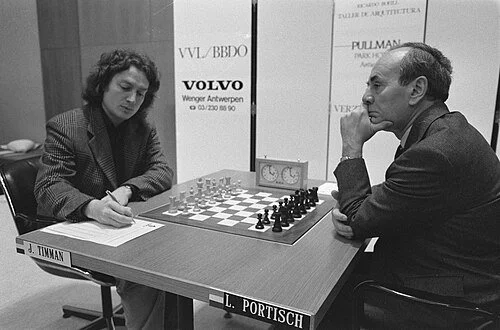
Rob Bogaerts / Anefo
Introduction
Lajos Portisch, or Portisch Lajos in Hungarian name order, belongs among the most consequential chess figures outside the Soviet Union in the second half of the twentieth century. Born on April 4, 1937 in Zalaegerszeg, he rose from provincial Hungarian chess to a place among the world elite, qualified for the Candidates eight times, reached the Candidates semifinals twice, shared world number two on the January 1981 FIDE list, and became the leading board for Hungary’s famous 1978 Olympiad victory over the Soviet team in Buenos Aires. In Russian-language chess sources his name appears as Лайош Портиш, a reminder that his career was followed closely across the Soviet chess world that he so often had to confront.
Portisch deserves attention today not because he fits a romantic legend of the uncrowned king, but because he embodied a rarer kind of greatness: durable, methodical, internationally respected excellence over three decades. He never became world champion, yet again and again he stood in the path of champions, challengers, and Soviet stars, often on equal or superior terms. The historical profile that emerges from federation records, contemporary interviews, and later specialist scholarship is of a player who combined professional discipline, deep opening study, endgame seriousness, and unusual cultural breadth.

GM Lajos Portisch with former world champion GM Boris Spassky at the Reykjavik Open, March 2008. Ted Cross
Early Life and Chess Formation
Portisch was born in Zalaegerszeg, in western Hungary, and his own recollections emphasize how provincial that starting point felt in chess terms. He learned the game at twelve, which he consistently described as late for an eventual world-class player. In later interviews he connected that late start to concrete material conditions: a small-town club, very few books, almost no clocks, and little chance to practice speed chess. He told both Albert Silver and Hungarian interviewers that the club in Zalaegerszeg had only three clocks, that coach Antal Csuti would not let the boys use them for five-minute games, and that this lack of early clock practice left him weaker at rapid and blitz than many contemporaries. He also later judged that a Budapest upbringing would probably have been more favorable to his development than a rural one, even though he remembered his childhood itself as happy.
His family background was not that of an established chess dynasty, but chess was present in the household. Portisch recalled that his father played “a little,” that he and his brother received a chess set as a Christmas present, and that an aunt and local adults likely helped teach them the rules. He and his brother Ferenc then watched adults playing by the Zala river, joined the local club, and came under the influence of Antal Csuti, who, by Portisch’s own account, lent books, gave lectures, and most importantly taught children to love chess. Ferenc Portisch later became a strong international master in his own right, which suggests that the family’s chess life was not incidental.
Portisch’s formative influences were both practical and literary. He remembered borrowing works by Géza Maróczy and other early manuals from Csuti, and he explicitly named Aron Nimzowitsch as a major influence, saying that obtaining two of Nimzowitsch’s books affected him strongly. That is important for understanding the mature Portisch. Even when he later became known for severe positional discipline, his opening imagination and his appetite for systems grounded in structure and logic were not accidental; they were part of an early intellectual formation in which books, not merely over-the-board hustle, shaped his chess identity.
His educational path was brief and revealing. In one interview he said he went to university to study economics after high school, found he had no talent for it, and left after about a month. In another conversation he described having started university and completed one year before the choice of a professional chess life became definite. Those accounts differ on the exact duration, but they agree on the larger point: by age eighteen he had concluded that his future lay in chess, not in a conventional academic profession. That decision was taken in the wake of his first major international success, the 1955 World Junior Championship in Antwerp, where he finished fourth behind Boris Spassky.
Music was the other enduring strand of his early life. He studied violin as a boy, later said that music had once felt like an obligation and only afterwards became a passion, and in later life became a serious singer with a heroic baritone repertoire. That double formation, chess and music, is not a decorative biographical footnote. It helps explain why Portisch repeatedly spoke of chess as not only a sport but also an art, and why even after reducing tournament play he remained publicly active through recital performance.
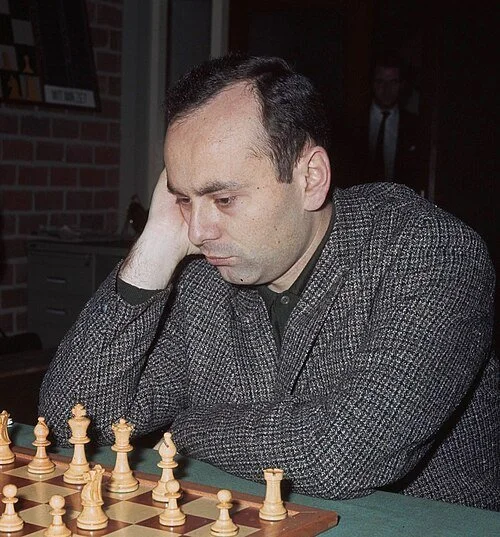
Eric Koch for Anefo
Rise in Competitive Chess
Portisch’s ascent into first-rank chess was relatively quick once his development took hold. Antwerp 1955 was his first truly strong international event by his own description, and although he finished only fourth, the result gave him confidence and national visibility. Hungarian official retrospectives date his rise very early indeed, noting master-level recognition while he was still very young, and by 1958 he had become an international master. FIDE and Hungarian sources agree that he received the grandmaster title in 1961.
In Hungary he broke into a national elite already rich in tradition. Official Hungarian and FIDE materials count him as a nine-time Hungarian champion, a figure repeated by the Hungarian Olympic Committee, FIDE coverage, and local civic honors pages. That domestic record was not merely a matter of longevity. It signaled that he had surpassed the generation immediately before him, especially László Szabó and Gedeon Barcza, and become the central Hungarian standard-bearer between the Maróczy-Szabó era and the later generations of Ribli, Adorján, Sax, Polgár, Lékó, and Rapport.
The first great international marker of his arrival was his win over Tigran Petrosian at Bled in 1961. Russian Chess Federation retrospectives identify that performance as the moment when the young Hungarian champion became widely noticed, and later Russian and English summaries alike stress that Petrosian, one of the hardest players in the world to beat positionally, found Portisch an unusually difficult opponent for many years. Douglas Griffin’s work on the Bled tournament book is useful here because it points back to contemporary annotations by Tal, Keres, Petrosian, Geller, and Gligorić, underscoring that Portisch’s breakthrough was recorded and interpreted by the leading masters of the day, not invented retrospectively.
By 1964 Portisch had become a genuine world championship contender. The Amsterdam Interzonal brought him through to the Candidates, and specialist historical summaries note that he secured qualification by defeating Samuel Reshevsky in an additional match. That detail is less famous than some of his later matches, but it captures the practical seriousness of his rise. He was not simply accumulating pretty tournament results. He was taking a place in the formal world championship system, against players who represented the old international guard as well as the Soviet establishment.
From the early 1960s into the late 1980s, Portisch became one of the most consistent fixtures in elite non-Soviet chess. World Chess Hall of Fame, FIDE, and Russian federation profiles all stress the same long arc: strong results across the interzonal system, repeated tournament victories or shared victories at events such as Sarajevo, Beverwijk, Las Palmas, San Antonio, and Tilburg, and a reputation for being one of the world’s most reliable top-level performers rather than an erratic genius or a brief meteor. That consistency is one of the central facts of his career.
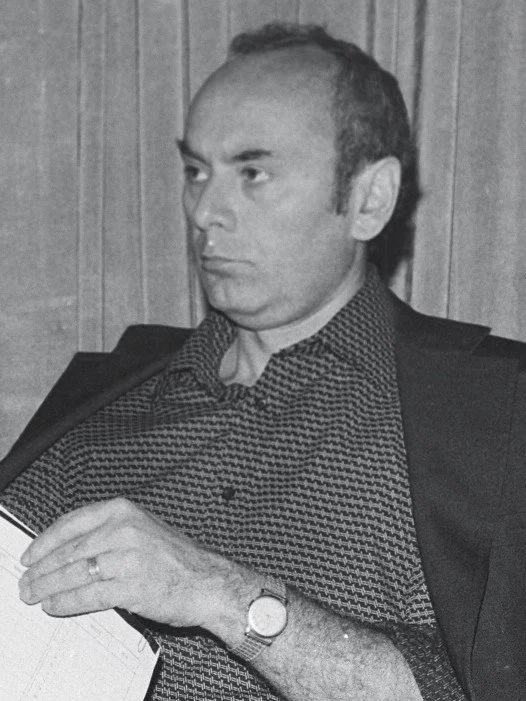
Portisch in Rio 1979. MBIHund
Career at the Summit
The broad outline of Portisch’s elite career is unusually clean. He played in twelve consecutive Interzonals from 1962 through 1993, qualified for the Candidates eight times, and twice reached the semifinal stage. That is one of the longest and most durable records of sustained world championship relevance by any player who never reached the title match itself. The World Chess Hall of Fame, FIDE, and later rating archives all confirm that at his peak he stood essentially one step below the title match level, not as a romantic possibility but as an established fact of the competitive record.
The first Candidates stage brought harsh lessons. He lost quarterfinal matches to Mikhail Tal and Bent Larsen, later lost another quarterfinal to Petrosian, and never crossed into the final stages in the 1960s and early 1970s. Yet the important historical point is not merely that he lost. It is that he kept coming back. He remained a recurring obstacle in the cycle long after many rivals had disappeared, and his best years were not confined to a single brief peak. By 1977 he broke through to the Candidates semifinal, defeating Larsen en route before losing to Boris Spassky. In a 2023 interview Portisch reflected on that Spassky match with extraordinary self-criticism, recalling his impatience, the heat in Geneva, and the role of his second Győző Forintos. This is valuable evidence because it shows that Portisch himself identified temperament, not knowledge, as one of the things that sometimes separated him from the final step.
He reached that level again in the next cycle. After tying Spassky 7 to 7 in 1980, Portisch advanced because he had scored more wins with the black pieces, then lost the semifinal to Robert Hübner. By January 1981, the FIDE rating list had him tied for second in the world at 2650, alongside Viktor Korchnoi and behind only Anatoly Karpov. That is the statistical high point of his career and an important corrective to any account that treats him as merely a very strong supporting figure. For a moment, and by official rating, Portisch occupied the nearest available place behind the reigning champion.
His role as a Soviet rival can be stated precisely without enlarging it into a general Cold War parable. In the 1970 Match of the Century between the USSR and the Rest of the World, Portisch scored 2.5 to 1.5 against Viktor Korchnoi on board three. In 1978, as Hungary’s first board, he helped lead the team that won Olympiad gold in Buenos Aires ahead of the Soviet Union, which FIDE and other official summaries still treat as a landmark result. This was not a matter of symbolism alone. Team chess was one of the main public stages on which the hierarchy of the chess world became visible, and Portisch repeatedly proved that Hungary could compete with, and on occasion surpass, the Soviet machine.
The longevity of his elite relevance is also easy to underestimate. FIDE’s retrospective on his eighty-fifth birthday stressed that he remained very near qualification even in 1993, when he was fifty-six and competing against a new generation that included Gelfand, Ivanchuk, Anand, Kamsky, and Kramnik. That late competitiveness helps explain why Portisch occupies such a large place in Hungarian chess memory. He was not only brilliant once. He was present, credible, and dangerous for an exceptionally long time.
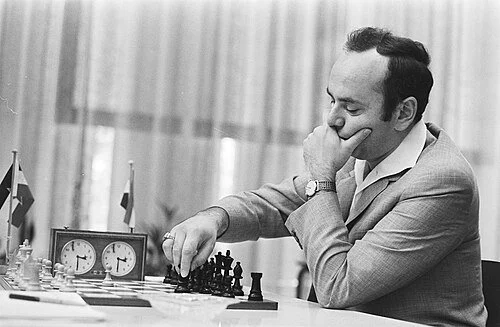
IBM schaaktoernooi 1971. W Punt for Anefo
Style and Reputation
Portisch described his own chess in simple terms: “Positional.” That self-description is consistent across his interviews and across the reputation that attached to him internationally. He became known as the “Hungarian Botvinnik,” a label he did not fully accept because he thought the comparison overstated the likeness, but which nevertheless captures something real about how other masters saw him: deeply prepared, theoretically serious, structurally alert, and determined to locate the strongest continuation rather than a merely acceptable one. FIDE and Russian federation assessments add the same traits from the outside, emphasizing his opening preparation, technique, and scientific approach to the game.
What is especially striking is how candid Portisch was about his own limitations. He said he had been tactically weak at the beginning, and later, when reflecting on the Botvinnik comparison, admitted that he was not able to sustain concentration as relentlessly as Botvinnik or Fischer. In another late interview he remarked that he stood closer to Smyslov than to Karpov in style of thought: more reliant on feel and judgment than on endless calculation. These are not excuses invented by later historians. They are Portisch’s own categories for understanding his game. They support a careful interpretation that his ceiling was shaped less by lack of chess knowledge than by impatience in certain critical, especially sharp or protracted, struggles.
At the same time, his reputation for dryness should not be overstated. Sutovsky’s FIDE tribute argued that Portisch was often mistaken for a cold technician, while closer acquaintance revealed a more complex personality. Portisch himself insisted that chess was art as well as sport. Max Euwe, according to Portisch’s later recollection, once wrote of him after a Dutch appearance that “every game is a masterpiece.” That quotation, because it survives here as Portisch’s memory rather than a reproduced newspaper clipping, should be treated cautiously, but it is still useful as evidence of the kind of esteem he believed he had earned among leading contemporaries.
A few carefully chosen games are enough to explain the reputation. The Bled 1961 win over Petrosian announced that Portisch could outplay the great defensive strategist in a kind of game Petrosian normally made his own. Russian federation summaries further note that Petrosian did not beat Portisch at all until 1974, which, even if compressed in retrospective phrasing, reflects a real long-term difficulty in the matchup. The San Antonio 1972 tournament, where Portisch shared first with Petrosian and Karpov, shows him not as a specialist spoiler but as a player fully at home in the hardest round robins of his age.
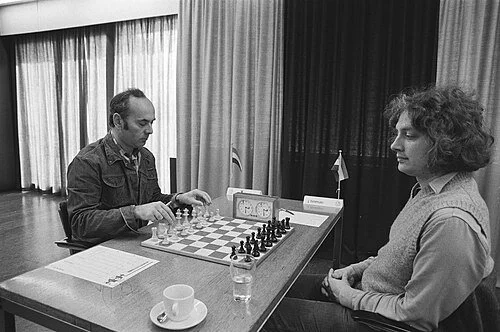
Interpolis Schaaktoernooi te Tilburg 1980. Hans van Dijk
Contributions Beyond Tournament Play
Portisch’s contribution to chess extended beyond results. He was an analyst of unusual seriousness, and his own descriptions of his working methods are revealing. Before computer databases became universal, he kept handwritten notes and a card-file system for preparation. He studied what he intended actually to play, not an encyclopedic range of openings for its own sake. Later in life he remained resistant to doing analysis directly on a screen, preferring printed games and a physical board. Whatever one thinks of that stance in practical terms, it illuminates the culture of top-level pre-computer professionalism from which he came.
His authorship also deserves notice. Archive records confirm that he co-authored Six Hundred Endings with Balázs Sárközy, first published in Hungarian and later in English translation by Pergamon Press. Archive metadata likewise confirms the publication of How to Open a Chess Game, the collaborative 1974 volume in which Portisch contributed alongside Larry Evans, Svetozar Gligorić, Vlastimil Hort, Tigran Petrosian, Paul Keres, and Bent Larsen. These books do not amount to a vast literary corpus, but they show that Portisch was more than a practitioner. He helped codify endgame and opening knowledge in forms aimed at serious players.
Official Hungarian sporting records also identify him as a mesteredző, or master coach, from 1979 onward. Later interviews show that he continued to think of himself as someone who could help Hungarian chess, and in 2018 he publicly lamented that the federation had not made more use of his experience, even after he had applied for the national captaincy. There is no strong evidence that Portisch became a major institutional trainer on the scale of Botvinnik or Dvoretsky, and it would be misleading to present him that way. Still, the documentary record does show a player who saw pedagogy, advice, and national service as part of his role.
His relationships with other leading players were also more substantial than a dry results list suggests. He analyzed often with Bobby Fischer during Fischer’s years in Hungary and came away convinced that Fischer remained extraordinarily strong even in his withdrawn period. He recalled direct conversations with Petrosian, including practical advice during the 1966 Piatigorsky Cup, and he spoke with respect about Smyslov as a model of intuitive judgment. These connections are historically useful because they place Portisch inside the lived network of postwar elite chess, not on its margins.
Music formed the other major part of his public life after his heaviest tournament years. FIDE’s coverage of the 2024 Budapest Olympiad recorded that Portisch held an aria evening during the event, performing works by Mozart, Wagner, Puccini, Verdi, Leoncavallo, Erkel, Rossini, Bellini, and Donizetti. His own Hungarian interviews explain that this was no late eccentricity: he had sung since childhood, trained seriously as an adult, and even performed with Smyslov on one occasion. In Portisch’s case, the often-invoked link between chess and music is not metaphorical. It is biographically literal.

Hans van Dijk
Historical Legacy
Portisch’s later honors confirm how firmly he entered the Hungarian sporting canon. Hungarian official bodies list him among the inaugural holders of the title “Sportsman of the Nation” from 2004, and subsequent honors included high state decoration, civic recognition in Zalaegerszeg and Budapest, and a Fair Play lifetime award. In 2023 he was inducted into the World Chess Hall of Fame, which placed him, institutionally as well as historically, among the defining figures of the modern game.
His legacy inside chess history is twofold. First, he is arguably the most important Hungarian grandmaster between László Szabó and Judit Polgár, the player who kept Hungary continuously present at the highest level of elite international chess. Second, he is one of the clearest examples of non-Soviet endurance in an era when the world championship system was still heavily shaped by Soviet depth. That is why the 1978 Olympiad remains so central to his public memory, and why his repeated Candidates appearances still seem historically weighty. He gave Hungarian chess not merely prestige, but a durable claim to competitive parity with the best chess culture in the world.
A concise historical assessment can therefore be stated without exaggeration. Portisch deserves attention today because he represents one of the strongest, longest, and most intellectually coherent careers ever produced by a player who never became world champion. He was a persistent Soviet rival, a scholar-player with genuine creative force, a carrier of Hungarian chess tradition, and a public figure whose life connected chess to music, pedagogy, and civic honor. His career shows that chess history is not made only by titleholders. It is also made by those who repeatedly define the level just beneath the throne, and by doing so shape the standards of an era.
Notes and Sources
This profile relies foremost on Portisch’s own recorded recollections and on official institutional summaries. The most valuable interview material used here comes from Albert Silver’s two-part ChessBase interview, Tibor Károlyi’s published interview material, the 2023 Hungarian interview in Sakkmező, and John Donaldson’s World Chess Hall of Fame interview transcript on the Piatigorsky Cup. For official records and honors, the strongest sources were FIDE, the Hungarian Olympic Committee, the World Chess Hall of Fame, and the Russian Chess Federation’s “Person of the Day” profile. Douglas Griffin’s tournament-history essays on Bled 1961 and the Tal-Portisch 1965 Candidates match were also useful as guides to contemporary primary annotation, even where they are not quoted directly in the body text.
One factual caution is worth flagging. Some modern reference pages give Portisch eight Hungarian championships, while official Hungarian and FIDE materials count nine. Because official Hungarian sporting bodies and FIDE now use the figure nine, that count has been followed here. Another small note concerns naming: Hungarian sources generally use Portisch Lajos, while Russian sources use Лайош Портиш. Those variations reflect language convention, not uncertainty about identity.
