Chess in Abkhazia
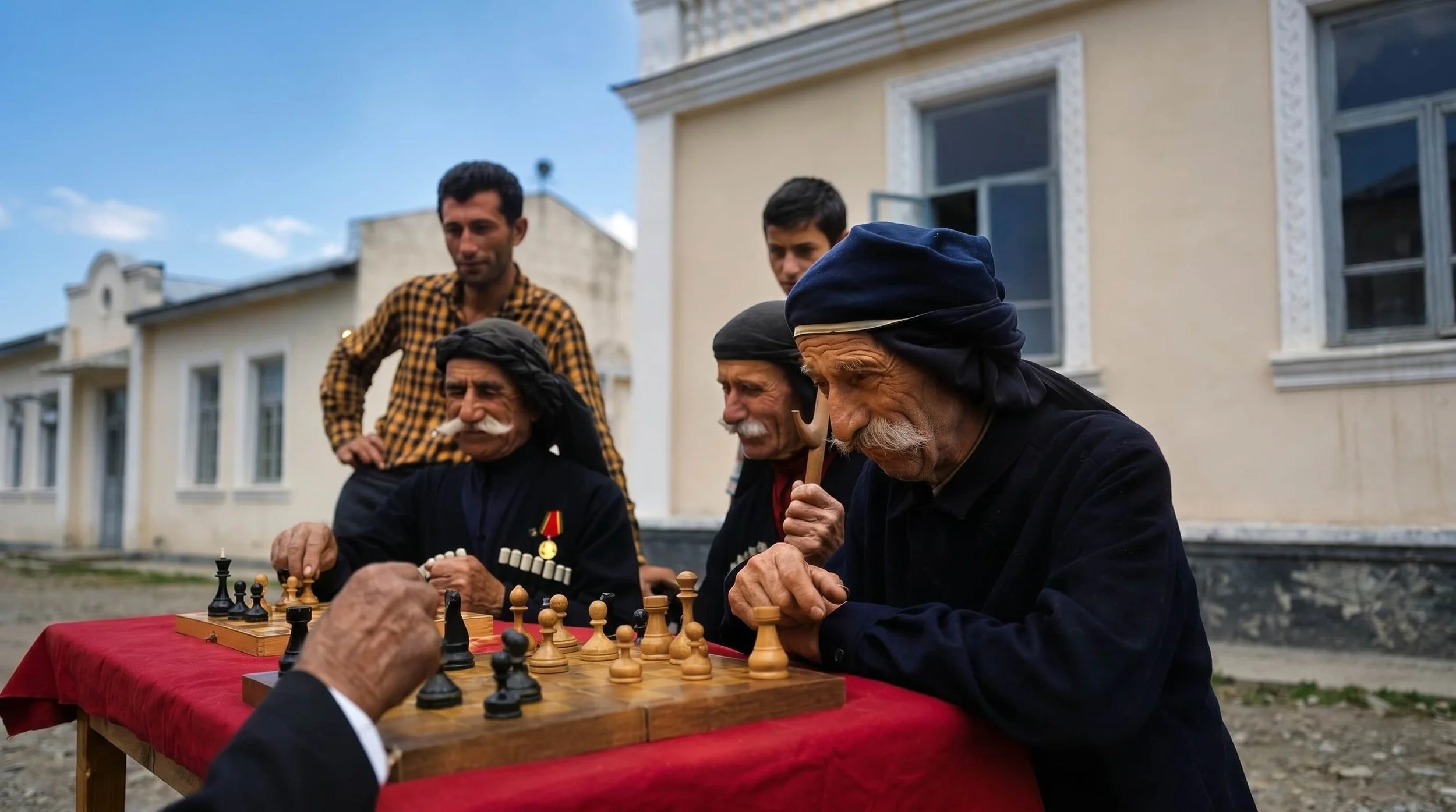
Abkhazian centenarians playing chess in Lykhny, Gudauta District, Abkhaz ASSR, Georgian SSR, August 1967. Today the village lies in Abkhazia, a de facto breakaway region recognized by Russia and a small number of states, while Georgia and most of the international community regard it as part of Georgia.
A quiet chess game in Lykhny, photographed in August 1967, captures far more than a village pastime. The image shows elderly Abkhaz men seated at a chessboard in what was then the Abkhaz Autonomous Soviet Socialist Republic, part of the Georgian SSR. Today, Lykhny lies in Abkhazia, a de facto breakaway region internationally disputed between Georgia and the authorities in Sukhumi. For a Soviet chess history archive, the photograph is valuable because it places chess outside the tournament hall, away from grandmasters, clocks, medals, and official ceremonies. It shows chess as memory, habit, social ritual, and everyday intellectual life.
The men are often described as “centenarians” or “hundred-year-old highlanders.” That phrasing should be handled carefully. Soviet culture had a long fascination with the longevity of the Caucasus, especially in Abkhazia and Georgia, and photographs of vigorous elders became part of a familiar visual language. Abkhazian longevity was celebrated in Soviet writing, journalism, and popular imagination, although many extreme age claims from the region have been questioned by later scholars. Still, the point of this image does not depend on proving an exact birthday. Its historical force lies in the scene itself: elderly village men gathered around a chessboard, treating the game as a natural part of communal life.
Lykhny is one of the most historically resonant villages in Abkhazia. It is associated with the Lykhnashta meadow, a traditional site of public gatherings, cultural events, and political memory. Nearby stand the ruins of the Shervashidze or Chachba princely residence, long connected with the ruling house of Abkhazia. The village is also known for the medieval Church of the Dormition of Lykhny, usually dated to the tenth century, with later frescoes and Georgian and Greek inscriptions. In other words, the setting is not incidental. A chessboard in Lykhny sits inside a landscape of memory.
That is what makes the photograph so useful for understanding Soviet chess culture. Soviet chess was not only Botvinnik, Smyslov, Tal, Petrosian, Korchnoi, and Spassky. It was also the amateur board in a workers’ club, the school lesson in a Pioneers’ Palace, the game in the park, the correspondence column, the family set, and the village table. The Soviet state promoted chess as a disciplined intellectual sport, but people also made it their own. In this image, the game belongs to the players before it belongs to any institution.
The phrase “highlanders playing chess for hundreds of years” should therefore be read poetically rather than literally. Chess has old roots across the Caucasus, and Georgia developed one of the great chess cultures of the twentieth century, especially through its extraordinary women players. But the specific claim that men in Lykhny had been playing chess continuously for hundreds of years would require stronger evidence. A more accurate interpretation is that the photograph shows chess embedded in a long-lived village culture, where age, conversation, patience, and public life all meet at the board.
The visual language is also important. The men are not presented as passive relics of the past. They are thinking, watching, and participating. Chess gives the photograph movement. A hand may reach for a piece. A spectator may lean closer. One man may be calculating, another remembering similar positions from years before. The board becomes a small stage for concentration and status. In many traditional societies, games of skill can function as public tests of intelligence, restraint, memory, and character. Soviet chess culture intensified that meaning by treating chess as a model of rational thought.
There is also a subtle contrast between the great Soviet chess machine and this intimate village scene. In 1967, Soviet chess was still at the height of its international prestige. The world championship had passed from Botvinnik to Smyslov, Tal, Petrosian, and soon Spassky. Soviet teams dominated Olympiads. Chess schools, journals, and clubs formed a powerful infrastructure. Yet this photograph reminds us that the deepest cultural reach of chess cannot be measured only by titles. The game’s influence can also be seen in a village where elderly men gather around sixty four squares and continue the habits of analysis, rivalry, and conversation.
For Soviet Chess History, the image belongs in the archive because it widens the story. It shows chess not simply as a sport of champions but as a shared language across age, region, and social class. It also asks us to be careful historians. The caption should preserve the Soviet-era location, name the Abkhaz context, and avoid flattening the region’s disputed present into a single political phrase. In 1967, Lykhny was in the Abkhaz ASSR of the Georgian SSR. Today, it is in Abkhazia, whose status remains internationally disputed.
In one photograph, Lykhny gives us the larger Soviet chess story in miniature. The board is small. The setting is local. The men are unnamed. Yet the scene carries the central idea that made chess so powerful in the Soviet world: the game could belong to everyone.
Notes
AbkhazWorld, “Abkhazian centenaries playing chess. Lykhny (August 1967),” Facebook post, accessed June 11, 2026.
AbkhazWorld, “Preserving Life: Saving a Linden Tree in the Village of Lykhny,” April 5, 2026.
Georgian Travel Guide, “The Church of Dormition of Lykhny,” accessed June 11, 2026.
Reuters, “Russia Resumes Flights to Breakaway Georgian Region for First Time in Decades,” February 7, 2025.
Freedom House, “Abkhazia: Freedom in the World 2022 Country Report,” accessed June 11, 2026.
