Mikhail Chigorin
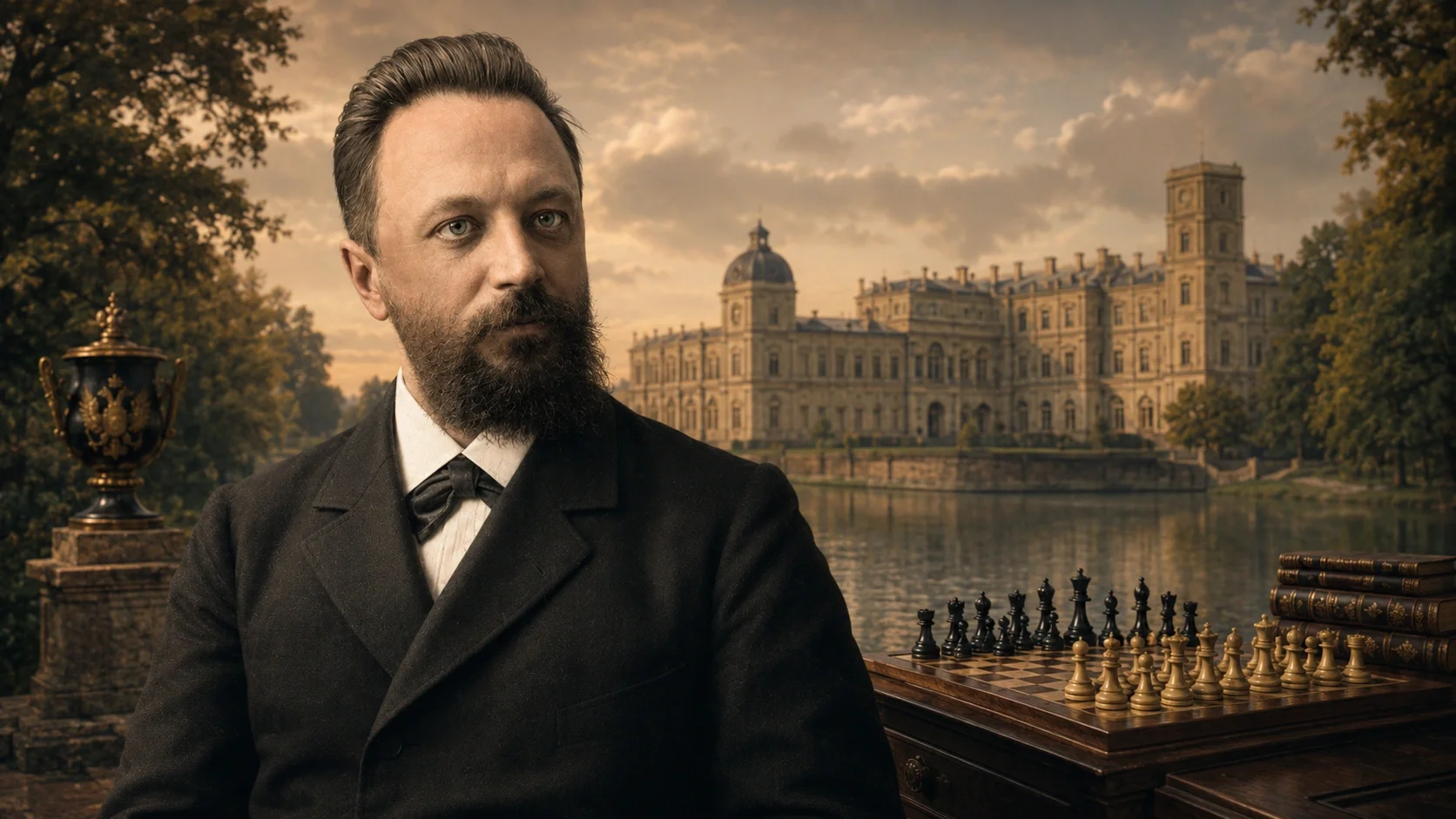
Mikhail Ivanovich Chigorin (1850–1908) stands as a legendary figure in chess history, often celebrated as the last great player of the Romantic era and the founding father of the Russian (later Soviet) school of chess. In the late 19th century, Chigorin rose from humble beginnings in Imperial Russia to challenge the world’s best players, including two World Championship matches against the reigning champion Wilhelm Steinitz. Renowned for his daring tactical style and imaginative innovations, he bridged the gap between the old romantic style of attacking chess and the emerging modern, positional school. Chigorin’s creative brilliance and tireless efforts to promote chess left an indelible mark, sowing the seeds for the Soviet chess boom of the 20th century and earning him a permanent place in the pantheon of chess greats.
Early Life and Rise in Russia
Chigorin’s path to chess stardom was an unlikely one. He was born in 1850 in Gatchina, near Saint Petersburg, and faced tragedy early, orphaned by the age of 10 and raised in an orphanage. It was there that a teacher introduced him to chess when he was 16, but young Mikhail showed only passing interest at first. Not until his early twenties, after completing his studies and working briefly as a government clerk, did Chigorin become serious about the game. Once chess seized his imagination, however, he made a bold move: quitting his job to pursue chess full-time. By 1876, Chigorin had even founded a chess magazine, appropriately titled Chess Sheet, which he edited in an effort to galvanize Russia’s chess community.
Immersing himself in competitive play, Chigorin honed his skills by taking on the best players in Saint Petersburg. He played a series of matches against established Russian masters, notably Emanuel Schiffers and Semyon Alapin, and scored impressive victories against both. These successes quickly cemented Chigorin’s reputation as Russia’s strongest player. In one early game against Alapin in 1880, Chigorin even sacrificed his queen in the opening for a dazzling checkmating attack, signaling the arrival of a brilliant and fearless new talent. By the start of the 1880s, Russian chess enthusiasts began to rally around Chigorin as a national hero who could finally put their country on the international chess map.
Breaking Onto the International Stage
Encouraged by his domestic triumphs, Chigorin soon tested his mettle abroad. His international debut came at the Berlin 1881 tournament, a strong event featuring many of Europe’s top masters. There Chigorin exceeded expectations by finishing in a tie for third place (with Szymon Winawer), behind only Johannes Zukertort and Joseph Henry Blackburne. The Russian’s performance, ahead of numerous seasoned masters, created a stir and proved that his aggressive style could compete at the highest level. In fact, the famed Polish master Winawer, who had met Chigorin a few years prior, had presciently encouraged him to enter international events after recognizing the young man’s potential. Chigorin’s success in Berlin validated that advice and earned him new respect on the European chess scene.
Chigorin continued to build on this success. At the prestigious London 1883 tournament, one of the great tournaments of the 19th century, he finished a creditable fourth, behind only Zukertort, Steinitz, and Blackburne. Along the way Chigorin notched two wins over Steinitz, the reigning world champion, catching the chess world’s attention with his fighting spirit. Commentators praised Chigorin’s uncompromising will to win; as one contemporary digest wrote, “he continuously played for the win, and his persistence guaranteed him success.” By 1885, Mikhail Chigorin was firmly established among the world’s elite players, a remarkable ascent for someone virtually unknown a decade earlier.
His biggest breakthrough came in New York 1889, one of the era’s strongest tournaments. There, Chigorin delivered an outstanding performance, tying for first place with the Hungarian master Max Weiss. This victory on American soil was historic, never before had a Russian player claimed top honors in such a prominent international event. It also earned Chigorin the right to challenge the World Champion, Wilhelm Steinitz, for the chess crown. The stage was set for a Russia vs. West showdown that chess fans had been anticipating: the brilliant attacking Russian against the veteran strategist Steinitz.
World Championship Battles with Steinitz
Chigorin’s clashes with Wilhelm Steinitz became the stuff of legend, showcasing a dramatic contrast in playing styles. Their first World Championship match took place in 1889 (Havana, Cuba), with Steinitz’s title on the line for the very first time. Chigorin started strong, in fact, he won the very first game of the match, and demonstrated that his dynamic attacking play could trouble the champion. Ultimately, however, Steinitz’s greater experience and positional prowess told: Chigorin was defeated by a score of 10½ to 6½ in that match. It was a respectable showing for the challenger, and he had proven he could go toe-to-toe with the world’s best.
Three years later, in 1892, Chigorin earned a rematch and once again faced Steinitz for the world title, this time in Havana under much anticipation. The 1892 Chigorin-Steinitz match was fiercely contested and featured many memorable, hard-fought games. Chigorin unleashed his full creative arsenal against the champion, and for much of the match he actually held a slim lead. As the lengthy contest wore on, however, the two opponents traded the lead back and forth. By the final scheduled game, Steinitz led by the narrowest margin. In a dramatic finish, Chigorin, needing a win to draw the match, obtained a winning position but then suffered a heartbreaking lapse: he blundered into a checkmate-in-two and lost the decisive game, and with it the match, by the final score of 12½ to 10½. Chess historians often cite this as one of the most tragic blunders ever in championship play: Chigorin came within a breath of the title, only to let it slip away in an instant. Nonetheless, his overall performance confirmed that he was one of the very strongest players of his time. In two matches against Steinitz, Chigorin had won a total of 14 games to Steinitz’s 18, a very competitive record.
Aside from the official matches, the two men even played an innovative “telegraph match” in 1890, a long-distance match conducted via telegraph moves, to settle an opening debate. Chigorin won both games of that friendly duel, vindicating his analysis in the chosen opening. Steinitz himself respected Chigorin enormously; he once praised the Russian as “the most worthy challenger in the struggle for the World Championship.” Their rivalry encapsulated a clash between Steinitz’s new positional theories and Chigorin’s Romantic attacking ethos, and it greatly influenced the development of chess style going forward.
A Romantic Playing Style and Innovative Ideas
Style. Chigorin’s playing style was widely admired for its tactical creativity, aggression, and imaginative flair. In an era when many top players were starting to adopt Steinitz’s more scientific, positional approach, Chigorin remained a proud romantic at heart, always looking for bold attacking chances. He was willing to launch sacrificial attacks and play enterprising gambits to unbalance the game. “For Chigorin, the word ‘draw’ did not exist,” wrote master Rudolf Spielmann, referring to the Russian’s uncompromising search for victory in every game. Fellow players marveled at Chigorin’s combinative vision, as the English master Isidor Gunsberg remarked, “combinations such as Chigorin’s can be created only by a great master.” Even in inferior positions, Chigorin showed remarkable ingenuity in complicating the fight; his resourcefulness and fighting spirit earned him a reputation as one of the 19th century’s most tenacious competitors.
At the same time, Chigorin was no mere swashbuckler, he had a strong grasp of endgames and positional nuances as well. The great Viennese master Carl Schlechter called Chigorin “an outstanding master of the endgame,” underscoring that the Russian’s skill set was well-rounded. In truth, Chigorin selectively accepted Steinitz’s new teachings, for instance, he agreed with Steinitz on the soundness of maintaining a solid defensive center, but he rejected any overly rigid doctrines that constrained creativity. He favored piece activity and dynamic possibilities over strict adherence to textbook rules. This independent outlook led him to experiment boldly in the opening and seek fresh ideas over dogma.
Opening innovations. Chigorin’s quest for dynamism made him an opening pioneer. Several openings and variations are named after him, attesting to his contributions. Most famously, he originated the Chigorin Defense to the Queen’s Gambit (1.d4 d5 2.c4 Nc6), a provocative reply in which Black develops the queen’s knight immediately to challenge White’s center. While long regarded with skepticism by classical players, this offbeat defense found new life decades later and is still employed by adventurous fighters (even in modern times, grandmasters like Alexander Morozevich have championed Chigorin’s old defense). Another enduring contribution is the Chigorin Variation of the Ruy Lopez (Spanish Opening), in which Chigorin showed that Black could forsake the usual …c7-c6 structure and instead play moves like …Na5 and …c5 to fight for the initiative. This idea was ahead of its time and remains a viable system that bears his name in contemporary opening manuals.
Chigorin was fond of unusual ideas that later proved quite insightful. For example, he introduced the queen move 2.Qe2 in the French Defense (after 1.e4 e6) as an early sideline weapon. At first glance this move looked odd, but it anticipated strategies akin to the King’s Indian Attack setup; today we recognize Chigorin’s 2.Qe2 as a creative forerunner of modern kingside strategies. He was also one of the era’s greatest exponents of gambits: the King’s Gambit, Evans Gambit, and other dashing openings were staple tools in his arsenal. In the Evans Gambit in particular, Chigorin’s treatment and innovations left a lasting impact, many of his improvements are still cited by theoreticians. Former World Champion Emanuel Lasker noted that Chigorin’s opening experiments “can serve as a model for chess masters,” praising the Russian’s original contributions. Indeed, Chigorin’s imaginative opening choices have stood the test of time, yielding ideas that continue to enrich chess theory more than a century later.
A brilliancy example. One game that exemplifies Chigorin’s style and creativity is his first-round victory against Steinitz in the 1892 World Championship match. Playing White, Chigorin trotted out the ultra-aggressive Evans Gambit, offering a pawn in the opening for rapid development. Steinitz accepted the gambit but responded a bit cautiously, allowing Chigorin to seize the initiative. Soon Chigorin established a powerful knight outpost on d6 (an “octopus knight” deep in Black’s position) and then boldly sacrificed that knight to rip open the defenses around Steinitz’s king. What followed was a brilliant attacking display: Chigorin’s pieces swarmed forward, chasing Steinitz’s king all the way out to the sixth rank. The hapless monarch found itself ambushed in the center of the board, caught in a mating net. In a final flourish, Chigorin gave up additional material to force checkmate with a pair of bishops and a rook coordinating in deadly fashion. This beautiful win, essentially keeping the enemy king in the center until delivering mate, earned wide acclaim and showcased Chigorin’s ferocious tactical ability at its best. It remains one of the celebrated games from the 19th century Romantic era, illustrating why no less an expert than Géza Maróczy opined that “no master was closer to the great Morphy than Chigorin.”
Later Years and Legacy
As the 19th century turned into the 20th, Chigorin remained a central figure in chess. He continued to post strong results in major competitions. Notably, at the famous Hastings 1895 super-tournament, one of the strongest tournaments ever held up to that time, the 44-year-old Chigorin delivered one of the finest performances of his career. He finished clear second place out of a stacked field, behind the youthful American star Harry Pillsbury, but ahead of World Champion Emanuel Lasker, Siegbert Tarrasch, and his old rival Steinitz. During that event Chigorin defeated both Lasker (with the black pieces, no less) and Pillsbury in their individual encounters. In fact, Pillsbury would later acknowledge Chigorin’s prowess, fittingly, Chigorin held a narrow plus score in their encounters over the years. Other successes followed: Chigorin tied for first at Budapest 1896, took second at Cologne 1898, and continued to rank among the world’s top five players as he entered his fifties. He also confirmed his dominance at home by winning the first three All-Russia national tournaments (the early Russian championships) in 1899, 1900/01, and 1903, further cementing his status as the patriarch of Russian chess.
By the mid-1900s, however, Chigorin’s health began to decline. He still enjoyed chess and participated in events (for example, a four-player tournament at Łódź 1906 where he finished second to the rising star Akiba Rubinstein). But in 1907, during a tournament in Carlsbad, Chigorin’s performance was uncharacteristically poor, and it became clear that something was wrong. He was soon diagnosed with advanced, untreatable diabetes, and doctors gave him only months to live. Suffering physically and emotionally, Chigorin had an anguished outburst in which he burned his chess set, as if symbolically raging against the fate that was forcing him from the game he loved. He spent his final days back with his estranged wife and young daughter in Lublin (in present-day Poland), and there on January 25, 1908, Mikhail Chigorin died at the age of 57. News of his passing was met with great sorrow in the chess world. The first Chigorin Memorial Tournament was organized the following year in St. Petersburg (1909) to honor his memory, drawing many top players of the day in tribute.
Chigorin’s legacy in chess is monumental. Through his original games, teachings, and writings, he is widely regarded by Russians as the founder of the Russian chess school, the tradition of creative, fighting chess that would later blossom in the Soviet Union. Former world champions of the Soviet era, such as Mikhail Botvinnik and Vasily Smyslov, credited Chigorin as a major inspiration for the Soviet chess boom decades later. Botvinnik wrote that Chigorin was “many years ahead of his time” and that his work would “always be an inexhaustible source for the development of chess ideas,” emphasizing how Chigorin paved the way for the Soviet chess hegemony to come. Indeed, the Soviet chess school’s emphasis on dynamic play and fighting spirit can be traced back to Chigorin’s influence. Starting in 1947, an annual Chigorin Memorial tournament became a fixture in the USSR (often held in Sochi), a tradition that continues in St. Petersburg to this day. The Soviet Union even honored Chigorin with a postage stamp in 1958, a testament to the esteem in which he was held as a national chess icon.
Today, Chigorin’s games and ideas still delight and instruct chess enthusiasts around the globe. His name lives on in opening theory through the various Chigorin variations and defenses that remain playable and intriguing to modern players. More importantly, his example as a fearless attacker and original thinker continues to inspire. In the words of grandmaster Harry Pillsbury, “there was never a master who combined the art of attack and defense to such an extent as Chigorin.” Mikhail Chigorin’s life story, rising from obscurity to contend for the world title, igniting a chess movement in his homeland, and leaving behind a rich treasure trove of games, embodies the very romance of chess. Over a century later, he is remembered not only as a great player and innovator, but as the patriarch of a chess tradition that produced many champions. His legacy endures in every creative game and fighting spirit that echoes the Chigorin tradition. As long as chess is played, Chigorin’s name and contributions will continue to be celebrated in the history of the royal game.
Sources
Steinitz, Wilhelm, ed. The Book of the Sixth American Chess Congress: Containing the Games of the International Chess Tournament Held at New York in 1889. New York: Brentano’s, 1891.
Steinitz, Wilhelm. The Modern Chess Instructor. New York: G. P. Putnam’s Sons, 1889.
Cheshire, Horace F., ed. The Hastings Chess Tournament, 1895: Containing the Authorised Account of the 230 Games Played. London: Chatto & Windus, 1896.
Kotov, Alexander, and Mikhail Yudovich. The Soviet School of Chess. Moscow: Foreign Languages Publishing House, 1958.
Hooper, David, and Kenneth Whyld. The Oxford Companion to Chess. 2nd ed. Oxford: Oxford University Press, 1992.
Linder, Isaak, and Vladimir Linder. Wilhelm Steinitz: First World Chess Champion. Milford, CT: Russell Enterprises, 2014.
