Evgeny Bareev
Introduction
Evgeny Ilgizovich Bareev, born on November 21, 1966 in Yemanzhelinsk in the Chelyabinsk region, belongs to the last great generation formed inside the late Soviet training system and then tested in the harsher, less centralized chess world that followed. He became world under-16 champion in 1982, earned the grandmaster title in 1989, spent long stretches among the world’s leading players, and by the September 2003 FIDE rating list had climbed to fourth place in the world. Russian federation sources describe him as a long-time member of the world top ten.
Bareev deserves attention not only because of his rating peaks and tournament victories, but because his career illuminates several connected histories at once: the provincial Soviet route into elite chess, the educational role of the Moscow chess boarding school, the post-Soviet importance of team events and seconds, the institutional work of the Russian Chess Federation, and the later migration of elite chess knowledge into a wider international and Canadian setting. Those are documented facts. The broader claim that Bareev is a bridge figure between Soviet institutional chess and the modern transnational chess profession is an interpretation, but it is a well-grounded one.
Early Life and Chess Formation
Bareev’s early environment was unusually rich in educational and chess culture. His father, Ilgiz Akhatovich Bareev, trained as a teacher of Russian language and literature, later worked in Yemanzhelinsk’s educational system, and from 1978 led a chess club at the local House of Pioneers. Municipal records credit him with devising methods for teaching chess to preschool and primary-school children and with helping turn local events such as Belaya Ladya into civic institutions. After Ilgiz Bareev’s death in 1994, Evgeny oversaw the publication of his father’s instructional book Grandmasters of Kindergarten. A later Russian profile adds that Evgeny grew up in a family of educators, that his father taught him the game, and that his early practice included games with his older brother Vladimir. That family detail is secondary rather than archival, but it is consistent with the broader documented picture of a pedagogical household shaped by local chess work.
A later hometown report records Bareev recalling that he had also been serious about athletics before chess took over, which is a small but revealing detail. It suggests that his eventual professional commitment was neither automatic nor purely predetermined. What is better documented is the speed of his chess development: he moved to Moscow, studied at the famous chess boarding school, and graduated in 1992 from the chess faculty of the University of Physical Education, a classic late Soviet path from provincial talent to centralized high performance training.
The institutional and human network around the young Bareev was strong. Russian federation material on Sergey Shipov notes that Shipov, Bareev, and Yuri Dokhoyan studied in the same class at the Moscow chess boarding school, placing Bareev in a cohort that would later supply top players, trainers, and seconds to elite Russian chess. A memoir by Alexey Dreev in Vladimir Barsky’s book on Mark Dvoretsky adds another valuable early detail: at the 1982 Soviet qualifying event for the world under-16 championship, Dreev and Bareev shared first, then played off in Moscow for the right to represent the USSR, and Bareev won. Denis Evseev later wrote that Bareev was a frequent guest at sessions of the Dvoretsky-Yusupov school, where he lectured and annotated his own games. Taken together, these sources show that Bareev was formed not by isolated talent alone but by a very dense educational milieu of peers, schools, trainers, and analysis culture.
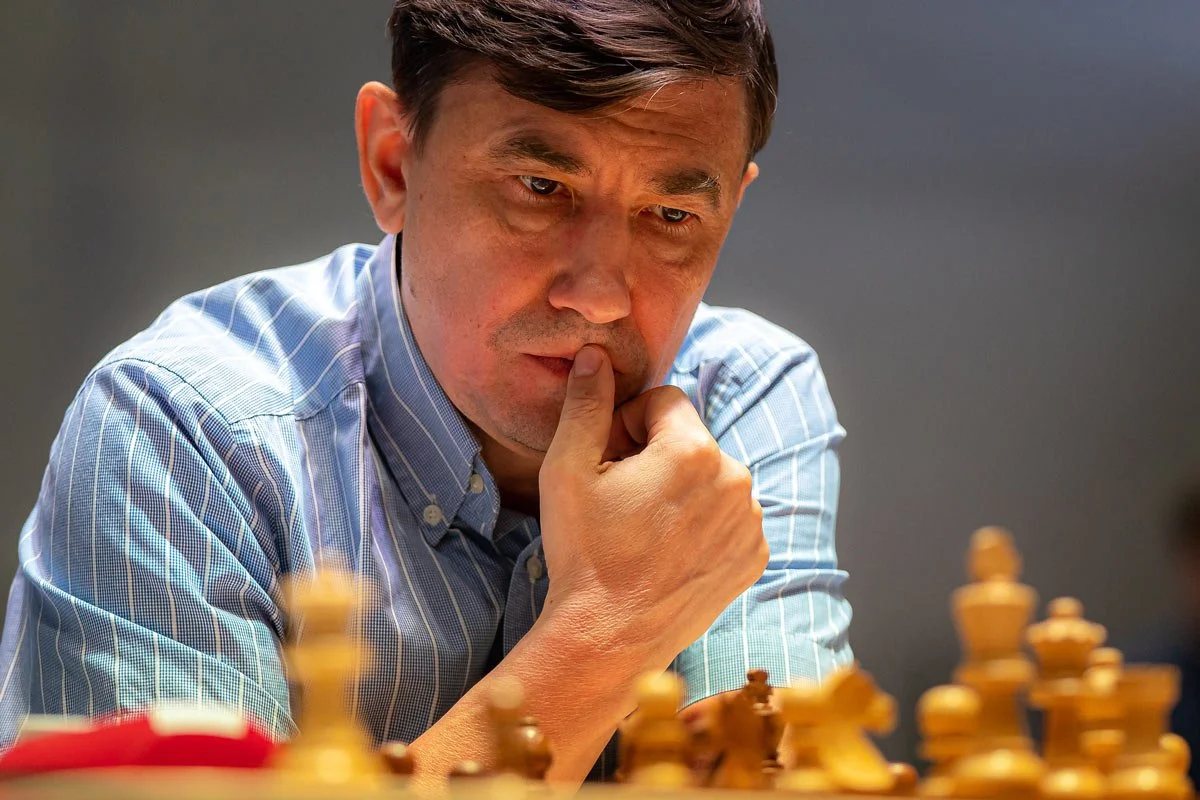
Evgeny Bareev, 2021. Photo Credit: Eric Rosen
Rise in Competitive Chess
Bareev’s rise was early, steady, and institutionally legible. The world under-16 title in 1982 marked him as a player of genuine international promise. He received the international master title in 1986 and the grandmaster title in 1989. Only a year later he was already on the Soviet Olympiad team that won gold at Novi Sad, a remarkable sign of trust in a player who was still very young for such a role.
The early 1990s established his reputation at the highest level. Russian Chess Federation profiles state that at the beginning of that decade he was one of the strongest grandmasters in the world, regularly placing first or winning prizes in the hardest events and remaining in the world top ten for a prolonged period. One concrete marker of that rise was his run of Hastings victories: OlimpBase records him as the winner of the premier group in 1990 and 1991, and as sharing first with Judit Polgár in the 1992 edition. Those results fit Bareev’s larger profile, a player who climbed without flamboyance but with unusual consistency and seriousness.
It is tempting to tell this part of his story as a narrative of sudden arrival, but the documented record suggests something slightly different. Bareev’s ascent came through repeated confirmation. He was not just a junior champion who briefly translated promise into adult results. He kept proving that he belonged, first inside Soviet structures, then in open international competition, and then at the level of full supertournament participation. That pattern helps explain why contemporaries trusted him so readily in team events and later in world championship preparation.
Major Career Achievements
Bareev’s achievements in team chess are central to his historical profile. He won Olympiad gold with the Soviet team in 1990 and later with Russia in 1994, 1996, and 1998. Russian federation sources also credit him with repeated victories in world and European team championships. OlimpBase records him as one of Russia’s major Olympiad contributors, with appearances across the 1990s and 2006, and shows his strong board performance in events such as the 1997 World Team Championship. These results support the view of Bareev as one of the most dependable elite team players of his generation.
His best known individual peak came in the early 2000s. In September 2000 he reached the final of the first FIDE World Cup in Shenyang, where he lost 1.5 to 0.5 to Viswanathan Anand. Two years later he produced what Mark Crowther in The Week in Chess called the finest result of his career when he won Corus Wijk aan Zee 2002 outright. FIDE’s tournament report shows Bareev scoring 9/13, ahead of Alexander Grischuk, Michael Adams, Alexander Morozevich, Peter Leko, Jan Timman, and others in one of the strongest tournaments of the year. In the same year, he advanced to the semifinals of the Dortmund Candidates event, qualifying from his group and then losing a hard semifinal to Veselin Topalov.
His later tournament wins, though less famous, help round out the picture. Russian federation sources note that he won the Higher League of the Russian Championship in 2005 and the Russian Cup in 2009. These were not the achievements of a player living on reputation. They show that even after his absolute peak, Bareev remained a dangerous and serious competitor. FIDE’s current profile, meanwhile, records that after transferring from Russia to Canada on September 5, 2015, he later won the 2019 Canadian Zonal, again qualifying for world championship cycle competition.
Style and Reputation
Bareev’s chess reputation rested first on strategic depth. Denis Evseev’s long profile of his play is particularly helpful because it is not generic praise. Evseev wrote that what had first struck him in Bareev’s games was the “depth of understanding,” the “consistent, purposeful strategy,” the “clear logic” of his decisions, and the “scrupulous and accurate calculation” that supported them. As an example, Evseev pointed to Bareev’s win over Valery Salov at Linares 1992, not for tactical fireworks alone, but because the game displayed a long strategic plan that was gradually transformed into an attack. This is exactly the sort of game reference that clarifies Bareev’s reputation without reducing him to a collection of brilliancies.
At the same time, Bareev was not merely a dry positional player. Evseev argued that his attacking skill had to be understood as part of a broader universality, and even spoke of an “instinct of the killer,” a phrase he used when describing Bareev’s readiness to exploit small signs of weakness with professional force. That duality is historically useful. Bareev’s best chess joined plan, restraint, and calculation, but once the position asked for force he could become very direct. In that sense he fits an older Soviet ideal of the universal grandmaster more closely than some of his more narrowly branded contemporaries. That last point is an interpretation, but it is strongly suggested by the evidence of both his games and the commentary of other masters.
His weaknesses were real and should be stated plainly. Evseev noted that in Bareev’s beloved French Defence, which he had used throughout his life, sudden collapses sometimes occurred with striking regularity, often quite early by grandmaster standards. He speculated that the cause was not the opening itself so much as some combination of danger sense, memory, and prepared opposition. Just as significant, Evseev stressed Bareev’s resilience: bad starts or isolated failures did not usually derail whole tournaments, and his rating rose slowly and steadily because his results were so stable. That is one of the most convincing ways to describe Bareev’s practical strength. His career had fewer spectacular headlines than some peers, but more structural reliability.
As a personality, Bareev was remembered as reserved, witty, and independent. Frederic Friedel’s ChessBase interview described him as “unassuming, almost shy,” while also noting that his views could be unconventional and startlingly direct. That combination, reserve in manner and independence in judgment, helps explain why Bareev later fit so naturally into roles as second, trainer, federation official, and commentator. He was not a player whose historical value ended at the board.
Contributions Beyond Tournament Play
Bareev’s work as Vladimir Kramnik’s second is one of the strongest reasons his name remains historically relevant. Russian federation sources state that he joined Kramnik’s team in 2000 and served as a second in the world championship matches against Garry Kasparov in 2000 and Peter Leko in 2004. He later co-authored, with Ilya Levitov, From London to Elista, a major insider account of Kramnik’s title matches. New In Chess describes the book as a behind-the-scenes reconstruction of preparation, match play, and psychological stress, and the English Chess Federation awarded it its 2008 Book of the Year prize. For chess historians, that book remains one of the more revealing testimonies by a leading second from the computer age.
His institutional work was also substantial. Between 2005 and 2014, according to the Russian Chess Federation, Bareev worked inside the federation, first leading the children and youth committee, then directing sporting work, and serving as head trainer of the national teams. FIDE’s profile lists him as a FIDE Senior Trainer from 2011. These facts place him within the machinery of post-Soviet Russian chess, not merely as a decorated veteran but as someone involved in the development pipeline and national team structure.
Bareev also trained individual players outside Russia. In a 2011 interview, Lê Quang Liêm said that he had worked with Bareev for six weeks in 2009. That cooperation does not make Bareev solely responsible for Liêm’s later successes, and it would be wrong to exaggerate the claim. Still, it shows that Bareev’s analytical and pedagogical authority was recognized internationally. In later years, Russian federation sources note that during the pandemic period he became one of the principal voices of the Levitov Chess channel, adding commentary and public explanation to a career already rich in private preparation and federation work.
His published work beyond the Kramnik book also reflects a coherent educational identity. Thinkers Publishing’s description of Say No to Chess Principles! presents it as a challenge to rote instructional maxims, organized around concrete strategic and psychological themes rather than slogans. That approach is consistent with the better documented parts of Bareev’s career: a player shaped by rigorous Soviet schooling who nonetheless distrusted simplistic formulas and valued concrete understanding.
Historical Legacy
After representing Russia for most of his professional life, Bareev transferred to Canada in September 2015, and Russian federation sources note that he played first board for Canada at the 2016 Olympiad. FIDE records him as a Canadian player today, and its tournament archive shows that he won the 2019 Canadian Zonal. ChessBase’s report on the 2021 zonals notes that he also took one of the Canadian qualification spots for the World Cup that year. These later results do not alter the center of his legacy, which remains Soviet and Russian in formation, but they do show an uncommon durability and a second national chapter rather than a mere afterlife on the margins.
Historically, Bareev is easy to underrate because his career lacks the single mythmaking hook that often secures permanent popular fame. He was not world champion, not a cult attacking icon in the Shirov mold, and not a public star in the Kasparov sense. But the documentary record points to a different kind of significance. He was one of the strongest players in the world for a sustained period, a four-time Olympiad gold medalist, a world-class second, a serious trainer and federation official, and an author whose insider testimony has enduring value. It is also reasonable to see continuity between the educational work of his father in Yemanzhelinsk and Bareev’s own later commitments as trainer, author, and chess publicist. That continuity is interpretive, but it rests on unusually strong evidence.
Bareev deserves attention today because he embodies a form of chess greatness that is often missed in simplified histories. He was not only a high-ranking grandmaster. He was a carrier of institutions, methods, and standards, from Soviet youth training to post-Soviet team chess, from world championship preparation rooms to later Canadian competition and public commentary. To study Bareev is to study how first-rate chess culture is transmitted, preserved, and adapted across political systems and generations.
Notes and Sources
This profile relies chiefly on primary and near-primary documentary material: the Russian Chess Federation’s Russian and English biographical pages on Bareev; FIDE’s player profile and tournament reports; OlimpBase’s team-competition records; the Yemanzhelinsk municipal record on his father Ilgiz Bareev; Alexey Dreev’s memoir of the 1982 under-16 qualifying cycle in Vladimir Barsky’s Dvoretsky volume; contemporary reports by The Week in Chess and ChessBase; and official or publisher material connected with Bareev’s books and public roles.
For style and historical assessment, I have also drawn on specialist master commentary, especially Denis Evseev’s portrait of Bareev’s chess, while treating those judgments as expert interpretation rather than undisputed fact. Family details about his mother, father teaching him the game, and his early play with an older brother come from a later Russian profile and are used here with that limitation in mind. I use the form “Evgeny Bareev,” which corresponds to FIDE and English-language Russian federation usage, while Russian-language sources cite “Евгений Бареев.”
Where this article advances broader conclusions, especially the view of Bareev as a bridge figure between late Soviet institutional chess and the later international professional culture of seconds, trainers, authors, and emigrant grandmasters, those conclusions are interpretive syntheses from the documented record above, not quotations from any single source.
