Viktor Gavrikov
Introduction
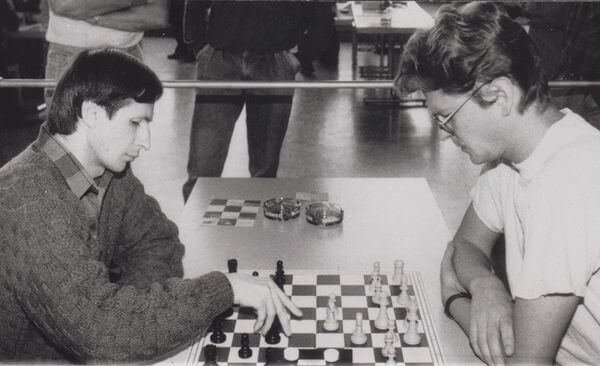
Viktor Nikolaevich Gavrikov was born on 29 July 1957 in Criuleni, in the Moldavian SSR, and died in Burgas, Bulgaria, on 27 April 2016. In the chess record he appears successively as a Soviet, Lithuanian, and Swiss grandmaster, with the FIDE grandmaster title awarded in 1984. His best official world ranking was nineteenth on the July 1985 FIDE list, while his highest published rating was 2605 in the mid-1990s. Those bare facts already suggest a career that was strong enough to enter the world elite, yet uneven enough to remain less remembered than those of the Soviet champions and Candidates who stood closest to him in the same years.
Gavrikov deserves attention today for three related reasons. First, he rose from the Moldavian training network into the hardest competitive environment in world chess and was immediately credible there. Second, he combined tournament success with a serious reputation as an opening specialist and analyst. Third, his later importance as a trainer and chess writer appears to have outlasted his period as an active top player, especially through his work with Nana Alexandria, Yannick Pelletier, and Viktorija Čmilytė. In other words, Gavrikov was not only a strong grandmaster who briefly stood near the center of elite Soviet competition, but also a transmitter of a particular Soviet analytical culture into post-Soviet European chess. That final point is an interpretation, but it rests on the documentary record of his students, publications, and federation history.
Early Life and Chess Formation
The published biographical record on Gavrikov is noticeably fuller on his chess formation than on his family background or formal academic education. Federation obituaries and memorial notices agree that he was born in a small Moldavian town and that his early promise led to a transfer for schooling to Bender, followed by serious work with the leading Moldavian trainer and theoretician Vyacheslav Chebanenko. Moldovan and Russian chess institutions alike remembered him explicitly as a Chebanenko pupil, which is already enough to place him inside one of the most fertile provincial schools of late Soviet chess.
According to the Russian Chess Federation obituary, Gavrikov was already a strong first-category player at the age of nine, was selected for the Dubossary district team, and helped that side win the Moldavian republic championship unexpectedly. He then moved to a school in Bender and soon became a Master of Sport of the USSR. Those details fit a recognizable Soviet pattern: exceptional early advancement, regional team competition, then absorption into a more centralized training structure.
There is, however, a small biographical discrepancy worth noting. A later memorial essay by Grigor Grigorov states that Gavrikov learned the rules of chess only at the age of twelve, whereas the Russian Chess Federation obituary presents him as a strong first-category player at nine. The safer conclusion is not to force precision where the sources disagree. What can be said confidently is that he developed quickly enough to attract institutional attention while still very young, and that Chebanenko's influence was decisive in shaping him as both player and theoretician.
Rise in Soviet Chess
Before Gavrikov became widely known as a player, he had already acquired a reputation as an analyst. In 1980 he was invited into the training team of Nana Alexandria during her Candidates cycle and later the match with Maia Chiburdanidze. Mark Dvoretsky, who worked in the same camp, later wrote that Gavrikov's contribution to opening preparation was hard to overestimate, describing him as an erudite analyst with an absolute memory who could provide expert guidance in virtually any variation. The Russian Chess Federation obituary reports that this work led to Gavrikov's receiving the honorary title of Honored Trainer of the Georgian SSR in 1981, an unusually early and unusual distinction for a player who was still building his own over the board career.
By the beginning of the 1980s he had also moved to Lithuania after marriage, and his rise in Soviet individual competition became abrupt. In his first USSR Championship final, at Frunze in 1981, he shared fourth and fifth place with 9.5 out of 17, behind only the joint winners Lev Psakhis and Garry Kasparov and Oleg Romanishin. The result was not a fluke appearance. Russian federation sources also credit him with victory in the all-Union Young Masters event in 1983 and notable tournament wins in Tbilisi in 1983, and in Leningrad and Nałęczów in 1984. By 1984 he had received the grandmaster title.
His rise is legible in the rating lists. On the January 1984 FIDE list he stood on 2485. By July 1984 he had reached 2505, by January 1985 he was 2550, and by July 1985 he had climbed to 2570 and nineteenth in the world. That is a sharp ascent, and in the Soviet context it signaled not merely technical strength but the ability to survive repeated testing against opponents who were themselves world class or nearly so.
Interzonal Moment and International Career
Gavrikov's defining tournament result came at Riga in the 1985 Soviet Championship. The event ended with Gavrikov, Mikhail Gurevich, and Alexander Chernin tied for first. The subsequent playoff in Vilnius did not separate them because every game was drawn, after which Gurevich received the title on the tiebreak rules from the main event. For historical assessment, the main point is that Gavrikov did finish in the leading group of one of the last great Soviet championship finals, and that this was strong enough to send him into the world championship qualifying cycle.
He then shared fourth and fifth place at the 1985 Tunis Interzonal. That left him one step short of the Candidates, because the last qualifying place had to be decided in an additional playoff with Chernin, which Gavrikov lost. This is one of the central turning points of his career. He reached the edge of the Candidates level, but did not cross it. In historical terms, this is why Gavrikov belongs among the strongest Soviet grandmasters who were fully capable of elite results without ever becoming a world title contender in the formal sense.
He confirmed that his 1985 run had not been accidental by again finishing near the top in the 1986 Soviet Championship. OlimpBase's championship summary records Vitaly Tseshkovsky as champion, with Gavrikov and Chernin in the tie for the next places. A contemporary Soviet chess encyclopedia entry, compiled while Gavrikov was still in his prime, lists his strong USSR Championship finishes in 1981, 1985, and 1986 together, showing that contemporaries already saw a consistent high level rather than a single spike.
Another major public moment came in Mazatlan in 1988, at the first FIDE World Active Championship. FIDE's historical account records that Gavrikov reached the final against Anatoly Karpov after a 13-round Swiss and knockout stage, drew the final match 5:5, and lost the title only on additional criteria. That result says something important about his reputation. Gavrikov was not just a classical tournament player who occasionally happened to score well in rapid. He was respected enough, and adapted quickly enough, to reach the final of the first major FIDE event in the format.
After the collapse of the Soviet Union, Gavrikov's career entered a distinctly European phase. He played under Lithuania in early post-Soviet rating lists, then for Switzerland from 1993 to 1997, and later again under Lithuania. During that period he won Biel in 1994, became Swiss champion at Arosa in 1996, and in 2000 shared first in the Lithuanian championship tournament that was won on tiebreak by the teenage Viktorija Čmilytė. His rating trajectory also remained strong for years after his Soviet peak, reaching 2605 in 1995 and 1996.
Style and Reputation
The strongest concise characterization of Gavrikov's chess comes from a contemporaneous soviet chess encyclopedia entry, which described his play as marked by versatile opening preparation, tenacity in defense, and high technique. ChessBase's obituary adds a closely related assessment, presenting one of his games as an illustration of good opening knowledge, sound positional play, and an eye for tactics. Taken together, those descriptions point to a player whose strengths were broad rather than narrow. He was not remembered principally as an attacking artist, or as a pure endgame specialist, or as a systems man with one lifelong repertoire. He was remembered as deeply prepared, resilient, and technically serious.
That picture is reinforced by testimony from those who worked with him. Dvoretsky stressed the depth of his opening knowledge and his extraordinary memory. Grigorov, writing from the perspective of a later student, described immense knowledge across every phase of the game, unusually strong analytical ability, and a perfectionist disposition that could sometimes impair practical decision-making. Yannick Pelletier, quoted by Grigorov, wrote that Gavrikov gave him a real glimpse of the Soviet school, with preparation so systematic that it felt as though computers already existed.
A careful historical interpretation would therefore describe Gavrikov as a universal, theory-rich Soviet grandmaster whose practical identity rested on preparation, positional understanding, defensive stubbornness, and strategic memory. The same sources also hint at a limitation. If Grigorov's recollection is fair, Gavrikov's pursuit of perfect solutions may have cost him some practical opportunities over the board. That is not a documented causal fact, but it is a reasonable interpretation of why a player who reached nineteenth in the world and the edge of the Candidates cycle did not leave a larger mark on title history.
Trainer, Author, and Chess Intellectual
Gavrikov's importance beyond tournament play is unusually well documented. His work for Nana Alexandria has already been noted, but it was only the beginning. Russian federation sources state that he later helped both Yannick Pelletier and Viktorija Čmilytė, and Grigorov's memorial goes further, arguing that his assistance was central to the grandmaster development of several later players. Pelletier himself wrote that if he had to credit one person for his grandmaster title, it would be Gavrikov. Such testimony should not be converted into arithmetic certainty, but it does establish Gavrikov as a trainer of real consequence, not a retired master merely offering occasional advice.
His work as an author and theoretician was also substantial. ChessBase records that he wrote opening surveys and annotations for ChessBase Magazine. New In Chess archives list him as the author of multiple magazine articles and seven Yearbook surveys between 1993 and 2002, on a range of opening subjects. Even without entering opening detail, the breadth of those contributions is revealing. Editors trusted him not as a one-line specialist but as a dependable analyst whose work would be useful to strong practical players.
He extended that pedagogical role into the early internet era. A 2008 Chess.com forum announcement advertised Gavrikov's live training, explicitly presenting him as a teacher able to explain positional play, critical positions, and strategic judgment, and noting that he was already registered as a teacher on ICC and Playchess. Grigorov also notes that Gavrikov collaborated from the outset with Modern Chess Magazine. Here again, the larger pattern is clear: Gavrikov's second chess life centered on transmitting deep preparation and positional understanding to others.
Later Life and Historical Legacy
After 1991, Gavrikov's career followed the broader routes taken by many Soviet-trained grandmasters into western and central European league chess, though his own combination of affiliations was distinctive. ChessBase records that he played for the Swiss federation from 1993 to 1997, represented clubs in the Swiss League and the German Bundesliga, and later returned to Lithuanian federation lists. The documentary trail also shows a family move to Switzerland after the Soviet collapse, followed by relocation to Bulgaria in the 2010s. Grigorov writes that Gavrikov and his wife Riina moved first to Petrich in 2010 and later to Burgas, where he lived until his death.
The last years of his life were spent more in training and writing than in front-rank tournament play. Both the Russian Chess Federation and ChessBase emphasize that shift. This phase should not be treated as an afterthought. For many strong Soviet players, later influence came less through titles won than through students formed, analytical material published, and intellectual habits passed onward. Gavrikov fits that pattern strongly.
His historical legacy is therefore twofold. As a player, he was one of the strongest Soviet grandmasters of the mid-1980s, a shared winner of the 1985 USSR Championship, an interzonal near-qualifier, and a finalist against Karpov in the first major FIDE rapid world event. As a chess intellectual, he was a Chebanenko pupil whose memory, opening range, and analytical seriousness impressed Dvoretsky, Pelletier, and later students. Gavrikov deserves attention today not because he can be inflated into something he was not, but because the historical record shows a figure of genuine depth: an elite but under-canonized Soviet grandmaster whose influence on chess culture extended well beyond his own tournament crosstables.
Notes and Sources
The key forms of his name in the sources are Russian, Viktor Nikolaevich Gavrikov, and Lithuanian, Viktoras Gavrikovas. The Russian Chess Federation obituary explicitly gives the patronymic and full Russian form, while Lithuanian media use the Lithuanian rendering. There is also a small but important discrepancy in some English obituaries regarding his age at death. ChessBase stated that he died at fifty-nine, but the documented birth and death dates, and the Russian federation obituary, indicate that he died at fifty-eight.
This profile relies most heavily on federation and archival sources: the Russian Chess Federation obituary and profile piece, the Moldovan Chess Federation memorial notice, FIDE's own historical page on the 1988 World Active Championship, OlimpBase's rating lists and Soviet championship records, a scanned Soviet chess encyclopedia entry, Mark Dvoretsky's recollection of the Alexandria team, and the archival records of New In Chess and The Week in Chess. ChessBase and Grigor Grigorov's memorial essay were used mainly for post-Soviet career, league affiliations, authorship, and student testimony. Where the record supports interpretation rather than direct statement, that has been signaled in the text.
