Jaan Ehlvest
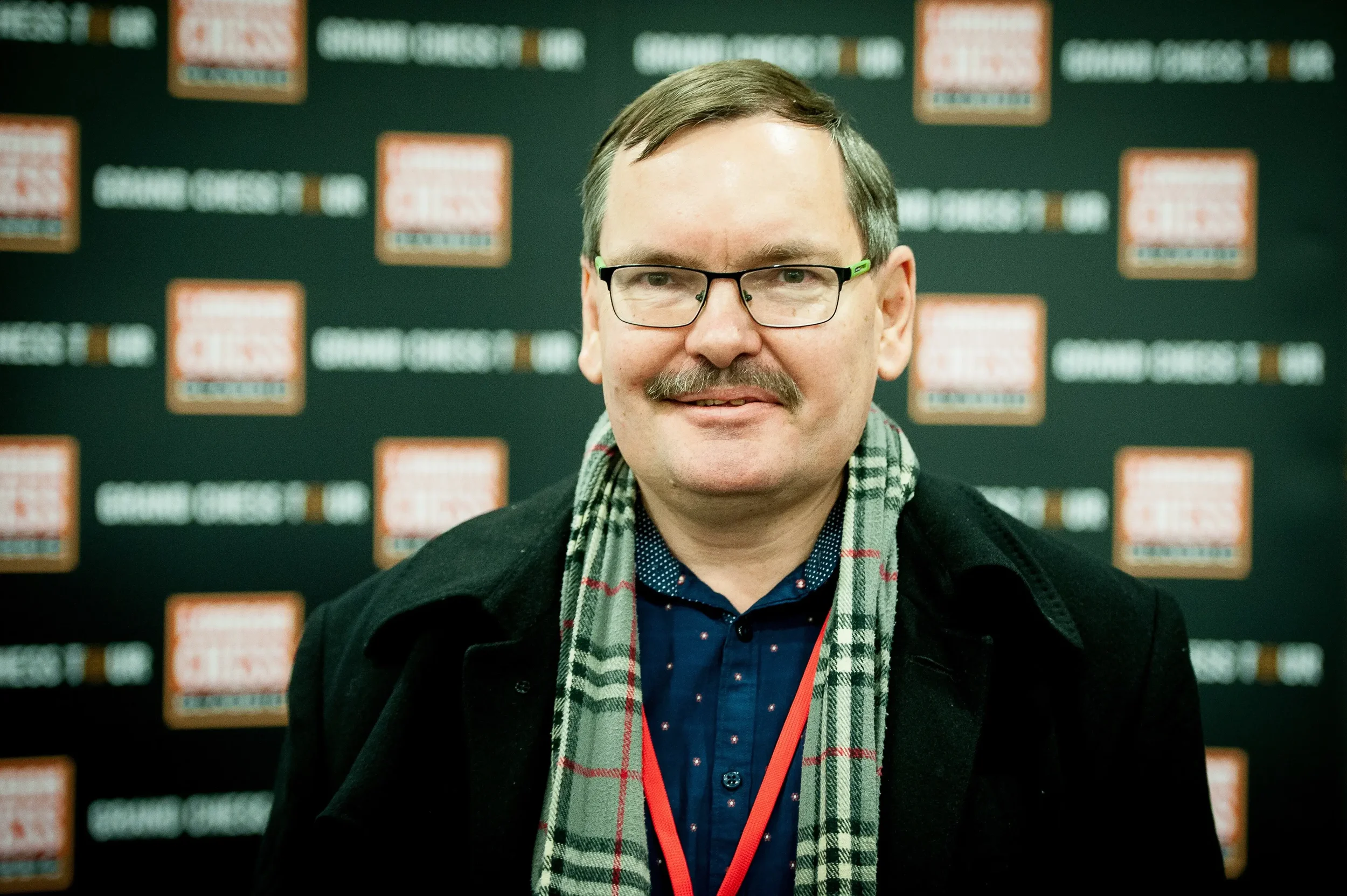
Wolfgang Jekel, CC BY 2.0
Jaan Ehlvest: Estonian‑American Grandmaster and Soviet Chess Legend
Jaan Ehlvest (b. 14 October 1962) is one of Estonia’s most celebrated chess players. Rising to prominence during the late Soviet era, he became a grandmaster in 1987 and briefly ranked among the world’s top five players. His journey reflects the evolution of chess in Estonia and the wider Soviet sphere: from a promising youth coached at Mikhail Botvinnik’s school to a player whose victories on international stages—particularly the Reggio Emilia super‑tournament in 1990—cemented his legacy. Ehlvest later emigrated to the United States and continued competing while writing and coaching, making him an important bridge between Soviet and modern chess cultures.
Early life and training in Estonia
Ehlvest was born in Tallinn to a family of physicians. His mother introduced him to chess when he was six, and by his teenage years he was attending a local chess academy while completing high school. After winning the 1976 Estonian SSR youth championship, he was invited to the famed Botvinnik School, where the patriarch of Soviet chess likened the young Estonian’s style to that of Paul Keres. The camp sessions were formative: although Ehlvest spoke little Russian, Botvinnik’s advice—relayed through coach Tõnu Truus—encouraged him to study games more deeply.
Ehlvest pursued higher education at Tartu University, earning a degree in psychology. The discipline’s analytical methods later influenced his approach to chess and his writings. He also comes from a family engaged in the arts; his brother Yuri is a noted Estonian writer.
Breakthrough in Soviet competitions
While still a student, Ehlvest emerged as one of the strongest juniors in the Soviet Union. He captured the USSR junior championship and European junior championship in the early 1980s, earning the International Master title after his victory at the European Junior Championship in 1983. In 1984 he debuted in the adult USSR championship final and scored a respectable 8/17.
His major breakthrough came at the 1987 USSR championship. Sharing the bronze medal with Vereslav Eingorn, he qualified for the Zagreb Interzonal, where his second‑place finish behind Viktor Korchnoi secured his grandmaster title and a spot in the Candidates’ matches. During the inaugural World Cup series (1987–1988), he placed fourth behind Garry Kasparov, Anatoly Karpov and Valery Salov, underscoring his rapid rise among world elites.
International success and world ranking
Ehlvest’s tactical acuity and psychological insight made him a formidable opponent on the international circuit. In 1988 he was part of the Soviet team that won gold at the Chess Olympiad in Thessaloniki and he later represented Estonia at Olympiads through 2004. His signature individual triumph came at the Reggio Emilia super‑tournament in late 1990; amid fierce competition from Vasily Ivanchuk and Anatoly Karpov, he scored clear first and lifted his FIDE rating above 2650. The performance placed him fifth on the FIDE world list, making him one of the few Estonians ever to reach the global top five.
During the 1990s he remained a regular in elite events: he reached the quarterfinals of the Intel Grand Prix series and the French team championship with the Lyon club. In knockout world championship cycles (1997, 1999 and 2000) he advanced as far as the round of sixteen. Outside Europe, he won open tournaments such as the Vršac (1987), Tallinn (1989) and New York Open (1994), and he was voted Estonian Sportsman of the Year in 1987 and 1989.
Transition to independence and later competitions
Political changes in the late 1980s affected Baltic players. As Estonia sought independence, its players were excluded from Soviet events. Ehlvest nonetheless continued to compete internationally, representing Estonia in successive Olympiads and winning prizes across Europe. In 2000 he captured the FIDE zonal tournament and again reached the Candidates’ bracket.
The early 2000s marked a shift toward open tournaments and professional coaching. He won the World Open in Philadelphia in 2003 and the U.S. Grand Prix in 2005. As an experienced grandmaster, he served as a second for Anatoly Karpov in 1995 and for Alexander Khalifman during the 1999 Las Vegas World Championship. His pupils include Darmen Sadvakasov and Sandipan Chanda, both of whom achieved international success.
Emigration to the United States and later career
Dissatisfied with limited support from the Estonian Chess Federation, Ehlvest transferred to the United States Chess Federation in 2006. He settled in New York and became active in the U.S. tournament scene, winning major open events and maintaining a FIDE rating near 2600. In 2007 he played two matches against the computer program Rybka. The grandmaster was given pawn odds and extra time, yet the machine prevailed; the exhibition highlighted the growing power of chess engines.
Beyond competitive play, Ehlvest engaged in chess administration. He served as president of FIDE’s Baltic Zone 1.7 from 1998 to 2002 and was a member of the FIDE medical commission. He founded “Ehlvest Chess Gates,” an organization promoting chess education and youth training.
Writing and philosophical contributions
Ehlvest’s background in psychology shaped his contributions as an author. He wrote Grandmaster Opening Preparation (1991) and The Story of a Chess Player (2005), among other works. The latter is an introspective memoir that explores his experiences growing up under Soviet rule, the transitional years of the late 1980s and his reflections on the nature of chess. In the memoir he contends that talent alone is insufficient at elite levels; he stresses the importance of psychological resilience and strategic understanding. The book was published by Arbiter Publishing in cooperation with his own educational organization.
Legacy
Jaan Ehlvest occupies a special place in Soviet and Estonian chess history. He followed Paul Keres as Estonia’s next world‑class player, validated by his invitation to the Botvinnik school and by his world‑top‑five ranking. His tactical victories, particularly at Reggio Emilia and in Soviet championships, bridged the Soviet era and the post‑Soviet chess world. Ehlvest’s later move to the United States extended his impact, allowing him to share Soviet training methods with Western students and to promote chess through coaching and writing. His autobiography and teaching endeavors testify to a reflective grandmaster who combined academic insight with over‑the‑board brilliance.
Footnotes
Sergey Kim, “ЯАН ЭЛЬВЕСТ,” Russian Chess Federation (Person of the Day, 14 Oct 2025), lines 203–211.
“Яан Эльвест,” Chess‑Boom Online, biography section, lines 54–76.
Sergey Kim, “ЯАН ЭЛЬВЕСТ,” Russian Chess Federation, lines 223–233.
Ibid, 274–279.
Jaan Ehlvest, coaching profile, Lichess.org, lines 55–80.
“Jaan Ehlvest,” U.S. Chess Championships biography, lines 64–74.
Jurgen Kaljuvee, “The Story of a Chess Player,” ChessBase, lines 168–191.
