Pyotr Dubinin
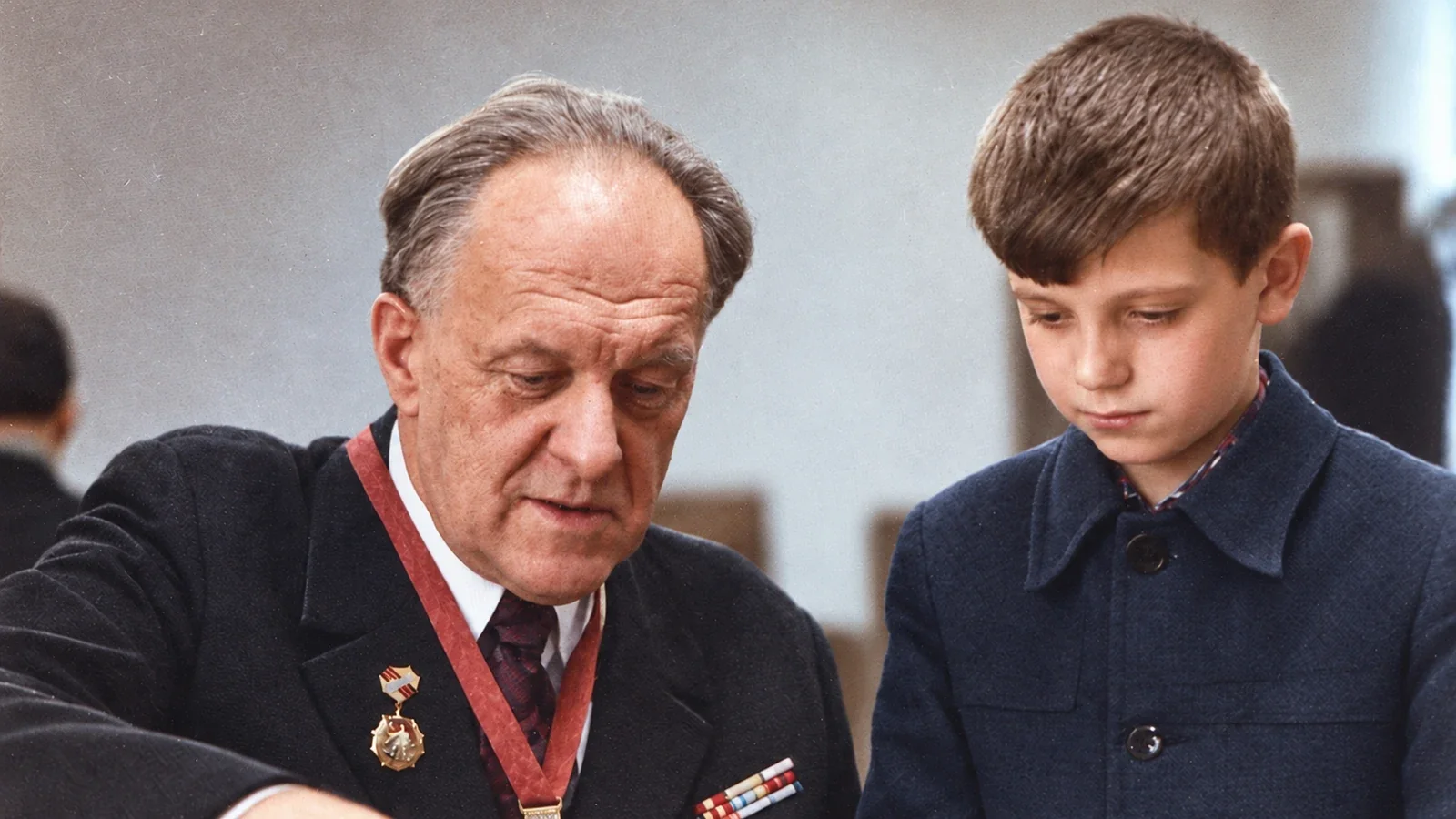
Introduction
Pyotr Vasilievich Dubinin (1909–1983) was a Soviet chess master, correspondence grandmaster, and teacher closely associated with Gorky, now Nizhny Novgorod. His career spanned the city’s early chess circles, Soviet championship finals, and international correspondence competitions. [1]
Dubinin received the FIDE International Master title in 1950 and became an Honored Master of Sport of the USSR in 1952. Later, he achieved a shared Soviet correspondence championship, second place in the world correspondence championship, and three team victories in correspondence Olympiads. Alongside these results, he spent decades developing chess at the Gorky Automobile Plant. [11, 12, 15]
Early Life and Chess Formation
Dubinin was born on 30 June 1909 in Warsaw, then part of the Russian Empire. His father worked at a metallurgical plant. After the outbreak of the First World War, the family moved to Nizhny Novgorod, and his father’s death left the household in difficult circumstances. At fourteen, Pyotr began working as a porter while continuing his schooling. [2]
A school friend introduced him to chess. He joined the local chess circle, attended its meetings, and studied chess literature. The circle gave him opponents and a community where his interest could develop. He also began composing chess problems. [2]
In 1926 he moved with his mother to Korosten, where his older brother Ivan lived. After the deaths of both his mother and brother, Dubinin returned to Nizhny Novgorod. Fellow chess players helped him find employment. He worked on the construction of the bridge across the Oka and won his first city championship in 1930. [2, 3]
Rise in Competitive Chess
Army service beginning in 1932 brought further competitive opportunities. Dubinin’s progress soon carried him into national competition, and he made his USSR Championship final debut in Leningrad in December 1934. The tournament continued into January 1935. [3, 4]
He defeated Ilya Rabinovich, who shared first place, and also beat Vyacheslav Ragozin and Alexander Ilyin-Genevsky. Contemporary reporting reproduced by historian Sergei Voronkov drew attention to his unusual distribution of points: he scored 5½ against the eight highest finishers. Those results established that the newcomer from Gorky could compete successfully with experienced masters. [4]
Dubinin earned the Soviet master title in 1938 after sharing third place with Alexander Kotov and Alexander Chistyakov in a USSR Championship semifinal. He was appointed a physical education instructor at the Gorky Automobile Plant, providing an institutional base for his chess work. [3]
In the 1939 USSR Championship he scored 8½ out of 17, sharing eighth through tenth places with Grigory Levenfish and Ragozin. His strongest national final followed in Moscow in 1940. There he scored 10½ out of 19 and shared seventh through ninth with Vladimir Makogonov and Gavriil Veresov. [5]
The 1940 field included Mikhail Botvinnik, Paul Keres, Vasily Smyslov, Isaac Boleslavsky, and the joint winners, Igor Bondarevsky and Andor Lilienthal. Dubinin defeated Boleslavsky and Makogonov and drew with Botvinnik and Smyslov. He finished one point behind the shared fifth place occupied by Botvinnik and Boleslavsky. His standing rested on strong results against a demanding field. [5]
War and the Return to Competition
The German invasion interrupted Dubinin’s participation in the 1941 championship semifinal in Rostov-on-Don. He entered the Red Army that year. He fought near Moscow, on the Northwestern Front, and around Velikiye Luki. After officer training, he served as a political officer in the 312th Novgorod Rifle Regiment. [2, 6]
Dubinin suffered a severe concussion during fighting near Königsberg in 1945. He earned the Order of the Red Star and other military medals. He remained in service until 1946. These years interrupted his competitive development at a time when he had established himself as one of the country’s leading masters. [6]
His return produced an immediate national success. In the 1946 Leningrad semifinal, Dubinin shared first place with David Bronstein on 11½ out of 18. This qualified him for the 1947 USSR Championship, his fourth final appearance. Contemporary reporting welcomed his strong performance after demobilization. [7]
Another substantial result came at the 1949 Russian republic championship in Yaroslavl. Dubinin and Georgy Ilivitsky shared first place with 9½ out of 15. Lev Aronin’s contemporary report praised the quality and originality of Dubinin’s games. The title was subsequently decided by an eight-game playoff, which Ilivitsky won 6–2. [8, 9]
Major Achievements in Correspondence Chess
Dubinin had entered Soviet correspondence competition before the war. During the postwar years, it became an increasingly substantial part of his career. He finished second in the second Soviet correspondence championship, shared first in the third, and placed second again in the fourth. [2]
The shared title came in the 1955–1957 championship, alongside Georgy Borisenko. The ICCF’s history of Russian correspondence chess records both men as champions. This run established Dubinin as a consistent contender in national correspondence competitions. [10]
His highest individual international placing came in the third World Correspondence Championship, which began in 1959. Dubinin finished second with six points from nine games, half a point behind Albéric O’Kelly de Galway. He won four games and drew four, including his encounter with the eventual champion. ICCF awarded him the correspondence grandmaster title in 1962. [11]
Team competition extended this achievement across several decades. Dubinin played for the victorious Soviet teams in the fourth, sixth, and eighth correspondence Olympiads. On second board in the fourth final, he contributed 5½ out of eight; on second board in the sixth, he scored five out of eight. His contribution to the eighth Olympiad was particularly strong and continued into his later life. [12]
Playing Style and Contemporary Reputation
Contemporary accounts describe a player whose positional understanding developed alongside increasing tactical ambition. Reporting on the 1940 championship, reproduced in Voronkov’s history, noted that Dubinin had become more enterprising and willing to sacrifice material for the initiative. It also noted his improved handling of advantageous positions. [5]
Aronin’s 1949 report from Yaroslavl offers a particularly useful assessment. He described Dubinin as an established positional player with a fine understanding of the game, and praised his calculation, tactical skill, and original treatment of the openings. Aronin illustrated these qualities through Dubinin’s tournament games against Nikolai Novotelnov and Vladimir Lyublinsky. [8]
These assessments identify several connected strengths: careful positional judgment, independent opening ideas, and the ability to calculate concrete complications. They also show why descriptions of his style should be tied to particular stages of his career. [5, 8]
Relationships and Place in Chess Culture
Mikhail Yudovich’s recollection places Dubinin within an active circle of colleagues and friends. They met in 1933 and remained friends for many years. Yudovich remembered evenings of analysis and discussion in Gorky, sometimes joined by Sergei Zefirov. [1]
A later generation remembered Dubinin as an exacting and respected figure. In a 2006 interview, Oleg Chernikov recalled the high standards Dubinin applied when judging another player’s ability. Chernikov also remembered attending Dubinin’s sixtieth birthday celebration with his wife in 1969. His account conveys the personal standing Dubinin held among Gorky’s chess players. [13]
Chernikov identified Dubinin as the city’s earlier Soviet master when recalling his own attainment of that title in 1963. For younger competitors, Dubinin provided a direct link to the national championships and prewar chess culture. [13]
Contributions Beyond Tournament Play
The Gorky Automobile Plant remained central to Dubinin’s teaching and organizational work. He led its chess section for many years, combining his own competitive activity with developing local players. He exerted influence through sustained contact with the factory’s chess community. [3]
Viktor Kuporosov offers a documented example of that work. Dubinin recognized his talent early and helped guide his early progress. Kuporosov subsequently continued his development at Tigran Petrosian’s school and became an international master. The sequence illustrates how Dubinin’s local teaching could prepare a promising player for further training elsewhere. In 1986, Kuporosov won the tournament held in his former teacher’s memory. [14]
Dubinin also contributed to chess composition. Evgeny Fomichev’s Шахматная композиция в Горьком records that he began composing problems in 1924 and turned to endgame studies in 1925. His first published problem appeared in Нижегородская коммуна. Fomichev explains that ideas for his studies sometimes came from the endings of his own games. [15]
A study published in Шахматы в СССР in 1938 was later included in the 1955 collection Советский шахматный этюд. This work reflects the same analytical interests evident in his practical and correspondence chess: closely examining a position and developing its possibilities into a finished piece of chess work. [15]
Later Life
According to the regional chess federation’s biography, Dubinin stopped playing in person in 1977 and devoted his competitive activity entirely to correspondence chess. By then, he was already a long-established correspondence grandmaster. [2]
The eighth correspondence Olympiad final began in 1977, shortly after his sixty-eighth birthday. Playing fifth board for the Soviet Union, Dubinin scored 9½ out of 12, the highest score on his board. The Soviet team won the event. His eight victories included wins against Csaba Meleghegyi, Vytas Palciauskas, and Peter Markland. This was a substantial late-career contribution to international team competition. [12]
During his final year, Dubinin helped Lev Bychkov prepare the material that became Шахматный Горький. The author accessed his annotated diaries, and Dubinin reviewed the manuscript. Bychkov records his death on the morning of 18 November 1983, aged seventy-four. [1]
Legacy and Historical Assessment
Dubinin’s distinctive contribution lay in the sustained connection between competitive achievement, analysis, and teaching. He established himself in Soviet championship play, reached the highest levels of correspondence competition, and helped develop younger players in Gorky. His compositions further expressed his interest in chess ideas.
Surviving tournament records, contemporary assessments, and colleagues' recollections give his career a clear historical shape. They document a master whose influence reached international competition while remaining closely rooted in the chess community of his home city.
Notes and Sources
Л. А. Бычков, Шахматный Горький: Творчество мастеров. Горький: Волго-Вятское книжное издательство, 1985. See pp. 5–6 for the use of Dubinin’s diaries; pp. 7–10 for Mikhail Yudovich’s recollections; p. 25 for his death. Bychkov’s account supports 18 November 1983; the federation biography in note 3 gives 19 November.
Федерация шахмат Нижегородской области, «Мемориал П. В. Дубинина». Biography accompanying the January 2015 memorial. Covers family circumstances, employment, early chess, correspondence results, and the end of his over-the-board activity in 1977.
Федерация шахмат России, «Петр Дубинин». Biographical entry. Used for his early competitive development, 1938 master title, and work at the Gorky Automobile Plant. See note 1 concerning the death-date discrepancy.
Сергей Воронков, «Старый конь борозды не портит». ChessPro, history of the ninth USSR Championship, 1934/35. Includes the crosstable and contemporary reporting. Historical commentary cited here was consulted through Voronkov’s reproduction.
Сергей Воронков, «Под колесом судьбы», on the 1939 USSR Championship, and «Ставка больше, чем жизнь», on the 1940 championship. ChessPro. Crosstables establish Dubinin’s scores and placings. The latter reproduces contemporary assessments from the tournament press and Шахматы в СССР.
ГПНТБ России, Центр шахматной культуры и информации, «Ватников, Дубинин, Гусев, Персиц». From the series «Они приближали Победу». Institutional account of Dubinin’s military service, concussion, decorations, and demobilization.
Сергей Воронков, «Мистерия Кереса». ChessPro, history of the 1947 USSR Championship. Reproduces reporting from Шахматы в СССР, nos. 11–12, 1946, on Dubinin’s shared semifinal victory with Bronstein.
Л. Аронин, «Десятое первенство РСФСР». Шахматы в СССР, no. 4, April 1949, pp. 110–112; crosstable on the back cover. Contemporary source for the Yaroslavl tournament and Dubinin’s playing style.
А. Львов, «На первенство РСФСР». Шахматы в СССР, no. 11, November 1949, p. 315. Contemporary report of the eight-game Ilivitsky–Dubinin playoff.
Сергей Гродзенский, updated by Андрей Павликов, ICCF history of correspondence chess in Russia. Official federation history listing Borisenko and Dubinin as joint Soviet champions for 1955–1957.
International Correspondence Chess Federation, Third World Championship final, official crosstable; and 2012 register of correspondence grandmasters, PDF p. 7, recording Dubinin’s 1962 title.
ICCF official Olympiad records: fourth Olympiad team result and Dubinin’s board; sixth Olympiad team result and Dubinin’s board; eighth Olympiad team result and Dubinin’s board.
Олег Черников, «Автобиография в стиле блиц». Recorded by Юрий Козин, Нижегородские новости, 13 October 2006. First-person recollections of Dubinin and Gorky chess.
«Он был в одной команде с Петросяном и Каспаровым». Нижегородская правда, 28 September 2011. Profile of Viktor Kuporosov documenting Dubinin’s role in his early development and his victory in the 1986 memorial.
Е. В. Фомичев, Шахматная композиция в Горьком. Горький: Волго-Вятское книжное издательство, 1989, pp. 48–49. Source for Dubinin’s titles, early compositions, and the republication of his 1938 study.
