San Antonio 1972
Introduction
The Church’s Fried Chicken, Incorporated First International Chess Tournament was played in San Antonio, Texas, from 19 November to 11 December 1972. Its fifteen competitive rounds ended on 10 December; adjourned games and the prize ceremony extended the official program through the following day. Sixteen invited players contested a single round robin at the San Antonio Convention Center. The field included ten grandmasters, a former world champion, several recent or future Candidates, and the twenty-one-year-old Anatoly Karpov. FIDE ultimately classified the event as Category XII.[1][2]
The tournament produced three joint winners. Karpov, Tigran Petrosian, and Lajos Portisch each scored 10½ points from fifteen games. No official tie-break separated them, and the prize money for the first three places was divided equally. Svetozar Gligorić finished only half a point behind, while Paul Keres, who had led much of the event, took fifth with 9½. The result joined three distinct competitive stories: Karpov’s sustained early command, Petrosian’s undefeated control, and Portisch’s exceptional finish.[2][3]
San Antonio deserves close attention because the tournament joined elite chess, private American sponsorship, and the immediate aftermath of the 1972 Fischer-Spassky match. Its historical value also lies in the record it left behind. Contemporary American and Soviet periodicals, wire-service reports, player interviews, and a substantial tournament book permit the event to be reconstructed with unusual precision. They also expose an error repeated in later accounts: the claim that play took place in the Hilton hotel.
Historical Setting
The first round began less than three months after Bobby Fischer defeated Boris Spassky in Reykjavík. Chess had acquired an American news audience far beyond its established clubs, and promoters were testing whether that attention could support major events. David Levy opened his contemporary report in Chess Life & Review by calling San Antonio the strongest tournament held in the United States since New York 1924. That claim conveyed the organizers’ ambition, although the two Piatigorsky Cups of 1963 and 1966 make any absolute ranking debatable. San Antonio’s Category XII designation and concentration of leading players still placed it among the strongest American round robins of its era.[2]
The international calendar made the field especially striking. The Skopje Olympiad had ended in October, and several San Antonio participants arrived after a demanding season. The Soviet delegation contained three generations of elite experience. Petrosian had held the world title from 1963 to 1969. Keres remained one of the most respected tournament players of the postwar era. Karpov had already shared first at Moscow 1971 and Hastings 1971-72, then scored 13 points from 15 games as a Soviet reserve at Skopje. Portisch entered after winning both Wijk aan Zee and Las Palmas earlier in 1972. Larsen, Gligorić, and Hort were familiar figures in top international competition, while Henrique Mecking and Walter Browne represented a younger cohort with growing reputations.[2][3][20]
Neither Fischer nor Spassky played. Contemporary advertisements show that Spassky was approached and at one stage listed as pending. An Associated Press report attributed to the organizers the claim that Spassky had accepted before the Soviet federation redirected him; independent confirmation has not been located. The same report quoted Fischer’s view that the money was insufficient, although the surviving publicity does not establish the terms of a formal offer. Fischer nevertheless appeared during the final round, watching from the rear of the hall through binoculars.[1][2][16]
The sponsor was locally rooted. Church’s Fried Chicken had begun in San Antonio in 1952 and was expanding rapidly by the early 1970s. Its chairman, George W. “Bill” Church Jr., was an enthusiastic chess player. He was the son of company founder George W. Church Sr., a distinction blurred in some later accounts. The tournament grew from Church Jr.’s personal interest and a corporate campaign with national ambitions. In a contemporary Associated Press interview, he connected chess with thoughtful management and described it as affordable sponsorship with broad social reach. The promotion included national crossword contests and a drawing for a trip to the eventual winner’s country.[14][16]
The announced commitment included more than $10,000 in prizes plus travel and living expenses for participants and officials. It was an unusually substantial corporate commitment to an invitational chess event.[1][2]
Organization, Format, and Field
The idea developed after Bill and Kaye Church visited George and Leah Koltanowski in San Francisco in February 1971. According to Koltanowski’s near-contemporary account, a casual game and the dinner conversation that followed led to the proposal for an international tournament. Koltanowski then spent roughly twenty months inviting players, inspecting the site, arranging the daily bulletin, and handling the many practical details of an elite round robin. Contemporary notices variously called him tournament director, technical director, and coordinator. Harry Golombek served as chief arbiter, with Ed Edmondson, the executive director of the United States Chess Federation, presiding over the opening ceremony.[1][2]
The sources disagree over the exact opening sequence. Levy placed the ceremony, cocktail party, and drawing of lots at the Hilton on the evening of 17 November, while the advance schedule listed a players’ meeting and drawing of lots on 18 November. Without further corroboration, a single date cannot be assigned confidently.[1][2]
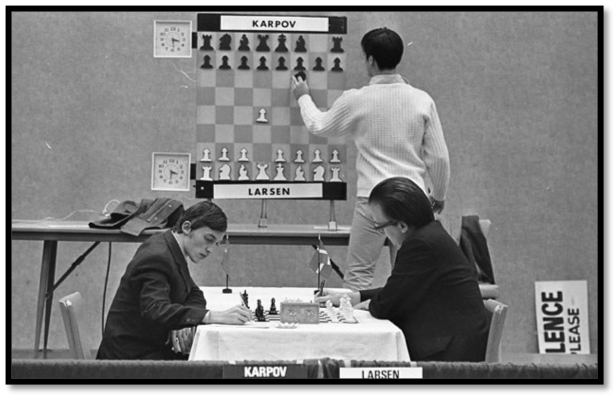
The players stayed at the Hilton Palacio del Rio, yet the games were played across the street at the Convention Center, in a hall identified in Levy’s post-event report as the Mission Room. An advance notice had named the River Room. The surviving sources do not explain that minor discrepancy. Later histories have collapsed hotel and playing site into one location. Levy’s eyewitness report, the local photographic archive, and contemporary coverage of a demonstration outside the Convention Center establish the distinction.[2][6][13][17]
The two buildings belonged to the civic landscape created around HemisFair ’68. The fair accelerated San Antonio’s convention facilities, River Walk development, and hotel construction, including the Palacio del Rio. Holding the tournament there placed the sponsor’s international chess project inside a setting designed to advertise the city as a convention and tourist destination. The local newspaper photograph archive independently identifies Karpov, Larsen, and Fischer in the Convention Center’s Mission Room, then places the closing banquet at the Hilton on 11 December.[17][19]
There was no qualification tournament. Koltanowski and the sponsor assembled an invitational field. An October advertisement still listed Lothar Schmid and Lubomir Kavalek, with Keres and Spassky marked as pending. It also advertised the preliminary dates 18 November to 14 December. The operative November schedule instead placed the rounds from 19 November to 10 December, followed by the last adjournments and prize awards on 11 December. By November, Karpov and Petrosian had joined the field, Schmid and Spassky were absent, and Kavalek was still expected. Donald Byrne replaced Kavalek shortly before play began; the contemporary reports do not give a reason for Kavalek’s withdrawal.[1]
The final field comprised Petrosian, Karpov, and Keres from the Soviet Union; Portisch from Hungary; Gligorić from Yugoslavia; Hort from Czechoslovakia; Larsen from Denmark; Mecking from Brazil; Browne, then representing Australia; Duncan Suttles from Canada; Julio Kaplan from Puerto Rico; Mario Campos-López from Mexico; and the United States representatives Larry Evans, Donald Byrne, Anthony Saidy, and Kenneth R. Smith. The composition combined established world-class players with regional representation, though the difference between the upper and lower halves was substantial. Karpov himself remarked on that imbalance in a contemporary interview.[7]
Each player met every other participant once, producing fifteen rounds and 120 games. The time control was forty moves in 2½ hours per player, producing a five-hour playing session, followed by sixteen moves per hour. Players voted on how resumed games should be scheduled and chose a single six-hour adjournment session, with a rest provision for anyone carrying more than one unfinished game. An arbitration committee combined officials and elected players: Golombek, Koltanowski, Donald Byrne, Larsen, and Keres, with Campos-López, Evans, and Gligorić as reserves.[2]
The final crosstable records 73 decisive games and 47 draws, a draw rate of about 39.2 percent. Levy’s contemporary description of a rate below 40 percent was therefore accurate and helps explain the event’s reputation for active play.[2][8]
The organizers pursued a deliberately polished presentation. Players received dark blue blazers carrying the Church’s Fried Chicken badge. A specially installed row of lights, reported to have cost $3,000, illuminated the boards while the rest of the room remained dark. Browne objected to the arrangement during the first round, and normal lighting was used thereafter. These details show a sponsor trying to make serious chess legible as a public spectacle, while the players retained influence over the conditions.[2]
The prize schedule also generated an early dispute. First prize was announced as $4,000 and second as $2,000. Several players wanted a flatter distribution. Golombek ruled that a change required unanimous agreement among the grandmasters; Larsen objected, leaving the original scale in place. Hort later recalled the episode independently. When three players tied for first, they divided the money assigned to the first three places and received approximately $2,333 each. The official crosstable explicitly states that no tie-break was applied.[2][10]
FIDE president Max Euwe attended the closing rounds and presented the prizes. His presence did not make the tournament part of a championship cycle, though it confirmed the federation’s institutional recognition of an event whose category and title norms had practical consequences for the players.[2]
Main Course of the Tournament
Karpov, Keres, and Larsen set the early pace with 3½ points from four rounds. Keres’s start was the most forceful. He defeated Hort in the opening round and then benefited from Larsen’s decision to press a theoretically drawn queen ending in round five. Larsen exposed his king and lost, while Karpov defeated Suttles. Keres and Karpov emerged as joint leaders.[2]
Their advantage grew through the eighth round. Keres defeated Donald Byrne in a game that later received the Turover brilliancy prize, while Karpov beat Gligorić. Both leaders stood on 7 points from eight games, two points clear of the nearest group. The position seemed to favor either the veteran Keres or the younger Soviet grandmaster who had been converting small advantages with notable consistency.[2]
Round nine changed the tournament. Portisch defeated Karpov, inflicting the latter’s only loss. Keres drew with Petrosian and moved into sole first place. The victory also transformed Portisch’s event. After beginning with only 4½ points from eight rounds, he entered a run that would yield six points from his last seven games. A telephone dispatch published in the Soviet weekly 64 before the final two rounds quoted Karpov’s judgment that he and Keres had made the same psychological error against Portisch: each saw the Hungarian playing below his usual standard, pressed too hard, and was punished. In the same phase Petrosian overcame Mecking after a long, contentious game that required three sessions.[2][9][15]
Keres could not preserve his lead. He drew with Smith in round ten, then lost to Portisch and Evans in rounds eleven and thirteen. The Soviet weekly 64 reported that he appeared visibly tired, a contemporary observation consistent with the abrupt reversal in his results. Karpov regained first place, though his own pace slowed with draws against Evans, Hort, and Kaplan. Portisch’s win over Keres was his third consecutive victory. Petrosian also advanced steadily, defeating Saidy and then Larsen. By the close of round thirteen, the margin at the top had contracted sharply.[9][15]
Gligorić remained within reach throughout. His 10 points included seven wins, and he had defeated Portisch. Illness complicated his campaign. Levy reported that Gligorić was suffering from bronchitis and experienced visual disturbance from medication during his game with Mecking, a draw that cost him a chance to join the eventual leaders. Keres also reported a persistent foot problem. These statements cannot establish the exact sporting cost of illness, though they belong to the contemporary explanation of why two challengers lost momentum.[2][7]
In the penultimate round Petrosian defeated Campos-López and joined Karpov on 10 points. Karpov drew Keres. Portisch stood half a point behind, with Gligorić and Keres another half point back. The final round therefore offered Portisch a direct route to shared first: he had to defeat Larsen and rely on neither Soviet leader winning.
Petrosian drew Suttles in ten moves. He then walked to Karpov’s board and spoke briefly to him. Karpov and Mecking agreed a draw after nine moves. Portisch still had to convert his opportunity, and he did so by defeating Larsen in thirty-five moves. Gligorić beat Campos-López and finished on 10, one half-point short. The three leaders ended on 10½, and the official equal division of first place followed.[2][9]
The Three Winners and Leading Contenders
Karpov scored seven wins, seven draws, and one loss. His San Antonio performance confirmed that his earlier successes were translating into results against a broad elite field. He led or shared the lead for much of the tournament, defended difficult positions against Petrosian and Kaplan, and defeated Gligorić. Portisch’s round-nine victory prevented clear first. In his interview with Saidy, Karpov called San Antonio perhaps the second strongest tournament he had played after Moscow 1971. He also said, with unusual precision for a young contender, “I hope to play Fischer in three or four years.”[7]
Petrosian’s route was quieter and equally effective. He won six games, drew nine, and remained the only undefeated participant. His victories over Gligorić, Mecking, Larsen, and Campos-López supplied the core of his score. The February 1973 issue of Шахматы в СССР, the official organ of the USSR Chess Federation, briefly celebrated the joint success of Karpov and Petrosian and immediately published Petrosian’s win over Gligorić. Mikhail Yudovich Jr. presented that game as another chapter in their long-running creative rivalry, a revealing Soviet framing that emphasized chess content over the sponsor’s unusual identity.[4]
Portisch’s result was the tournament’s strongest finish. His sole defeat came against Gligorić, and he recovered from a middling first half by scoring six points in seven rounds. Wins over Karpov, Keres, Saidy, and Larsen supplied the decisive late sequence. The final victory carried extra weight because the short draws on the neighboring boards had given him an exact target and no margin for error.
Gligorić’s fourth place was a narrow miss. He defeated Portisch and scored 10 points despite losses to Petrosian and Karpov. Keres finished fifth after holding the lead for several rounds. His 9½ points and brilliancy prize preserved the tournament’s association with his imaginative play, though his late losses changed the title race. Suttles tied Hort for sixth on 9 points and exceeded the Category XII grandmaster norm. FIDE awarded him the grandmaster title in 1973, making San Antonio a landmark in Canadian chess as well as an elite international event.[2][11]
The North American results also exposed the depth of the visiting field. Suttles was the major exception. Donald Byrne finished tenth, and none of the United States representatives reached the upper half. Browne, who later became a leading American player, represented Australia at this event. The crosstable should therefore be read according to 1972 federation affiliations, not later national associations.[3][8]
Critical Games and Turning Points
Keres’s victory over Donald Byrne in round eight affected both the standings and the tournament’s reputation. It placed Keres on 7 from 8 and helped establish the two-point lead he shared with Karpov. It also won the $150 Turover brilliancy prize, becoming the event’s officially recognized artistic achievement.[2]
Portisch’s victory over Karpov in round nine was the central competitive turning point. It ended Karpov’s undefeated run, released Keres into sole first, and began Portisch’s climb from the middle of the leading group. No detailed variation is needed to understand its importance. Karpov’s late error ended the game abruptly, and the point later proved indispensable to Portisch’s shared victory.[2][9]
Petrosian’s win over Larsen in round thirteen brought the former champion fully into the title race. Larsen had entered San Antonio as one of the favorites, yet five losses offset his seven wins. Against Petrosian, an ambitious defense failed and the result helped Petrosian reach the final round tied for first.[2]
Portisch’s final-round win over Larsen completed the event’s narrative. Petrosian and Karpov had already taken short draws, so Portisch knew that victory would produce a three-way tie. He met the competitive demand directly. This game, more than the two quick draws, determined the official form of the result.[2][9]
Disputes and Unusual Circumstances
The most serious playing-room dispute involved Mecking and Petrosian. Levy reported that Mecking complained about Petrosian’s physical mannerisms and sounds at the board, and that Golombek declined Mecking’s requested intervention. After using a second scoresheet, Mecking miscounted the moves and lost on time while considering his eighty-seventh move; the next control was at move eighty-eight. On returning to Brazil, he alleged deliberate distraction and accused Soviet players of arranging draws among themselves. These were Mecking’s allegations. The available tournament record supplies no independent proof of either charge.[2]
The final-round sequence inevitably renewed the issue. Levy observed Petrosian’s ten-move draw, his brief communication with Karpov, and Karpov’s immediate nine-move draw. In his editorial note, Saidy characterized the two short Soviet draws collectively as an “amicable last-round arrangement.” Fischer’s presence with binoculars gave the scene an enduring image, especially because he had long accused Soviet players of collective behavior in international events. Karpov later recalled that he entered the game intending to secure the draw that guaranteed shared first. That competitive aim does not establish an agreement with Mecking or coordination with Petrosian. No cited source documents a prior agreement, an instruction from officials, or a breach ruling by the arbiter. Historical care requires separating the observable sequence from the inference of collusion. The two draws secured at least a tie for the Soviet players; Portisch’s victory then made that tie threefold.[2][7][21]
Politics also reached the entrance to the playing hall. On 22 November, several dozen Jewish youths and adults demonstrated outside the Convention Center against Soviet restrictions on Jewish religious, cultural, and emigration rights. The local Masadah chapter and the San Antonio district of the Zionist Organization of America organized the protest. Their statement explicitly said that the target was Soviet policy and the participation of Petrosian, Karpov, and Keres, not the tournament or its promoters. A delegation left a letter for the players at the Palacio del Rio.[6]
Smaller incidents reveal the practical fragility of even a well-funded event. A dance band in a room below disturbed Portisch during his opening-round game with Campos-López. The costly lighting installation survived only one round. Several players reported illness. Golombek also had to rule on clock procedure during Browne-Mecking. Such details should not displace the chess, though they correct the polished image suggested by the matching blazers and corporate branding.[2]
One archival curiosity concerns Golombek’s title. Contemporary American publicity repeatedly called him “Sir Harry.” Golombek held the OBE and was never knighted. Edward Winter has documented the recurrent error, which offers a small warning about treating even close contemporary coverage as infallible.[12]
Contemporary Reception
San Antonio received substantial coverage within American chess media. The three winners appeared on the January 1973 cover of Chess Life & Review. That issue published the final standings and emphasized Karpov’s seven wins, Petrosian’s unbeaten score, and Portisch’s 6-from-7 finish. The February issue carried Levy’s multi-page tournament report, Karpov’s annotations to his victory over Gligorić, and Saidy’s interviews with Keres, Petrosian, and Karpov. The San Antonio Express-News created a dated photographic record of the hall, players, Fischer’s visit, and the closing banquet. The treatment made the tournament one of the most thoroughly documented American chess events of the winter.[2][3][7][17]
General news coverage began before the first round. An Associated Press interview with Church described the sponsor’s commercial aims, the international field, the prize fund, and the three open tournaments that accompanied the invitational. The side events gave local and visiting amateurs a place in the wider program.[16]
Karpov’s contemporary assessment of the main event is also important: he told Saidy that public attendance was small. That observation tempers the familiar idea that the Fischer boom automatically filled every American chess venue. San Antonio possessed international prestige, corporate finance, side events, and national press attention, while its daily hall audience remained limited.[7][16]
Soviet readers received both immediate and follow-up coverage. With two rounds remaining, 64 reported Karpov’s narrow lead, identified Portisch as the principal rival of the Soviet grandmasters, recorded Suttles’s grandmaster norm, and printed the final-round pairings. The February 1973 issue of Шахматы в СССР then recorded the complete finishing order, identified the success of Karpov and Petrosian, and devoted its main space to an annotated game. The sponsor, the final-round optics, and the protest did not structure these reports. Their emphasis is useful evidence: American coverage focused heavily on organization and personalities, while the Soviet periodicals presented San Antonio primarily as a sporting contest and a source of instructive chess.[4][15]
The documentary legacy expanded in 1973 with Bent Larsen and David Levy’s San Antonio ’72: Church’s Fried Chicken, Inc. First International Chess Tournament. The 271-page book included all 120 games, player annotations, photographs, crosstables, and biographical material. As a near-contemporary tournament book with participant contributions, it remains the central printed source. Its evaluations and anecdotes still require comparison with the crosstable, period press, and other testimony.[5]
Legacy and Historical Assessment
For Karpov, San Antonio was an early public demonstration in the United States of the qualities that would soon carry him through the 1973 Interzonal and the 1974 Candidates matches. It did not alone establish his future status, though it placed him level with a former world champion and one of the strongest non-Soviet players of the period. His prediction that he hoped to face Fischer within three or four years became striking in retrospect, even though the anticipated match never occurred.[7]
For Petrosian, the undefeated shared victory confirmed that he remained an elite tournament competitor after losing the world title. For Portisch, the result crowned an already exceptional 1972 season and demonstrated his resilience under a clear final-round demand. Gligorić’s half-point deficit and Keres’s late decline gave the final standings unusual density: five players finished within one point of first.
For Soviet chess culture, the result is best understood as evidence of continuity across generations. Karpov matched a former world champion, Petrosian went undefeated, and Keres remained in contention until late in the event. The contemporary Soviet reports recorded their performances without declaring an inevitable succession. San Antonio confirmed Karpov’s established rise; it did not create it.[4][15][20]
San Antonio also offered a striking example of private patronage. A local businessman, a national chess organizer, a corporate budget, and a civic convention venue assembled a field that a federation alone might have struggled to finance. The event did not become an annual Church’s tournament, despite its official designation as the “First International.” Its singularity contributed to its reputation. Later celebration should still acknowledge the sponsor’s commercial calculations, the modest live attendance, and the uneven competitive field.[1][2][16]
The company’s chess support did continue in other forms. In 1979 Chess Life & Review awarded Bill Church a Koltanowski Medal for contributions that included San Antonio, the Church’s Grand Prix, and the Master Tours. The evidence therefore supports a specific conclusion: the 1972 elite round robin was not repeated, while the relationship between Church’s and organized American chess lasted beyond it.[18]
The tournament’s reputation has sometimes been reduced to two images: a fried-chicken sponsor and Fischer watching the final round through binoculars. The historical record is richer. San Antonio 1972 documented Karpov’s ascent, Petrosian’s continued strength, Portisch’s late surge, Keres’s challenge, Suttles’s grandmaster norm, and an American experiment in corporate chess promotion. Its controversies can be described precisely without treating allegation as proof.
San Antonio 1972 deserves attention today because its result remained unsettled until Portisch won on the final day, and because its organization tested whether American commercial enthusiasm after Reykjavík could sustain an elite international tournament. The experiment was not repeated in the same form. The event itself endures through a remarkably complete archive and a shared first place that joined the established Soviet elite, its emerging successor, and Hungary’s leading grandmaster.
Notes and Sources
“Church’s Fried Chicken International,” advance notices, field changes, schedule, prize terms, officials, and format, Chess Life & Review, October 1972, p. 605, and November 1972, p. 704. The October advertisement gave the superseded dates 18 November to 14 December; the November issue printed the operative schedule. October 1972 issue; November 1972 issue.
David Levy, “Church’s Fried Chicken Inc. First International Chess Tournament,” Chess Life & Review, February 1973, pp. 63-68. This is the fullest contemporary report and the principal source for the organization, course, conditions, disputes, prizes, and final-round sequence. February 1973 issue.
“CFC Final,” Chess Life & Review, January 1973, p. 8. The notice confirms the 11 December completion date, three-way tie, scores, and official final order. January 1973 issue.
San Antonio result notice, Шахматы в СССР, no. 2, February 1973, pp. 11-12, followed by Petrosian-Gligorić with notes by Mikhail Yudovich Jr. The magazine identifies itself as the organ of the USSR Chess Federation. Searchable Russian scan.
Bent Larsen and David N. L. Levy, San Antonio ’72: Church’s Fried Chicken, Inc. First International Chess Tournament (New York: RHM Chess Publishing, 1973), 271 pp., ISBN 0-89058-000-6. Open Library work record; bibliographic listing.
“Jewish Youth Protest at Chess Match,” Jewish Telegraphic Agency, 22 November 1972. This contemporary report confirms the Convention Center as playing site, the Palacio del Rio as the players’ hotel, and the organizers’ stated purpose for the demonstration. JTA archive.
Anthony Saidy, “Interviewing the Soviet Stars at San Antonio,” Chess Life & Review, February 1973, pp. 69-70. Interviews with Keres, Petrosian, and Karpov, with Saidy’s editorial note on the last round. February 1973 issue.
Stephen Wright, “Internationals: San Antonio 1972,” British Columbia Chess History. Used to cross-check the final crosstable, ratings as listed in modern databases, national affiliations, and individual results. Full crosstable.
Goran Urošević, “Iz šahovske istorije: San Antonio 1972,” based in part on Šahovski glasnik, no. 2 (1973). The page provides the dated round record, crosstable, and access to the complete game file. Serbian-language tournament dossier; 120-game PGN archive.
Vlastimil Hort, “Vlastimil Hort: Erinnerungen an Bent Larsen,” ChessBase, 2015. Hort’s later first-person recollection corroborates the opening dispute over prize distribution. German-language ChessBase article.
Chess Federation of Canada, “FIDE Titles.” The federation lists Duncan Suttles as grandmaster, 1973; Levy’s contemporary report identifies San Antonio as the Category XII norm event. Official Canadian title list.
Edward Winter, “Harry Golombek,” Chess Notes. Used for the correction that Golombek, OBE, was never knighted despite the “Sir Harry” form in period American coverage. Chess History article.
Christopher Toolin, “San Antonio 1972,” Texas Chess Association, 29 March 2020. A useful modern Texas retrospective with reproduced photographs and promotional material. Its identification of the Hilton as the playing venue is superseded by the contemporary sources above. Texas Chess Association article.
Rajni Madan, “America’s Favorite Chicken,” Handbook of Texas Online, Texas State Historical Association; and Church’s Chicken, corporate anniversary history. Used only for the company’s San Antonio origins and period of expansion. Handbook of Texas; Church’s anniversary release.
“Сан-Антонио: до конца два тура,” telephone dispatch, 64: Шахматное обозрение, no. 49 (232), 1972, p. 16. The report gives the standings with two rounds left, Karpov’s explanation of his and Keres’s losses to Portisch, Suttles’s norm, the announced 11 December conclusion, and the last-round pairings. Direct issue PDF; complete 64 archive.
John Lumpkin, Associated Press, “Fried Chicken Exec Sponsoring Chess Tourney,” Abilene Reporter-News, 18 November 1972, p. 3A. This pre-event interview documents Church’s commercial aims, promotional campaign, side events, and contemporary reports concerning Fischer and Spassky. University of North Texas newspaper scan; direct OCR.
University of Texas at San Antonio Libraries, San Antonio Express-News Photograph Collection, tournament entries for 18 November to 11 December 1972. The finding aid identifies the Mission Room as the playing hall, Fischer there on 10 December, and the closing banquet at the Hilton on 11 December. Archival finding aid.
“Koltanowski Medals,” Chess Life & Review, October 1979, p. 556. The citation for Bill Church names San Antonio 1972, the Church’s Grand Prix, and the Master Tours. October 1979 issue.
“San Antonio,” Handbook of Texas Online, Texas State Historical Association, and the San Antonio River Walk Association’s institutional history. Used only to situate the Convention Center and Palacio del Rio within the city’s post-HemisFair convention landscape. Handbook of Texas; River Walk history.
OlimpBase, “20th Chess Olympiad, Skopje 1972: Soviet Union.” Used for Karpov’s 13/15 reserve score immediately before San Antonio. Soviet team record.
Anatoly Karpov and Alexander Roshal, Девятая вертикаль (Moscow: Molodaya Gvardiya, 1982), chapter “Жареные цыплята.” This later memoir is used with attribution for Karpov’s intended final-round strategy and recollection of the event. Searchable Russian scan.
