Valery Chekhov
Introduction
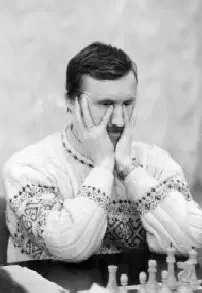
Valery Alexandrovich Chekhov occupies a distinctive place in Soviet and Russian chess history. His victory in the 1975 World Junior Championship made him the fourth Soviet player to win the event, after Boris Spassky, Anatoly Karpov, and Alexander Beliavsky. It also supplied the first major competitive proof of Mark Dvoretsky's emerging training method. Chekhov subsequently built a substantial grandmaster career, represented leading Soviet teams, assisted Garry Kasparov during an important early qualifying campaign, and devoted much of his later professional life to teaching.
His record resists a simple youth-champion narrative. Chekhov never became a candidate for the world title, and his three appearances in the USSR Championship final did not produce a leading finish. He did, however, remain a strong international player across two political eras. His best results included first place in the 1983 Kotov Memorial, a share of the 1982 Russian championship title, several international tournament victories, and valuable contributions to Soviet team successes. In later years he helped turn experience acquired in the Palace of Pioneers and under Dvoretsky into a formal program for training young players.
The Russian form of his name is Валерий Александрович Чехов. English sources use both Valery and Valeriy Chekhov; German publications commonly render the name as Waleri Tschechow.[1]
Early Life and Chess Formation
Chekhov was born in Moscow on 27 November 1955. The accessible published record says little about his family background or general education. A contemporary Soviet report described him simply as a Moscow student in 1975, without naming an institution or field of study. No reliable source consulted for this profile identifies his parents or establishes a fuller educational biography. Those details should remain open pending an interview or archival evidence.[2]
His chess formation is much better documented. Chekhov trained at the Moscow Palace of Pioneers under Grigory Ravinsky, an experienced master and one of the important teachers in the capital's youth-chess system. The Palace joined instruction, team competition, and regular contact with elite players. Chekhov's first widely reported success came through that institutional setting. At the 1972 All-Union Palace of Pioneers competition, he defeated Anatoly Karpov, then the leading young challenger to the established Soviet elite, and former world champion Boris Spassky in clock simultaneous exhibitions. Anatoly Bykhovsky later recalled that Chekhov received a special prize from the newspaper Moskovskii komsomolets for the two wins, which he characterized as technically accomplished. The points also helped the Moscow team win the event.[3]
The episode is significant for more than the prestige of the opponents. It shows that Chekhov's early reputation rested on disciplined play against first-class opposition, before he possessed an international title. It also brought him into the network through which the Soviet federation selected and prepared its strongest juniors.
In 1973 Chekhov began intensive work with Mark Dvoretsky. Their collaboration continued through the 1975 World Junior Championship. Dvoretsky later called Chekhov his first serious pupil and described a program centered on decision-making technique and economical use of thinking time. The latter emphasis addressed a specific weakness: in Dvoretsky's account, the young Chekhov was habitually short of time.[4] This was characteristic of Dvoretsky's developing approach. Training was organized around recurring practical defects, with carefully selected positions used to develop transferable habits.
Later accounts sometimes assign the decisive formative role to different figures. The evidence supports a cumulative view. Ravinsky provided Chekhov's early education at the Palace of Pioneers; Bykhovsky supervised the Soviet junior pathway and the selection process; Dvoretsky conducted the concentrated individual preparation of 1973-1975. Recollections published many years later indicate that public credit for the world junior victory became a sensitive issue and that the training relationship with Dvoretsky did not continue. They do not erase the documented work of any of the three men.[5]
Rise in Competitive Chess
Chekhov's route to the 1975 World Junior Championship was itself a test of competitive nerve. In the final Soviet qualifying event he caught Alexander Kochiev by winning his last three games and shared first place. Dvoretsky's memoir records that the selectors sent Chekhov to the World Junior Championship and Kochiev to the European Junior Championship. Both won their assigned event. For Chekhov, the finish demonstrated an ability to recover ground under severe tournament pressure, a quality that would complicate later attempts to describe him solely as a quiet positional player.[6]
The World Junior Championship was held at Tjentište, Yugoslavia, from 16 August to 1 September 1975. It was the first edition played as a 13-round Swiss tournament. Chekhov finished undefeated with 10 points from 13 games, half a point ahead of the American Larry Christiansen; Jonathan Mestel and Ventzislav Inkiov followed on 9. Contemporary Soviet coverage presented Chekhov as the country's fourth world junior champion. The result brought him the international master title in the same year.[7]
The manner of the victory influenced his early reputation. The Latvian Soviet magazine Shakhmaty published its report under the headline “Chekhov Resembles Karpov,” a revealing contemporary comparison. It pointed toward qualities associated with technical control, positional judgment, and the accumulation of small advantages. The comparison should not be treated as a forecast of equivalent careers. It is useful evidence of how observers understood the 19-year-old champion's play at the time.[8]
The championship also affected Soviet chess beyond Chekhov's own advancement. Boris Postovsky, who worked closely with Dvoretsky, recalled that Iosif Berezin used the success to secure Dvoretsky a stipend from the Burevestnik sports society. That support enabled Dvoretsky to concentrate on coaching. His later pupils included Artur Yusupov and Sergei Dolmatov. Chekhov's title was therefore an institutional turning point in the career of the coach who would become one of the game's most influential teachers. It was one enabling event, alongside Dvoretsky's own work and the support of colleagues.[9]
Major Career Achievements
Chekhov entered the adult international circuit with a FIDE rating of 2530 on the January 1976 list, already placing him among the stronger grandmasters and international masters of the period. His first major senior team assignment came that summer at the World Student Team Championship in Caracas. The Soviet team won, and Chekhov, playing as second reserve, scored 6 points from 7 games without a loss. His 85.7 percent result was the best performance on that reserve board. The contribution is easily overlooked because the starting lineup included Oleg Romanishin, Rafael Vaganian, Alexander Beliavsky, Evgeny Sveshnikov, and Sam Palatnik.[10]
His progress from international master to grandmaster was gradual. Chekhov shared first place in the 1982 Championship of the Russian Soviet Federative Socialist Republic with Anatoly Vaisser, finishing second after the competition's tiebreak procedure. In 1983 he won the Kotov Memorial in Lviv by a full point ahead of Iosif Dorfman in a field that included several established Soviet grandmasters and ambitious younger masters. First prizes at Lviv and Irkutsk in 1983, Barcelona in 1984, and shared victories at Dresden in 1985 and Berlin in 1986 marked the most productive phase of his individual tournament career. FIDE awarded him the grandmaster title in 1984.[11]
Chekhov reached three USSR Championship finals: Vilnius in 1980-1981, Lviv in 1984, and the last championship of the Soviet Union in Moscow in 1991. These appearances placed him on the country's highest domestic stage, where qualification was itself demanding. His results there were modest, and he did not enter the group contending for the title. The distinction is important. Chekhov could win strong international and republican events, while his performance was less consistent in the deepest all-Soviet fields.[12]
His expertise was also used behind the scenes. The Russian Chess Federation records Chekhov as a member of Garry Kasparov's supporting team at the 1982 Moscow Interzonal, alongside Alexander Nikitin and Alexander Shakarov. Kasparov won the tournament and advanced to the Candidates cycle. Public sources do not define Chekhov's exact analytical assignments, so the evidence supports identifying him as a second and member of the preparation group, without attributing particular opening discoveries to him.[13]
Team chess remained an important part of his professional life. Chekhov had a long association with the Armed Forces chess organization and CSKA. He was part of the Soviet Armed Forces team that won the USSR Team Cup in Kyiv in 1984. He also belonged to CSKA's winning squad in the 1987-1988 European Club Cup, scoring 2 points from 4 games in the preliminary stage; OlimpBase records no appearance for him in the final group at Rotterdam. Earlier, he had played one drawn game for the Soviet team that won the first Telechess Olympiad in 1977-1978. These were supporting roles, yet they document the trust placed in him by the country's strongest team institutions.[14]
Chekhov's highest published FIDE rating was 2550 in January 1992, when the official list placed him 105th in the world. The date is instructive: his numerical peak arrived after the dissolution of the Soviet Union, confirming that his playing strength extended into the post-Soviet era. He continued to compete internationally through the 1990s, although tournament play gradually ceased to be the center of his professional work.[15]
Style and Reputation
The surviving evidence suggests a player with a broad positional foundation and considerable practical resilience. The 1975 comparison with Karpov reflected Chekhov's command of technical positions and his capacity to maintain control. Bykhovsky's description of the 1972 wins over Karpov and Spassky supports the same impression. Dvoretsky's account adds two further elements: Chekhov needed systematic work on clock management, and he responded well to a method that reduced complex decisions to trainable procedures.
His games also caution against defining him as a specialist in quiet play. Chekhov's victory with Black over Lev Psakhis in the 1980-1981 USSR Championship became one of his best-known games because he accepted substantial tactical risk and conducted a direct attack on the king. Chess historian Douglas Griffin notes that Chekhov repeatedly proved an especially difficult opponent for Psakhis. The game is relevant here as evidence of range, not as the basis for a tactical classification.[16]
Chekhov's strengths can be described with reasonable confidence: sound positional organization, good endgame technique, competitive composure, and the ability to commit to concrete play when a position demanded it. The documented weakness of his youth was time management. His senior results reveal a second limitation in competitive terms: tournament-winning performances were interspersed with less successful results in USSR Championship finals. No reliable source examined here ties that pattern to health, motivation, or institutional treatment. Explanations of that kind would be speculative.
Among contemporaries, Chekhov's reputation was stronger than his limited visibility in later English-language chess writing suggests. His selection for elite Soviet teams and Kasparov's analytical group supplies concrete evidence of professional standing. His record is best understood as that of a durable grandmaster whose value also lay in preparation, team service, and instruction.
Contributions Beyond Tournament Play
Chekhov made a focused contribution to opening literature with Sizilianisch: Sweschnikow-Variante, richtig gespielt, published in German by Beyer in 1994. The book treated the Sveshnikov Variation, an opening closely associated with Soviet analytical practice and one that Chekhov had used extensively. It remained his principal published contribution to opening literature and shows his willingness to organize practical grandmaster knowledge for a wider audience.[17]
His more substantial later contribution came through coaching. From the 1990s onward, teaching occupied an increasing share of his work. In 2006 he and grandmaster Sergei Arkhipov began developing the chess program at Moscow Secondary Specialized School of Olympic Reserve No. 1. The institution combined academic study, residence, physical training, and chess instruction. Chekhov later explained that the coaches experimented with different forms of instruction and developed a coherent training system. He also spoke candidly about the program's constraint: weak funding left students with too few tournaments in which to apply their work.[18]
The program trained a notable group of young players. Arkhipov identified Elena Tairova, Alina Kashlinskaya, Vera Nebolsina, Anastasia Bodnaruk, Anastasia Savina, Olga Girya, Andrey Stukopin, Vladimir Belous, and others among those who passed through it. These players had multiple influences, and their later achievements cannot be assigned to one coach. Their own testimony establishes Chekhov's direct role. Girya thanked both Arkhipov and Chekhov and described entry into the school as a “fantastic step” in her chess development; Kashlinskaya likewise identified them as her coaches after joining the school in 2006.[19]
Chekhov and Arkhipov also tried to make their system portable. With Viktor Komliakov they produced Programma podgotovki shakhmatistov IV-II razryadov in 2007, a curriculum for players from fourth through second category, followed in 2009 by Programma podgotovki shakhmatistov I razryada - kandidatov v mastera sporta, covering the transition from first category to candidate master. Each volume assigned material to a defined classification band, giving youth sports schools a graded curriculum.[20]
His public reflections on chess education reinforce that emphasis. In a 2011 interview Chekhov argued that the famous “Soviet chess school” was primarily an institutional network of clubs, Pioneers' Palaces, coaches, competitions, and state support. In his account, its member institutions did not follow one technical doctrine. His own later work sought to supply a more explicit sequence of training within the leaner institutions of post-Soviet Russia. That view came from experience on both sides of the transition, first as a beneficiary of Moscow's youth system and later as a coach trying to preserve serious instruction under financial pressure.[21]
When Arkhipov left the Olympic reserve school in 2011, Chekhov remained. He explained that he did so in part to keep the chess specialization from closing. This decision is a useful measure of his later priorities. The world junior champion had become an institutional custodian, concerned with continuity, access to practice, and the survival of a training environment.
Historical Legacy
Chekhov's legacy has three connected parts. The first is competitive. The 1975 World Junior Championship remains his defining title, supported by a long grandmaster career, victories in strong tournaments, three USSR Championship finals, and valuable team performances. The second is collaborative. His world junior success helped establish Dvoretsky as a professional coach, and his later work in Kasparov's team placed him within one of the most consequential analytical groups of the early 1980s. The third is educational. Through coaching, curriculum writing, and institutional work, he carried methods formed in Soviet youth chess into a post-Soviet setting.
This broader record corrects two distortions. A comparison with Soviet junior champions who later challenged for the world title sets an unhelpfully narrow standard. Chekhov's adult career was substantial in its own terms. At the same time, presenting him only as the 1975 champion leaves out the work that occupied much of his later life and influenced a new generation of Russian players.
The Russian Chess Federation marked Chekhov's 70th birthday in November 2025 and continued to describe him as a grandmaster and coach. FIDE's current profile lists him as inactive. His relative absence from general histories follows largely from their concentration on world-title contenders.[22]
Notes and Sources
Shakhmaty: entsiklopedicheskii slovar, ed. Anatoly Karpov (Moscow: Sovetskaya entsiklopediya, 1990), 471; FIDE profile for Valery Chekhov; Russian Chess Federation, “Valery Chekhov”. The encyclopedia gives the Soviet titles Master of Sport, 1974; International Master, 1975; and Grandmaster, 1984.
Boris Shashin, “Chetvertyi chempion,” digitized issue, 64, no. 38 (377), 19-25 September 1975, 4. The description of Chekhov as a Moscow student is contemporary, but it supplies no further educational detail.
Anatoly Bykhovsky, interview with Vladimir Barsky, Russian Chess Federation; Gennady Kalinin, “The Palace of Pioneers,” ChessPro. Bykhovsky reproduces Chekhov's 1972 win over Karpov and records the separate victory over Spassky and the special prize.
Mark Dvoretsky and Artur Yusupov, Attack and Defence, trans. John Sugden (London: Batsford, 1998), 28-31; searchable Internet Archive text; Mark Dvoretsky's final interview, ChessBase.
Russian Chess Federation biographical profile. The profile preserves the later disagreement over credit. Dvoretsky's own account of the training content is cited in note 4.
Mark Dvoretsky, For Friends and Colleagues, vol. 1, Profession: Chess Coach (Milford, CT: Russell Enterprises, 2015), discussion of the 1975 Soviet junior qualification. Dvoretsky's account is a memoir written long after the event, but its description of his own pupil's preparation is detailed and consistent with his earlier instructional writing.
OlimpBase, 1975 World Junior Championship; OlimpBase, World Junior Championship overview; Shashin, “Chetvertyi chempion”, 4.
“Chekhov napominaet Karpova,” digitized issue, Shakhmaty (Riga), no. 23 (383), 1975. The headline is valuable as contemporary evidence of reputation. It does not establish equivalence between the players' careers or complete styles.
Boris Postovsky, “Velikii truzhenik,” in For Friends and Colleagues: A Book in Memory of Mark Dvoretsky; Dvoretsky's final interview, ChessBase.
OlimpBase, 1976 World Student Team Championship, Caracas; FIDE rating list, January 1976, reproduced by OlimpBase.
Russian Chess Federation biographical profile; Shakhmaty: entsiklopedicheskii slovar, 471. Tournament place names follow the forms used at the time; Lviv is rendered Lvov in many Soviet records.
Russian Chess Federation biographical profile; 1984 USSR Championship crosstable and games, Chessgames.
Russian Chess Federation biographical profile. The source identifies Chekhov, Nikitin, and Shakarov as Kasparov's seconds at the Moscow Interzonal.
OlimpBase, CSKA Moscow in the 1987-1988 European Club Cup; OlimpBase, 1988 European Club Cup final; OlimpBase, Valery Chekhov's Soviet team record; Russian Chess Federation biographical profile.
FIDE rating list, January 1992, reproduced by OlimpBase; FIDE profile.
Douglas Griffin, “Lev Psakhis”, which includes historical context and the Chekhov-Psakhis record. The game was played in the 48th USSR Championship at Vilnius, 1980-1981.
Valery Chekhov, Sizilianisch: Sweschnikow-Variante, richtig gespielt (Hollfeld: Joachim Beyer Verlag, 1994), ISBN 3-89168-044-9.
Valery Chekhov, interview with Vladimir Barsky, Russian Chess Federation, 25 August 2011; Sergei Arkhipov, interview with Vladimir Barsky, Russian Chess Federation.
Olga Girya, interview with Eteri Kublashvili, Russian Chess Federation; Alina Kashlinskaya, interview with Chess-Rex; Arkhipov interview.
Valery Chekhov, Sergei Arkhipov, and Viktor Komliakov, Programma podgotovki shakhmatistov IV-II razryadov (Moscow: Mozhaiskii poligrafkombinat, 2007), ISBN 978-5-8493-0068-9, catalogued by the Russian National Electronic Library; Chekhov, Arkhipov, and Komliakov, Programma podgotovki shakhmatistov I razryada - kandidatov v mastera sporta (Moscow: Mozhaiskii poligrafkombinat, 2009), ISBN 978-5-8493-0076-4, publisher and bookseller description.
Chekhov interview, Russian Chess Federation, 25 August 2011; Colin McGourty, “Le Quang Liem and the Soviet School of Chess,” Chess in Translation, translating and contextualizing Chekhov's comments first published by Chess Moscow.
Russian Chess Federation, “Valery Chekhov”, published for his 70th birthday; FIDE profile.
Historical Assessment
Valery Chekhov deserves attention today as a world junior champion whose historical significance extends well beyond one title. He was the first major pupil of Mark Dvoretsky, a strong and durable grandmaster, a trusted team player and analyst, and a serious educator who helped convert Soviet training experience into a structured curriculum for a later generation. His career shows how chess influence can be exercised through competition, collaboration, and the patient maintenance of institutions.
